19 April 2012

April 1941: Part One

 
Destroying equipment at Nauplion.

In the summer of 1978, swimming just outside the harbor at Nauplion, I glimpsed on the seafloor what looked like part of the bridge of a ship.  The Blue Guide mentioned the British-Anzac retreat in April 1941 from Greece.  Later, I wrote to leading newspapers in Australia and New Zealand, asking if anyone remembered Nauplion.  This post and the next will consist of excerpts from the dozens of letters I received about those days.  I have not edited the excerpts beyond indicating where I have omitted text.  
* * * * * *

Jack Underwood, 1st. Aust. Corps Salvage Unit, Wollogong, NSW:

I was evacuated from Nauplion . . . on April 25, 1941.  I was just 20 years of age then and a driver with a bomb disposal, salvage-cum-recovery unit.  . . . I did keep a diary . . . unfortunately I was rather busy at Nauplion and scrawled in fewer lines in those couple of days. . . I was given duty of destroying (per tipping over cliff) trucks, cars, bikes, etc. which were arriving hourly bearing personnel of every description and country.  For a depression kid who never owned more than a push bike it broke my heart to see such a waste. This carnage went on all day during which we were bombed pretty consistently although casualties were surprising light.
      I just noticed I wrote: "bloody Stukas again!" -- Remember coming back from cliff face and seeing quite a few bodies at road-side.  I clearly remember being assigned to group and under cover of darkness moved northwards to Argos (from Nauplion) . . . We were told our ship was to be the Ulster Prince.  Recall the ship sidling into bay, then to our horror saw it run aground. . . with a short period, over came bombers with grounded ship as target.  Ship caught alight and continued to burn throughout night, lighting up whole area.
     In early hours of morning in came the Glenearn and we boarded her "ducks" and ferried out bay to her.  One of "ducks" was hit by a destroyer and sunk with loss of life.  Ours made it to mother ship but boarding was all haywire with many of us taking a ducking in attempts to get aboard.  . . . Might add in passing, with me was my father who had joined AIF with me claiming to be my elder brother!


Jim Roberts, Manly West, Queensland

I was with the 6th Div Signals  . . and we fought the rearguard action during our withdrawal from Greece, on reaching Argos . . . a sad sight met our eyes, the ship on which we were to escape on was in flames, having been hit by the German bombers . . . we traveled to Kalamata and waiting as we had received a radio signal that a ship would pick us up from there.  In the early hours of the morning we saw a light coming in from the sea and it was a destroyer.  My brother and I were two of the last soldiers to board her on her final run to the Dilwara, as we found out after the war that a Sgt friend of our was captured half an hour after we left.

 
 Troops of the 2nd New Zealand Expeditionary Force at Nauplion. 

Michael Stark-Brown, 2nd NZEF, Aukland, NZ

. . .  Our route was south to the town of Trikala, east to Larissa, southeast to Volos, then southwest to Lamia where we dug in.  Our stay was not much more than a week when the Greek army to the west was overrun and we had to pull out again.
      This time we uplifted the 25th Maori Battalion and brought them back in one night through Eleusis and Corinth to Nauplion where they marched to Tolo and were taken out that night.  We hid up in a pine forest till dark then went back to Corinth to pick up the rearguard battalion.  Back at Nauplion my most vivid memory was at how quickly the Greek peasants took everything moveable before we destroyed the vehicles.  The heavy vehicles like repair trucks were tipped off a cliff into the sea, the rest the radiators and engine sumps were drained and motors raced at full gun until everything broke, tyres were shot and slashed to bits and all told it was a shambles.  At about 2 am on 25th April we went on board the troop carrier Glengyle and after a fairly hectic sea voyage made it to Suda Bay.
      . . .  On food, we fed quite well on the whole during the Greek affair.  During the actual withdrawal we fed like lords.  We had huge food dumps etc. in our area and were told to help ourselves before they were destroyed.  . . . it was rather a gamble as none of the cases was labelled and if you did not know what the numbers meant, anything could happen.  . . . I understood several Greeks were later shot by the Germans for being in possession of foodstuffs they had acquired from the dumps.  On the whole, the people we met were very hungry even before we landed there.  It was not unusual for the females to offer themselves or even their daughters to the troops in return for food.  Tea was the highest price commodity with canned beef running a close second.
      . . .   Probably about 80% boredom.  The remainder? 18% a lot of noise and about 2% drama and danger.


Ex. Sgt. R. J. Corbett, Brisbane, Queensland:  

I left Athens in a small convoy on 23rd April and after some drama we crossed the Corinth Canal and arrived during bombing and straffing at the small port of Argos.  We were a bit short on sleep -- and rested all day -- the 24th  -- in tense German air activity.
     At midnight we were instructed to gather at the loader's edge and were ferried in small boats to the side of the Stirling Castle (I believe that was the name*) and clambered aboard . . . I remember bread & coffee  & a long sleep until dawn. A heavy AA gun mounted on the predeck began firing and scared the daylights out of me.  I jumped up and saw we were part of a convoy preceded by many Royal Navy ships -- 2 of the 3 aircraft were hit and we proceeded to sea.  News was that we were on the way to Egypt.  However -- after passing Crete, I understand the crew volunteered to go back to Greece to pick up further troops.  It was 25 April. . . . The ship turned round and we were off-loaded on Crete at Suda Bay.

 Soldiers being evacuated on the Thurland Castle.


* Not Stirling, but Thurland Castle.


13 April 2012

Pavane for a Dead Princess: Part Seven


 Agia Sophia, Mistra

Nikeforas Cheilas said: 
When the appointed day came, the day on which our Saviour consented for our sake to be nailed to the cross, on that same day and at that same hour of His sufferings and burial, she died and was entombed together with Christ.
Cleofe Palaiologina Malatesta died on Megali Pareskevi, April 10, 1433, about noon, in childbirth.  Her husband was beside her bed, mixing some medicine. There was a sudden hemorrhage, a great deal of blood, a dead baby.  Bessarion said she flew out of his hands. 

She flew away, Cheilas said, leaving amazement.

No one expected death, though she had spoken seriously to friends about her thought that she might not survive. She had given birth successfully before, though she had been afraid, then, too.  Doctor Pepagomenos said her body was built for childbearing.  But she had been keeping an exceptionally austere fast, standing much of each night in prayer, and she  had become extremely anemic.  You could expect a hemorrhage with anemia. 

Cleofe's body was carried on a bier up the hill to the palace chapel of Agia Sophia and interred that afternoon -- some people in the city only learned about it when they saw the procession, Theodoros following the bier, beating his head with his fists, howling (ὀλολύζοντος). The bier was mobbed, everyone trying to put a hand to support her. 
Mistra was struck as if by a collective wound, Pepagomenos said: it was if everyone had a sudden fever in the bones.

Like a crystal shattering, Cheilas said. He had come up to Mistra, expecting celebration, as they had celebrated before when this woman first came from Italy -- a light from Hesperia, he said. 

You gave us then a celebration, showing us all something new, a reason to sing sweetly, songs worthy of your goodness and of the good fortune that came to us from you . . .  But now you set us to deep grieving, to uttering long cries of pain,
to weaving a tragic song, antiphonal to our former hymns,
Pepagomenos implied that the baby was a boy:
But we were hoping that a successor for the race and a continuation of the monarchy . . . that there might be skipping and dancing in your realm, . . .that we might sing rightly about this and hymn it to the limit of our abilities. 
 When they spoke of her later, it was in terms of light, and music.  The Epitaphios service that evening must have been unbearable.


Translations: Pierre A. MacKay. For his translation of Cheilas' monody for Cleofe, go here.  For the sources for Cleofe's death, here.

Pavane for a Dead Princess, I
Pavane for a Dead Princess, II
Pavane for a Dead Princess, III
Pavane for a Dead Princess, IV

Pavane for a Dead Princess, V
Pavane for a Dead Princess, VI
Glory Days
Theodoros' Poem to Cleofe

Theodoros II Palaiologos
 

Malatesta "dei Sonetti" Malatesti
Bessarion to Theodoros, II
Bessarion to Theodoros, I

Her Most Dear Daughter, Helena
Scholarios talks about Theodoros II

07 April 2012

The Church in the Street -- Εκκλεσία στους Δρόμους

Some who minister at The Church in the Street:
Georgia, Georgia, Irene, Helen, Agnes
Mary, Vassilis  


[At 11 minutes in this Swedish film shows the Church in the Street.]

Just after that first Easter, Jesus said, "Feed my sheep." An interracial, interdenominational group in Athens -- The Church in the Street -- Εκκλεσία στους Δρόμους -- now on Pieros Street -- has been doing that daily since it was formed in early 2009.  I was privileged to volunteer with them briefly. If some of guests are homeless, undocumented unwanted, addicts, defenseless -- harassed by the police, harassed by right-wing patriots, harassed by their embassies, more are Greeks wounded by a collapsing economy.

Although Εκκλεσία στους Δρόμους is directed by male clergy, it is mostly women who serve.  The budget is small and unreliable, foodstuffs minimal and changeable.  Sometimes they can give bottles of water: sometimes the water disappears.  Volunteers come and go. Important clergy and bank directors come to visit and are photographed, but the budget does not increase.   This is not the only feeding program in Athens -- far from it -- but this is the one I know.

Here, as a reminder of what Easter means, are portraits I took -- with permission -- of the guests I knew in 2009 and some of those who minister to them.


 Georgia who feeds multitudes with five loaves and two fish.


 Agnes, who has served every day since the food program began.


 Arm of policeman, left, trying to keep me from taking photographs


Pastor Jimoh


One of the founders, the late Ephraim Boms. 


For more on the complexity of the problems, read this.


01 April 2012

Archons: Petro Bua

Drawing by Gentile Bellini, ca. 1480. 


When The City was taken in May 1453, the Morea went into panic.  It was said that both the despots, Demetrios and Thomas were leaving for Italy.  No one knew what was going to happen to the Morea. There was no identifiable authority.  This is when Petro Bua enters the written record.  He urged the Albanians to elect their own leaders, and they did, and despite Greek historians recording this as a revolt or uprising, they were in fact filling the void left by the total failure of the Greek despots.  

The Albanians in Thomas' despotate of the former Principality of Achaia chose Centurione Asan Zaccaria, claimant to the Principality and half-brother to Thomas’ wife. He had "escaped" from prison at Chlemoutzi where Thomas had held him since he had tried to join Murad's invasion of the Morea in 1446.  Those in Demetrios' despotate chose Manuel Kantakuzenos, Demetrios' governor of Mani, great-grandson of the emperor John VI Kantakouzenos, and grandson of Manuel Kantakuzenos, Despot of the Morea.  Both men, neither Albanian, were reasonable heirs to the territories for which they were chosen.  Sphrantzes said that essentially all the Albanians in the Morea were in revolt: the Venetians said thirty thousand.


Petro Bua was identified by Chalcocondyles as a man of rough manners and dishonorable character (Πέτρου τοῦ χωλοῦ, ἀνδρὸς τὸν τρόπον οὐκ ἀγαθοῦ), an identification that modern Greek writers have accepted without question and without evidence, because he was Albanian, although after all the time I have spent with Manuel Rallis and Demetrios Laskaris Asan (whom Chalcocondyles never criticizes), I am not clear how that description would distinguish him from a great many other archons.  In fact, in contrast to what the Venetians reported about Rallis and Asan, they reported Petro Bua to be a sterling character.
 
More specific information about him has survived than for most of the other archons in the Morea. [But see note below.] His great-grandfather, Ghin Spata, had been Serbian despot of Angelokastro ("Despot of Romania") and governor of Arta and Nafpaktos. His grandfather, Paul Spata, had been forced out of Angelokastro by Carlo Tocco in 1405 and then had handed over Nafpaktos to the Venetians in 1407. The family seems to have moved into the Morea then, along with a great many other Albanians, and may have been part of the immigration that Manuel II so praised. A clan-leader (the fall-back description for Albanian leaders), Petro Bua was probably a kefali for the despotate, though there is no evidence for where. When Manuel Kantakuzenos was chosen leader of the Albanians revolt against Demetrios, he took the name Ghin, the name of Petro’s father and the name Petro would have given a son of his own: this may suggest a particularly close relationship between them.

The 1453 attempts at leadership and organization quickly spun out of control, with the despots under attack and fighting each other for supremacy, and Ottoman forces being invited in to help or to tame the rebels.  Various individuals were in negotiation with the Venetians and the Genoese and the Neapolitans, and finally twelve archons  decided the only sane thing to do was to guarantee their own protection by Mehmed.   I have written on this before, and it need not be repeated, other than to say that Petro Bua (Petro end of first line below, Bua, misspelled,


beginning of second line) was one of the twelve.  The dean of Moreote historians, Denis Zakythinos, in his brief discussion of this document, lists the first eleven archons -- all Greeks -- and then adds "etc." for Petro Bua.  Bua is the outsider in this group of archons, not just as an Albanian, but also because to judge from surviving documents his family had apparently not intermarried with the families of the other archons on the list, although later in the century we find marriages of Buas with descendants of Manuel Rallis and Krokontylos Kladas.


By 1459 Venetian documents called him caput of all the Moreote Albanians, and he, with Manuel Rallis -- one of the twelve -- was fighting with the Venetians at the Isthmus in August 1463.  It is not clear what happened to their agreement with Mehmed: I speculate that Mehmed's land assignments in 1460 took little account of that document.

Bua was frequently noted as having sent written information when kapetanios in the 1464-78 war, and although all of the archons can be assumed to have had the Byzantine education of their class, of the twelve, it is Bua, the Albanian, who is recorded as owning important manuscripts.  Uncle of the famous condottiere, Mercurio Bua -- he had no sons of his own so Venice recognized his nephews Mercurio, Nicolò, and Petro as sons -- Petro Bua was still leading stratioti for the Venetians in the Ionian islands twenty-five years after the submission and as late as 1489 was being given a new contract by Venice.   I am not sure when he died: I find no mention after 1489 until May 1501 when he is "the late Petro Bua."

He was crippled (χωλος) but not so much that he could not ride a horse.  He was given a gift of fine scarlet cloth in 1464 in appreciation of his loyalty to Venice. He made at least three trips to Venice to get payment for his troops.  In 1476 Venice gave him triple the cash gift they gave Kladas at the same time. In 1478 the Doge made him a knight and gave him a gold robe. Thirty thousand Albanians regarded him as their leader.  This just about takes care of all the "facts" we have for Petro Bua: it is not enough.   


ADDITIONAL NOTE 4/3/12: On further reflection, I do not feel I can trust the genealogies I have seen for Petro Bua, in that if they give him sons, how can I believe in his father?  If anyone knows primary sources for family before 1454, I would be grateful to know about them.  Also, I have been looking at the Albanian names in TT10, part of the Ottoman cadaster for 1460-63.  I am finding clusters of names I know were used in his immediate family in the vicinity of Gardiki -- and of Chlemoutsi.  This suggests possibilities, but cannot prove them.


26 March 2012

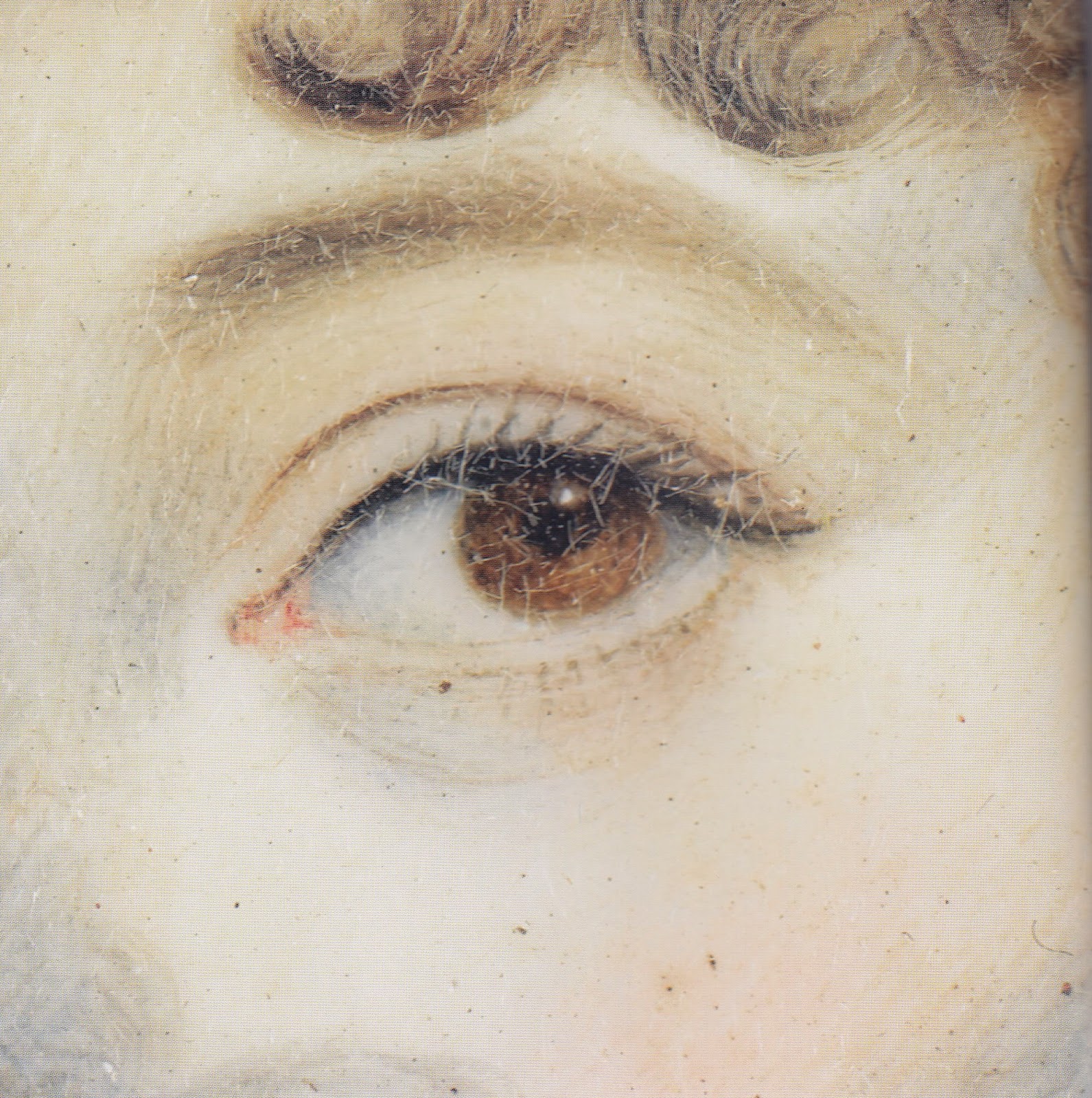
Eyes


All the pictures are taken from the exhibition catalog,
The Look of Love.


I never knew there was a whole world of eye miniatures, but I have just encountered the catalog for The Look of Love, an exhibition currently at the Birmingham Museum of Art.  There was, apparently, for the short period of 1790 through 1820, an intense fashion for jewelry with a painting of the eye of your lover. Nan and David Skier of Birmingham have collected these miniatures for twenty years.  Ninety-eight of these miniatures are shown in the catalog.  I have selected eleven to show here, most of them set in pearls, to emphasize the enormous variation in presentation.

The word "miniature" should be emphasized. You are seeing pictures much larger than the originals. To judge from the catalog descriptions, very few of these eyes are half an inch long.  The detail is astounding.  More astounding is the unexpected intimacy and erotic power that can be conveyed by a single, painted, eye.

I was born in Birmingham, and the Museum of Art provided me a haven during some difficult times.  I hope they will take this as a note of gratitude.

* * * * * *


* * * * * *

The exhibition continues through June 10. The catalog can be ordered here.

20 March 2012

The Count of Paleopoli de Menelao

+ θεόδορος ἐν Χ(ριστ)ῷ τῷ Θ(ε)ῷ εὐσεβὴς 
δεσπότης Παλαιολόγος ὁ πορφυρογέννητος +
Signature of Theodoros II Palaiologos


On 29 May 1419, Theodoros II signed an argyrobull to Pope Martin V with a signature like the one you see here. Do appreciate the artistic Ts and enthusiastic accents -- they turn up in other family signatures.  A year earlier, Martin had signed a formal dispensation for the sons of Manuel II to marry Latin rite wives, and apparently the negotiators got right to work.  Theodoros' document begins, "Desiring the most serene lady, our dearest future consort, the lady Cleope Malatesta" and goes on to say that the gentleman, Mastino of San Sepulcro, has come with the marriage arrangements.

Theodoros promises that Cleofe will keep her religion ("in consueta devotione sua circa divinum cultum"), and the ceremonies of the Roman church in which she was raised, and that she can have a chaplain.  More than that, she can keep her Italian practices and customs ("mores suos ytallicos").  If he dies, she will be free to return home with all her possessions.  It didn't quite work out that way, but you can see that he was really quite enthusiastic at the beginning.

The gentleman, Mastino de Cattanei, of San Sepulcro -- a gracious city, home to the teenage Piero della Francesca -- is identified as Cleofe's "procurator and orator": he is authorized to speak on her behalf, or on her father's -- we don't know how old she was, we don't know anything about negotiations, we don't know how much leeway he had. He was probably suggested by the Pope. We do know that Theodoros seemed quite pleased with the result.

On June 19, a month after he wrote the Pope,  Theodoros signed an argyrobull -- that is the signature above, this time to Mastino de Cattanei, making him comes Paleopoli de Menelao -- Count of the Old City of Menelaus, or Count of Sparta.  This was a title that would be understood in Italy, and it turns up later in letters of 5 September 1420 and 19 June 1423 naming him as Senator of Rome. This is a grander title than it might seem: the Senator of Rome was its governor, though the term of service was a matter of months.  Another document written in Rome on 30 October 1423, commends Mastino's service as Senator. (Cleofe's father had been  Roman Senator twice, too.)  In the Cattanei palazzo in San Sepulcro, there was in the 1960s, may still be, a portrait of Mastino painted around 1600 which identified him as "Mastinus Cataneus eques, comes palatinus et senator Romae" -- Knight, Count Palatine, and Senator of Rome. Possibly he had received a title of count from the Pope, or possibly that referred to his title from Theodoros.

"Count" was not a title used in the Morea, and Theodoros probably asked Mastino or the person who wrote the document what would be a good Italian equivalent for a top-rank archon. The title went to Mastino, and his heirs.  They were permitted to make use of the double-headed crowned gold eagle in a red field on their insignia and shield, and they were free from taxes in the Morea. No one in the Morea noticed. Mastino did not actually receive possession of Sparta, or of any land: he got a title that turned out to be worth quite a lot to him in Italy.

These argyrobulls to Martin and Mastino are extremely interesting in that they are written in  Latin, rather than Greek.  Both needed to be understood in Italy.  The one to Martin has both Greek dating ("anno a creacione mundi sex milibus nonigentis viginti septem") and western ("millesimo quadringentesimo decimo nono, indicione XII, die vigessissima nona Madij"). That to Mastino is western, with slight variations ("millesimo quadrigenteximo decimo nono indicione duodecima et die decimanona junij"). Martin's was written "in palatio residencie nostre," while Mastino's specifies that it bears his silver seal with gold around hanging on a red cord, and is signed in Greek in red ink.

Who wrote these argyrobulls?


For the article and document on which this entry is based, go to:
"Un argyrobulle inédit du despote de Morée Théodore Paléologue," in
Revue des études byzantines 21 (1963) 208-220, here.

14 March 2012

Corcondille

Κροκοντηλος – Krokontēlos
Karitena
   

This is not the name Κροκόδειλος used in Mazaris and Sphrantzes for "crocodile," although most people then and now would not hear -- if articulated -- the difference between the sounds of -d- and -nt-. In fact, Sphrantzes wrote, "Κροκόντυλος , or rather, as his associates called him, Κροκόδειλος," making a distinction between the name and the animal.  Since Sphrantzes very probably knew Krokontulos Kladas -- both of them being associated with the despot Thomas in the Morea between 1453 and 1460, I have decided to use his spelling for the sake of avoiding as much as possible the automatic crocodile-association.

The man who paid for the inscription, a part of which is used as spolia at the church of Zoodochos Pigi, Karitena, is almost certainly not the Krokontulos of my concerns, but is probably in the family, even an ancestor.  This inscription -- I am told there are more pieces in a church but I have never been able to get access to the church -- identifies him as "servant of the basil---", probably the basilissa, Zampia Lusignan Kantakouzene of a century earlier.

I have recently been reading The Chronicle of Morea in the Greek, French and Aragonese versions, with the company of the splendid book by Teresa Shawcross,* examining the story of Corcondille.  Corcondille appears only in the French version, which looks like this:

Et trova .j. bon homme grec de la Grant Arracove que un sournom estoit appellés Corcondille, qui estoit la venue pour vendre sa soye: liquelz entra en paroles avec cellue chevalier. Sire monseignor Girars se corouça par yre que il ot. Si fery d’un tronchon de lance que il tenoit en sa main cellui Corcondille, ne say .j. cop ou .ij.
 or
There was a Greek man of standing at Great Arakova** whose surname was Corcondille who had come [to the fair] to sell his silk.  He had words with a certain knight.  Sir Girars struck him because of the anger he had.  He struck him a blow with the lance which he had in his hand, this Corcondille, I don't know, one or two blows.
[Notice it says "surname."  We know of several people named Ακροκόνδυλος in the 1370s.]

There was an annual fair, in June, in the broad grasslands just south of Nikli/Tegea -- beautiful country -- to which people came from all over the Morea. It was a Frankish fair but close to the Byzantine border.  Corcondille was a man of mature age, as we learn he has a Frankish son-in-law. He had public respect and owned a house in Great Arakova.  This public humiliation was untenable, and Corcondille felt he would die of shame if he did not make Sir Girars "die the bad death" -- "faire le morir de male mort."  He decided that the best way to go about it was to get the nearby castle of St. Georges into Greek hands.

Corcondille went up to see his kinsman, Leon Mavropapas at Chelmos in Mantinea.  Mavropapas commanded a contingent of Turkish mercenaries for the Byzantines.  They worked out a plan.  Corcondille went back south to his son-in-law, Amimo, who was cellarer of St. Georges, and his friend Bonifaces who was glad to share in any rewards. 

Mavropappas brought his Turks to a castle near the border, a hundred of them, travelling by moonlight.  The narrative is not perfectly clear, but it seems that Amimo managed to lock the look-out in the dungeon.  Crocondille and his friends came to the gate, overcame the guard and locked them up, and then lit a fire on the tower to signal Mavropapas who arrived at dawn with his Turks and took possession of St. Georges.

There is then a long narrative about the Frankish siege of St. Georges by Florent of Hainaut which involved building a second castle and importing a trebuchet expert.  The narrator sensibly says there is too much to relate, and that Florent died.  The narrative runs through 21 sections: Corcondille disappears after the 14th, and we never know if Sir Girors died the bad death.

Now, the version in the Aragonese chronicle omits Corcondille completely.  He tells of a commander of the Emperor going to the fair to buy horses -- whatever the price -- and arms.  Having done so he armed the Greeks who raided a celebration the Franks were holding at a church.  The commander apologized to the Frankish captain who rejected his apology.  So the commander went to the parallel Greek fair, and arranged for them to attack the Franks and then retreat.  The pursuing Franks were caught in an ambush, and the Greeks took the Frankish castle at Nikli and several others.

This is essentially the same story, told two ways -- the Greeks trick the Franks, using horses. (Does this story sound familiar?)


But there are three more stories in a very short chronicle accompanying the most important manuscript of the French chronicle that mention St. George.  Perhaps they are this story, perhaps not:


[Florent of Hainaut] fought with the emperor Quir (Kyr) Andronigo Paleologo which lasted 7 years after the taking of the castle of St. George of Scorta, which was in 1294.

In 1319, the 3rd indiction, on 3 February, at night, he took the castle of St. George of Scorta, by the treason of Mote--dou Liege and of  Nicolucho of Patras, who betrayed them and gave it to Sgoceco.*** 

In 1320, the 4th indiction,**** 19 September, the castle of St. George was given by Nicoluchus of Patras where he was castellan to Quir Andronico Assaigni (Asan).*****


The French chronicle is very clear that the castle of St. George was near the fair, toward the eastern side of the Morea, and that is what Scorta indicates.  It never tells us that Corcondille was given the castle.  This site cannot be identified on the ground.

The castle of Ag. Georgios that Krokontulos Kladas gave Mehmed II was toward the western side of the Morea, south of Karitena.  I deduce this from the routes and acquisitions of Mehmed given by the various chronicles. Additionally, Kladas was loyal to Thomas which indicates his land was in Thomas' despotate.  This site cannot be identified on the ground either  A third of the width of the Morea separates the two sites.

How does one link Corcondille and St. Georges with Krokontylos and Ag. Georgios?


*Teresa Shawcross, The Chronicle of Morea: Historiography in Crusader Greece (OUP 2009). 
 Review.  Amazon.  OUP.

** Possibly Karies. 
*** I don't know who "he" is and I don't know who Sgoceco is.
**** The indiction numbers are wrong for both years.
***** This section tells us that Asan also got Mathegriffon (Akova), Polyfengos, and Karitena.  They are too widely dispersed to be of any use in locating St. George.

08 March 2012

Giving up for Lent


Turkish wall photographed by Boryana Katsarova
National Geographic  


I keep being asked what I am giving up for Lent.

I am giving up.  

What I mean is this: For a period when my daughters were young, I went to New York one day a week for my job at Voice of America in Washington, DC.  I usually brought them back small presents.  One evening when I arrived home, the second daughter came tearing down the stairs and began pounding on me, "What did you bring me?"  I said, "I can't give you anything if your hands are not open," and then, stunned at the profundity of what I had just said, I dropped the presents.

 The gesture of giving up is hands upraised, open. The gesture of praise.  Or of prayer.  Or even of the presence of angels.


02 March 2012

On Vacation: Hawk Roosting

Bat Hawk, Joseph Wolf ca. 1860

                      HAWK ROOSTING                             
I sit in the top of the wood, my eyes closed.
Inaction, no falsifying dream
Between my hooked head and hooked feet:
Or in sleep rehearse perfect kills and eat.

The convenience of the high trees!
The air's buoyancy and the sun's ray
Are of advantage to me;
And the earth's face upward for my inspection.

 My feet are locked upon the rough bark.
It took the whole of Creation
To produce my foot, my each feather:
Now I hold Creation in my foot

Or fly up, and revolve it all slowly --
I kill where I please because it is all mine.
There is no sophistry in my body:
My manners are tearing off heads -

The allotment of death.
For the one path of my flight is direct
Through the bones of the living.
No arguments assert my right:

The sun is behind me.
Nothing has changed since I began.
My eye has permitted no change.
I am going to keep things like this.

     Ted Hughes