Showing posts with label Theodoros I Palaiologos. Show all posts

28 August 2014

Another missing woman - the second wife of Theodoros I


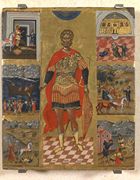
Picture from unidentified source. Help requested.


This entry is based on a fascinating article by Angeliki Tzavara and Thierry Ganchou which can be downloaded and read  here.  Although it was published in 1999-2000, I have only just seen it through the magic of the Academia website, and as far as I can tell from 6 years of Morea research, it has been quite thoroughly ignored. Tzavara and Ganchou found a document in the Venetian archives which clearly identifies a second wife for Theodoros I of Mistra.  That the sole source is Venetian is another reminder of Byzantine misogyny in the imperial family. It may be remembered that Manuel's daughters have gone completely missing, as has his wife's mother, some of his grandchildren and others.

Theodoros is known to have been married to Bartolomea Acciaiuoli, daughter of Nerio Acciaiuoli of Corinth and Athens.  It will be recalled that Chalkokondyles said she was one of the most beautiful women of the age. She may have been, but there is no reason to rely completely on Chalkokondyles, as he also said that Nerio left Corinth to Theodoros.  Nerio did not.  At Nerio's death in 1394 he forgave the 5000 ducats Theodoros owed him, but left essentially everything to his other daughter Francesca who was married to Carlo Tocco.  Carlo Tocco took possession of Corinth. Theodoros went to war for Corinth, and eventually gained possession.  Nothing is known of what happened to Bartolomea, but she probably died after 1396.

Theodoros died of gout in June 1407.  Manuel II went to Mistra immediately and created his young son Theodoros Despot.  Manuel and his brother had him in Mistra already, so there would be no doubt about the inheritance.  Manuel's long funeral hagiography for Theodoros never mentions any marriages or children.

The second wife appears in a Venetian document of 1412, five years after Theodoros died.  In it, a judge on Rhodes appoints a procurator to act on her behalf to collect money owed her there.  This is how she is described: "illustrissima principissa et domina domina Caterina Palaiologina, relicta bone memorie serenissimi principis et domini domini Th. despotis Amoree . . . (by the) most illustrious princess and lady, Lady Caterina Palaiologina, widow of the prince and lord, Lord Theodoros, Despot of the Morea of good memory."  That is all we have, but the combined Rhodian and Venetian legal systems were not likely to have invented an imperial wife.


18 May 2012

Red Ink


Image of signatures of Demetrios Palaiologos, 1451.*


I was recently reading Warren Woodfin's fascinating book, The Embodied Icon,** which discusses ecclesiastical dress. At one point (173) he relates the color of the ink used in signatures to the rank and costume of the signer: patriarchs tend to wear blue and sign in blue ink; the emperor wears red shoes and signs in vermilion; despots wear shoes of mixed purple and white, and sign with purple. (There is also an article on this topic here.)

I like that idea a great deal, but it makes me think that no one told the later Palaiologues.  The treaty Theodoros I signed with Venice in 1394 described itself as "subscriptione in fine instrumenti rubei literarum manu propria domini dispoti . . .."  Theodoros II signed a letter to the Pope and a grant of land in red -- vermilion -- ink.  The same with the signature of Demetrios, above.  The image in last week's entry showed the little Despot Theodoros wearing red: we couldn't see his shoes.
 

A signature of Andronikos in 1414, confirming a grant from Manuel in Thessaloniki on his way south to build the Hexamilion -- is in black.***  He was a minor then, just 14, and the signature is in the genitive -- Andronikou -- "by me, Andronikos." You will notice that Demetrios' signatures above and below are in the nominative.

Manuel and Andronikos, 1414.

A  second signature at Thessaloniki, this from 1419, is in red and the ending is in the nominative -- δεσπότης.***  Eighteen was a significant age for Byzantines, and I believe the change in case ending is an indication that Andronikos had become of age to rule for himself, without a regent.
 

A signature from Demetrios,*** when he was Despot of Lemnos under Mehmed II,  is also in red.


Demetrios Palaiologos, Despot, 1462.


                * Image from: "Σφραγιδες των τελευταιων Παλαιολογων και των περι αυτους," Νεος Ελλςηνομνημων 1: 416-432.
** Warren Woodfin, The Embodied Icon.  Oxford University Press, 2012. 
*** Treasures of Mount Athos, Thessaloniki 1997. Ch. 13.  The quality of the color printing in this heavy, expensive volume produced by Athos and the Ministry of Culture is shameful.

19 February 2012

When the Palaiologos family visited Monemvasia


Dying child, fresco of King David
Voronet Monastery, Romania  


In 1400, Manuel and Helena Palaiologos left Constantinople on a Venetian galley.  Married in 1392, they now had five children and she was pregnant again. Manuel was on his way west to get aid for Constantinople, under desperate threat from Beyazid.  Manuel had come to terms with his nephew, John VII, and had left him in charge of the City, but unwilling to take the chance of his family becoming hostages, he had decided to take them to the Morea to stay with his brother Theodoros, the Despot.

There were rumor that John had already come to terms with Beyazid, that he had 10,000 Turkish horsemen, that he would give the Turks Constantinople in exchange for the Morea. Theodoros, fearful of another Turkish invasion -- there had been two in the past four years, had sold off Corinth, Kalavrita, and Mistra to the Knights of Rhodes, and had moved his administration to Monemvasia.

So when Manuel and his family arrived in the Morea -- it was a Venetian galley so they had to bypass Monemvasia which would, of course, have been a convenient stop and go on to Methoni -- Helena and the children and her suite had to travel back to Monemvasia.  I hope there was a ship they could travel on, rather than have to make that miserable trip by land, but the famous Monemvasia shipping disappears from the record in the 15th century whenever you need a ship.


These were the children: John, aged about 7; Constantine; Theodoros, aged about 3, and two sisters.  Sphrantzes tells us about the sisters, but no Byzantine -- or anyone else -- managed to write down the names of Helena's mother or of her daughters.  We know nothing about where they stayed in Monemvasia: I have climbed up that sun-blasted rock to the citadel three times in my life, though never pregnant, and I hope Helena was able to stay in the lower city.  A few people had great wealth in Monemvasia, but we know nothing of anyone's relationship to the imperial family at this point.  It would have been a fine city for small boys to explore, with swimming off the rocks, and perhaps the occasional day on a fishing boat.

Helena gave birth to a son whom she named Andronikos.  This means that she not only named him for Manuel's grandfather, Andronikos III, but she named him for the only emperor to have visited Monemvasia. Manuel's biographer, John Barker, who has an extraordinary taste for prurience, begins on Andronikos like this:
For Manuel's third son, however, we know no precise date of birth. Since Andronicus is not mentioned among the children left behind in 1400, assuming Ducas did not overlook him, he was presumably not born at that time. As there is no evidence to warrant suspecting Helena of misconduct during her husband's absence, there would thus be two possibilities for his birth date: either Helena was pregnant with him when Manuel left.
Well, duh.

Two years earlier, in 1398, the Eighth Death, as the chronicles called it, had broken out in the Morea.  In 1401, plague erupted again.  It is recorded in ports, in Methoni and Koroni.  It was still raging in 1402, so that the Venetians, planning for Manuel's return trip, would not take the responsibility of letting him stop in Methoni.  Manuel's return was delayed, and delayed again, so that it was well into 1403 before he left Venice and by that time, Methoni was clear of plague and his ship was free to stop there.


Plague had also appeared in Monemvasia.  Three of the Palaiologos children died -- Constantine, and the two little girls.  Plague is identified first of all by its devastating high fever, and their deaths would not have been clean and tidy like that of the child in the picture above. The children were buried in a church in Monemvasia. Despot Theodoros established a fund for liturgies and Manuel later gave the Metropolitan of Monemvasia the territory of Helikovounos so the income could provide  two liturgies each week -- on Thursday and Saturday -- for the children's souls. Plague would be a commonplace for the two older sons -- two of John's wives would die of plague, and so would Theodoros.

In any mention of Manuel's daughters, the subject of illegitimacy has to come up.  Barker cannot let the topic alone: "Manuel apparently had several other illegitimate children," and continues with a breathtaking sequence of assumptions about these dead daughters for which he can offer no evidence: "Whatever our ignorance about these children, however, it is still plain that they must have been illegitimate, though by whom is not known, and that they were sired by Manuel before his assumption of the throne and his marriage."* Sphrantzes is the way we know about these daughters, and nothing he says or does not say can be twisted to justify this twaddle.

Helena had to travel back to Methoni to meet Manuel, this time with three children.  The Venetians had agreed to transport a suite of 25-30 people along with Manuel, though by the time Helena and Manuel met up in May, they had a suite of 58 people. They then apparently sailed to Vasilopotamos, near Elos, at the end of the Eurotas River, and then traveled up to Mistra where Manuel and Theodoros discussed how Manuel was going to repay the Knights of Rhodes after the people of Mistra flatly refused to let them into the city.

In Feburary 1404, there was a new son who was named Constantine in place of the one who died.


The next time you are in Monemvasia, light candles for the unnamed daughters.


* No one should write me about Manuel's illegitimate daughters who has not read Thierry Ganchou's meticulous study on the subject:  “Ilario Doria, le gambros Génois de Manuel II Palaiologos: beau-frère ou gendre?" Études Byzantines 66 (2008): 71-94, which should put paid at least to the Zampia question.


31 October 2011

What Happened to the Parthenon's Stud Farm

Detail from an icon of Ag. Menas, Emmanuel Lampardos, 16th C.
Istituto Ellenico, Venice


What happened to the stud farm is a good question.  Most of this will come from work by Julian Chrysostomides* who transcribed mounds of documents from the Acciaiuoli period.**

Nerio Acciaiuoli, Lord of Corinth (acquired in 1371 as security for a loan) and first Florentine Duke of Athens (a new title that year) died on 25 September 1394.  Two months earlier a visitor had noted that he was aged and unwell. A few days before he died, "sano de la mente ben che infermo del chorpo," he had made his will which begins with the request that he be buried in Santa Maria de Setines, the Atheniotissa or Christian Parthenon.  We don't know if that request was fulfilled.


In the second section of his will
he leaves the city of Athens to Santa Maria de Setines. The silver, gold and jewels Accaiaiuoli had earlier removed for his ransom have been mentioned before: he asks that the silver be restored to the door, and that all the other furnishings, gold, silver, jewels and precious stones be bought back and restored to the church.  I wrote earlier that we didn't know how that worked out: I still don't.

Nerio asked that twenty canons say masses night and day for his soul (which he probably needed), and that these be provided for out of the intrade, the income, from Athens. The intrade was also to pay for repairs to the cathedral.  All this was to be handled by his executors, who were to be backed up by the Signoria of Venice.


He left a rouncey to each man in his employ, and gave the Bishop of Argos the horse of his choice.  Otherwise, he left all the çumente, his spelling of jumenta -- horses -- in his stables to the church in Athens.  This would be the famous stud farm, and in the contemporary world, "stud farm" implies race horses.  But in my understanding of medieval terms, jumenta were animals that could carry weight -- war and pack horses.  That understood, he certainly had a very large stud farm, or farms: one witness recalled seeing a herd of fifty 3-year olds at Vasilicata, on the coast west of Corinth.  Three horses in the Acciauoli stable, corserii -- war horses, were valued at 300 ducats apiece.

Carlo Tocco, Duke of Kefalonia, was married to Nerio's daughter Francesca. Theodoros Palaiologos, Despot of Mistra, was married to Nerio's other daughter Bartolomea.  Each considered himself the rightful heir to Corinth and all that was Nerio's, quite apart from Nerio's own opinion.  There ensued a great tangle of events, bad behavior, falsified documents, disguises, the participation of the Navarrese and Evrenos Bey, war around Corinth, and intimidation of the executors. Chrysostomides explains it all as clearly as anyone can.*

Tocco won, for a while, although in less than a year he was reduced to selling Corinth to Theodoros who had occupied the territory with Turkish help. (And two years later, in 1397, Theodoros offered Corinth for sale to the Hospitallers.) But while Tocco still considered himself a winner, one of the first things he did was to send twenty of the best horses as a gift to Beyazid, who was going to war in Wallachia.  


Financing this required selling and pawning a considerable amount of jewels and silver from Corinth. (The Venetians reported that everyone who sat at table with Francesca ate and drank out of silver vessels, and after Tocco got there, they didn't.)  The twenty were to be taken by his brother, Leonardo, to whom he gave the largest and most valuable courser, a grey. He also gave a horse to the person he sent to take over Francesca's castle of Megara, and other horses to assorted people who had come with him from Cefalonia.

Then he packed up Francesca, the jewels, pearls, silk cushions, wall hangings, furniture, curtains, beds, mattresses, and a great many horses and palfreys and sent them ahead of him to Cefalonia.  Nerio had made Francesca his heir to Corinth: he was quite capable of mentioning Tocco had that been his intent.  In fact, it looks as if he wanted neither of his sons-in-law involved.  Nothing is reported of Francesca's opinions, but it is clear from the statements of various participants that there was a great deal of personal loyalty to her and none at all to Tocco.

As best I can understand, the Greeks of Athens did not like the idea of belonging to a Latin cathedral, and asked for Ottoman help.  In the summer of 1395, a small Turkish force took over Athens.  One of Nerio's executors, the castellan Matteo de Montona, sent to Negroponte for Venetian help, in accordance with the will.  The bailo there, Andrea Bembo, sent down enough soldiers to drive the Turks out.  A Venetian administration was sent out from Venice, which decided that since so many horses had disappeared from the stables, there was not enough income to support twenty canons, and so the twenty were reduced to eight.

At the time of Nerio's death, his son Antonio was Lord of Thebes.  Nerio had, as one witness said, kept Antonio "on a very short leash."  So quite a few people were surprised when, in 1402, having observed that there was a very small Venetian force to defend Athens, Antonio took over Attica and all of Athens except the Acropolis.  After seventeen months, the Venetians surrendered from hunger.  Except for an interval of four years, Antonio was Duke of Athens until 1451.  Early on, because of Turkish raids, he moved the stables to Negroponte, good relations with the Venetians having been restored.

So that is, more or less, what is known about what happened to the Parthenon's stud farm. Other provisions of the testament will be considered in another entry, but given all the fassaria, I am skeptical as to how much Corinth, Argos and Nauplion actually received from what they were bequeathed.


* Julian Chrysostomides, "Corinth 1394-1397: Some New Facts," Byzantina 7 (1975) 83-110.
** Julian Chrysostomides, Monumenta Peloponnesiaca (Camberly, 1995) #160 et seq.


27 July 2010

Lady of Nauplion


There are no pictures of Maria, or Marie, d"Enghein, or d'Enguino, or any of six other spellings, but a hundred years ago, the occasional writer on medieval Greece and Nauplion tried to make some sort of romantic picture of her as Lady of Nauplion, summering in a pretty tower across the bay.  That tower was built by the Turks,centuries later, and although she did "own" Nauplion and Argos for a few years, there is no direct evidence that she actually was ever there.  But she may have been.  Modern historians rush right past her as unimportant.

Except that without her signature on a document, Venice might not have acquired Argos and Nauplion.   

Maria was born in 1364, the only child of Guy d'Enghein, Lord of Argos, Nauplion, and Kiveri, and his wife, Bonne de Foucherolles, daughter of the Enghein governor of Argos.  So it is very likely that Maria spent her youth in Nauplion and Argos.  She was betrothed at the age of 7 to a John de Lluria, probably the son of the Navarrese ruler of the Principality of Achaia. This marriage would have united the western near-half of the Morea with the Argolid, and would have intensely antagonized the Venetians in the south, the Byzantine Despotate of the Morea, and the Florentine Duchy of Corinth.

There are no documents for the interval, but one has to assume that Venice which had merchants in Nauplion and Argos had noticed the excellence of its port and the fine fortifications of both cities.  At some point Guy acquired citizenship in Venice, and possibly a house.  Guy died in 1377.

It should surprise no one to learn that two Greek archons with houses in Nauplion, a Kamateros and a Kaloethos, petitioned Venice for her to marry a Venetian, specifically Piero Cornaro, son of Frederigo, the wealthiest man in Venice, who had an abiding interest in the security of his trade interests in Greece. The petition was brought to Venice by Giovanni Gradenigo, one of the Venetian merchants of Nauplion.  It explained that everyone there was concerned lest Nauplion be taken over by Theodoros I, Despot of Mistra, or "that cruel tyrant" Nerio Acciaiuoli.  A Greek chronicler tells us that Kamateros and Kaloethos received large gifts for their concern.

Maria was married to Piero that same year in Venice.  The senate kindly provided a galley to take Piero out to govern Nauplion on her behalf.  She presumably remained under the supervision of her father-in-law.  In November 1381, the senate kindly provided a galley to protect Nauplion against the frequent Ottoman pirate raids.  There is another seven years of no information.

In 1388 Piero died. Maria was a widow at the age of 24. Nauplion petitioned that Venice take the Argolid into her tender care, since a young and grieving woman could not possibly be expected to manage such responsibility.

We have the contemporary Venetian copies of two documents that Maria signed on 12 December 1388, "in the house of the late Frederigo Cornaro."  One transfers her castles, places, fortresses, districts, pertinences, and jurisdictions of Argos and Nauplion on behalf of herself and any heirs,  to Leonardo Dandolo, "noble and wise man, knight, honorable procurator of S. Marco," acting on behalf of Venice. 

The second document said that Maria would receive for this an annuity in perpetuity of 500 gold ducats for herself and her heirs (and since her husband had been away for years the chances of heirs were fragile), and an additional annuity of 200 gold ducats for herself for life, and should she not have heirs, the right to bequeath 2000 gold ducats to anyone she pleased, payable out of the Venetian treasury, in her will.  And she would forfeit all of this should she marry anyone not a Venetian patrician.

Now, both these documents say that she is "over the age of fourteen and under the age of twenty-five."  She was twenty-four and everyone knew it.  What that means is that she was old enough to be married, but not of an age to legally transfer property.  Twenty-five was the legal age for a woman to transfer property.  This has not before been noticed by anyone writing on the subject, and it seemed not to be an issue for the notaries present, or for Dandolo, or for the Doge and commune of Venice.  All these legalistic public servants managed completely to ignore the law, Nauplion and Argos came under Venetian control, and 1388 entered the list of important dates in Nauplion's history. 

A young woman with 700 gold ducats a year of her own was highly desirable as a wife, and she shortly was married to Pasquale Zane, about whom we know nothing other than that he died in 1392.  We do not know why, nor do we know the cause of her death in 1393 at the age of 29.  Nor do we know what happened to that 2000 gold ducats she could bequeath.

However, in 1388, upon hearing of Piero's death, Theodoros of Mistra immediately came up with troops and occupied Argos.  He probably learned of the death within four days, while it would have taken a month, even two, for the news to reach Venice.  Theodoros did not move on Nauplion, having no ships of his own which would have been needed for defense.  [Late correction: he apparently did try a siege of Nauplion but Venice was able to keep it supplied by ship.] There were several years of mild war and bickering on the matter, which is a topic for another blog.

The last item in Maria's story occurred in August 1393, when the Venetian senate received a letter from her uncle, Englebert d"Enghein of Bruges, who said that he was technically Maria's heir, and he would like to have Nauplion and Argos.  The senate replied mildly that he could have them, just as soon as he reimbursed them for the expense they had been put to in the acquisition and defense of the territory.
 The picture above is Ruskin's watercolor of Frederigo Cornaro's house in Venice, now Ca'Loredan which, with Ca' Farsetti, is now the seat of the government of Venice and the Veneto.  This is where Maria lived.
 * * * * * *

Late comment:  An anonymous commenter -- and I have asked that comments NOT be anonymous, complains about my spelling.  It is a meaningless comment under the circumstances: spellings in contemporary documents include, but are not limited to: d'Erigano, d'Anguein, d'Enghein, Dagyhein, Daghein, Enquien.
 

14 May 2010

Archons: Demetrios Laskaris Asan of Mouchli


This court official of Mistra  is standing in for Demetrios Laskaris Asan.  He was known to the Venetians in Nauplion and Argos as Demetrios Laskaris, and to the Greeks as Demetrios Asan, and it has taken a while to figure out that they were the same person.  Demetrios was the kefali, or governor of Mouchli, one of the Byzantine border fortresses, and he was not one of the glories of Byzantium.
Mouchli is this great bald peak, to the left of the highway from Myloi to Tripolis, just at the point where you begin to come down out of the mountain curves.  It has the same configuration as the peaks of Mistra and Karitena, and it is completely isolated from the mountains that chain down from west of Argos.


Mehmed II did not take Mouchli by blocking an aqueduct, as Kritoboulos claimed, because there is no place from which an aqueduct could have brought water to Mouchli. [Late correction: not Kritoboulos: Chalcocondylos.] There are still springs on the hillside, and they and cisterns would have been adequate for a city that probably never held even 2000 people.  Mehmed took Mouchli by a simple surrender from Demetrios Laskaris Asan because six years earlier he had already pledged his loyalty to Mehmed.  

Little is left of Mouchli now -- this photo shows the most interesting remains, though there are considerable traces of walls made from the local stone and the same color -- but there was never much of Mouchli.  Twenty-five years ago you could still find traces of a fresco on a wall fragment of what is called the Mouchliotissa, a church of the Virgin.


Like Mistra, Mouchli was a new city, founded for its defensive site at the end of a major mountain pass.  It was built by Andronikos Asan, Byzantine governor of the Morea between 1316 and 1322.  He was the son of Tsar Ivan IV of Bulgaria and Eirene Palaiologos, sister of Andronikos II who appointed him to the job.  Asan's daughter Eirene married John VI Kantakouzenos, whose daughter Helena married John V Palaiologos, which makes Andronikos Asan the great-grandfather of Manuel II and Theodoros I Palaiologos. From then until the final surrenders to Mehmed in 1460, Asans married Palaiologoi and held governorships.

It is difficult to think what would have supported the city of Mouchli, other than sheep and goats, and high-level brigandage --  waylaying travelers and merchants from Venetian Argos and Nauplion, raiding the Argolid.  We have evidence for both.  Last spring the apple trees were blooming across the hillside, and there is a nearby town named for pear trees, but fruit cannot have contributed much to the economy.  

Demetrios Laskaris Asan was a difficult person.  Anonymous of Nauplion went to him in 1449 to complain about Mouchli Albanians rustling his animals at the Fair of Ag. Demetrios, and Asan's response was to imprison and torture him for two months, before sending him home.  (Another Asan at Mouchli did this to Nicolò Catello of Nauplion in 1399 when he went to clarify a financial matter.  The Venetian governor had to write to the Despot, Theodoros I, to get him freed.)

The Venetian community of Argos wrote a complaint to the Signoria of Venice about Asan, about what happened at the same Fair of Ag. Demetrios that Anonymous attended:
Also, about the Albanians who live in the territory of Your Excellent Signoria -- [Demetrios Laskaris Asan] orders them about and attacks and beats them, and takes them by force and imprisons them, and judges them in his way and says that they are his and not the Signoria's.

And he makes the Chief of the Albanian catuna pay 1 gold ducat for each hearth, for some two ducats, and for some three according to the families that he has. The said Chief is called the primicerio, and if he doesn't pay immediately, his cow or horse or sheep is taken, and he is put in prison. Because of this they ask the favor that they be protected so that they want to be under Your Signoria rather than under Greeks. La chiefali of Mouchli is named Dimitri Laskaris.

He came to trade at the Fair of S. Francesco at Kiveri, that was last Saturday and that he should favor our journey, for we wanted to go to Venetian territory for the one at Nauplion since I trade with him. And the Sunday of which Dimitri was at the fair we were making our way between Argos and Kiveri. He dashed past the toll post, and we were surrounded, and we were seized and we were unhorsed and were taken with an Albanian from Argos who came with us to bring the horses back.

And he strikes to the ground and inflicted much dishonor on Messer the Rettor [Perigrino Venerio di Bernardo], and has horses given to us, pretends to let us go on our way, and he sends a man to say that we would be held in Mouchli. And because of that Messer the Rettor sends the horseman to see what was going to happen to us, and thus he was held as well. And he has the horse of Messer the Rettor taken -- the poor young man went on foot -- as far as Argos, where he ate, and ordered taken the pigs of the brother of the Albanian whom he had in prison. And he sent the Albanian to take the horse of the priest-teacher and [he said] “Give it to me and then I will give you your pigs!”

Answer. We are writing the Lord Despot Demetrios [Palaiologos at Mistra] in the usual form to satisfy custom that he should see that similar incidents do not occur.
This is only part of a fascinating document, and it gives us a lot of subsidiary information, such as the fact that there was a Franciscan monastery at Kiveri [now Myloi], and that pigs were raised in the territory.  But this makes two serious incidents -- the Anonymous affair, and this last, really a cluster of incidents -- involving Demetrios Laskaris Asan of Mouchli and the Fair of Ag. Demetrios of 1449, and we have no reason to think he was any worse than a number of other archons of the Morea.  People who lament the fall of Byzantium might bear in mind that the archon business was a very large proportion of that civilization for all of its thousand years, in Asia Minor and in Greece.

Demetrios Laskaris Asan was acquired by Mehmed at the surrender of Mouchli in 1460, and then was the intermediary who arranged for the surrender of Demetrios Palaiologos, Despot of the Morea, and Mistra on 29 May. [Late correction: Mouchli was surrendered in 1458, and it was Mathaios Asan of Corinth who dealt with his brother-in-law, Demetrios Palaiologos, on Mistra.] He would have accompanied Mehmed when he returned to Constantinople.  It was Mehmed's practice to keep the nobles of conquered lands close to him so he could keep an eye on them, occasionally putting them in governing positions in other territories with other languages.  But we don't know what happened to him after 29 May 1460. [Correction: after the summer of 1458.]

This last dramatic view shows what Anonymous and the assorted prisoners and merchants saw as they looked to Nauplion beyond the distant mountains, with Mouchli on the right.