Showing posts with label Anthony Kaldellis. Show all posts

13 March 2015

A new Chalkokondyles


the concluding page of the 1318 Herodotos belonging to George Gemistos Plethon, 
used by Bessarion in 1436, belonging to Laonikos Chalkokondyles. 
The bottom, faded, inscription is the only surviving writing by Chalkokondyles.


The intellectual world of Mistra mostly dissolved in the disorders of the Morea after 1453. George Gemistos Plethon died in 1454 (or 1452: there is disagreement, but 1454 suits my purposes better).  Chalkokondyles and his teacher Gemistos had had many conversations over the past few years comparing the progression and personalities of the Ottomans, with what Herodotos had to say about the Persians. After the Fall of the City, which surprised none of them, Gemistos told him it was his responsibility to write a new Herodotos to explain current events, and presented him with his own copy in which he had made correctionsAfter Gemistos died, Nikolaos Chalkokondyles, in his mid-20s, left Mistra, with the Herodotos . John Eugenikos left that year for Trebizond: perhaps Chalkokondyles took the opportunity to go with him and collect material on Trebizond. He ended up in Constantinople -- Eugenikos seems to have gone to Constantinople, and family members were in business there. 

This is what I imagine happened: we have no information one way or another, but there are a number of reasons to think he was writing in Constantinople.

Exhilarated by Gemistos' confidence, Chalkokondyles wrote at the end of the Herodotos – you can barely see it above on folio 340v – “[Belonging to] Laonikos the Athenian. It seems to me that the Greeks displayed a virtue greater than what is merely human, and that they made a demonstration of deeds such as to amaze us when we learn about them in our inquiries.  They were also fortunate to have a herald who himself did not fall far short in worth of the deeds themselves, I mean Herodotos of Halikarnassos, who recounted these events in the way in which each happened, in a manner akin to a divine procession." 

He was going to be the new herald, and he began: Laonikos the Athenian has written here the events that came to his attention during his lifetime, both those that he witnessed and those he heard about. . . . In my opinion, those events are in no way less worthy of being remembered than any that have ever taken place anywhere in the world. I am referring to the fall of the Greeks and the events surrounding the end of their realm, and to the rise of the Turks to great power, greater than that of any other powerful people to date.”

I have recently been delighted to acquire copies of Anthony Kaldellis' new two-volume translation of Chalkokondyles, and a third companion volume, A New Herodotos which is a gracefully-written analysis of what we can know about Chalkokondyles, his ideas, and his sources.  Kaldellis has wrestled with Chalkokondyles' murky prose -- if he was writing a new Herodotos, he was trying to use Thucycides' language -- and made it lucid. Working back and forth with these books has provoked my speculations.

It is the ending, though, that gives a memorable view of Chalkokondyles.  He had intended to write nine books, like Herodotos, and Book 9:78 has a sort of ending, one he would have improved had he had time to revise and clean up his text.  But August 1461 was not the end of the history of the Ottomans and the Greeks, and he kept writing. (He had also acquired good material on Vlad the Impaler he had to use.)  But the Histories sputter to an unplanned ending early in 1464 with the Ottoman-Venetian war, and the last several pages are a feverish jumble of remarkable fragments of information and errors.  Kaldellis comments in his notes, on the incoherence of the last sentences.  In these last pages we are watching Chalkokondyles forcing himself to write until he knows he has come to his end. His last sentence is a formal act of reverence to Thucydides.  He wrote:ταῦτα μὲν τοῦ χειμῶνος ἐς τὴν Πελοπόννησου ἐγένετο / That, then, was what was happening that winter in the Peloponessos." Thucydides had ended his third book:  “ταῦτα μὲν κατα τὸν χειμῶνα τοῦτον ἐγένετο . . .," and other books similarly.

It has been thought he died of plague but we don't know: plague arrived in the Morea in August 1464 and travelled north, although it is not reported in Constantinople until 1467. It could have been plague.  There is certainly an impression of the effects of  high fever on the mind. 

The manuscript of his book got into the hands of George Amiroutzes, who stuffed in a great deal more information about Trebizond than Chalkokondyles had found it necessary to include. (The first copy was made after Amiroutzes had finished.) This makes me wonder whether Chalkokondyles had heard about the incident in Florence (he himself would have been only about 7 then), an intense discussion between John VIII, Amiroutzes, Bessarion, and Isidore of Moscow who were supporters of Union, against Mark Eugenikos and Gemistos who opposed it. Amiroutzes berated Eugenikos so humiliatingly that Gemistos intervened, only to be shouted down. John said nothing to stop or reproach Amiroutzes, "nothing of solace" (πρὸς θεραπείαν) to Gemistos. Cyriaco of Ancona was at the Council of Union: he met young Chalkokondyles nine years later at Mistra when the boy was about 17. Already interested in history, Chalkokondyles showed him the ruins of ancient Sparta.

The manuscript of Herodotos you see above was in Rome in 1480, in the hands of the copyist Demetrios Rallis Kavakes who was from Mistra. 


08 September 2012

What happened to the children?

Detail, icon of S. Georgio dei Greci, Georgios Klontzas, 16th C.
Istituto Ellenico, Venice
I have already written here about the ability of the Palaiologues to lose close members of the family, in this case the children of Manuel II's brother, Theodoros, Despot of Mistra, not to mention Manuel's own daughters.  There are more misplaced children, and Manuel's grandchildren, too -- the children of his son Andronikos.

That would be poor, sad Andronikos, Despot of Thessaloniki, who died young of leprosy. He was Despot from the age of 8, in 1408, until 1423 when he handed the city over to the Venetians with the hope that they might defend it better than Byzantine resources could.  He seems to have gone to the Morea for a while, then to Constantinople where, in the family tradition, he became a monk in the Pantokrator, and died at the age of 28, in March 1429.

A. Sideras, in "Neue Quellen zu Andronikos Palaiologos," in Byzantinische Zeitschrift 80 (1987) 3-15, has found more information on Andronikos than anyone imagined existed, and it isn't very much.  What interests me here is a footnote with a scrap from a manuscript in Moscow that says:  
. . . for your sons (παισὶ) this has been sorrowing loss, over your absence and their separation from one another as they were scattered here and there . . .
One of the children has been identified as John, and the John Palaiologos whom Cyriaco of Ancona met in Mani has been stated to be the son of Andronikos. Because of the ages and additional genealogy, I believe Cyriaco's John to be the son of Theodoros I.   But what happened to Andronikos' John and his brother?  Were there more than two children.  Why were the children scattered? 

It is not clear in that excerpt -- which is all Sideras gave me to work with -- whether the scattering was after Thessaloniki, or after the death of their father. Did no one in the family have any regard for them? Constantine probably did: he was the one for whom we have any record of family affection. It is certainly asking to much to wonder
what happened to their mother.  Or mothers.

No chronicler or historian thought any of this information important to record. We are told that Byzantines, like other people, loved their children.  Of course they did, but we have precious little evidence for it outside of the wonderful essay Psellos wrote on his daughter.  If we go by the pictures they left, the Byzantines for the most part thought children were short, deformed monsters, as in the Klontzas icon above.  Look at these two fresco details from the Pantanassa at Mistra: 


 Seldom do we find a child appropriately proportioned to an adult:  

Detail from Triptych, Georgios Klontzas, 16th C.
Istituto Ellenico, Venice

The more time I spend with the Palaiologos family, the more I see of civil war, to the end and well past the end, and the hiving-off of young children. The family models the history of the late Byzantine period.


Don't miss Mothers and Sons, Fathers and Daughters: The Byzantine Family of Michael Psellos, by Anthony Kaldellis (Notre Dame Press, 2006).

16 January 2010

The Fire


When I wrote the last entry, I had not yet seen Anthony Kaldellis' new book on the Parthenon.*    I was unable to borrow a copy locally, and it is expensive enough that we had to think a good while about buying our own.  But we did, and the book has now arrived.  It has a little more on the fire, much more on other topics, and some very interesting images.  Here you see Manolis Korres' drawing of what the Parthenon must have looked like after the catastrophe.  Korres leaves more standing than I would have thought one could hope for, but perhaps he is drawing on Evliya's description of two levels of fluted columns.

Some writers associate the fire with the Herulian assault in 267. Kaldellis finds evidence in Julian, and others, that it was not a ruin when he was studying in Athens in 355, and suggests it is more likely to have been caused by Alaric's Goths in 396.  I'm not sure why an invasion is necessary.  Pausanias reports a number of temples that burned because of carelessness with a lamp.  Perhaps the idea of external violence is more comforting than that of an internal accident.  More interesting is  Kaldellis' information that Korres found evidence that the columns were rebuilt and the statue of Athena restored.  Not the gold and ivory statue -- I learn that it had been dismantled and turned into cash long before -- but a replacement.  The cella was reroofed with clay tiles, but the space between the cella and the cage of columns was left open.
                
Then it was converted into a church, and we are hopelessly ignorant of the dating of fire and repair and conversion.  I was wrong when I thought that the Christians took over an empty hulk.  We do not know what the Christians converted.  There were a number of elements to this transformation, but I will leave them with Kaldellis, except for another image from Korres, this of the two stages of the transformation of the apse.

Anothere image in the book that particularly interests me is of the holy water font, or phiale, in the narthex.  Evliya mentioned it, commenting on how mighty must have been the men of old who drank from it.  This is pleasingly reminiscent of Nestor's cup, but Cyriaco who had seen this kind of thing in Italy did not find it impressive.  Here is a drawing of it by Xyngopoulos from a drawing by Pallas, which sounds rather as if we were talking about horse breeding.  Nerio Acciaiuoli had a stud farm which he left in his will for the support of this Church of the Virgin.  We do not know how that worked out.


* The Christian Parthenon: Classicism and Pilgrimage in Byzantine Athens byAnthony Kaldellis.

09 January 2010

Evliya Visits the Acropolis

George Wheler, 1676

In 1676 and earlier, when Evliya Celebi visited Athens, the minaret was not in the center, but more in the right front corner of the Parthenon: this will do as an impression of what Evliya saw in the extremely hot summer of 1668.

Athens was, you will be fascinated to learn, founded by Solomon. (Evliya is always interested in local history). He went up to the "walled city" which we know as the High City, commenting that its sides went down like the sides of the pits of hell.  Evliya saw the "Friday mosque," not the Parthenon: his descriptions give us the single best image we have of the Byzantine and medieval church of the Virgin.

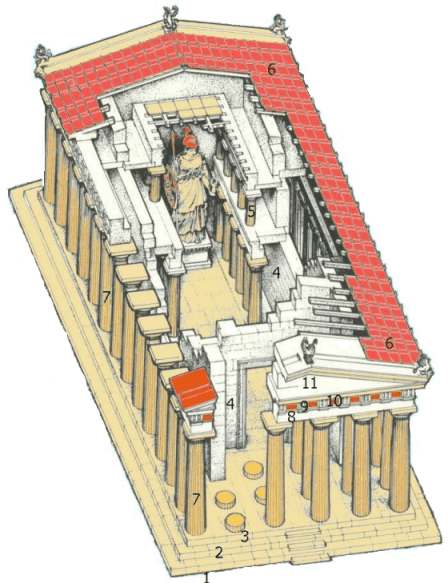
Think of the Parthenon structurally as a box inside a cage of 46 columns, originally with a lid running from one side of the cage to the other. Remember the lid.  That is how Iktinos and Kallikrates built it.  When you come through the Propylea and head for the Parthenon, you are heading for the west end, which the ancients considered the back side.

The original entrance was around at the east end. Visitors approaching from the east went through a cluster of columns and a recessed door to enter the
cella with the great ivory and gold statue (We are, I think, the better off for not actually seeing Athena Parthenos). Here is an imperfect but adequate view of the interior construction. Behind the statue was a wall with an entrance to the treasury. Remember that wall.

When it became a church -- probably in the 6th century -- an apse was constructed on the east end where the entrance was.  Evliya was informed that Plato used to hang a lamp in that dome with naphtha-soaked wicks that were lit in the morning through the heat of the sun on special stones.  Pilgrims reported an ever-burning lamp over the altar, and about 1020 Basil II had given a hanging lamp in the form of a golden dove.

A grand entrance was made in the west end, the treasury became the narthex, and the door between the treasury and the cella became the entrance to the church. Evliya described its finely carved cypress leaves "twenty yards high" which had once been gilded and still retained the insets that once held jewels. (In the late 14th century, Nerio Acciaiuoli needing cash had removed the silver covering Basil II had given for the doors, as well as the gold and jewels. He left money in his will for everything to be replaced but we do not know if it ever happened.) One of the ambones, pulpits, was constructed on six slender columnettes, which Evliya saw supporting a marble throne for Plato under its own dome.  When it was time for the cathedral to become a mosque, it served nicely as the mimbar.  Evliya much admired the colored marble of the furnishings, but essentially all that remains from the interior now is a few pieces like this -- a pretty carving from a world  very different from what had been 900 years before:


The ceiling Evliya saw was made of cypress, gilded and painted.  This was not the lid of marble coffers constructedby Iktinos and Kallikrates.  At some time in the unwritten history of Athens between about 250 and 550 -- Evliya said it was on the night of the birth of Mohammed * -- there was a catastrophic fire in the cella.  The gold and ivory Athena was consumed, and the marble lid came crashing down, bringing down most of the interior structure with the double levels of columns.  Essentially only the box was left.  Archaologist Manolis Korres has scraped off the calcined marble on what would have been the treasury wall behind the statue, and shown how frighteningly thin is the remaining supporting wall.  Athens is on an earthquake zone and it is remarkable that the wall did not collapse long ago, or come down in the incident of 1687.   The Christians took over a shell, not Pericles' Parthenon. Evliya knew of a second fire -- set by a mythical Egyptian sultan who looted the church of its treasures -- and said you could see "wounds" from that fire.  A second fire is quite possible.  [
Please read the subsequent entry for some corrections to this account of the fire.]

This mythical sultan is responsible for the disappearance of the jewels and treasures of the church to which Evliya keeps referring, though there were not many jewels and treasures remaining after the Franks of 1204 and the Catalans and the Acciaiuoli had made use of what Basil II had taken from his conquests in Bulgaria and given to Atheniotissa, the Virgin of Athens.

When Evliya saw the Parthenon, he saw a mosque with a minaret, surrounded by 46 columns, and for most of the way around, the space between the columns and the walls was open to the sky, not lidded over.
  He saw sculptured scenes on the metopes between the tops of the columns, and more scenes around the top of the cella. Our interpretations are dominated by archaeologists, but Evliya was under no such handicap.  The sculptures he saw contained fairies, angels, dragons, elephants, rhinoceri, giraffes, scorpions, crocodiles, thousands of mice, cats, ghouls, cherubs, and many many other kinds of creatures from this world and others in processions: one of the saved in Paradise, the other of those petrified in Hell.

Evliya says these sculptures are in the courtyard. In Evliya's experience of the classical Turkish mosque, the mosque is approached through a colonnaded courtyard, like the glorious Selimiye at Edirne.  The columns here, joined by lintels but almost completely separate from the interior structure ever since the fire and the collapse of the roof, allow him to interpret the Parthenon-mosque as a mosque
inside its courtyard.

He was fascinated with the holy water font in the narthex which he saw as a great goblet, large enough for a man to fit inside -- the men of old must have been mighty indeed to have been able to drink so much!  (Cyriaco had noticed the font, but little else.) He noticed that there had been a pipe organ over the door from the narthex into the church, but what fascinated him was a column supported by an arch. 

The mosque made use of the apse as a kibla, which he shows us covered with gold mosaics.  The arches and walls of the sanctuary were overlaid with multicolored mosaics which reminded him of the Dome of the Rock in Jerusalem. (Is there a reason there seem to be no good photographs of these mosaics on the internet?) I am imagining mosaics like these from Thessalonike.  

There was a gallery around the interior of the church, and the four columns closest to what would have been the altar were of porphyry.  So he said, Evliya always put the best possible interpretation on what he saw.  He counted 60 columns in all -- because of the gallery there would have been two levels -- all fluted and grooved. (An earlier Venetian visitor had said there were 80 -- this is the only known occasion on which Evliya produced a smaller number.) He doesn't mention the frescoes Basil gave, of which a few ghosts can still be seen, exposed to rain and Athens air for 450 years.

Evliya had seen the great mosques of Damascus and Edirne and Cairo and Jerusalem and Constantinople, but he said:

Presently there are well-constructed locations which have been disfigured by the wounds from the fire, but still, in the sphere of this ancient world, there is no such sparkling and luminous mosque since, no matter how often you enter it, on each subsequent entrance so many kinds of artful, individual and exemplary illustrations are evident and manifest. **


* You will recall that a fire the night of the birth of Alexander the Great brought down the great temple of Artemis of the Ephesians.
** Translation, Pierre MacKay. 

Notes:
  • Evliya's description of Athens and the Acropolis is to appear soon in a book of Evliya excerpts by Robert Dankoff.
  • An important new book is The Christian Parthenon: Classicism and Pilgrimage in Byzantine Athens byAnthony Kaldellis.   BMCR review. Bill Caraher's review. 
  • And thanks to  http://www.mlahanas.de/ for the Wheler image.