On 17 December 1432, Bertrandon de Broquière went to Ag. Sophia for the service of the Three Hebrew Children in the Fiery Furnace but he spent the service watching John VIII with his mother Helena, his wife Maria, and his brother Thomas, Despot of the Morea. Actually, Bertrandon wasn't interested in anyone but Maria, a "tresbelle dame." He thought she was a honey.
Five years later, Pero Tafur was invited several times to go hunting with John and Maria several times. He left a brief description:
The Empress rides astride, with two stirrups, and when she desires to mount, two lords hold up a rich cloth, raising their hands aloft and turning their backs upon her, so that when she throws her leg across the saddle no part of her person can be seen.
Although Pero Tafur had other, conversational, encounters with Maria, that is the most he does in the way of description. Compare it with Bertrandon's account. He was clearly hoping to see her legs:
I went all day without food and drink, almost to vespers, very late, to see the Empress who had rested in a residence nearby which seemed to me as beautiful as a church, to see her come out and how she mounted the horse. She only had with her two woman and two or three elderly men, and three of the kind of people the Turks have to guard their women. When she came out of the residence someone brought a bench from which she could mount and then they brought out a very beautiful roncey draped with rich and beautiful bardings. Going beside the bench, one of the elderly notables took a long mantle which she carried and then went to the other side of the horse and raised up the mantel with his hands as high as he could. She put a foot in the stirrup and then mounted the horse like a man, and then he threw the mantel on her shoulders.
There are several elements in this narrative that raise questions, such as why wasn't there a more private place where she could do this, but it is difficult to find information with which to approach the questions. The other thing thing Bertrandon mentioned is that she wore one of those long pointed Greek hats
on the point of which she had three golden plumes which suited her very well. She seemed as beautiful to me as she had before. She came so close to me that someone said I should follow behind, and it seems there is nothing to say, except that her face was made-up, which was not necessary because she was young and fair. One her ears, hanging from each one, was a large flat earring with many stones, more rubies than anything else. It appeared, when the Empress mounted her horse, that the two women with her were equally beautiful, and they wore mantles and hats.**
So riding astride, the Empress and her two women rode the length of the city of Constantinople, from Agia Sophia to the Blachernae Palace up a steep hill overlooking the Golden Horn, in the December dark. Accounts in this period offer intriguing glimpses of a combination of formality and informality among the royals. Take Pero Tafur again:
At the entrance to the Palace . . . is an open loggia of marble with stone benches round it, and stones, like tables, raised on pillars in front of them, placed end to end. Here are many books and ancient writings and histories, and on one side are gaming boards so that the Emperor's house may always be well supplied. Inside, the house is badly kept, except certain parts where the Emperor, the Empress, and attendants can live, although cramped for space.
A little more can be said about that hat, but only a little. Extensive hat-searching turned up three images of pointed Greek hats. This first is from an early 15th-century Italian painting which I have not been able to identify, but it is surely based on an impression of Manuel II when he was in Italy and Paris between 1399 and 1402.
Artists were fascinated by Manuel and his hats, the way the Italians were fascinated by John and his hats five years after Bertrandon saw the hat with golden feathers. They took up Manuel's beard and curled hair and imperial outfits with great enthusiasm, using him to portray ancient philosophers and wise men and one of the Three Kings.
 There is another pointed hat, found in the Très Belles Heures, in another image of Manuel, when he was visiting in Paris. Only one other pointed Greek hat has turned up for me, painted by Carpaccio more than eighty years later in St. Stephen Preaching at Jerusalem, but no one would wear it with golden feathers and ruby earrings. I am seeing Maria's hat as being made of elaborate fabric like that of the philosopher-king, but of the style of the Belles Heures which seems much more suited for riding.
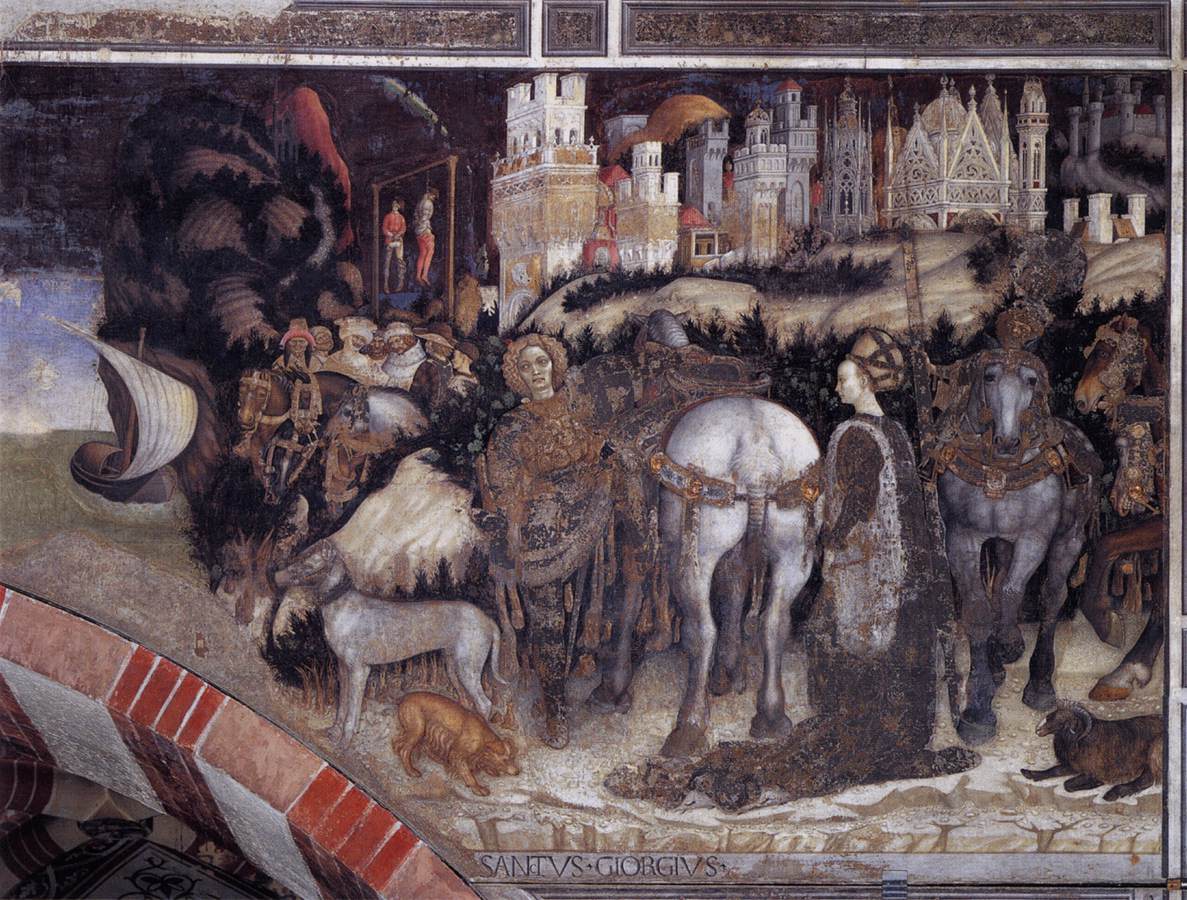
 I have already used the picture of the lady above to represent Maria. It is by Pisanello, and appears to be the same lady as the Princess in his fresco of St. George and the Princess of Trebizond. She, too, is young and fair, almost as if seen in a dream, and does not look at all like young women in Italian paintings. Pisanello drew, modeled, and painted John extensively, and I like to think John had a portrait of Maria with him.
[Later comment: I do not think this is a portrait of Maria, although an Italian art historian does. I am much more inclined to think it based on women of the Malatesta-Gonzaga family and originally intended as a portrait of Cleofe Palaiologina. See here and here for partial thoughts on this. I have not yet published my reasons for this, as I am still in the process of gathering evidence for AND against.]
** Go here for a little more on Maria's wardrobe.
I have already used the picture of the lady above to represent Maria. It is by Pisanello, and appears to be the same lady as the Princess in his fresco of St. George and the Princess of Trebizond. She, too, is young and fair, almost as if seen in a dream, and does not look at all like young women in Italian paintings. Pisanello drew, modeled, and painted John extensively, and I like to think John had a portrait of Maria with him.
[Later comment: I do not think this is a portrait of Maria, although an Italian art historian does. I am much more inclined to think it based on women of the Malatesta-Gonzaga family and originally intended as a portrait of Cleofe Palaiologina. See here and here for partial thoughts on this. I have not yet published my reasons for this, as I am still in the process of gathering evidence for AND against.]
** Go here for a little more on Maria's wardrobe.
 These are Theodoros and Andronikos Palaiologos, about six and four, possibly a little older. They are portrayed with their parents, Manuel and Helena, and big brother, John, in a formal portrait sent to Paris in 1403 or so, in a picture that can be seen here That same year a Spanish nobleman, Clavijo, visted them and wrote:
The Emperor was seated on a raised dais, carpeted with small rugs, on one of which was spread a brown lion skin and at the back was a cushion of black stuff embroidered in gold. After conversing for some considerable time with us, the Emperor at length dismissed us, and we returned to our lodgings, whither later on his Highness sent up a stag, which his huntsmen had just brought in to the palace. With the Emperor at our audience had been present the Empress his wife, with three young princes, the eldest of whom may have been eight years old.
The eldest was John who was actually eleven, but he was small for his age and fine-boned, having inherited his father's build. When John was emperor, in 1437, another Spaniard, Pero Tafur saw the lion skin again, it or a replacement: "I then entered the Palace, and came to a hall where I found him seated on a tribune, with a lion's skin spread under his feet." But the palace was run-down and though the royal apartments were kept up, John and the lovely Maria of Trebizond and their attendants lived crowded in together. Still, the palace must have been a civilized place to visit:
At the entrance to the Palace . . . is an open loggia of marble with stone benches round it, and stones, like tables, raised on pillars in front of them, placed end to end. Here are many books and ancient writings and histories, and on one side are gaming boards so that the Emperor's house may always be well supplied.
For all his magnificent wardrobe when on show, John seemed to prefer a lack of complications, given the choice. He was an unexpected guest of Giovanni di Jacopo di Latino de' Pigli, out from Florence one day in 1439. De'Pigli quickly prepared a bed for the Emperor--it had white sheets and a green bedspread--but given that it was July in Italy, he reasonably prefered to nap in the garden:
. . . instead he had a sort of couch made on two benches with a little mattress and with a carpet . . . under the arbor, and there he slept until his people produced something for him to eat. When food was provided, he had a small table placed before his couch. I found him some white table cloths, and then he ate alone;
His desire for privacy was strong. De'Pigli thought he had lost the use of his legs because he had come into the house on his horse, dismounting only in the view of close friends. John did have episodes of terrible pain in his legs and could be bed-ridden for days--possibly rheumatoid arthritis? [Late correction: he had severe gout.] The nap gave De'Pigli time to send around to the neighbors for help with lunch--John was travelling with a party of about seventy--and it does sound like a meal put together in a hurry. I like to think I would have done better on the meat, at least for him.
. . . the first food the Emperor ate was a salad of purslain and parsley, with some onions, which he himself wished to clean. After that there were chickens and pigeons, boiled, and then chickens and pigeons quartered and fried in the frying pan with lard . . . he took what he wanted, and sent them along to the others. His last dish was eggs thrown on hot bricks . . . and then they set them before him in a plate with many spices.
After lunch John played backgammon under the arbor and joked with friends. De'Pigli spent the time talking with Cyriaco of Ancona who was one of the party.
Mostly, though, what John's guests reported was hunting--it was mobility and air, even when his legs were not working-- and he enjoyed having guests. In 1437, just before John left for Italy and the Ferrara-Florence circus, he was host to Pero Tafur:
This day the Emperor sent for me to go hunting, and we killed many hares, and partridges, and francolins, and pheasants, which are very plentiful there, . . . and from that day onwards, when he or the Empress, his consort, desired to hunt, he sent horses for me, and I went with them, and they said that they had great pleasure in my company. . . The Empress rides astride, with two stirrups, and when she desires to mount, two lords hold up a rich cloth, raising their hands aloft and turning their backs upon her, so that when she throws her leg across the saddle no part of her person can be seen.
Maria of Trebizond's riding astride fascinated the Westerners. Bertrandon de la Broquière had seen it a few years earlier and wrote that three eunuchs held up the screen. This is an interesting detail left hanging: was she the only woman hunting? Did she not have ladies-in-waiting? When John and his delegation of nearly seven hundred had left for Italy, Tafur went on to his business in the Black Sea and visited Maria's family in Trebizond. When he came back to Constantinople, he had letters and news for Maria, and spent time with her and and with Constantine who was serving as his brother's regent. Then she and Constantine took him to services at Ag. Sophia and gave him a guided tour of the relics--Constantine held one of the keys to the relic chamber. The next year when Tafur was in Italy, en route home to Spain, he stopped in Ferrara to visit John who was a guest of the Marquis of Ferrara, in a palace on the banks of a river, with gardens:
In the evening I went to wait upon the Emperor of Greece, and gave him letters from his consort and from his brother the Despot. He received me gladly, saying that I was his kinsman and a native of his country. He drew me to him and made me sit there beside him, asking me for news of his country and telling me that I must visit him each day I was there, and that it would give him much pleasure if I were to reside with him. Thus we were very familiar together . . .and he made me dine at his table and showed me many kindnesses.
Cyriaco was with him again in 1444 for a summer hunt. John's interested in clothes extended to his hunting wardrobe, and he had handsome Persian bow and arrow cases. It is unfortunate to have to admit that when he was at Ferrara there were complaints that he and his courtiers had denuded the countryside of game (and had trampled the farms), but in 1444:
The most serene emperor himself, John Palaiologos, and his brother, Theodore Porphyrogenitos . . . left Byzantium to go on a hunt, splendidly accompanied in the usual royal manner by his more high-born principal courtiers . . .The hunters brought to the king's tent from their booty two bristly boars and two fawns. From these the most splendid prince made gifts . . .. And finally, the Cretan falconer Manuel held out a large, long-footed lizard that a peregrine falcon had killed before my eyes in the clear sky. Then the jovial emperor invited me to receive a portion of the prey.
A rare period of happiness for John in those years, but he can never have been jovial. Later that year, Cyriaco visited John's brother Constantine at Mistra. He had nothing special to report about that visit, but once Constantine had taken him to watch an athletic competition in Sparta at which he distributed prizes. The outdoors comes into these accounts of visits with the Palaiologues, again and again, fresh air and movement and space as antidote to the ceremonies and close quarters of the palaces, interludes of release from the squeeze between the Unionists and the Turks and the Anti-Unionists.
For fuller accounts of these visits.
 On 17 December 1432, Bertrandon de Broquière went to Ag. Sophia for the service of the Three Hebrew Children in the Fiery Furnace but he spent the service watching John VIII with his mother Helena, his wife Maria, and his brother Thomas, Despot of the Morea. Actually, Bertrandon wasn't interested in anyone but Maria, a "tresbelle dame." He thought she was a honey.
 This first is from an early 15th-century Italian painting which I have not been able to identify, but it is surely based on an impression of Manuel II when he was in Italy and Paris between 1399 and 1402.
 There is another pointed hat, found in the Très Belles Heures, in another image of Manuel, when he was visiting in Paris. Only one other pointed Greek hat has turned up for me, painted by Carpaccio more than eighty years later in St. Stephen Preaching at Jerusalem, but no one would wear it with golden feathers and ruby earrings. I am seeing Maria's hat as being made of elaborate fabric like that of the philosopher-king, but of the style of the Belles Heures which seems much more suited for riding.
 I have already used the picture of the lady above to represent Maria. It is by Pisanello, and appears to be the same lady as the Princess in his fresco of St. George and the Princess of Trebizond. She, too, is young and fair, almost as if seen in a dream, and does not look at all like young women in Italian paintings. Pisanello drew, modeled, and painted John extensively, and I like to think John had a portrait of Maria with him.