Showing posts with label Nauplion castle of the Franks. Show all posts

19 February 2015

Excavations at Nauplion's Castle of the Franks


The Castle of the Franks, Grimani map ca. 1712.

Wall and tower shown below directly in the center.


The Greek Archaeological Service has after many years taken up work again on Akro-Nauplion with large projects in the Castle of the Franks. In November, thanks to Ioanna Christoforaki, I was shown over the sites by archaologist Natassa Basileiou and two of her colleagues.  It could not have been a more inconvenient day for them because of organizational changes, but they were generous with their time and humor and information, and it is a great pleasure to know that these are the people who are the future of the Archaeological Service.


 Archaeologists Eirini Oikonomopoulou,  
Kostis Boundouris,and Anastasia Basileiou. 


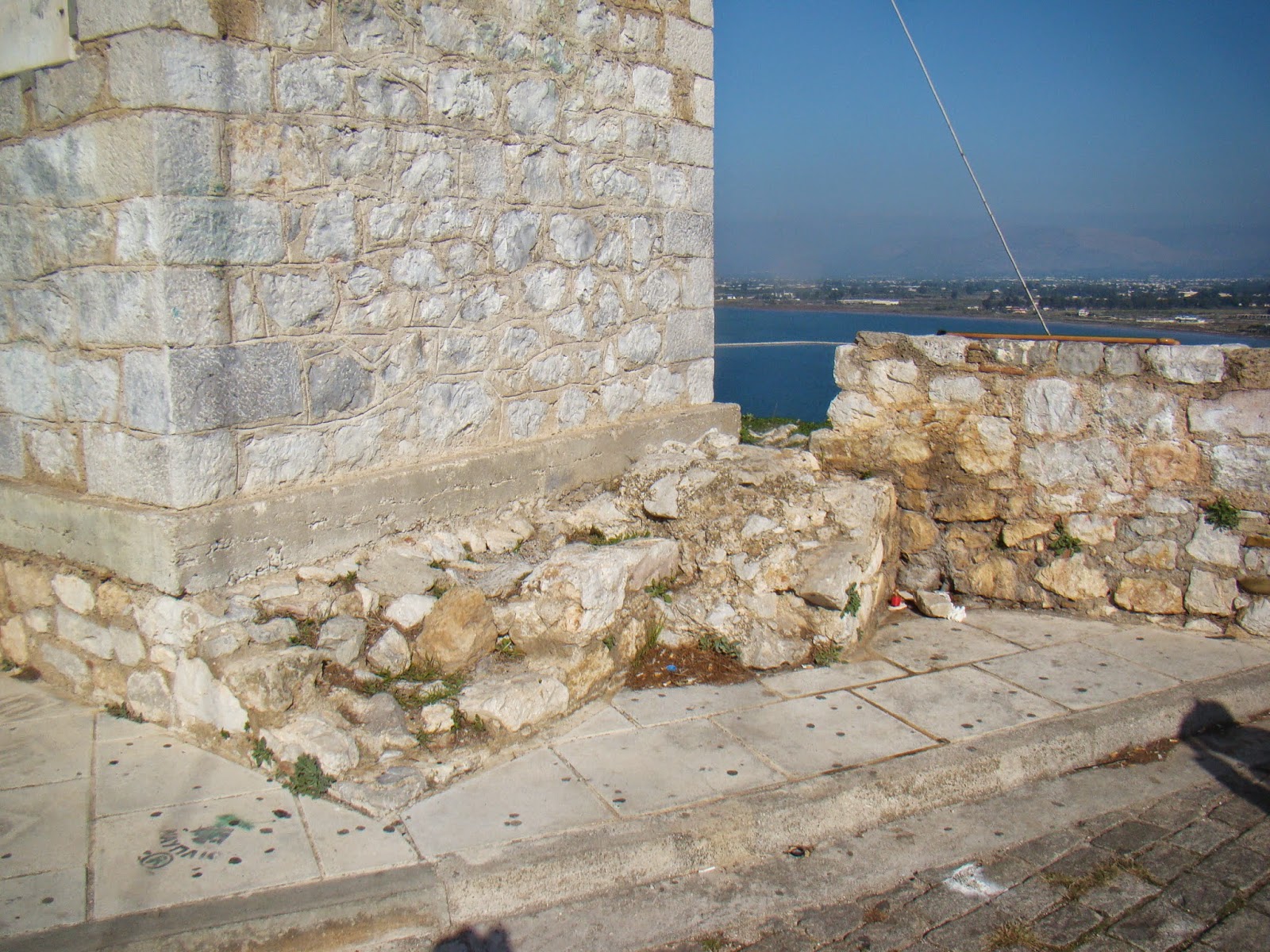
Visitors to Akro-Nauplion have a certain familiarity with the great merloned Venetian cross-wall built in 1470 during the Venetian-Ottoman War because there the road is forced to turn abruptly right and go through a narrow bend to gain access to the bell tower and then the hotel further down. Up on the hill behind this Venetian wall is a cross-wall with a large square tower in the center built by the Franks probably 250 years earlier to defend against Greek Nauplion. The Archaeological Service has uncovered the remains of the square tower, and has identified remains of the cross-wall at the bell tower.


The Castle of the Franks, Francis Schaefer, 1936.
Cross-wall and tower, left; central tower with frescoes, right.
Bell tower, top left.


Remains of square Frankish tower. 


                                                                   End of Frankish cross-wall at bell tower.


Inner entrance to tower with frescos.


As part of the restoration project for the tower, the interior fill deposited over the centuries has been removed, and the inner approach to the tower cleared down to the base. I did not ask where Schaefer had found the child sacrifice but it was much on my mind.


View of frescoed chamber with Angel barely visible above
on plaster over arch of Roman brick.


When Francis Schaefer saw the tower frescos in 1956, he thought them in good-enough condition so as to need no restoration work. When I saw them first in 1977 – knowing only that they were “Frankish” – I could make out almost no details. That winter the tower chamber was sealed and the subsequent deterioration was rapid. In the last two years they have been restored to the extent possible -- and the photo above shows how very pale they are now.  None have the color or show the marvelous detail of the small Angel of the Ascension on the overhead arch.  

The photographs below that I was able to take are underwhelming, but they have been much brightened and the colors intensified with Gimp.  The identifications are those made by Francis Schaefer. The frescos are dated between 1291 and 1311, and were probably created by Greek painters for Frankish employers.


Ornamentation shown on right of previous photograph.


Warrior before Gimp.


Warrior after Gimp.


St. Anthony.


 Bishop. 


Saint.


Some information thanks to Monika Hirschbischler, “The Crusader Paintings in the Frankish Gate at Nauplia, Greece,” in Gesta XLVI/1 (2005) 13-30.


13 August 2010

Otranto


-->
Bones of 1480, Otranto Cathedral

When I lived in Venice 12 years ago, the manuscript I was working on contained a number of references -- from 1479, 1480, 1481 -- to the seventy crossbowmen in Nauplion's Castle of the Franks who were much overdue to be paid and so who were close to starvation. They were unimportant in the manuscript as a whole, but I became fixed on the idea of these seventy hungry crossbowmen and it became very important to know who they were. Then I learned that there was a crossbow competition at San Sepulcro -- they have done this annually with another town since 1441 -- and went with delight because I could combine crossbows with Piero della Francesca.

I learned a lot about crossbows and crossbowmen that day. There were exactly seventy men in the competition, of all ages and physical types. They sat to shoot. The quarrel -- the bolt shot by the crossbow -- was terrifying. Those men gave me my seventy hungry crossbowmen, and I saw something of the period in which I was working.

Similarly, the bones of the eight hundred honored in the Cathedral of Otranto have stood witness in my mind -- quite apart from the respect due to their own history -- to the eight hundred of Davia, the  eight hundred of Methoni, the eight hundred of Negroponte. Eight hundred seems to be the chosen number for the summer executions after Ottoman victories, but when a city fell without surrender, all lives were forfeit. 

The siege began on 28 July.  Otranto had no cannon of their own for defense, but even today it
is littered with Ottoman cannon balls. They sent messengers to Ferrante of Naples asking for aid, and hunkered down.  The Ottomans offered a chance for surrender, but Otranto rejected it, filled an Ottoman messenger with a second offer with arrows, and threw the keys of the city into the sea. 

It was a very short siege. On August 14, 1480, the male survivors were executed.  Or massacred.  Or martyred.  These eight hundred have since been honored as martyrs who refused to exchange their religion for their lives.  John Paul II beatified the eight hundred there on this day in 1980, and in 2007 Benedict XVI formally authenticated their martyrdom.

According to the story, an elderly tailor named Antonio Primaldo, was the first to die.  A renegade priest in the employ of the Ottomans tried to persuade Primaldo  to convert, but he refused with a terrific speech.  Thus, all eight hundred males over the age of 15 were condemned to decapitation.  It would be a much more moving story did it not include the detail that when Primaldo was decapitated his corpse stood up, headless, and remained standing through the next 799 decapitations.

As a historian, I am uneasy with elements of the martyrdom because of what I think know about the Ottomans in the period of Mehmed II. I have neither the language competence nor the time to do the research I would like. The story is said to come from Francesco Cerra, one of four surviving eyewitnesses. The heroism of Otranto was magnificent and the story deserves honor as it stands.  Martyrdom gives meaning to the unbearable and I will not take away meaning from this extraordinary chapel and these bones.

Otranto was retaken a year and a month later, on 13 September 1481.  The brothers and relatives and friends of the eight hundred sorted through what the birds and the dogs had left. It must have been nearly unbearable.  The account of martyrdom made their work possible. Most of the bones retrieved were saved in the cathedral, some were sent to King Ferrante of Naples.  These are the bones in the picture above, three great cases heavy with them. Tourist information calls them "spooky," "Gothic," "gruesome." For these bones, such words are obscenities.

When we visited in January 2005, we spent a long time with the bones.  It was easy to spot wounds and fractures in skulls, smashed jaws, damage from abscesses, and after a while we were able to work out faces, some older, some very young. We were surrounded by a great crowd of witnesses to 14 August 1480, and we stood among them as witnesses ourselves.