Showing posts with label Carpaccio Augustine. Show all posts

19 February 2013

Bessarion's Little White Dog

St. Augustine, Carpaccio, ca. 1504


In Carpaccio's painting of St. Augustine, at the instant when he becomes aware of the death of St. Jerome, there is a small fluffy white dog. This dog, too, has become suddenly alert at the sudden stream of light from the upper right. It is a wonderful room, books piled on books, a wooden platform to keep feet from the cold floor, books along the wall, another room of treasures, his clerical effects untidily lying around the altar, a shelf of Greek antiquities to emphasize the Greek connection, and a bear-paw sconce for a light like the sconces in Cocteau's La Belle et la Bête.

Although Cardinal Bessarion had been dead for thirty years (1472), Augustine and his room are based on Bessarion's life (I like to think my own study reflects Bessarion and Augustine), and Carpaccio shows, among Bessarion's collection of astronomical instruments, the astrolabe made for him in 1462 by Regiomontanus.    This astrolabe still exists. He had met Regiomontanus in Vienna the year before, when he was travelling on behalf of the Papacy looking for support for a crusade in Greece against the Turks. Regiomontanus left Vienna with Bessarion and spent several years in his household, collecting and copying scientific manuscripts.


As far as I know, there is no mention of a little white dog in any Bessarion material, but I have always been charmed by the dog, and so imagine my delight when I discovered another little white dog in this Ptolemy manuscript made for Bessarion's collection.


The dog seems to be perched in Bessarion's cathedra, adjacent to his studiolo with Venetian ornamentation, and with that studiolo we come back to St. Jerome who was the Renaissance prototype for the scholar in his studiolo.  

Portrait of Ptolemy, Geography, c. 1453.
Biblioteca Nazionale Marciana, Cod. Gr. Z. 388 (=333)f. 6v


This picture should be quite large when downloaded, which you will need to do if you are to see all the wonderful details in it, including that astrolabe again. This one, too, has a stream of light from the upper right, illuminating the mind of Bessarion who is shown as a magos, a wise man who studies the stars, as did his teacher, George Gemistos Plethon. He also has all those untidy piles of books -- look at that wonderful large illustrated codex, and platforms to keep his feet from the chill.  Bessarion -- or Ptolemy -- is wearing a crown, which associates him with the "wise men from the East," the Magi who became kings in Western art.

Now about the dog.  I read some years back that wise men, magoi, were represented with white dogs, as wise women (who of course must have been witches) were supposed to have black cats. (I should admit here that a preliminary sketch by Carpaccio shows a beardless man with a rather nasty-looking cat, instead of a dog.) This dog-cat assignment sounded quite reasonable, but it occurred to me recently that these are the only two images I have seen of wise men with white dogs.  Most of the Jerome images give him a cat, possibly because of his lion.  So I don't really know if magoi have dogs, and would be delighted if any readers could produce more images.  Nor do I know if Bessarion actually owned a white dog, or any dog.  He probably did.  Bessarion was always adding people to his household who needed help in some way or another, and surely local dogs would have noticed that.
So if any reader should come across a line in a 15th-century source that mentions a white dog in Bessarion's household, or any dog,  I would be particularly delighted to know about it.

One more comment about the manuscript painting: ranged along the top are several fantastical towers.  I think the painter was aware of Pisanello's Verona fresco (ca. 1436-38) with the towers of Trebizond in the upper register.  He was probably also aware that Bessarion came from Trebizond, and that Regiomontanus had just been working on a Ptolomy manuscript from Trebizond. 


And for information about one of my favorite novels, The Towers of Trebizond, go here.   


05 September 2008

The Lion in the Cloister

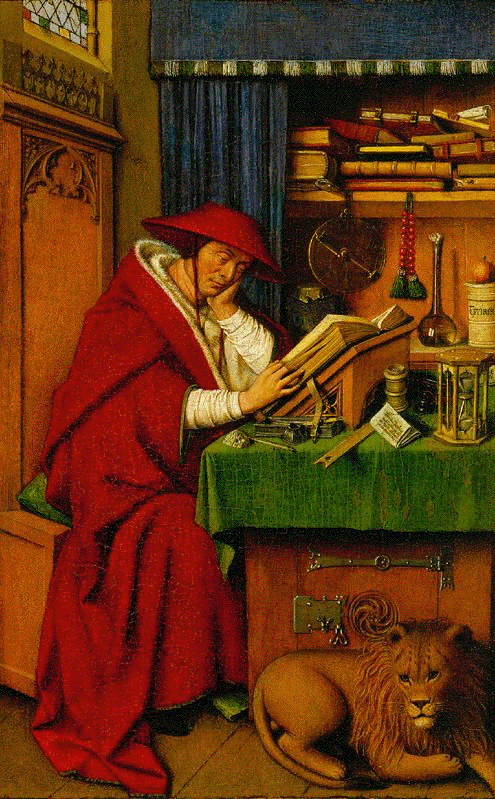
There are a lot of studioli in paintings of St. Jerome because he was a scholar and scholars need privacy to work. The studioli are small wooden studies, such as you can see here, a small room inside a room, or a panelled side of a room, with raised platforms to keep feet off the cold floor, nearly all with sliding piles of books, and hourglasses and pens and inkwells, more books on the floor, books toppling over in cabinets, reading stands, writing stands, astrolabes, green baize or Turkish carpets for table covers, high-backed seats to keep the draft off, prayer beads, vases, pots of flowers, a pear for snacking, scissors, glasses, notes on bulletin boards, cardinals' hats (because that is half of how you identify Jerome), clocks, birds and shells, antlers and squirrels; peacocks and quail--because scholars study nature.
The other half of how you identify Jerome is his lion--lions like kittens, lions like stuffed animals, sometimes Jerome looks like a lion, lions like old dogs, and in Durer's along with a dozing lion there is a sleeping dog, because wise men who are scholars have white dogs, in contrast to old wise women who are witches who have black cats. The best known of these white dogs is Carpaccio's Augustine, but that painting is about Jerome, too, because Augustine in his wonderful study--far grander than a studiolo--has abruptly had a vision of Jerome in death. Both of those last two wise men with white dogs are intended as portraits of Cardinal Bessarion and Bessarion is the explanation for the astrolabes that appear in Carpaccio's Augustine, and in occasional paintings of Jerome. The astronomer, Regiomontanus, made an astrolabe for Bessarion, and Bessarion, like Jerome, was a Cardinal. Most of these studiolo paintings bring you close in to the studiolo with Jerome, give you that wonderful enclosure, but the painting by Antonello da Messina showing an elevated studiolo in a setting something like a church, surrounds Jerome with privacy. In other paintings, the lion is sleeping, or guarding, or holding up his paw to have a thorn removed--at some point the story of Jerome got mixed up with the story of Androcles--and Bastiani and Carpaccio have great fun watching the lion scaring the monks.in the cloister. For Antonello, though, Jeroma has a cat among his flower pots, because scholars tend to work quietly and cats like not to be disturbed.

Far off to the right of Antonello's studiolo is the image you see above, an alert gracile lion pacing among the pillars of the cloister as if they were trees. Other studiolo lions might represent the taming of the bestial in man, the triumph of law over nature, the redemption of fallen nature, and so on and so forth, but not this lion. Antonello's lion is a metaphor for scholarship--for the deliberate and watchful stalking of information, for the pacing nature of thought, for the open spaces of the mind, for the easy interchange of views. And because it is Jerome: the lion suggests the possibility of the radical transformation of the culture from which the studiolo protects.

For much more, see the wonderful book by Eugene F. Rice, Jr., Saint Jerome in the Renaissance. and a modern architect's recreation.