Showing posts with label Methoni. Show all posts

23 October 2013

Remember the slaves, especially Margherita


Detail, Giovanni Bellini, Miracle of the Cross, 1500.

It is difficult to find pictures of slaves who are not black.  A hundred years after the documents in this blog, the European image of slaves was of a black African, but in the 14th and early 15th centuries, slaves were more likely to have been white -- Slavs, Greeks, Circassians, Tatars.  It is disconcerting to discover in Sally McKee's *** collection of Cretan wills that Greeks, and Greek priests, owned Greek slaves.

Almost nothing has survived from the Morea about slaves in the Byzantine-Franish-Venetian period, and what has survived has come from Methoni and Koroni.  Slaves were probably statistically insignificant in the Morea, but it is disturbing to see what a matter-of-fact process was the sale and purchase of a slave.  Most of them had been stripped of their identity by being baptizes and given a new, "Christian," name, yet in some cases someone was careful to make a record of the former name.A few names appear several times, both purchasers and slaves.  Some of the slaves here would end up in Venice.

There is not enough information to understand the prices, though  Greeks were usually the least expensive slaves. Only one of the then slaves here is a male.  The females were all wanted as "house" slaves, and whatever their other duties, would have been cooking and scrubbing and hauling water.  Studies of Mediterranean slavery have shown that buyers rarely wanted to introduce a male into the intimacy of a household.


  • 1372. Alvise de Tinto, resident of Methoni, sells to Luca de Albrigo of Venice, now living in Methoni, a female slave, formerly a Tatar, of sound body, about 28, named Lucia, for 30 gold ducats.
  • 1372. Pietro Bianco, tailor, resident of Methoni, sells to Francesco de Galvano, soldier in Methoni, a male slave, Tatar, about 20, named Cotulloga, for 25 gold ducats.
  • 1372. Lorenzo of Ancona, merchant, resident of Methoni, sells to Nicolo Montanari, resident of Methoni, a female slave, Tatar, about 20, baptized Bona, for 28 gold ducats.
  • 1373. Catellano Trevisan, resident of Methoni, sells Antonio Romano, resident of Koroni, a female slave, about 16, Tatar, baptized Zana, healthy and of sound body, virtuous, for 100 hyperpera.
  • 1374. Zualle Zuliano, resident of Koroni, sells a female slave whom he bought in Candia, Tatar, named Guthlugus, now baptized Maria, of sound body, to Luca de Albrigo of Venice, now present in Koroni, for 24 gold ducats.
  • 1374. Giorgio Strovilli, resident of Koroni, sells ser Manfredo de Botis, resident of Koroni, a female slave, Kali, Greek, about 14, for 22 gold ducats.
  • 1374. Giovanni Bon of Venice, now in Koroni, sells Nicolo Viaro of Venice, now present in Koroni, a female slave, Tatar, now baptized * * *, about 13, of sound body, for 27 gold ducats.
  • 1374. Pietro Bon of Venice, resident of Methoni, sells to Gerata, widow of Giacomelli Zanetti, now resident of Methoni, a female slave, Tatar, about 24, named Dierormuo, now baptized Agnese, for 30 gold ducats.
I don't find a document that tells me how Bon got Dieromuo back, but:
  • 1374. Pietro Bon of Venice, resident of Methoni, sells to Paulo Bitturi of Benice, resident of Methoni, a female slave, Tatar, about 24, named Dierormuo, now baptized Agnese, for 31 gold ducats.
The next pair of documents give a warm feeling, until you read a further document and discover that Enrico bought a new, younger, slave girl.
  • 1373 (16/9). Enrico Barbarigo of Venice, now resident of Methoni, makes you, Caterina, Tatar, my slave, free.  No one can hold you in servitude, but you will be recorded as free. Your present children and those to be born of you will remain free and in permanent liberty.
  • 1373 (16/9). Giovanni Rigi of Lucca, now resident of Methoni, with my heirs, give a receipt to Caterina, my beloved wife, servant of Enrico Barbarigo, for her dowry of 200 lire di denari piccoli.  You will remain secure and quiet in perpetuity.
  • 1373 (18/9). Zanobio of Florence, now resident of Methoni, sells to Enrico Barvarigo of Venice, now resident of Methoni, a female slave, Tatar, about 12, baptized Margherita.


Source: Documenta Veneta: Coroni & Methoni Rogata, Vol. 1. Andrea Nanetti (Athens, 1999).

Vade, Sta, Ambulent: my article on freeing slaves in Crete.

*** Sally McKee has a number of articles on Cretan and Mediterranean slavery.


16 October 2013

Methoni: The marketplace


Lotto, St. Barbara, detail.

Last week, Surprised by Time looked at some of the laws in Methoni intended to maintain peace and quiet. More laws concern details of the marketplace. Monetary equivalents:*
                            1 ducat          = 130 (1424) - 175 (1457) soldi
                            1 soldo           = 4 tornesi/torneselli
                            1 hyperperon = 20 soldi/80 tornesi
                            300 soldi       = month's wages for a soldier or sailor
  • 1416. Anyone who sells wine at an eating house will pay 30 hyperpera for each offense and will stay 2 months in prison and 1 day in the pillory, if a man, and if a women in place of the pillory will be led through the castello with the wine jug hanging from her neck and her offense cried out before her. If anyone is found carrying a jug or other container of wine, and the tax collector asks about it, and the said person pours it on the ground, he will pay 10 hyperpera, half to the tax collector and half to the commune.
  • 1416. There are two ships here that will go to Flanders, and they want to buy corloti (a wine). No one is permitted to sell them corloti: experience has shown it does not travel well, and it will do great damage to Venice and this territory. Anyone who sells them corloti will spend a year in prison and pay 1/2 ducat for each offense. Anyone who sells corloti to anyone not from this territory, without a license from and the knowledge of the castellan, will suffer the same penalty.
  • 1416. It is permitted to anyone who has herd animals (mandra) to kill young goats, sheep, pigs, and other animals for the use of his household, without paying a tax. Similarly, anyone who raises pigs in his house and kills them will not pay a tax.
  • 1417. Anyone who transports wine out to the casali or anywhere in the territory without paying the tax will pay a penalty of 10 hyperpera, and double the tax. From the penalty one-third will go to the commune, one-third to the tax collector, and one third to the accuser. If the accuser is the tax collector, he will have one of the two-thirds.
  • 1417. No one of any rank can buy greens or fruit in the terra (Methoni) except at the produce market at the column of the piazza, with a penalty of 1 hyperper for each offense and confiscation of the purchase. Also, no one may presume to put a hand in the sack of the seller of the produce or take any produce against his will, with the same penalty. [This had also been made a law in 1344.]
  • 1428. No one of any rank may sell any quantity of grain, small or large, to any seller of bread without a license from the castellan, under penalty of losing the grain and the price of it. No seller of bread may buy any quantity of grain without a license from the castellan, under penalty of losing the grain, and the value of it, and one day in the pillory.

Lotto, St. Barbara, detail.

  • 1432. Anyone, either man or woman, who sells greens at 1 soldo a bunch, that is pozi, cabbage, (horse)radishes, zevole, pastonagie, or other vegetables, from here on will sell for 1 tornese a bunch, under penalty of 5 hyperpera.
  • 1440. No one may sell tallow candles except at the price of 5 soldi the pound, with 24 candles in a pound, under penalty of 20 soldi. [A pound = 301g. or 66% of a modern pound.]
  • 1440. No one may salt pork, either in the fortification or the borgo or the district, without a license from the castellan. It is permitted to each person to salt for household use one or two pigs, or as much meat as would equal two pigs, and no more.
  • 1444. No one should play any game of chance except in the loggias and porticos of the shops of the castello to the corner of the Memo house. There are those who play between the two gates and blaspheme God and the saints, and distract the guard, and they come to words and draw arms to the great danger of the guard. It is decreed that from here on no member of the guard can play any game of chance for any reason at the gate of the castello, if not in the loggias and porticos of the shops as far as the corner of the Memo house, under penalty of 40 soldi for each offense. This applies to the night guard as well.
Wartime affected market regulations.
  • 1468. No one of any rank can take or send out of this city or borgo or district or casali of this district, any grain, wine, oil, or food, without a license from the rettori given in writing at the chancery, under penalty of losing it all, or the value, as contraband, 1/3 to go to the commune, and 2/3 to the accuser and the rettori.
  • 1469. At present fish dealers have multiplied in this land who sell fish at a higher price than customary to the detriment of everyone. No one of any rank will sell a pound of fresh fish for more than 4 soldi, and little fish and bobe/pogue/gopa for more than 3 soldi a pound, under penalty of 5 hyperpera for each offence. 

* Money from Alan M. Stahl, The Venetian Tornesello: A Medieval Colonial Coinage, 1985.

Pictures from the fresco by Lorenzo Lotto, The Legend of St. Barbara, 1523-24, in the Oratorio Suardi, Trescore.


09 October 2013

Methoni: Law and order


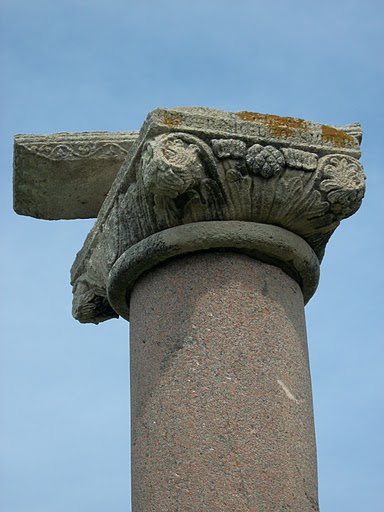
Column in the central plateia of Methoni wher
all  announcements were made, public
justice enacted, and the main market held.


Volume 4  of Sathas has a wonderful collection of laws and market regulations for Venetian Methoni. Laws were produced when there were problems to be solved. Some were produced locally, by the governor and his advisors, some were produced in Venice. New laws were announced by the gastaldo (and a trumpet) in Venetian-Italian and Greek at the column in the central plateia -- which still stands, as well as at the land and sea gates, and at other relevant locations.  Very similar laws were in effect at Koroni, though not always the same, and at Nauplion. Some monetary equivalents:
                            1 ducat          = 130 (1424) - 175 (1457) soldi
                            1 soldo           = 4 tornesi/torneselli
                            1 hyperperon = 20 soldi/80 tornesi
                            300 soldi       = month's wages for a soldier or sailor
  • It has been noticed that spicers and other shops in Methoni sell risigal and arsenic indiscriminately to anyone who wishes to buy. It might happen that one might be poisoned by his wife and die.  To avoid such errors, no one will sell risigal, arsenic, or other poisonous substances without a prescription and the knowledge of the paid city doctors.  If anyone does so, he will stay in prison for one full year, without remission.
  • 1415. The Honorable Castellan of Koroni and Methoni, misser Marco Dandolo, orders that from now on no one should throw, or cause to be thrown, garbage or night soil into the port of Methoni inside the breakwater, under penalty of 10 hyperpera for each offense, half to go to the accuser.
  • 1416. It has been noticed that there are many errors in the cadaster with people not declaring what they should. It is ordered that within the next 8 days, all the householders in the casali 1of this territory, whatever their class, should declare the residents in their house, and who has been born, or died, or fled, or returned, or come to stay, under penalty of 10 hyperpera for each omission, half to go to the accusor. Also they are to report their animals, whether bull or cow or mule, or if one has died. For a second offense they will pay another 10 hyperpera, and their hair and beard cut off, and put in the stocks. For a third offence, another 10 hyperpera, and they are to be branded three times with the seal of S. Marco.
  • 1426. It has been noticed that horses are being brought into the territories of Koroni and Methoni by Greeks, Albanians, and Serbs, and by people from the Greek territories, and from the Principality. They are sold to our people with the result of all kinds of errors. From here on, a Greek or Albanian or Serb or anyone else who wants to sell or buy a horse has to prove to the castellans where he got the horse.
  • 1427. It is noticed that there are those who do not obey the commands of the Lords Castellans and presume to come and go outside the borgo by way of the enclosure at the house of ser Jacomo da Pesaro to the shore. From here on, anyone who does will pay a fine of 10 hyperpera for each offense. If he cannot pay the 10 hyperpera, he will receive 25 lashes at the column. No person, whether soldier or citizen of the territory, of whatever rank, can carry outside the borgo of Methoni, either by land or sea, any crossbow without the permission of missier the Castellan, under penalty of losing the crossbow which will become the property of the commune. The accuser will have half of the value of the crossbow.
  • 1436.  It is noticed that there are soldiers and landworkers who leave Methoni illegally without orders and without permission.  Missier Piero Zen, honorable castellan of Methoni and Koroni declares that any soldier or landworker who leaves without permission, from here on, will stay in prison for six months straight, and pay 100 hyperpera to the commune, and then will be banned from Methoni and Koroni without pay.
  • 1458. It has been noticed that there have been frequent break-ins and escapes from the prison, counter to the dignity of our authority.  Anyone who gives any aid to an escape, or who provides tools or picklocks (grimaldelli), or breaks into, or helps to break into the prison will pay 25 hyperpera for each offense, and will stay one month in prison. 
With Methoni as the primary port for disembarking troops for the Peloponnesian war in the 1460s and 70s, there is a sequence of laws concerned with weapons, noise, and the inevitable violence. The last of the three included here reflects despair over the harshness of Venetian taxes, & the continual raids on farms by continually unpaid soldiers.2
  • 1464. Presumptuous individuals who have no shame go at night and offend newly-weds verbally, and with horns and drums, with a chivaree (zaravarini). The Doge Lorenzo Loredan, and the captain and provveditor Benedetto Gritti, declare that as of the second hour of night (about 8 PM) no one will bear arms, and no one will have a chivaree day or night.
  • 1467. Presumptuous individuals bear arms in the piazza, market, and between the city gates, and they do the same at night. The rettori and provveditori order and declare that anyone who bears arms against anyone between the gates, market, and piazza from the house of the late Ser Nicolò Tinto3 as far as the palazzo will pay 200 hyperpera for each offense, and if he cannot pay he will be whipped from the piazza to the mole.4 Anyone who does this at night, in the city or the borgo5 will be imprisoned for 3 months.
  • 1469. It has been recognized that some individuals through malice have set fire to their fields or vines or trees, with the greatest damage to this city. Anyone of any rank who dares to do this without the express permission of the rettori will pay a penalty of 200 hyperpera (with half to the accuser and) and stay six months in prison. If he cannot pay he will be whipped and put in prison. 1480. The hand that set the fire will be cut off.
This last law was an attempt to stabilize the Methoni food supply. Taxes on produce and sales were important, but the real issue was food. Because of the war, the soldiers who needed to be fed and who looted, and the recent two years of plague with the loss of so many farm hands, Methoni was constantly on the brink of starvation.
  • 1478. Anyone of any rank who brings into his house a female slave or servant for carnal purposes will pay a penalty of 100 hyperpera and will stay 4 months in prison. Any female slave or servant who brings a man into her master's house for such purposes will be whipped from the harbor gate to the piazza.

Next week, Surprised by Time will look at some of the laws of the Methoni marketplace.


1  Casali: villages on landholdings.
2  In 1465, provveditor Jacopo Barbarigo had written of his embarrassment at not being able to control his         soldiers looting, because they weren’t being paid.
3  I have no idea who Ser Nicolò Tinto was, but apparently his house was quite prominent.
4  The mole led from the harbour gate to the little island tower
5  Borgo: the city outside the fortifications.


05 April 2013

Cities

Idealized city walls, Pantanassa, Mistra

I have been trying to get a portrait of the cities of the Morea in the fifteenth century.  City, in this case, indicates the presence of walls, the position of bishop who may reside elsewhere, a market, craftsmen, some kind of local administration with a governor or his representative, and possibly a few foreign merchants or their agents. One can make no assumptions about size or architecture.

The port cities -- Patras, Clarenza, Corinth, Kalamata, Methoni, Koroni, Nauplion -- were small and shabby (possibly Monemvasia was an exception early in the century), and the interior cities -- Mistras, Mouchli, Leontari, Longaniko, Nykli, Mostenitza, Andravida, Chalandritsa -- were small. As a comparison, fifteenth-century Italy -- admittedly the most urbanized area of Europe -- had more than 90 cities with a population of 5000 or more. In the Morea, none is likely to have had more than 2000. 


A Latin memo of 1437 reported that the Morea had 30 cities, 200 of the strongest fortifications, and 400 villages: this was propaganda to encourage aid for Greece and cannot be used for court evidence. Pero Tafur, seeing Corinth in the 1430s, said that it was much depopulated. In the Ottoman cadaster of 1460-1463 it had 392 households, or about 1400 people, making it the largest city in the cadaster which represented between 1/3 and 1/2 of the population of the Morea. The other "large" cities in the cadaster were Vumero with 242 households, Ag. Georgios with 242, and Leondari with 204. All of them were larger than Argos with 115 households in 1450, fewer than 200 households a generation later in 1480.  (I have been using 4.2 as a multiplier for households to get the population.)

Tafur reported Clarenza depopulated, though it had apparently been a small city at best: in the 1390s it had only 300 households. Tafur was there in 1437 and there was some rebuilding and refortification just after 1441. Mistra is unlikely to have had as many as 2000 people within the walls on that steep hillside -- Tito Papamastorakis thinks only 1000 after comparing maps of the excavations with Venetian maps of 1700 and the population then of under 1100 -- and it was a heavily masculinized city primarily of monasteries and church administration.    The former Frankish capital of Andravida had 36 inhabitants. In 1460 Mouchli and three outlying villages accounted for 105 households, or fewer than 500 people.

Minio suggests an unprepossessing Nauplion -- "the best house that I could manage, considering the condition of the place."
Casola found Methoni with its 2000 inhabitants shabby, the houses of wood, the cathedral impoverished, and said that, "in the finest and widest street there, the houses appeared to be shut up for the most part, and when I stood in the market place I did not see many people." Even late Byzantine Athens had grain fields within the city walls, and in 1395 was said to have been a town of 1000 houses. If so, it was larger than anything in the Morea -- except, again, Monemvasia. Fortifications were often mud-brick and rubble, like the city wall of Argos, or the outer wall of Nauplion at the Ottoman attack in 1463. 

It is a depressing image of the Morea, but one could hardly expect better of cities in a culture whose archons occupied themselves by raiding
the food resources of other cities.  The Ottoman raids are blamed for much, but they cannot bear all the blame here. 


 Idealized city from the Kariye Djami


27 August 2012

Methoni, 1509

Methoni castle (Kal 'a-i Metoni) 1509,
Kemal Paşa Zade, Tevâŕh-i Al-i Osmân (Ms. Dresd. Eb.391)

[Late note: A correspondent has just sent me a link to the Dresden library ms of the map and I see that they date it 1550.  Thanks, Tom.]

A new correspondent has just sent me photographs of an Ottoman manuscript dated about 1509 1550.  This image of Methoni -- captured from Venice by the Turks in 1500 -- is fascinating where the details are clear.  It is accurate for the moat, the drawbridge, the mole, the cannon ports in the towers, the market place, and the bourdzi, but it shows a brighter, more prosperous, and more citified Methoni than any visitor ever described. 

Canon Casola stopped in Methoni for a few days in 1494, and this is some of what he had to report (I omit the borgo and the  Jewish and gypsy neighborhoods from his account, and from the other writers, as this image shows only the walled city.):
It has strong walls with drawbridges at every gate which are four according to my reckoning .  It is well furnished with towers, and on the towers and the walls there are large pieces of artillery . . . I entered the city where I did not see either houses or palaces worth of description; for its size it has many houses, and they are close together.  I think there are few inhabitants, for in the finest and widest street there, the houses appeared to be shut up for the most part, and when I stood in the market place I did not see many people.  Those I saw, besides that they are Greeks -- for they also belong to the Morea -- are thin and ugly to look at.  The majority of their houses, whether they are large or small -- at least from the middle upwards and on the side facing the public streets -- are built of timbers.  In short I did not see any other beauty there.
He had a bad night of it:
. . . If I had waited even the sixth of an hour, the whole house would have been in flames, and consequently the adjoining houses: for this house was of wood, and very old, of the dryest kind of timbers and with party walls to similar houses in a congested narrow street.
Casola did not see the city of this manuscript. Nine years before this picture was presumably made, the city of wooden houses and dry timbers had been sacked and mostly burned in the Ottoman siege and assault, and it is unlikely that in nine years the Ottomans had rebuilt it in western-style architecture.  I don't believe the painter of this picture had seen the city of this manuscript although he had certainly seen pictures of Methoni.  His Methoni is full of the kind of buildings Turkish manuscripts conventionally used to indicate western-style houses.

In 1497 or so, three years before the Ottoman conquest, Arnold von Harff stopped by Methoni and met a German master-gunner, Peter Bombardere
who gave me good company and friendship.  He showed me the strength of the town and the artillery, and it is in truth a small town but strong.  . . . he took me around the innermost wall, which was very thick and built of rough stones: in addition there is a great rampart against the wall on which stood many fine cannon, great carthouns and slings.
Casola, von Harff, and Felix Fabri and Bernard von Breydenbach (1483) wrote about churches in Methoni, with slight variations.  I have no idea if I am seeing churches in the picture: as in the Koroni picture below, the Ottoman conventions for western houses look remarkably like the western conventions to indicate churches.
(von Harff) . . . a Roman bishopric where the service is according to our use.  Item: they have also built there a mother church of St. Leo, where he lies in person.  There is also the head of St. Athanasius.

(Fabri) I took my lords and some other pilgrims to the church of the Preaching Friars and there we heard High Mass . . . the Cathedral which is consecrated to St. John . . . in which is the body of St. Leo, a German pilgrim who died among the Turks and who was renowned among them for many miracles, the head of Athanasius, Bishop of Alexandria, and the two fingers of Sts. Cosmas and Damianus.


(von Breydenbach) In the parish church named after St. John there are the body of St. Leo and the head of St. Athanasius the bishop.
(Casola) The Cathedral can join the company of the other miserable churches, being badly kept in every way. . . .the relics were shown to us with a very poor light.  We were shown the head of Saint Athanasius [of Alexandria] . . . and the body of Saint Leo.   . . . he was a pilgrim who came from the Sepulchre and died on the galley, and was buried on the seashore.  Afterwards he was revealed to the Bishop who caused him to be brought into the church where he worked many miracles . . . To tell the truth, the said body was kept in a wooden chest which was in a very bad condition.  I do not mention the other churches, because I saw nothing there worth of remark. . . . The said convent [of St. Francis] has no cloister and no refectory; the dormitory consists of four rooms made of planks. 


This manuscript portrays a dozen or so sites -- Koroni, Galata, Lipari, Nafpaktos, Rumeli Hisar, and some others, nearly all of them with these ships that look like geometric tugras.  The image of Koroni, like that of Methoni, is not completely convincing as historical evidence, but it has this charming drunken cluster of western buildings and a mosque on the seashore.


Kemal Paşa Zade, Tevâŕh-i Al-i Osmân, from whose manuscripts these images apparently derive, was an important Ottoman historian and astoundingly prolific writer, and you may read about him here. There is too little information about him in English for me to write with much confidence, nor am I sure that the historian was the painter of these pictures credited to him.  The accounts in the Brill First Enclyclopedia of Islam, and in Babinger omit mention of the pictures at all when discussing his manuscripts, and I look forward to readers giving me more information.


13 July 2011

Nauplion's Wooden Houses

Nauplion Houses.
Detail from Camoccio map, 1571.


Towards the end of the fifteenth century, Canon Casola and Felix Fabri described Modon:

CC: I did not see either houses or palaces worthy of description; for its size it has many houses, and they are close together. . . . The majority of their houses, whether they are large or small--at least from the middle upwards--are built of timbers.   

FF: If I had waited even the sixth of a hour, the whole house would have been in flames, and consequently the adjoining houses: for this house was of wood, and very old, of the dryest kind of timbers and with party walls to similar houses in a congested narrow street.

No one described Nauplion houses, except for Bartolomeo Minio's remark when Giovanni Dario visited: "I paid the expense of a house for him and his household, the best that I could manage, considering the condition of the place."

At the beginning of the century, from 1400-1405, Giovanni Cavaza was castellan at Nauplion,the second-highest position in the administration. A Venetian merchant who was a permanent resident in Nauplion, he had been appointed to the job where we might have expected a castellan to be an official sent out from Venice. The castellan had a budget of about 500 ducats a year. Cavaza was responsible for defense of the city, police functions, security of the castro, operation of the prison, and executions. He made “foreigners” and sailors sleep outside the city at night, regulated curfews, taverns and markets, kept shops and workshops closed on holy days, gave permission to bear arms within the city, supervised guilds, punished illegal dumping of trash, and had laws and announcements proclaimed in the marketplace “in latino et greco.” In addition to the 500 ducats,which paid for staff and expenses, Cavaza collected fees from innkeepers, shopkeepers and prisoners.

Cavaza is mentioned in two brief documents from 1400 in which the Senato Mar made arrangements for repair of the house provided for the castellan. These documents make dire remarks about the “ruritura” of the house and castro, about a man without a place to house “sua familia.” The podestà, Albano Contarini, had written a number of letters about “magna reparatione omnino necessaria,” apparently to small effect until Cavaza delivered a proposal which stimulated a decision. Cavaza had offered to bear half the expense of rebuilding the official residence. Apparently his residence was even more desperately in need of repair than that of the bailo of Negroponte, described in 1403 as:
. . . in the worst condition, because the rain comes through almost the whole roof, and the wood is rotten, and in parts threatens ruin. Similarly, most of the sala magna is badly covered and it pours in, and the wood is rotten, and it is like that in the whole.

The Senato Mar, in a list that slips back and forth between specificity and “other things” itemized wood and nails--in standardized sizes--to be shipped out for repair of the house and the “turrim Sancti Marie.”
      For construction on the tower of S. Maria, larch posts de mesura 12
      Larch planks 40
      Rafters for fitting the house of the said castro 100
      Beams for fitting the house of the said castro 40
      Large nails for constructing a frame for the thatching 200
      Fir posts 10
      Fir beams 50
      Fir planks 300
      Lathes 1050 

      Large nails to repair the roofbeam and for work on other things 200
      Small nails 600
      Slats 200
      #25 nails 2500 
The important thing to note here is that all the items on the list came in standardized sizes.  It is well-known that the arsenal used standardized, interchangeable, parts for building galleys on an assembly line.  It has not, as far as I can tell, been noticed that construction materials for houses were also standardized.

The Senato also provided 200 ducats for administration, another 200 for transporting earth for land-fill, and for manual labor, and gave Cavaza a tax exemption on his half of the imported lumber. Clearly, the castellan’s house, on a standardized plan, was primarily of wood, at least above the ground floor. Cavaza’s thatched roof comes as a surprise, though it is perhaps not so surprising in an economically stressed community without a convenient supply of clay for tiles, fuel for firing, or adequate transport. Still, the image of wooden houses with thatched roofs changes pictorial assumptions of medieval Greece.

[Nauplion construction for the past 400 years -- until cement -- has been mostly half-timber above the ground floor.  But in the 15th-century, Nauplion had no one available who could cut stone, and Minio had to have stone-cutters sent out from Venice when he was working on repairing the walls of Acro-Nauplion and building the walls of the lower city, and he sent soldiers and wagons to Tiryns to collect suitable building stone for the stone-cutters to work on.  The village in the ruins of Tiryns seems to have been abandoned then.]


In the years immediately after this document, massive amounts of wood were shipped to Greece for Venetian concerns. In 1402, a shipment of wood was sent to Corfu to repair the castro. A thousand posts were sent in 1404 for construction at the “Garland” -- the castle -- of Argos. In 1403, the Senato Mar sent wood and nails for the unroofed Arsenal at Negroponte and sent 30 33-foot larch poles, 30 larch posts, 500 planks of larch or fir, 500 palm-sized nails, 500 foot-sized nails, and 6000 #25 nails. With this shipment went wood for the ruined house: 400 fir planks, 100 larch planks, 500 narrow planks, and one barrel of posts. A little later, the regimen of Methoni and Koroni needed to import firewood from Venice, and Nauplion had to import wood to construct a mill.


This is not to suggest that all Venetian houses in the stato mar were generally either wooden or shabby. Canon Casola who found Methoni tawdry apparently saw a few grand houses and non-wood houses there, and he reported that Candia had beautiful houses, beautiful palaces, beautiful gardens.


And there is a slender hint that Nauplion may have had a few substantial houses. Cavaza had been involved in building on another house: in his will, he makes reference to a house in the burgo, on which “fecerim multas expensas de meis denariis.”   I cannot help but wonder about that tax-free wood supposedly shipped out for the castellan’s official residence, and the idea that he had two houses is provocative. He also held a fief of 200 stremmata, and a few years after he died that fief was the reason for the attempts at murder here.

A house in the burgo, the part of the city outside the defensive walls, is an important piece of information: it has been an article of faith among those writing on Nauplion -- most of whom pick this up from Kevin Andrews who got it from (Pseudo)Dorotheos of Monemvasia -- that there was no construction outside the castro until the landfill projects after 1500. Cavaza’s will provides documentary evidence to supplement the visual evidence to be found in Nauplion that such construction had been taking place at least 200 years before the assumed literary date.  

 * * * * * *

Late addition: I have been thinking about the nails and wondering about their manufacture.  I asked the people at the Guru's den at Anvilfire.  This is their answer

"It depends somewhat on the size and type of nail but a nailmaker working a long (10 hour) day was said to be able to make 1,000 nails in a day. In modern nail making competitions it is not unusual for a smith to make 25 nails in 15 minutes. This adds up to 100 per hour or 1,000 in a 10 hour day.

"Such work was often done by young apprentices, women or slaves. Making your daily quota probably determined whether or not you got fed. The reason I say this is because doing such boring work is is easy to let your mind wander and your production rate to fall. So maybe it was a 12 hour day. . . Quotas may have varied according to type of nail."


This material is from my article “The Wooden Towns of the Stato Mar: Medieval Construction in Nauplion,” Studi Veneziani 40 (2000) 169-178.
 

13 August 2010

Otranto


-->
Bones of 1480, Otranto Cathedral

When I lived in Venice 12 years ago, the manuscript I was working on contained a number of references -- from 1479, 1480, 1481 -- to the seventy crossbowmen in Nauplion's Castle of the Franks who were much overdue to be paid and so who were close to starvation. They were unimportant in the manuscript as a whole, but I became fixed on the idea of these seventy hungry crossbowmen and it became very important to know who they were. Then I learned that there was a crossbow competition at San Sepulcro -- they have done this annually with another town since 1441 -- and went with delight because I could combine crossbows with Piero della Francesca.

I learned a lot about crossbows and crossbowmen that day. There were exactly seventy men in the competition, of all ages and physical types. They sat to shoot. The quarrel -- the bolt shot by the crossbow -- was terrifying. Those men gave me my seventy hungry crossbowmen, and I saw something of the period in which I was working.

Similarly, the bones of the eight hundred honored in the Cathedral of Otranto have stood witness in my mind -- quite apart from the respect due to their own history -- to the eight hundred of Davia, the  eight hundred of Methoni, the eight hundred of Negroponte. Eight hundred seems to be the chosen number for the summer executions after Ottoman victories, but when a city fell without surrender, all lives were forfeit. 

The siege began on 28 July.  Otranto had no cannon of their own for defense, but even today it
is littered with Ottoman cannon balls. They sent messengers to Ferrante of Naples asking for aid, and hunkered down.  The Ottomans offered a chance for surrender, but Otranto rejected it, filled an Ottoman messenger with a second offer with arrows, and threw the keys of the city into the sea. 

It was a very short siege. On August 14, 1480, the male survivors were executed.  Or massacred.  Or martyred.  These eight hundred have since been honored as martyrs who refused to exchange their religion for their lives.  John Paul II beatified the eight hundred there on this day in 1980, and in 2007 Benedict XVI formally authenticated their martyrdom.

According to the story, an elderly tailor named Antonio Primaldo, was the first to die.  A renegade priest in the employ of the Ottomans tried to persuade Primaldo  to convert, but he refused with a terrific speech.  Thus, all eight hundred males over the age of 15 were condemned to decapitation.  It would be a much more moving story did it not include the detail that when Primaldo was decapitated his corpse stood up, headless, and remained standing through the next 799 decapitations.

As a historian, I am uneasy with elements of the martyrdom because of what I think know about the Ottomans in the period of Mehmed II. I have neither the language competence nor the time to do the research I would like. The story is said to come from Francesco Cerra, one of four surviving eyewitnesses. The heroism of Otranto was magnificent and the story deserves honor as it stands.  Martyrdom gives meaning to the unbearable and I will not take away meaning from this extraordinary chapel and these bones.

Otranto was retaken a year and a month later, on 13 September 1481.  The brothers and relatives and friends of the eight hundred sorted through what the birds and the dogs had left. It must have been nearly unbearable.  The account of martyrdom made their work possible. Most of the bones retrieved were saved in the cathedral, some were sent to King Ferrante of Naples.  These are the bones in the picture above, three great cases heavy with them. Tourist information calls them "spooky," "Gothic," "gruesome." For these bones, such words are obscenities.

When we visited in January 2005, we spent a long time with the bones.  It was easy to spot wounds and fractures in skulls, smashed jaws, damage from abscesses, and after a while we were able to work out faces, some older, some very young. We were surrounded by a great crowd of witnesses to 14 August 1480, and we stood among them as witnesses ourselves.