Showing posts with label Abraham Darby rose. Show all posts

22 July 2012

Sappho's Broom


  Goldfinches in winter.

Surprised by Time began four years ago today.  This is the 250th post -- at least 398,000 words -- and I am more surprised. I've loved this work these four years.  Surprised is linked to by nearly 150 other blogs, websites, and university research sites, and has had, as of writing this sentence, 140,135 readers page loads.  The past week has averaged 140 page loads a day. (Other than the total number of readers page loads. I only know the statistics for the most recent 500.)  I don't really know what 140 a day means in the blog world, but it seems generous when you consider that Wikipedia reports 156,000,000 blogs in existence a year ago. 

A strong number of readers look in regularly, and have for most of the four years.  Usually the largest percentage of readers is from Greece.  But readers baffle me.  Someone from Paris loads the same page 38 times, then comes back and looks at the same page a dozen times more.  Someone from Athens loads up 78 pages about Cleofe. (Everything I do here can be Copied and Pasted into your own document.) Someone from Bulgaria or Greece or North Carolina or Algeria finds the blog, makes 40 -120 page loads in a single day -- do these people have no diapers to change? no kitchens to clean? no gardens to weed? -- and disappears.  I have been awed to find readers from St. Helena and Reunion Islands.

Many readers arrive, clearly looking for something else -- "second-hand hats," "sophie's corner painting" -- and apparently a great many restaurants in US cities have names I thought were stratioti names. It was a mistake to have titled one post "Dating."  Many people have ended up there looking for women, and I hope they have been crushingly disappointed.  I remind readers again that my software tracks readers of the site, where they have come from, what they do on my site, and in most cases identifies their specific organization or university.

Most of the entries in this blog are work-in-progress, background notes for my book. I write as part of trying to solve problems I encounter.  Opinions have shifted.  More sources have been found. Corrections are needed.  Fine-tuning.  Readers should be wary of what they collect.  I do try to go back and correct facts as I identify them, but interpretations are more difficult.  Do not assume that I still hold a conclusion from a year or three years ago -- but I might.  Should you want to make use of material here, my work is available under a Creative Commons Copyright which you should read.

 Stellar's Jay

The garden is fine, thanks to all the time Alexandra spent getting it into something we can just about maintain. The five species of red poppies suppressed the pink, white, yellow, and orange poppies, and a good feed of horse manure pushed the Greek poppies 4 feet tall.  We added a new rose. a second Just Joey, a Christmas present from Rosalind bought from a local garden shop, but otherwise the roses were very slow, held back by exceptionally cool weather.  Rose buds prevented from blooming when they should will open out deformed -- this is important to remember whether you raise children or roses. 

Previously questionable, and cheap, no-name roses have done well, while half the catalog roses have done abysmally. Three name David Austin roses -- a  Winchester (stunning the first year, and never again), an Abraham Darby, and a Just Joey - - died off, and their root stock produced shoots with quite different roses.  Two of them are beautiful, but not what I had paid for.  David Austin's Pat Austin (no petals ever had a lovelier curve, but its stems were too weak for the blooms) died.  Or so we thought, but two shoots appeared overnight last week, so we are waiting. Altissimo has been spectacular. A friend's gift of  Rosa Mullaganii (from the UW Horticulture Center) has become huge, striking out in different directions and pushing a white tunnel through the pink cascades beside it.  It must have had several hundred blooms scenting the whole front yard on the one day of sun when the lavender beneath began to bloom.  (The lavender harvest will be this afternoon.)

Our aged broom with the sculptural twisting wood died, but the new broom plants I abducted from Sappho last November have flourished. (We had our Thanksgiving Day picnic there last year.) Sappho is a  three-way intersection in the north-west corner of the state, with a filling station, a bus stop, and a road sign that says "Entering Sappho".  You never know at which point you have left Sappho in three directions.

There is a place near Sappho called Pysht.  It is generally believed that Pysht is an attempt at Psyche, but for me that explanation does not carry the ring of conviction.

The pictures here are my attempts to record our birds.  We have six bird feeders now, plus the squirrel feeder, plus the upstairs balcony for the crows, plus salvia, penstemon, and Hot Lips sage for the hummingbirds and butterflies.  All June we had baby birds around the feeders, fluffy untidy things with blurry markings -- from the chickadee nest in the bathroom window frame, from the nuthatch nest in the lilacs, from the wren nest in the hawthorn, and chestnut-sided chickadees from the far side of the yard. A baby would land -- on the suet or sunflower seed feeder -- and then look around, not knowing what to do until a parent arrived and demonstrated.  The little nuthatches took turns handing each other the seeds they pecked out of the suet, clearly aware that a beak should have food put into it. The baby house finches arrived in early May and caused great anguish by their tendency to take food to the ground to eat.  The cat was severely reproached.

One squirrel has learned to come around the house to the power line in the hawthorn tree 20 feet from the window where I work.  He looks at me with an air of quiet desperation until I bring him a walnut. The crows get up before I do, and fly over the skylight over the bed cawing if they see no food. There is always one on watch for me to come onto the balcony who announces when I appear with food.  Another flies back and forth in front of the study window cawing when more food is required. There is always a crow watching us . . .

Crows have strong food choices.  Walnuts and meat are preferred.  Beef cat treats are good, but chicken cat treats are rejected.  Pizza crusts, but not toast crusts.  Occasional suet, but not daily. My hairdresser said her neighbor fed his crows corn meal.  My crows spilt out the corn meal and shrieked criticism until they had adolescents to feed, and then it was acceptable.  They have learned to eat dry cat food, as have the jays.  From the kitchen, we hear the steady thumps of crows landing above, the rattle of beaks in the metal food pan.

Female Anna's Hummingbird.

The crows used to cluster above  the yard and caw at the black cat.  After four years of that, they seemed to have accepted that he was part of the yard, and left off.  Yesterday I heard a mob of crows shrieking danger, swirling up and down the street in their carmagnole. It turned out that they had spotted Pierre a block away, wearing his big floppy black sun hat, and had been diving into his head.  Did they think him a stranger wearing a dead crow on his head?

One crow has started dropping pine cones in the yard. Gifts in exchange for food? 

Early in the spring, I started another blog -- Firesteel.  I did not know the word until I was looking for an explanation of the Palaiologos flag with a B in each quarter and read that the emblem was derived from firesteels.  I became obsessed with the word, have identified a blacksmith who can make me one, and finally reserved a blog address for the name -- firesteel was taken for all the servers I tried, but not pyrekbolo, the Greek version.  The word linked in my mind with the translucent grey sphere that covers The Garden of Earthly Delights when the side panels of the triptych are closed, a grey world humming with the first evidence of the creation of light.  Today's poem is "The Creation" by James Weldon Johnson, and I have never lost the thrill of hearing it on a 78 rpm recording when I was nine years old.

Firesteel is a blog for poetry and the occasional prose that thrills, that make chills run along my neck, or sparks shimmer inside my head -- a blog for words that strike fire.  It appears on Sundays, and has a modest core of faithful readers. 

Thank you.

Townsend's Warbler


01 June 2011

Garden Notes


The hawthorn under my window, my window top right.
 Anna's Hummingbird and Bewick's Wren perform from the top,
while the yellow Wilson Warblers and the electric
Western Tanagers hunt insects just below.


The first entry was written in the garden nearly three years ago, after a heart episode that required the emergency room, and now my partner has had his own heart episode with the emergency room and a week of hospitalization. He has come home with experimental medications and every expectation of getting back to a normal life.

Work -- writing -- was impossible for the week. When not at the hospital I was in the yard acting out my anxieties in war with the weeds.  Most of these blue flowers, scilla, are weeds.  Some are forget-me-nots which are probably weeds, too, but they are fragile and shallow-rooting, while the scilla pushes its bulbs down to a foot or more, beyond reach of normal digging tools, where it multiplies in private.


The waves of blue in the shade are quite lovely at first and have a delicate scent, but as soon as the blue begins to fade we pull and dig as much as we can. We do no damage. There will be many more next year.  This feathery plant, stinkweed, is also a weed.  It is an imperialist, growing like a miniature banyan tree, fortunately shallow-rooted. It has pretty pink flowers, and when pulled, gives off a strong nutty odor.  I'm not sure why I remove it, other than to reduce the clutter.  It aggresses in tandem with bindweed, which has a web of long white worm-like roots that tunnel through the whole yard. Removing it is something  like the technique for stripping veins.  Google identifies another plant as stinkweed, but that is what it is called in this neighborhood.   


Weeds aside, we are also rich in poppies.  The giant poppies have at least 20 large buds. The area where most of the Greek poppies grew last year -- and where I put many many seeds -- has exactly two plants, while the majority of the diaspora has migrated down by the street into the province of the Shirley poppies.


There is more of the diaspora on the next block, and we have found a colony on the road in the park. The poppies lay claim to their own provinces. The tangerine California poppies have taken over the south side of the house, while the pale lemon Icelandic poppies are all over the back yard and in the interstices between the paving stones under the arbor.


It has been very cool this spring, and the roses are slow, but the Abraham Darbys have a fine supply of buds.  Just Joey nearly died last year but there are two strong buds that will open in another couple of weeks.  The rugosas have been magnificent.  The pale yellow down by the street that I threatened two years ago for non-performance has at least 30 fluffy blooms, and the magenta beside it has more.


Thomas Merton wrote: "The times are normal and good and permissive of joy."


21 July 2010

Poppies


-->
Five Greek poppies, three varieties

This blog began two years ago today.  At the time, I had no conscious intention as to where it was going, but I would have been quite certain that I couldn't have found 121 topics to write about.  I began the first in a garden, and I returned to the garden a year ago.  This year it is less a garden than a war zone.  I was unable to keep up with it for the most important two months of the growing season, what with Byzantine conferences in Australia and at Dumbarton Oaks, a new grandson, and two cataract operations, and now it is daily hand-to-hand combat.  It is profoundly disturbing to be aware that all the time I am weeding, the weeds are growing just beyond my reach.

It is quite obvious why God put humans into his garden, when you see what happens to a garden without them, and a garden is a poor place on which to base one's theology, if you consider the preponderance of strangling plants. That must be where the idea of the snake came from, though the person who made up the story knew little about gardening or snakes, either.  The best thing you can say about garden theology is that much of the real work is done on one's knees, and I am always fascinated with how respectful passers-by are of me when I am down there in the dirt communing with the weeds. And the tiny yellow-bellied spiders. And the beetles.  There was a magnificent beetle this afternoon in many-sectioned silvered armor.

This spring and early summer were unusually chill and wet, superior for the strangling plants, but very poor for almost everything else, and especially too cool for sitting under the grape arbor.  Most of the small cherry crop spoiled on the tree before it ripened. Nine-tenths of the iris failed to bloom at all. Several dozen large buds on the Abraham Darby roses aborted. The Pat Austin produced of two roses, neither of which could hold her head up. On the other hand, I thought the Tradescants had been ruined by black spot  but they have pulled themselves back splendidly.  The rugosas have been great -- especially the pale yellow that was up for eviction for non-production, and the weebly white rose that has looked like fainting for four years abruptly threw out half a dozen blooms before settling in to produce three new canes.

And the poppies! The poppies have been spectacular.  Glimpsing the small patches of poppies is like hearing laughter.  They have gone about their business, unaffected by the chill and the damp.  There are new ones this year -- large dreamy things like girls in floaty dresses -- mixed in with the cornflowers, each in a different shade of red, pink, orange, yellow.
 
But the faith and the love and the

-->
The giant poppies, both up by the house and down at the sidewalk, have been stupendous.  After several years of three or four begrudged blooms, they have erupted into dozens.


-->
We have identified three varieties of poppies resulting in the seeds brought back from Greece over the years, and here I have learned a profound lesson.  I had noticed in Greece that poppies tended to grow in land that had been turned over and I have been careful to dig up their patches every fall.  The poppies grew up full of tall grass and weeds, so I carefully over several days weeded between their slender stems and untangled their necks from the tall grass.  Weedless, the poppies lay down on the ground and declined to stand.  I carefully staked each one.  Staked poppies look like prisoners in the stocks.  


Then the Eureka! moment.  Greek poppies often grow in grain -- which of course needs the land turned over -- or tall grass.  As you can see in the picture below, the buds hang completely down (unlike the buds of the giant poppies above) and hook if they can onto whatever is nearby.  Thus they have the support of the grain or grass that is also growing up.  When they are ready to bloom, the heads have got up to the surface of the field, nicely propped, and then the hook straightens out for the full bloom.  Poppies need their weeds.  I will know this next year.  As with tomatoes and children, you cannot get lovely results by insisting on your own way.


-->
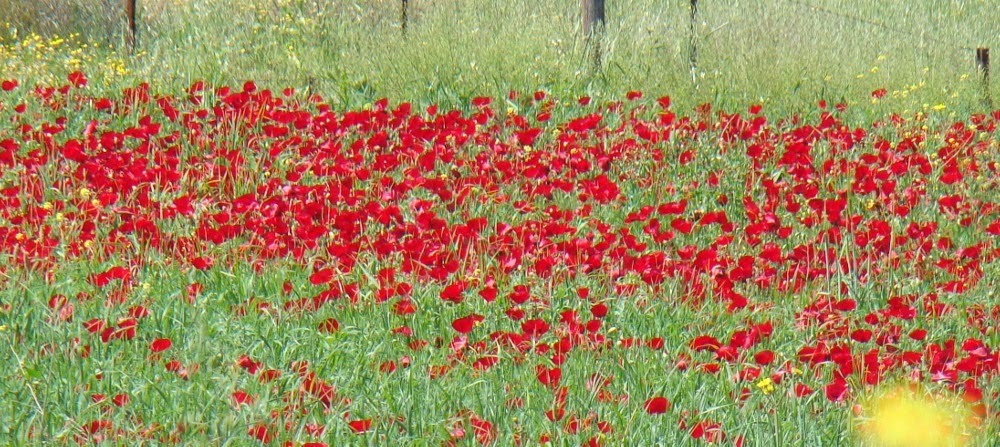
The color of the poppies changes as they age, or even as they move against the light.  We have little space in the yard, really, and I cannot help comparing my small patches with the fields  I saw last 16 April near Midea.


Some poppies photograph with more success than others.  We also have the lemon Icelandic poppies that appear individually in odd places, such as beside the posts of the arbor:


-->

or the so-called California poppies (not really poppies) that bunch in corners like piles of tangerines. 


The best picture, I think, is this that shows the extraordinary beauty, magnificent with spots like the great cats, of poppies that have been surprised by time.


-->

. . . there is yet faith
But the faith and the love and the hope are all in the waiting.
Wait without thought, for you are not ready for thought:
Wait  
-->
So the darkness shall be the light, and the stillness the dancing.
Whisper of running streams, and winter lightning.
The wild thyme unseen and the wild strawberry,
The laughter in the garden, echoed ecstasy . . .
From T. S. Eliot, Four Quartets:East Coker

21 July 2008

Late Afternoon

Late afteroon, cool breeze, warm sun. The lavender drying on the grape arbor scents the yard.

I had a heart attack scare last week and feel now perhaps as a butterfly just out of the chrysalis feels, new, not ready to fly. It turned out not to be the heart after all, but a confluence of several moderate problems that together produced astounding transforming pain. I now have various prescriptions, and the assurance this will not interfere with my plans for my life. 


But it is a good time for sitting under the arbor with the lavender, the lemon trees, the cats, the baby birds. The roses, except for the Abraham Darbys and the rugosas, are resting, though Pat Austin and Just Joey are covered with buds, St. Cecilia has a few, and Winchester has begun to bud. The little Tradescants that bullied everyone else up in the main bed have been quite subdued since they were moved beside the street. The old yellow rugosa has failed to bloom for the third year and will have to come out. The
rosa mulligani from Greg, now in its fourth summer, abruptly exploded the first of the month, having climbed six feet in the last year. Until I moved to Seattle in 2003, I had never gardened, and when Pierre gave me a Sally Holmes as a present for my first birthday here, I was bemused. Then Rosalind and Greg gave me more.


After a lifetime of anxiety and anxieties, attention to the roses, and learning their individual idiosyncrasies, has brought me finally to content.