04 February 2009

Pavane for a Dead Princess: Part Two

The story of Kleope Malatesta and Theodoros II Palaiologos has already been told here, a version of it with what the research had shown up to that point. It used a borrowed portrait to represent Kleope. The child here is Theodoros, painted when he was about six years old, in a formal family portrait. It is the only picture that has survived of him, but he tells us below that there was another, of him and Kleope together, at Mistra. It has been ravaged, as was so much else there, by time.

Kleope
died on April 18,1433, the Saturday after Easter, following a long illness. They had been married just over twelve years. She was buried in the church of Agia Sophia just up the hill from the palace at Mistra.

There is a poem in the Bessarion manuscripts in the Marciana in Venice long thought to be a poem by him on the tomb of Kleope. This only shows that no one has ever paid any attention to the poem at all, and that the fact that it is in Bessarion's handwriting was considered by scholars who should know better an adequate reason to consider him the author. But it is impossible to read the poem and not think that it comes from her grieving husband.

It is a striking poem, if only because the Byzantines almost never wrote romantic personal poems, and this one is to a woman in heaven who is guiding the writer on earth, a woman whose body the writer knows. The poem is written on the Italian model--Dante's Beatrice, Petrarch's Laura are easy associations, and there is that famous poem by Petrarch supposedly written to be put into Laura's tomb, as this one surely was put into Kleope's.

Kleope's father was a well-known poet, Malatesta dei Sonetti, and his father had been a friend of Petrarch. Everyone in her family wrote poetry: it was what humanists did. Beyond that, this poem suggests that this Byzantine prince, known for his qualities as the quintessential geek, had been reading and writing poetry with his Italian wife. It suggests that the marriage reported to have been miserable had in reality developed into a union of intellect and body.

Theodoros had been reading Theocritus--she knew Greek as well, and the ending of the first section of his poem with its reflection that the one thing left for consolation in his heartbreak is song alludes to the opening of Theocritus' poem on Polyphemus, which is framed by a teasing remark to a physician that some diseases are beyond the healing power of medicine and for them the only remedy is the effort of composing poetry. (And one of the eulogies for Kleope had mentioned the failure of medicine, and her doctor had himself written a lament.)

Theodoros was a mathematician, and this poem makes quiet reference to that with its structure based on the number five, thinking of the five senses, identifying five ways he and Kleope could be together. Possibly he set out to write one example for each sense, but then after Touch, Hearing, and Sight, found himself unable to match the final ways and senses.

He gives us one other valuable piece of information: he tells us that her tomb is marked by a dual portrait. There are other such portraits of husband and wife on Mistra tombs, and the image used to stand for Kleope is half of such a portrait--but it was found in a church other than the one where Kleope was buried.

Before this poem was buried with her, the monk Bessarion, who was the same age and a fellow-scholar, and who thought she was lovely, must have asked to be allowed to make a copy for himself.


Here is Theodoros' poem for Kleope:

Although we were before, my dearest, brought together
being one flesh, the word of God says
that it is better now to be with the spirit,
as you, in pure intelligence, look down from Heaven
on my life, my words, and all my thought,
as it is right that you should
while I am torn apart, ah, painfully,
calling out for you with scalding tears,
one thing is left for me, one good thing, song.

In this way, picturing you in this image,
I have added myself to the image,
wanting to join myself with you in a third way.
so as to quench the terrible fire of longing
and to empty out the agony from my soul.

But, you who have died and live, as you deserve, with God,
when in the same tomb necessity brings
my bones together with yours in a fourth way
showing me what lies outside the five senses
join with me in a fifth and greater way
to share in the delights of Heaven and the sight of God.
My courage lies with you, who possess and indeed
give me, my fellow-poet, this song.


A scholarly discussion of this poem, written with Pierre A. MacKay, will be appearing later this year.

The Greek poem and the other primary sources for the Theodoros and Cleofe story can be found here.

 The narrative is continued in

Pavane for a Dead Princess, III

Pavane for a Dead Princess, IV 
Pavane for a Dead Princess, V


Pavane for a Dead Princess, VI

Glory Days

Theodoros II Palaiologos 
Malatesta "dei Sonetti" Malatesti
 

29 January 2009

Ag. Anastasios of Nauplion

This is the olive tree from which Anastasios was hanged. That is the story that was told in the little book sold in the church next to the tree, and the story I was told by people in town thirty years ago. The story has become quite elaborated since then, but I am going with tradition. Besides, you can still see nails in the tree that had something to do with something, so it might as well be the hanging.

The most interesting thing about this Anastasios who was born and bred here, and who died in Nauplion on the first day of February in l655, is the almost total absence of information about him. Perhaps the fragility of his claim to sainthood is intuited, for in the selection of icons, the faithful have chosen to remember him as a rather near‑sighted, tender young man: a young man with an overpowering sort of mother who raised him so that she would have a son on whose sensitivity other mothers would compliment her, and so a son who inevitably chose disastrously when he came to fall in love.

Anastasios is said to have been a painter, although it is not remembered whether he painted icons or frescos or the sentimental wreaths and flowers which wealthier Turks and Greeks were pleased to have painted on their ceilings. During his short life, before and after, Nauplion was known as a center of icon and fresco painting, even though under Moslem rule which, characteristically, managed to be both extremely legalistic and extremely indulgent.

Anastasios fell in love with a Moslem girl. Local tradition says that she and her mother, witches both, had cast a spell on him. The girl might have been Greek: numerous Greeks found that conversion to Islam coincided with a lower tax rate.

Anastasios would not have been the first young person to confuse the surgings of immature sexuality with those of religious fervour, but however it happened, or under the influence of this spell, Anastasios abjured his Christianity, and announced his conversion to Islam by putting on the turban. The turban, by law either white or green, was restricted to Moslems: merely wearing a turban was accepted as evidence of his changed status. Two hundred years earlier, he would have gone before a Muslim priest, raised his right forefinger, and said, "There is no God but Allah, and Mohammed is his Prophet," the priest would have put a turban on him, and then there would have been general public celebration and a parade surrounding a circumcision ceremony. It is not known if Anastasios enjoyed this kind of attention, or if the Moslem community in Nauplion took special note of conversions.


Eventually he discovered that, in the gentle expression of a Nauplion guidebook, "she was not faultless in her morals," and he became insane. A variant of the legend says that the local authorities, seeing he was unwell, shipped him off to an island reserved for the insane. Either on the island or in Nauplion, he came, miraculously, to his senses, stripped off the turban, and ran about the streets shouting, "I am a Christian, I was a Christian, I will always be a Christian."

Whereupon he was seized by an outraged mob and lynched. It was, in fact, a capital crime for a Moslem to convert to Christianity, regardless of his spiritual heritage: accusation alone was adequate for execution, but it is to be hoped that he was passed through the proper judicial procedures before being executed by strangling. His body was left to hang in chains from the olive tree to encourage the others.

From shame at its role in the martyrdom, the olive tree refused to bear any more fruit. It must be admitted that this part of the legend does not hold up under examination, and this last fall there was a very large crop of olives. Anastasios, or what was left of him, was buried in the town cemetery, outside the town wall and across from the silted‑up moat, close to the present former train station.

Forty years later, around 1700, Nauplion had come under the brief and uncomfortable period of Venetian rule during which the present Panagia was built. In Greece it has always been the custom to clear out graves every three years, or whenever space is needed. When the bones of Anastasios were dug up in their turn, it was noticed that they gave off the odor characteristic of saints and of sweet basil, and that, taken in connection with the circumstances of his death, made someone think them worth saving. They were put in a box in a corner of the new Venetian church and forgotten.

They remained forgotten for two hundred years. In the early part of the twentieth century, Nauplion was suffering a cholera epidemic, and all hope had been abandoned. When it seemed as if the city might perish within its crumbling walls, a priest remembered something about old bones, and suggested that there would be no harm in trying them. There was a procession around the walls of the town, with priests and chanting and incense, and the bones, and of course, the cholera vanished. This is true: I had it from the nephew of a man who saw the whole thing.

Ever since that time, Anastasios has been regarded as one of the New Martyrs, a term which refers to Orthodox saints of Turkish production. His Feastday is observed on the anniversary of his martyrdom, February l, and that day is the high point of the whole Nauplion year.

Or it was thirty years ago. This is what happened in 1979:

Two days before, the streets around Panagia were cleared of cars and swept, the neighboring buildings and the Hotel Otto hung with Greek flags and blue and white bunting. The day before, an old man from the country arrived with a donkey and a mule laden with laurel branches, or oleander, which he strewed on the streets and the little Plateia Anastasiou before the shrine. On the Eve of the Feastday, the Liturgy of Agios Anastasios was celebrated: four or five visiting bishops were enthroned on a dais, looking for all the world like Amahl's night visitors; the seats in the church were filled with the town officials and their wives, and all the fur coats owned in Nauplion.

The Feastday itself began at seven in the morning with the firemen's band marching through the streets of the old town making a splendid racket. Troops from the local army base ‑‑ inductees served their first three months in Nauplion ‑‑ were trucked in much too early and shouted into lines outside Panagia by a small man with the chest of a pouter pigeon who stomped up and down. When the service in Panagia finished, huge baskets of bread blessed in the service were distributed to the gathering crowd. Each piece had been wrapped in pastel‑coloured paper so the impression was of enormous baskets of angular Easter eggs. Several gypsy girls with identically-withered hands pushed through the crowd, asking for money in a peculiar droning whine, "Drachmi, se parakalo, drachmi." Miraculously, the hands always healed at the touch of a coin. All the balconies around the Panagia and plateia were jammed. The procession began to form.

Altar boys in peach brocade carried poles with hanging lamps which no one remembered to light; no one had remembered to light them the year before, either. The local clergy wore brocades and samites: combinations of green and gold, blue and pink, red and gold, blue and gold, white and gold, blue and red and gold; gold with towering black hats. The Bishops of Nauplion and Argos and Corinth and Patras, and the Metropolitan from Athens, head of the Orthodox Church in Greece, all with jewelled dragon‑headed staves, and jewelled onion‑dome crowns, grouped together, each offering precedence to the others.

The Fire Department, wearing shining helmets and white gloves, carried out the great gilded icon of Agios Anastasios, a sort of Ark of the Covenant, supported on poles; the four most senior priests held ribbons that trail from the upper corners of the icon which provided a Maypole effect. A monk followed behind the icon bearing against his breast a silver reliquary with all that was mortal of the little painter. The chanters followed, just ahead of the firemen's band. There was a military unit with Sam Brown belts and shining helmets and the newest in American bazookas, then several groups of soldiers with distinctive sets of weapons, and the army band. The army band played something quite different from the firemen's band, and all proceeded from the Panagia to the waterfront.

The bells rang from Panagia's Venetian tower where half a dozen small boys had been slugging each other for the past hour to work out who should have the honor of ringing. The ships in harbour blew their whistles; both bands played different tunes as loudly as possible; bells from all the other churches in town pealed out; the bells in the clock tower on the hill joined in; all was magnificent cacophony, and obviously the little painter was quite a saint indeed to have generated such a gloriously satisfying moment.

The procession curved along the waterfront, turned right past the high school ‑‑ following the city walls of 1481 which stood until the 1930s ‑‑ turned right again to follow the main street up to the central square with the bank and the museum. The main street was one person narrower than the official procession: the banners waved and ducked to avoid the balconies. Looking headlong into the procession from the vantage of the square, there was a fore‑shortened jumble of hundreds of flag‑draped balconies where people stood with lighted candles and bowed heads, of waving flags and poles and banners and swaying crosses and icons and jiggling bayonets, and the glorous din of chanting and bells and brass reverberating in the narrow street.


At the square, the procession paused for prayers, and for the girls' choir; the Bishop of Nauplion in turquoise satin delivered a homily. Going back to the Panagia, the procession deteriorated completely, snaking around the museum to end up at the shrine of Agios Anastasios for closing prayers, and an abrupt dissolution of the crowd. The little plateia that had been so jubiliant an hour before was nearly empty, strewn with trampled laurel and field flowers, and a thousand pastel‑coloured wrappers drifting in the breeze under the olive tree.

24 January 2009

Girl with a Pearl Earring

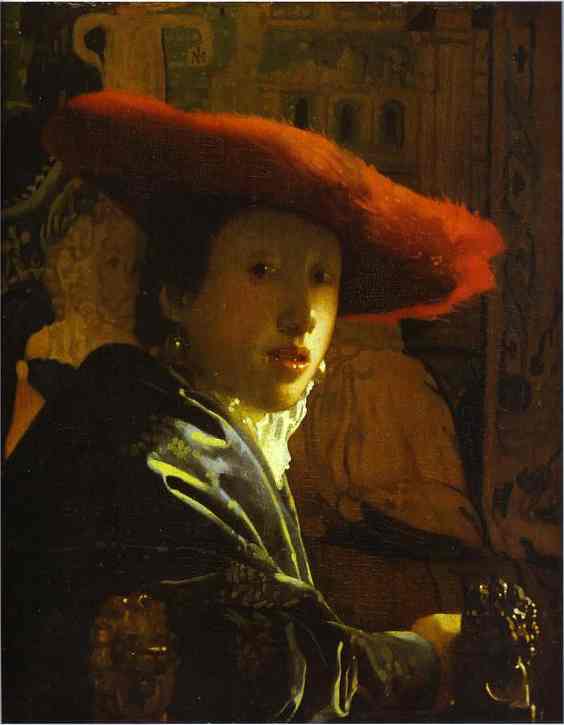
This may be the loveliest picture in the world. Not the greatest, for which Count Orgaz is my current candidate, and Vermeer has a greater portrait with the Red Hat, but this tender girl is surely the loveliest.

When people talk about this painting, they immediately use the word "luminescent," mention how perfectly the pearl is painted, and go on to how the girl herself looks like a pearl. But that is how Vermeer painted. He is incapable of painting without luminescence and all his women look like pearls. The luminescent quality of his paintings is simply what you see when the Dutch air holds the sun in its fine mist.

We know the gold jacket and the earrings. They or others very like have served Vermeer well in other paintings. Here, the jacket calls attention to the slightness of the girl's body. It is a woman's jacket and this girl's breasts have barely begun to develop.

Unlike Vermeer's usual meticulous reportage of linen coifs and hair ribbons and braids and hats, this headdress is a fantasy--the blue wrap, the blue and gold scarf, that signal that this is not the world you think you know.

Unlike nearly every other face from the centuries before and after, and unlike every other Vermeer, this one has no background to give a sense of that world. The girl is backed by a dark panel, so dark as to be almost black, cut off from any recognizeable world, blocked from retreat, and from that she turns into this present world, almost shocking in her vulnerability.

You need to see the painting itself to understand it, that is, if you can find a place to stand in the midst of the tour groups and all the people who have to wear earphones to hear the portable lectures. The clue to this painting is in the mouth. Reproductions give an impression of a pink smudge. What you see in the original is that this girl has just been kissed, kissed long and firmly, so that her mouth is slightly swollen and blurred in definition. Vermeer has painted her in the instant after the kiss before she has had time to move her lips or blink her eyes.

The girl with her luminous skin and her pearl earring is on the verge of discovering desire. She is beginning to soften and open, and she has not quite assimilated what is happening in her body and her imagination. Look again at the nearly absent breasts--she is very young, she is in the thrall of the kiss, and there is no going back from the previous moment.


The viewer is in the position of the person who has just lifted his head and stepped back. The viewer stands in the same relationship to her as with Antonello da Messina's Virgin, and there the viewer is supposed to say "Fear not!" Perhaps the person who has just moved back is about to tell her the same thing. Perhaps this luminescent girl should be afraid. It is difficult to think about the picture independently if you have read the novel or seen the movie, but the story they relate is plausible, and even so, any girl of 1665 could only look into her future with reasonable fears.

The viewer is at risk of falling in love with the tenderness of her face. But then the girl with uncombed hair and brown anorak sitting in the row ahead on the Amsterdam train turns around for a moment and you see that the girl with the pearl earring does not have such an unusual face after all. This painting is not about a face: it is not a portrait. It is about a young girl overwhelmed by feeling, a young girl in the fraction of an instant before her future happens.

[For another young woman in a painting, go here.]

15 January 2009

Byron under Glass

Ioannis Gennadios, who referred to Cyriaco of Ancona as a looter, may have known what he was talking about.

In the reading room of his library in Athens -- splendid columns, dark red portico -- where the books are under glass, a large exhibition cabinet holds Byron memorabilia under glass.

More Byron memorabilia is under glass in the National Historical Museum, in an exhibition space that looks remarkably like a chapel, centered as it is on a table surrounded by icons of Byron. That space holds, among other things, Byron's travelling trunk that unfolded to make a bed, his helmet, and three portraits: beautiful in adolescence, romantic as a poet, bloated in his maturity.

Byron is a national hero of Greece and every town has a street and a hotel named for him, something like you will find for Lord Alexander Fleming in Spain (think: bullfighting, gored bullfighters, infection, penicillin). Had Byron lived, they would have tried to make him king, but he died miserably of malaria and iatrogenic infection, soaked in sweat, his mouth saturated iwth bile.


So it is not completely unreasonable that Ioannis Gennadios -- or some other wealthy Greek interested in literature and history -- would have shown up on Wednesday, 18 August, 1880, at the Sotheby's auction of Byron memorabilia. This is what Gennadios bought for the coffin-case, according to the labels in it:
  • A matching set of a very small inlaid mahogany tea caddy and watch stand that belonged to Byron's half-sister Augusta Leigh.

  • A piece of deep blue silk exquisitely embroidered with flowers by Augusta Leigh.

  • A small black leather pocket folder and a small red leather-bound notebook, with her name and initials.

  • An Italian silk scarf of pale green and ivory with narrow deep red lines, given to Augusta by Byron.

  • A thick scrapbook of "portraits, pedigrees, biographical notes and autographs of Byron, and a small collection of mememtos inluding a lock of his hair."

  • A miniature portrait of Theresa Makri copied in 1834 by Bate from the 1812 Allason portrait.

  • A piece of a dreadful plaid of green, black, and whitem from one of Byron's jackets.

  • His rosewood holder for playing cards.

  • A cameo portrait of Byron.

  • His marvellous small gold and blue enamel pocket watch.

  • Four seals -- two shaped like hands; one ivory, one amethyst, one mother-of-pearl -- with various romantic mottos of the period.

  • Two examples of the Byron arms marked out on canvas for embroidering.

  • A homemade drawing case -- cardboard laced together with green ribbon, with a cover picture of plums and leaves and a worm pasted on -- with watercolors by Byron's daughter Ada and her friends, from 1826-27.

  • And finally, a heart-breakingly fragile, dried wreath of bay leaves and flowers sent by the people of Mesolonghi that was laid on Byron's coffin.

So it is difficult to know what to think about defining looting, but I know that if given the choice between free and full possession of either the Elgin Marbles or Byron's memorabilia, I would take Byron.


Here in this detail from a famous bad historical painting, a much too-young Byron is shown arriving at Mesolonghi, being welcomed by the beleagured defenders Notice how his travelling cloak has been disposed to give the impression of classical Greek dress.

08 January 2009

Lady 'Reen, the Little Bird, and the Pirate


The Skleroi's lovely lady 'Reen and Doukas' Areti,

and Goldilocks, three fairest maids ever in Napoli,
went out one day to take a walk, they went to take a bath.

Katsi Rini, was the name mother Skleraina used,
her father said, "My 'Rini, go. I worry for your care.
To help us all, I have a plan, I'll set up lookouts three.
The first I'll put uo on the mount, the second by the sea,
the third and best I'll place below to guard the gate for thee."


And so the story moves along and so the crisis breaks:
the tower on the mountain cries, "A sail, there comes a sail,
it cuts the white foam on the waves, it nears the platan tree!"


The tower on the sea cries out, "And now two fustas sail,
they've set their prows right toward the baths, they come onto our shore."
The tower cried, the third and best, "O maidens, be aware!"


Areti she changed her steps and 'Rini turned around,
and Goldilocks threw down her bag, and ran back into town.
some crawled in the window, and some dashed in the gate,
the darling of the Skleroi froze and waited for her fate.


The Turkish youth, he swept her up, clad in her golden hair,
he fiercely seized her fair white hand, he took her to his ship,
he kissed her mouth amidst her cries, he wrapped her in his arms.


The bird flew fast and sat him down, he perched high on the mast,
it did not call out like a bird or twitter like a swallow,
it only cried and spoke aloud, it cried out like a child.


What dreadful thing, Skleraina dear, you suffer, on this day
with dearest 'Rini, best-belov'd, your sweetly-perfumed child,
where goes the brother, there, you see, the sister 'Rini goes.


It's not a crime, it's not a shame, it's not a route to hell
if brother hold his sister close pressed up against his chest,
but like a bride he kisses her, he sees her like a man.


"Hark, hark, o hark, Turkopoulo, what does the small bird say?
It's just a bird and yet it cries, a bird and still it speaks!
I say to you, Turkopoulo, who are you, what's your name?
I had a brother long ago, he loved to travel far,
some told us once that he had died, some told us he had drowned,
some told us he became a Turk in places hot with sand."


"Tell me, o tell me, maiden mine, how does your lineage run?
"What can it matter now to you how does my lineage run?
since now it brings anathema, it brings the hurricane."


"Tell me, o tell me, lovely girl, your birth and your descent?"
"My father is from Napoli, my mother from Corinth,
The name Skleros is known by all, they call me Lady 'Reen."


"My sister, hold me out your purse, and hold me out your shoe."
The purse he filled with florins gold, her shoe he filled with coins,"
"Go, 'Rini, you go home at once, go find our family dear,
and I will follow close behind to see how you will wed."


She kissed him like a brother dear, again she pressed his brow,
he kissed her like a sister dear, and then she took her bath.


***************************

This old folksong was collected in Nauplion in the 19th century. There is no way the geography of Nauplion can be reconciled to the narrative. The jogging translation fairly reflects the jogging of the Greek. The theme of brother-sister incest appears frequently in narratives of the Ottoman and post-Ottoman period, reflecting anxieties raised by the Ottoman child tax (which was never in effect in Nauplion). The little bird is a persistent inhabitant of Greek folktales and songs. The names Skleros and Doukas are known from the Byzantine period.

01 January 2009

Along with the Bishop and Huntsmen . . .

A recent blog mentions a book by diplomat and bibliophile Ioannis Gennadios on the looting of Greek antiquities, which he apparently identified as starting with Cyriaco of Ancona in 1440. (How did he ever miss the Romans?)

Now I sit in Gennadios' library and it is a pleasing place, but Gennadios is unjust, and to use a word like 'looting' surely indicates nationalist assumptions rather than information about what Cyriaco himself recorded.
Earlier notes
here tried to indicate the richness of Cyriaco's personality.


This is what Cyriaco felt about taking things, recounting a visit to Cyzicus:

But alas! How unsightly a structure we returned to, compared to the one we inspected fourteen years ago! For then we saw thirty- one surviving columns standing erect, whereas now I find that [only] twenty-nine columns remain, some shorn of their architraves. . . . ruined and dashed to the ground, evidently by the barbarians.

He did something about it: he visited the Ottoman governor of the area, who was a Greek, and talked with him about the need to preserve such treasures. The governor promised to help.


Cyriaco loved antiquities, and everywhere he went, he copied inscriptions -- it is only because of him that we have information about hundreds of Greek inscriptions now missing, drew carvings and buildings -- the drawings here are of three grave markers and a statue of Dionysios he saw in Nauplion, now missing. His drawings of antiquities at
Merbaka allow us to compare what he saw with what survives, though the large panel is missing -- might a cleric, or a Turk, have thought a carving of an undressed couple on a bed unsuitable for public viewing, even if they were accompanied by the family, the horse, and the snake?

I cannot find, rereading what survives of Cyriaco's diaries and letters, anything that might be considered looting, although he did buy a secular manuscript on Mount Athos. This is what he did in the libraries on Athos:
. . . we examined . . . we took pains to copy . . . he showed me numerous books . . . I purchased this splendid volume from him . . . I picked out a selection of books and noted down the incipits . . .
That is the way he travelled, always finding local Greeks and resident Italians who cared about antiquities, and making notes:
  • "we did take care to record here the most important inscriptions"
  • "I investigated more closely"
  • "we also observed"
  • "guided by [the sailor] we first looked at the ancient walls"
  • "we observed numerous sculptured dancing nymphs"
  • [at Ainos] "these princes and distinguished men . . . expertly showed me all of the city's important sites"
  • "I made sure to record here"
  • "we saw . . a number of marble sarcophagi at the port that had been demolished and thrown together . . . to serve as a mole"
  • "we viewed the ancient walls of the city"

Travelling in Imbros with the historian-to-be Michael Kritoboulos, the two of them composed an inscription and had it carved in Attic letters and set at the main gate of the new citadel that the governor had constructed out of older stones.

He made his notes and explored with joy. Read, finally, this description of his searches on Crete:

13 July 1445. . . . we settled down in the bishop's country house near Miscea, at the foot of White Mountain . . . we saw on the banks and reverenced another small, old church of the Blessed Virgin enclosed by trees laden with fruit. But, to see what we came to see . . . those famous mountain-cypress trees -- and to inspect certain antique remnants of towns that I had heard still exist . . . on the next day, Jove's lucky day, along with his excellency the bishop and accompanied by a number of rustics and huntsmen from the neighborhood, we climbed through rocky, steep hills to the White Mountains themselves. There we first inspected the towered, scattered walls of a certain very old town . . . There the bishop chose to linger, to study the walls, which were composed of huge stones, and to render to God due glory; whereas I, accompanied by a local, Basil, climbed to higher, wooded summits of the mountains, steep, unfamiliar trail, my feet clad in sandals of Hyrcanian hide; and, under the personal guidance of our wing-footed Mercury, we saw at last the object of our quest, numerous cypresses, tall, fragrant conifers menacing the sky with their foliage, ever green, the distinguished glory of the forests . . . But first I made sure to record here a fine, intact marble statue base that I found in a garden near the sea.


Church of Merbaka which Cyriaco visited.

Review
of the best Cyriaco book yet, by E. Bodnar, S.J.

23 December 2008

Crowning


What is wanted here is silence.

That the young woman is pregnant is suggested by her unlaced gown, shorter in front than in back. Her labor has begun, and her right hand both indicates her pregnancy and feels the movement of the contraction, while her other hand presses into her back to relieve the discomfort. She has moved deep within herself into silence.

The angels, mirror images, their colors inverted, are closing the tent to give her privacy. Inevitably these angels are described as pulling back the curtains to reveal her: this would be the convention, and innumerable putti pull back draperies to uncover lovers or other important events. But Piero is never conventional when he follows conventions, and an understanding of the young woman's posture and the way in which they shield her with their wings makes it clear that they are protecting her, giving her privacy.

This tent, though is even less conventional.

Exodus 25-26-27 describes the making of the tent of the Ark of the Covenant. Piero gives us an imperial tent of his day and here the red-dyed rams' skins and the gold of Exodus have become heavy red brocade woven with gold roses. Where Exodus constructs the tent of skins, Piero lines the young woman's enclosure with fur. The King James Version reads the skins as badger skins, but the word may actually refer to sealskins (there were and are seals in the eastern Mediterranean), and Piero's furs have that softness. So this young woman standing in the Tent of the Ark, flanked by two angels as was the Ark, becomes herself the Ark and the Covenant will be present among us this winter night in the protective quiet and warmth of the enclosing fur.

The first chapter of the Gospel of John, which nearly every church will read tonight at midnight or tomorrow morning, says, "And the Word became Flesh and pitched his tent -- ἐσκήνωσεν --
among us." Translators make that say that he lived, or dwelled with us. But John meant what he wrote: the tent of the Ark of the Covenant was pitched in our midst, and he created in words this image that Piero has translated into fresco.

Piero always paints silence, whatever the images, the silence between notes, and the silence of this young woman about to give birth brings to mind a poem that ends:

She's crowning, someone says,
but there's no one royal here.
just me quite barefoot
greeting my barefoot child.


The poem is by Linda Pastan, from A Perfect Circle of Sun.
A larger version of the painting.

17 December 2008

ΜΗΝΙΝ. ΑΕΙΔΕ.


FURY.

Athens' students have learned well the lesson of the eighteenth division of the first book of what it means to be Greek.

. . . so from the head of Achilleus the blaze shot into the bright air.
He went from the wall and stood by the ditch . . .
There he stood, and shouted, and from her place Pallas Athene
gave cry, and drove an endless terror . . .
As loud as comes the voice that is screamed out by a trumpeter,
by murderous attackers who beleaguer a city.
Humiliation leads to fury. Fury leads to destuction that is anything but mindless. These minds were concentrated on destruction.

Whatever else was involved in making this crisis -- there are many factors, and this is a very partial and prejudiced account -- the students have been humiliated: humiliated by the thinness of authoritarian education in shabby classrooms; humiliated by undereducated and underpaid teachers; humiliated by a culture that will only have employment at graduation for half of them, most of that employment at minimal rates outside the area of their discipline; humilated by the loss of the future.
Despair has been fed by anarchists supplied with drug money, by frustration exploited by political extremists -- extremists are alien to irony, but reflect, will you, that Socrates was executed on a charge of corrupting the young.

Those first nights, koukouloforoi
-- "the hooded ones" -- whirled through the streets bringing terror, raging against the long-legged buildings like the flames whirling about the mannequins in the image here, smashing into plate glass with steel bars and hammers, throwing Molotov cocktails into shops and at the underpaid, undertrained, underequipped police whose job it is to get themselves abused to make the government look as if something is being done. But the koukouloforoi seek terror and destruction, not social justice, and the name recalls the nightriders of the Klan whom my mother saw riding with torches when she was a child.
Homer's warriors hurled stones (such as no man now could lift): the koukouloforoi, fuelled by adrenalin, testosterone, and the joy of destruction, smash sidewalks and pavements to get missles to hurl at the police or through the windows of shops. Blazes shot into the air from Achilleus, the green blaze of lazer pointers shoots from the koukouloforoi.

My generation learned of Molotov cocktails from the Hungarian students in 1956 who stood against Russian tanks, and the flames in Budapest came from torches made by the spontaneous lighting of newspapers that first evening when there was still hope. Students standing against tanks takes us to Tianamen Square. The fury in Athens has the dignity of neither, but it, too, is a revolution. The Athenian press calls it polemos -- war.
History is wrenched from the pavement to shatter assumptions.
Achilleus raged with unimaginable fury and his fury created such destruction that nature recoiled from him. The river vomited up his his destruction and the gods cried out: Achilleus has destroyed pity!


SING.

Saturday when the city was almost quiet, I was walking in a part of Athens new to me and glanced up absent-mindedly to see the soaring north side of the Acropolis -- the Parthenon and the Erechtheum. They came to me like singing rather than sight, singing of order, singing out what this city knows of building and mindfulness.

Then the next day at St. Paul's Anglican Church, the surrounding pavements glittering with shards of glass and burned buildings not twenty feet away, we had a reading from Isaiah:

. . . instead of ashes . . . They shall build up the ancient ruins, they shall raise up the former devastations; they shall repair the ruined cities, the devastations of many generations.

11 December 2008

The Miracles of Ag. Demetrios-Karakalas

Nuns from an icon since the nuns of Ag. Demetrios Karakalas are not to be photographed, although the nuns of Ag. Demetrios Karakalas could never show the grimness on these faces.
One of our visits was on the twenty-sixth of October, the Feastday of the saint,
and the road was clogged with pick-up trucks and small cars and ery small donkeys. The crowd had clotted at the convent gates, waiting to pass the gauntlet of gypsies, beggars, and pretty girls who sold lottery and admission tickets. Inside the gate we were snatched by Sister Akakia who rushed us into the parlour calling ahead to the others that we had returned and calling back to us that she wanted us to see their miracle.
On each visit the nuns told us stories of miracles, in the matter-of-fact way in which children discuss Christmas presents: one feels a certain confidence in their reports. On this visit they introduced us to a woman who had experienced a miracle in the convent three years earlier. She was a thin woman with large tranquil eyes, though pain had clawed deep lines in her face. She told her story.
For some years, she had been depressed, finally, to the point of anorexia and aphasia. Her family was in despair. They brought her to the convent for help, and their whole village came with them. At night they came to the chapel with its great double doors, a dark sweet church smelling of incense and lemon oil and fresh flowers and bread, and they knelt and prayed together all night long.
In the night, Agios Demetrios rode into the church on his red horse, and pointed his spear at her and said, "Speak."
She said, "I can't speak."
He said again, "Speak."
She said, "I can't speak."
He said, "Speak."
She said, "I don't have anything to say." And then Panagia, the Mother Holy above All, came and put her arms around her and patted her, saying over and over again, "Everything will be all right."
She and her family and her village prayed in the chapel for three nights. Each night Agios Demetrios rode in and commanded her, "Speak," and each night Panagia came and held her and said, "Everything will be all right."
And everything was all right. She was able to speak, and at the convent she was helped to eat again. For the first year after that, she wore black; in part to honour the miracle, but also to bury the sickness, and because even in healing, a certain loss must be acknowledged.
The nuns were delighted with this miracle, but not boastful, for the roses were blooming exceptionally well for the end of October, and a child was playing in the courtyard who was expected to die. These women all assumed that miracles are reasonable happenings. They radiate good health, bodily and mentally, all of them moving not as women who have made sacrifices, but as women who are constantly receiving abundance.
On this feastday they went about their duties, embracing women and children, cooing over each little Demetrios or Demetria, or Mimis or Dimitri or Demetra or Dimitraki, the new crop of babies since last feast day, all fat and engulfed in hand-embroidered baby clothes and clouds of blankets. The sisters applauded other women's pregnancies, exclaimed over this year's new engagement and wedding rings, passed out plates of candied apricots, relayed messages, complimented each other, and carried stacks of handwoven and embroidered linens to the guest rooms which were crammed wall to wall with pallets for the pilgrims.

We had met other miracles there, such as Sister Paraskevi, thin and precise like the point of a librarian's pencil. She was, for a Greek, tall and thin; her triangular face barely visible under her wimple; a prominent nose and chin. She had a masculine walk and a masculine handclasp, meaning that she showed great self-possession, confidence, authority.


She described herself to us, on her arrival at the convent, as sickly, scrawny, mean, complaining, depressed, unloveable, and so nearsighted as to be nearly blind. She chose Paraskevi as her convent name, for the saint who has particular responsibility for eyes. She bathed her eyes regularly with water that had been poured over a miraculous icon of Agia Paraskevi, and wore a scapular with a piece of cotton soaked in the miraculous oil from the tomb of Agios Demetrios.
She had a nervous habit of doodling. Someone, she said "the convent," saw that what she did was good, and encouraged her to draw. She drew constantly, losing as she did so her tendency to whine and to feel poorly, and her eyes were not so weak. The convent bought her books on art and painting, reproductions to study, and she gradually trained herself as an icon painter. She became widely known; the convent had a long backlog of orders for her work from churches all over Greece.
Sister Akakia was another example of this particular intelligence in the convent. She had come to Ag. Demetrios Karakalas after living in Crete for twenty years as a weaver. In the first months she was depressed and lonely, and "the convent" asked what made her happy at home. When she spoke of weaving, they provided her with a loom and the necessary materials, and she delightedly taught Sister Christoforo and some of the others how to weave. All the hangings in the church and the convent were of their own weaving, as were the vestments of the priest of the Evangelistria in Nauplion. When he stood among the brocades and samites of the other clergy in a simple white cotton sprinkled with blue flowers, he had the appearance of the true prince among the false claimants.

The convent -- a monastery until the end of World War II -- has survived Venetians, Turks, Greeks, Albanians, Egyptians, and Germans, all of whom harassed and burned and killed. Toward the end of the eighteenth century, the monastery gave refuge to klefts from the mountains, and some said that the monks were themselves klefts. It was dynamited by the Germans under the assumption that it was sheltering andartes from ELAS in the sick bay; in the depredations of the Civil War, it was fired by Communists who claimed that it was aiding the Government troops, and fired by Government troops because it was hiding Communists. They were both right: the monks were never particular about the political views of the wounded.

04 December 2008

Bartolomeo Minio

This is not Bartolomeo Minio. Minio would never have given his attention to dressing this well, and he couldn't have afforded to. But he has Minio's resolution, isolation, and the deep marks of experience: he was Minio's contemporary, and represents him here.

There is a myth of Venice, often disparaged, and it has been fashionable in the last 20 years for historians to deconstruct one part or another of the myth. But Minio was the man the myth describes and he deserves honor. He is knowable, in the way that few men from 500+ years ago are knowable, because there survive 150 letters that he wrote,* in addition to many small references to him in Venetian government documents, comments in the Sanudo Diaries, and bits that can be inferred from other records..

Minio was born about 1428 and died in the summer of 1515. He should have died a number of other times for which records survive -- of malaria in Nauplion in August 1480, of dysentery in the Ferrara war in 1484, in a night battle at sea with pirates in June 1485, of pneumonia in Crete in 1501. He was a lonely man, tense, with neck cramps and migraines. He thought he followed a strict construction of his intructions, but you can watch him developing friendships and making decisions more out of concern for actual people.

The variety of his professional life reflects the expectations Venice had of its representatives in the stato da mar. He built the sea walls of Nauplion and the great tower of Famagusta. He developed warm relationships with a series of Ottoman governors and officials in the Morea, and after a stratioti revolt was able to commit Venice to an exceptional grant of amnesty that prevented an all-out revolt across the country. He kept having to deal with starvation -- in Nauplion, of the chronically unpaid soldiers stationed there, and of the city after a crop failure; in Crete he received the refugees from the capture of Methoni and Koroni by the Turks, and reported that there was no place for them but the streets, and no way of providing food. He had orders to obtain 40 falcons for the French fleet in the dead of winter, and to bury the headless body of an acquaintance executed for treason.

His first post immediately after his return from Nauplion in 1483 was provveditor over the stratioti taken from Greece for the Ferrara war. The stratioti had been so shocked at the violence and slaughter in their first Italian encounter (which was with Federigo, Montefeltro, Duke of Urbino) -- guerilla fighters had been sent in opposite a mounted charge in full armor -- that they refused to fight without a commander who knew what he was doing, "not one of those Italians." Minio was selected because he had dealt with the same men for nearly four years, and he was complimented for his success in managing them and for winning battles in the field.

The next year, 1484, he was elected captain to defend the galley convoy, muda, to Flanders and England, and this is a story worth following. On 3 August, the four galleys reached the Atlantic. They were attacked off Cape Vincent in the Bay of Biscay by seven armed ships flying the flag of Charles VIII of France, commanded by the corsair
Nicolò Griego ("Nick the Greek"). In the ensuing battle which lasted from the first hour of the day to the twentieth, 300 galioti oarsmen who were armed and expected to fight – were killed, as were most of the crossbowmen, and two of the patroni. Christopher Columbus was one of the pirates and a sensational description survives in a biography written by his son. Most of the galioti were killed. Minio and two of the investors were set on the coast of Portugal to make their way home. The pirates went away with the galleys and at least 200,000 ducats worth of goods for sale, and the potential of bankrupting half the merchants in Venice.**

He is the only one of some 500 Venetian governors in Greek territories before 1540 who was remembered by the Greeks. He wrote once, in extreme unhappiness, about having to use forced labor at Nauplion working on the walls -- it was a hardship for "these poor people," but, he said, he worked with them in person. The Greeks remembered that, and a chronicle records:

At that time, the governor of the place, that is, the Venetian, with all the people of Nauplion, did all the building, and built the walls around, just as they appear today . . . and the governor of the place, the Venetian, gave benefits and many gifts . . .

Bartolomeo Minio is one of those people of whom Cavafy wrote:


Honor to those who in their lives
are committed and guard their Thermopylae.

Never stirring from duty;
just and upright in all their deeds,
but with pity and compassion too;
generous whenever they are rich, and when
they are poor, again a little generous,
again helping as much as they are able;
always speaking the truth,
but without rancor for those who lie.


* See Diana Gilliland Wright and John Melville-Jones: The Greek Correspondence of Bartolomeo Minio: Volume I, Dispacci from Nauplion (1479-1483),
UniPress, Padova, at 40.00 euro plus shipping, by e-mail from unipress2001@libero.it or fax 39.049.8752542.
** This story will be told in Volume II, Dispacci from Crete (1500-1502) which should be out next winter.