25 April 2011

On Vacation: Hoopoe


In this entry, the hoopoe with the lovely gawkiness of a young teenage girl: a 17th-century Turkish plate, the hoopoe that was my neighbor in Athens, and an early 15th-century drawing by Pisanello.


21 April 2011

Waiting for Easter

 Lenten Altar
Thompson Chapel, St. Mark's Episcopal Cathedral, Seattle  


Where do you live?

What do you want with us?  

Who is my neighbor?  

 Why does he speak this way?

Why does he eat with them?

What should we do?

Do you intend for us to feed all these people?

Don't you care that we are perishing?

Is it I?


* * * * * * 


Why have you gone on ahead of me?


15 April 2011

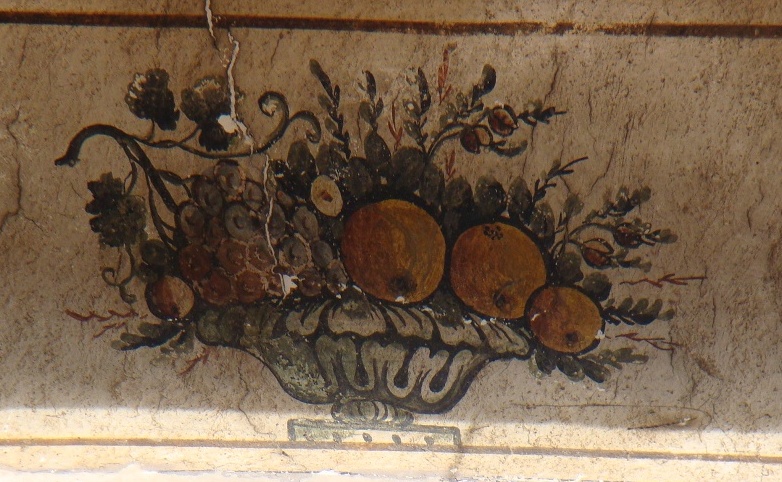
On Vacation: Eave Painting


From a house on Plapoutsas, the only surviving eave paintings from newly-independent Nauplion. I discussed one of the paintings here some time ago.  A few other houses continue the tradition of stencils, quite garish in contrast to these that evoke Roman fresco.   They all derive from Turkish styles of house decoration.  I hope the archaeological authorities of Nauplion will make some effort to stabilize and conserve these lovely paintings. 

Later: That was obviously wishful thinking. I am adding photographs made in November 2010 sent by Brigitte Eckert who has been responsible for the Bettina Schinas translation.  Mine were taken in early 2009.  Notice the amount of deterioration in less than two years, particularly at the corner.


08 April 2011

The Marathon Stone

There is no image for the Marathon stone because photography was forbidden on the occasion when we saw it, and we have not been able to find any photographs. When one becomes available, it will go here.  


Later: Amelia Brown, a classicist at the University of Queensland in Australia, has sent us an article from HOROS [17-21 (2004-2009) 679-692] by G. Steinhauer with these pictures of the stone.  (Go here for a color photograph of the stone.)
* * * * * *

Nearly two years ago, I wrote of a missing Acropolis marble and the Marathon stone. Recently, thanks to the Times Literary Supplement of March 18 (p10) we saw a partial English translation, indicating that the text of the inscription has been published.

This entry continues with Pierre MacKay as author:


The first two lines “Fame, as it reaches the furthest limits of the sunlit earth, / Shall learn the valour of these men: how they died” which turn out to be an immense improvement on the original publication, still involve translation of a line of Greek that could not possibly have been written even in the 7
th century AD, let alone the 5th century B.C.

We first saw the stone as members of a small group that was grudgingly permitted to make a hurried dash through a damp, poorly lit basement under the long-closed museum of the town of Astros, near the villa of the Athenian billionaire Herodes Atticus. Even rushed along, as we were, we could recognize from letter-forms, orthography and the rather odd format that this was part of an unpublished casualty list of the Athenians who fell at the battle of Marathon in 490 B.C.

From the research blog for the Center for Hellenic Studies, we have a citation in Supplementum Epigraphicum Graecum, the internationally acknowledged authority for discussions and new discoveries in Greek epigraphy LVI, #430.

The editors of SEG LVI, #430 have recorded, with understandable distaste, the Greek text as it was available to them, remarking that the excavator, G. T. Spyropoulos “has made minimal use of IG, no use of SEG, and his texts contain inaccuracies and faulty accents, which we do not repeat here.”

Ἐ          ρ          ε          χ          θ          ε          ΐ          [ς]
Φêμις ἄρ᾽ | hος κιχ[άν]<ει> αἰεὶ εὐφαõς hέσσχατα γαί[ες]
τõνδ᾽ ἀνδρõν ἀρετὲν πεύσεται hος ἔθανον
[μ]αρνάμενοι Μέδοισι καὶ ἐσστεφάνοσαν Ἀθένας
[π]αυρότεροι πολλõν δεχσάμενοι πόλεμον
Ἀντιφõν
Ἀφσέφες
Χσένον
Γλαυκιάδες
Τιμόχσενος
Θέογνις
Διόδορος
Εὐχσίας
Εὐφρονιάδες
Εὐκτέμον
Καλλίας
Ἀντίας
Τόλμις
Θοκυδίδες
Δῖος

Ἀμυνόμαχος
Λεπτίνες
Αἰσχραῖος
Πέρον
Φαο[δ]ρίας
[- - - - - - - -]

Two stone fragments have bits of names:
Ι
ΑΝ
ΡΙ
ΤΕ
ΦΑΓ
ΚΙ
Ο
Γ
ΘΙ
ΟΓ
Σ
Ε


A blog from Wabash College -- essential parallel reading for this post-- gives a translation:
Good report indeed, as it reaches always the furthest ends of
well-lit earth, will report the aretê of these men, how
they died fighting against Medes and crowned
Athens, a few having awaited the attack of many.
But it seems even better for Fame to learn from this monument, rather than to report it.

The blog by Nikolaos Papazarkadas (writing from the Center for Hellenic Studies) asks how “the alleged crux of L. 2 (first verse of the first hexameter)”:
                      Φε̃μις ἄρ᾽ | hος κιχ[άν]<ει> αἰεὶ εὐφαõς hέσσχατα γαί[ες]
can be solved. As it is, the line is clumsily restored, (presumably by Spyropoulos) with a quite unnecessary extra syllable <ει> inserted to spoil the meter, and another, the õς of εὐφαõς, lengthened so that it makes the situation even worse.

I hope regular readers will forgive a very short technical excursus here.

The Greek alphabet as used by Athenians in 490 B.C. did not contain an ETA or an OMEGA, and did not use accents. (When these Athenians wrote H, they meant the sound we mean by “h”.)

Athenians wrote E for both epsilon and eta, and O for both omicron and omega, and on inscriptions they wrote in all caps. It was up to the reader to know which sound was appropriate in context. Spyropoulos found two instances of O in this line and he got both of them wrong. He seems to have seen ( I do not have access to a photograph):

ΦΕΜΙΣ ΑΡ hΟΣ ΚΙΧ[. .] ΑΙΕΙ ΕΥΦΑΟΣ hΕΣΣΧΑΤΑ ΓΑΙ[. . ]
and to have decided, inexplicably, that the fragment of the verb, κιχ-, should be filled out as a present tense, κιχ[άν]〈ει〉. The generalizing (gnomic) aorist is far more likely in this context, and the line can quite easily be interpreted (I shall use post-403 B.C. Athenian conventions for the vowels, to make it clearer.)
ΦΗΜΙΣ ΑΡ hΩΣ ΚΙΧ[EN] ΑΙΕΙ ΕΥΦΑΟΣ hΕΣΣΧΑΤΑ ΓΑΙ[ΗΣ]
This produces a slightly different translation from the ones given above, in that it is Fame that is brilliant, rather than the ends of the earth.

Fame, ever brilliant as she seeks out the ends of the earth,
Shall learn the valour of these men: how they died
Fighting the Medes, and and placed a crown on Athens
A few, accepting battle against many.

εὔφαος, incidentally, is not found in the Thesaurus Linguae Graecae database, but it is a perfectly reasonable formation, and would agree with the feminine noun Φῆμις.

* * * * * * * * *

Of at least as much interest as these epigraphical quibbles, however, is the fact that the first general access to this extraordinary inscription is in translation, in a review in the Times Literary Supplement. It seems to have been around for several years. The editors of SEG speak well of an article, G. Steinhauer. Horos 17-21 (2004—09) 679-92, but I could not expect to see a copy of this in fewer than three weeks, so I cannot evaluate the reasons which may have led Steinhauer to stick with Spyropoulos’s present tense here, where the unaugmented gnomic aorist would seem very much preferable on all counts.

If we ask how the inscription got to the villa in the Peloponnesos, the answer is likely to be that it was taken there by a self-indulgent plutocrat whose wishes could not well be ignored. Until now, I had regarded the quaintly archaic accusation of “Aiming at Tyranny” that was more than once directed against Herodes Atticus as a sort of petty vendetta, but this fragment, effectively looted from Attica has led me to reconsider the charge. Herodes may have forced or bribed a subservient Athenian administration to permit the looting, but it was still looting, rather like Lord Elgin’s arrangement with the Ottoman authorities to take away marbles surrounding the Parthenon which were otherwise destined for the lime-kiln, or the repairs to the lower courses of the Acropolis wall.

There is some irony in the preservation of this fragment and the Elgin marbles because they were looted, but there is the difference that the Elgin marbles have been on public exhibit for more than a century, and there is no indication that this Marathon fragment, or its fellow artefacts, have been set free from their damp tomb. The Horos article cited above informs us that G. Spyropoulos uncovered this stone between 1980 and 2001.  We might recall, that when the German Archaeological Society discovered the glorious inscribed bronze Persian helmet from Marathon (ΑΘΕΝΑΙΟΙ ΜΕΔΟΝ ΛΑΒΟΝΤΕΣ) in the excavations at Olympia, they exhibited photographs of it in the very same year.

03 April 2011

The lovely mighty waves will carry her away

Bettina as a young woman
Bettina was engaged to her S -- Konstantinos Dimitrios Schinas -- for ten years before they were finally able to marry.  She traveled by carriage with her family from Munich to Ancona, where S met them for the wedding.  This first letter, from Bettina and her brother Franz, to their aunt Meline Brentano von Guaita, is in Franz's handwriting:
* * * * *
My dear and precious little aunt,

We reached the aim of our journey . . . maybe you don’t know about dear Bettina’s desolate incertitude, staying without news . . . but it showed her character so much the greater!

We did not leave Munich until September 27, travelling to Verona in 5 days, not without some fears for father which turned into as many hold-ups: here we found a pile of letters: Schinas, having passed the quarantine in Ancona, expected us with utmost impatience; Bettina in extreme excitement could not be delayed any longer: father needed a day of rest; so I alone accompanied mother and sister the very next morning to the destination of tearful happiness.

. . . For 10 years my sister has lived only for him and loves him till death! - more I cannot say! He knows it, he feels it,  yes, surely: he responds to it - God will judge if all of us there were right to give our blessings in glad sacrifice. Father arrived two days later and so we could rejoice in the happy ending, after more than once doubting it  and suffering many a anxiety.

 
October 9 at 11 in the morning we saw our sister at the altar! a beautiful bridal crown on her head! O, what a sight!  It’s the obsequies of vestal life, of the child in the fold of the family, but also of 9 years of consuming heartache. Now she has peace, happy satisfaction, the good girl! . . . She has dropped out of our family, yet a few days and the lovely mighty waves which are washing ashore at our house will carry her away, all the way! We too will be traveling home, our group will be smaller, it will be very boring at home! we have had her such a long time.

 
The Greek celebration was extremely beautiful; we had gathered calmly in the Greek consul’s Dorutti house, an excellent man who had prepared an altar in a pretty friendly room. I will never forget the sight of them both standing there in front of the altar holding hands and each a burning candle in the other one and on their heads each a wonderful crown according to Greek orthodox custom; a very beautiful veil, attached to the crowns, fell down behind them as a joint cover: so they stood united as the priest made the sign of the cross three times holding the rings to fronts and chests of them and spoke the blessings over the bonded names! We cried very much, but no bitter tears.

 
You would not believe how easily she moves into wedlock, like she has been born to it. The tender love of both of them is our full joy, and the fate that was meant for her and us could not come true more untroubled and perfect. . .

Yours devotedly, Franz


Corfu, Oct. 24th 1834
Bettina and Konstantinos Schinas to Mr. and Ms. von Savigny,
(hand of Bettina)

Right now Schinas comes telling me a boat will leave for Triest in half an hour. I am using this opportunity to inform you in a hurry that we happily arrived here yesterday evening 8 o’clock. A long and detailed letter will be dispatched from here via Otranto in a few days.

 
All the people on the boat except the sailors, Count Lunzi an me were awfully sick so we were engaged in nursing. I was in such a mood I wanted to laugh all the time about everything going on around me. Be glad with me I was keeping up so robustly. I also wasn’t afraid for one moment, not even in the night during a thunderstorm. Christiane (her maid) wanted to die at my feet. Schinas was lying on his couch, Stephano (family servant) under it, both sick.
(hand of Schinas)
The Austrian cargo boat is leaving today (to be specific at 12) but we slept late and finished our toilets only at 11 -- a real shame -- neither Bettina nor her lazy husband can write much. For today it is enough to tell that we arrived yesterday evening at 8 at Corfu after a rather happy passage, were received very kindly and caringly by Mr. Faber (Greek consul) and will leave Sunday at 5 in the morning for Patras with the English steamer which we fortunately found here.

 
Bettina attracted the admiration of all passengers because of her vivacity and for being almost the only person who did not get sick once.


 * * * * * *

Constantinos and Bettina Schinas made their home in Nauplion for several months.

29 March 2011

The Nauplion Petition

Detail from the Camoccio map of Nauplion,
showing the piers and the route up to Akro-Nauplion
(See Section 8 below)


The same day the Signoria answered the Argos petition, 26 July 1451, it answered a much longer petition from Nauplion. Nauplion had more money, and better grammar and spelling in its petition, but it, too, was also having a difficult time.

Venice acquired Nauplion and Argos in 1388, but then Theodoros I Palaiologos, the Despot of the Morea, occupied Argos. It took until 1394 to get him out without actually going to war. Argos had its own administration for three years, but after the Turkish invasion in 1397 (see Section 1 of the Argos petition) Argos was administered by Nauplion. In 1442, Argos was again given its own administration. You will see in the Nauplion petition how infuriating this was to them, the contempt they have for Argos, and how they have tried to get Argos back under control. You will also see how Argos has tried to fight back.

Again, this is my paraphrase of sections of the Venetian document.

* * * * *.


1. Your Signoria promised your subjects of Nauplion to observe their traditions, and the citizens consented to a tax from which you could collect a certain sum to pay the salaries of the podestà, the guard, and certain other positions, and the rest would go to repair the walls, and other needs, such as supplying the galley. Your Signoria has added the salaries of the rettor of Argos, the camerlengo, and castellan, and so the money that should be put into repair of the walls is spent on salaries. The city gate is in a dangerous condition and the walls of the suburb are crumbling. The port needs clearing, parts of the castle walls are earthen, and the rest near ruin. Your citizens are in danger because everything is open and anyone can go in and out at any time as they please. We are in the jaws of the wolf, by land and by sea. Your subjects and loyal citizens humbly supplicate and request that you will provide for the needs and necessities of this place. We ask you how the funds of this city can pay the aforementioned salaries since God knows the taxes that come in can in no way supply them.

Response: Since we desire the safety of the city and so the walls are repared, for the next 5 years the treasurer of Nauplion will retain from every salary 2 hyperpera out of every 10, and the fine from every judgement be paid to the treasury, and these used for construction and repair of the walls. We further desire that the podestà convoke the council and persuade them to contribute to the said work on their part.

2. Some of the rettori of Argos, and especially the one there now, against the will of Your Signoria and against custom, have taken new action harmful to your treasury. From ancient times to the present Nauplion and Argos were one place, joined, with one ruler, one treasury, one signoria, and the treasury always at Nauplion, but the present rettor wants to divide the territory between Nauplion and Argos, and have a treasury at Argos, and farm the taxes and do things never done with great prejudice to your treasury at Nauplion, and the rettor collects his salary from the treasury at Nauplion. We remind Your Excellency that Argos compared with Nauplion is a village and a warehouse, and no one lives there but people who work the land, all foreigners,* while Nauplion has good citizens, and has maintained its old traditions better than any other terra.

Your citizens and feudatories of Nauplion have their own land and collect their rents, and now the rettor of Argos will not let them collect, but insists that they must move from Nauplion and reside in Argos if they want to collect. There never was such injustice. We remind Your Signoria for the good and well-being of your place, so we can live openly, that it please you to direct the said rettor, and his successors, that there should be no such innovation but that things are to remain as they were; that the rettor does not collect his salary from Nauplion; and that he cannot make concession of or alienate or sell any land, but that it all should be handled in Nauplion as it was before; and that the administration of Argos should be under that of Nauplion as it was in times past.

Also, that the rettor of Argos cannot hold criminal proceedings without the consent and direction of the podestà of Nauplion, and that anyone who has a complaint should appeal to the administration of Nauplion, and in this way it will work to the honor of Your Signoria, otherwise manifest peril will follow one day when those of Nauplion are cut apart from those of Argos.

Response: 1. As of last June 27, we provided that the rettor of Argos may make no impediment to our taxes. 2. We write and direct the said rettor of Argos that he permit our feudatories to live in Nauplion and collect the rents they have in the territory of Argos. 3. We do not want to make innovations in criminal matters, but the liberty and authority of the rettor of Argos is to be preserved according to his commission.

3. We remind Your Signoria, for the good and well-being of your città, that because misser Despoto Greco [Demetrios Palaiologos] and his barons and subjects appropriated the territory of Santa Marina of Didymo, and castra, and other territories under the jurisdiction of Nauplion and Argos from the beginning, and also planted by the former treasurer, ser Giovanni Catello. This should come back under your jurisdiction and the treasury of Nauplion have the benefit. Also all the wheat and grain will be brought to Nauplion, so that we can give to your other places that have need.

4. We remind Your Signoria for the good and well-being of the Nauplion treasury that in the jurisdiction of Nauplion and Argos are a good number of Albanians who have taken an oath and have been subjects of Your Signoria for a long time with their families. They are forced into personal service and their crops taken by the zefali [κεφάλη, governor, Demetrios Lascaris Asan] of the Despot and the treasury loses the annual payment from them. We would remind Your Signoria that nothing has been done about misser Despot up to now, and because it is expensive to send a gentleman from Venice we would remind you that misser Priamo Contarini is provveditor and ambassador, and he could go to the Despot with great efficiency because he speaks Greek.**

Response: We will write the Despot Demetrios in appropriate manner that he should return the lands and castra, and that he should make no more attacks on our Albanian subjects.

5. Also, we remind Your Signoria for the good and well-being of your commune, that since the old men who knew the boundaries and fields of your commune are dead, a thousand conflicts have developed between Your Signoria and your feudatories. Please direct the podestà to make new descriptions and assignments so that everyone knows his own and the citizens of Venice have what is due them.

Response: With all consideration, we want the podestà and captain of Nauplion to correct the errors and to consign lands to the feudatories, keeping the records of all the lands in the Nauplion treasury.

6. We remind Your Signoria for the sake of good order, that traditionally when someone was banned from Nauplion for homicide he was banned from Argos, and when he was banned from Argos for homicide he was banned from Nauplion, but when the rettori came from Venice to Argos, this was not observed but if one committed homicide in Nauplion he went to Argos, and if in Argos he came to Nauplion. This is against honor, and it happens daily. Please direct that it be as before, so that one banned from Nauplion is also banned from Argos, and vice versa.

Response: It is our desire that a person banned from one place be banned from the other so that homicide and crime end.
. . .

8. We remind Your Signoria for the well-being of your subjects and also for the benefit of the treasury that the podestà here need firewood, and since there is no large gripparia here to send, so they have been sending the boats here. They unload at the port and the former administrators have demanded that the villeins here carry the wood on their mules to his residence, and then the gate is closed and they cannot go out to work. Considering that the administrators here are poorly paid, will Your Signoria assign 3 ducats a year from the treasury to transport the wood?

Response: We do not want to make any innovations: let the custom continue.

9. We inform Your Excellency for the well-being of your commune that in the territory of Nauplion, Thermissi has such remarkable salt wells that the whole Levante can dig out a well of gold ("un pozo doro"). This is not guarded and the Albanians and subjects of the despotate come take the salt. One could say that the whole Morea is supplied without spending a soldo.*** In this way your treasury suffers great damage. If Your Signoria sends an ambassador to the Despot and this matter is settled, your treasury would have great profit. We remind Your Signoria that ships go to Syria for salt and leave money there. It is more convenient to come from Candia for Nauplion salt, and the salt is better than that of Syria. This would be better and make a great profit, and benefit for your città.

Response: We are writing the Despot in the appropriate form and will let you know what happens.

10.When the Despot or his barons come to your territory, and the administration has to give them grain for their horses, and feed them, and they do the same thing at Argos, that is double the expense for your treasury, and makes a heavy tax on your poor subject who have to bear the expense. This is contrary to custom. We ask you to pay for the gifts.

Response: The Despot and his barons come rarely and the expense is minimal. We will not make any innovations.  

* * * * * *

* The 'foreigners' are primarily the Albanians, and some Greeks, from the Morea that Nauplion invited in to replace the huge number of Greeks taken away by the Turks.  

** Contarini's knowledge of Greek was extremely useful in handling the case of the Anonymous Naupliote.

*** A soldo was a very small coin.  A day laborer would earn perhaps 12-15 a day.

23 March 2011

The Argos Petition

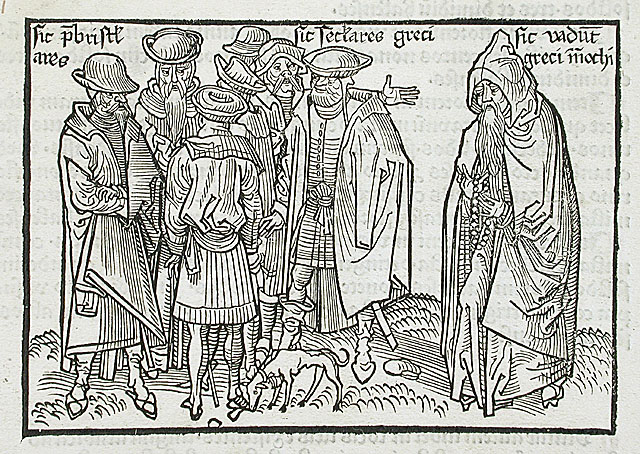
Greeks, by Erhard Reuwich, 1455-1490.
 
This picture has been overused in blogs, but there are 

so few contemporary pictures available.  These men are consulting
 
together, which is indirectly what this blog is about.


On 26 July 1451, the signoria of Venice responded to a petition from the citizens of Argos that had been sent to them in late 1449.  The signoria was not often swift to respond.  It is informative on many levels, but it particularly illustrates that the citizens of Argos -- which had a population of fewer than 500 -- were having a very difficult time of it.  Longtime readers of this blog will recognize the incident of Section 6.

I am giving here my paraphrase of parts of the petition.  I have tried to keep the tone of the language, but my spelling and grammar are much better.  Each section has the signoria's response to the issue.

* * * * *

1. The commune of Argos asks that you recall that the Turks took Argos in 1397, 3 June, and took 14,000 souls, and burned the land and the castle and left. Nauplion was much harmed by the Albanians who raided. Your Signoria wanted residents in Argos and directed Nauplion to announce that anyone who wanted to come their with their families would be free persons, and free from payment of any dacio.* Each would get 40 stremmata of public land and 4 stremmata of vines, and a burnt-out house. There were 18 families from the Morea who took this privilege, then 7 more families, and these increased to 115. The houses were rebuilt and the vineyards are growing. These privileges misser Piero da Canal, the chamberlain, recorded, as did misser Zorzi Corner, the chamberlain who was captured by the Turks. The records were sent to Venice to the Corner house. So we ask that you please direct the relatives to give back the records to the Signoria, because Nauplion will not allow us to copy the ones they have. Please do right and not wrong, because we have expended our labor and money on these properties.

Response: We direct the podestà of Nauplion to read this petition carefully and to have a copy of the land records made.

2. Also, we who have lands and have worked them have to pay one half of the produce to the lord of the land and the person who planted has the other half for the work and expense he has made. If he wants to give a dowry to his daughter or a gift to his son, or sell the land, he needs a paper. Please let us have our share according to tradition.

Response: We want to preserve custom, and the rettor of Argos is to make descriptions of all the said lands, so that we do nothing against custom.
. . . .

4. Also, a band of Albanians attacks the place and does robberies and murders at the fair, and they waste the fields and vines and rob the gardens. There are no armed men here except the men they call the Greek stratioti and the rettori have given 15 of them land and paid 2 gold ducats apiece for a man and his horse, for the good of the communità.

Response: We don’t want to make any changes about this, as they get the land for service.

5. When the Greek despots come through Argos, we have to give presents.** Would you please pay for them?

Response: This is a small expense and we want to continue the usual practice.

6.  About the Albanians who live in the territory: He [Demetrios Laskaris Asan of Mouchli] orders them about and says they are his, not the Signoria’s. The chief of the catuna has to pay from 1 to 3 ducats a hearth, and if he does not pay immediately he is imprisoned. The Albanians want to be under Your Signoria, not under the Greeks. Asan came to trade at the fair of San Francesco at Kiveri. The Sunday of the fair we were going between Argos and Kiveri. He dashed past the toll post & we were seized and our horses taken. We were taken to Mouchli and imprisoned, and two people were executed. When the rettor of Argos sent a messenger to inquire he had the messenger’s horse taken. He also took the pigs of the brother of the Albanian he had in prison.***

Response: We are writing the Despot Demetrios in the usual form that he should see that similar incidents do not occur.

7. Every two years the rettor makes an announcement that anyone who holds land from the commune should show his papers, under penalty, and the landholders from Nauplion never come here to show theirs.

Response: We order the podestà of Nauplion that the landholders from Nauplion should immediately go to Argos with their papers so that they can be seen and the lands known.

8. Also, we ask that you will please send us 2000 ('duga migiara') arrows for defense, and since we are poor in cash we will pay you in grain.

Response: We will send 3000 arrows, and another 2000 from Crete, and you will give the storehouse in Nauplion grain for their value.

9. Also, we complain about misser Zan Contarini who was vice-rettor in Argos, when he assigned land he asked for cash gifts. We ask that the money please be returned.

Response: We want the rettor of Argos to diligently inform himself about the money acceppted by ser Giovanni Contarini for land concessions, and arrange that our loyal subjects have their money back.

* * * * *
* Dacio: annual payments to the lord for the house, and for each piece of land. 
** We don't know anything about presents for the despots, but when the Ottoman governors of the Morea visited Nauplion around 1480, Bartolomeo Minio's gifts usually included a silver cup, cloth, sugar, fresh fish, bread, and wine.  Most of these were given by landholders and merchants who had an interest in the prospective negotiations.
*** This is told more fully in Archons: Demetrios Laskaris Asan of Mouchli.

18 March 2011

Non-Invasive Archaeology

 The street where we live.
On occasion I follow the lead of Kostis Kourelis and Bill Caraher and engage in non-invasive archaeology in the neighborhood.  It is much nicer to be able to call it 'non-invasive archaeology' than 'prying.' It isn't very exciting, but how much of our lives is?  The mass of green at the very bottom of the picture, to the left of the street where we live (A marks our house), has been my latest project.  Face-to-face with that mass of green, you see a mess. 


 You see the stump of the tree that provided that mass of green.  It is a liminal space, this area: the boundary between the family neighborhood above, and ours across the street, and between both of us and an erratic street squalid with student rentals and fraternity back lots.  Three or four years ago, on a Saturday night a small black bear wandered up from the lake shore, somehow found itself two blocks down the street from us, strolled through the fraternity drinkers milling in the street, climbed across a couple of porches, and ended up at the bottom of the first photograph, where the forces of the law shot too many tranquilizers into it.


The corner, where the mass of green shows in the first picture, is where a hill was sliced away for the sake of the road grade -- this neighborhood was laid out and built between 1900 and the War to End All Wars. The  corner was terraced with large uncut stones which have since collapsed. In recent years tree-trunks and stumps have been intentionally positioned across the slope .

Up the sidewalk to the right -- always dark and damp, no matter the weather -- following the main tree-stuffed road to the left, is a long retaining wall, its construction varied according to the tastes of the builders of the houses above.


The houses have steps up from the sidewalk which are almost completely unused, as you can drive up and around the hill to get to them. Some have garages built into the side of the hill, a very common construction all over Seattle. Here you see the cut in the curb for a driveway whose garage was allowed to collapse.  The hole filled in over the years with rubble, fallen branches, and leaves.  An electric power pole was planted in the middle of the driveway.


At the time the neighborhood was laid out, an electrical relay station was built to the left of the driveway, and probably the garage belonged to it.  In mid-century, it was decommissioned  About ten years ago the little building was acquired by an architect for his studio.  He turned the relay station into an Art Deco whimsy using the most minimal gestures of color and shape, taking his lead from the three squares of bricks inlaid on edge at the time of the original construction.  


There was a fire in early January while we were in San Antonio.  Since last week, the debris has been cleaned up and the building rewired for electricity.


We are waiting for the next transformation.

13 March 2011

"the valor of our stratioti"

 Sketch of a Turk, Gentile Bellini, 1480.

A couple of years after Minio arranged for pardons for the stratioti who participated in the Kladas affair, Giovanni Dario was in Turkey representing the signoria of Venice at the court of Beyazid II. What happened at that point with the stratioti is best conveyed in Dario's own words:

 * * * * * *
 Yesterday a slave from the Porte arrived here unexpectedly who brought letters from the Most Illustrious Sultan . . . The third letter, which was addressed to me alone, contained complaints by the Ottoman governor of the Morea about the many excesses perpetrated in the Morea by many stratioti and other subjects of Your Excellency, both from Nauplion as well as from your other places in the Morea, and he sent me a good many papers in which are -- all annotated in order -- 56 offenses, including, among others, the insult and rebellion made in the Mani by Kladas and some of the stratioti from Nauplion in time past.

. . . at present there have returned to the territory of Your Excellency some of those banned for the aforementioned excesses -- that was the reason the former governor of the Morea . . . requested and constrained the magnificent messier Bartolomeo Minio . . . that he would pardon them and received them back into favor, because the said governor (who was the more offended and more powerful because of ending the great scandal) had done the same and our administrator was reluctant to consent, and did something that he should not according to our laws . . . This seems an incurable disease and a scandal between us.

* * * * * *
Then two days later Dario had a meeting with the Lords Pasha.  They informed Dario that they knew Venice was not at fault, but the administration of Nauplion and the citizens were sharing the stratioti loot, and had in their houses the robes, the turbans, and swords, and other possessions of the murdered Turks.  In the year since the end of Minio's term, all his restrictions and concern for law and peaceful relations with the Ottomans had been abandoned. The Ottoman governor had been ordered to 'cut to pieces' any Venetian stratioti found in the Morea, and not to accept anyone who was not a merchant or 'original citizen' of the country.  Dario told the Lords Pasha that Venice would have no problem with that. They told him that Piero Busichi was the commander of the thieves, and had become rich from the system.

Piero Busichi was well-known to the Signoria.  Piero was one of four Busichi who had to have special pardons for all their homicides so that they and their troops could be drafted for the Ferrara war.  He first appeared in Venetian records in 1473 when he was hired for 50 ducats a year and a robe worth 100, plus pay for his company of 25 stratioti.  When Ismail Pasha and Minio were trying to settle the Kladas revolt, he acted as go-between.  Then the next year, at the time of the Ferrara draft, he had led a rebellion against Minio for more pay.  He got it.  Five hundred and forty stratioti had enlisted under him for Ferrara and they were so successful that he was given a bonus of 8 ducats for each of them, in addition to the 12 he had already been given.  

As soon as Dario's letter reached Venice orders were given for the arrest of the Venetian governor of Nauplion and a replacement was sent.  Dario wrote again.   

 * * * * * *
There was recently brought to the Porte, in a cart, a timariot named Ciri Pasha, robbed and beaten by our stratioti just when he was leaving the Morea, as he said, and 100 ducats taken, and clothes and silk cloth, and other possessions, and the pashas ordered that he should be sent to my house immediately so I might see for myself the valor of our stratioti.   

I responded to those who brought him that I deeply regretted the occurrence, which I did not know about, but I wanted to be informed by them about the persons, so that they could be identified, and would write to Nauplion, and if the malefactors are there, they would settle the accounts and bring them to justice.  They replied that the pasha said that the families of the malefactors were in Nauplion, enjoying his goods and those of others, and also that they aided their husbands to break the law and worse . . .  I, on my part, have written the rettor of Nauplion, and given him information about the names of the malefactors and the stolen items, according to the man who was beaten, and I am informing your Excellency.  

* * * * * *
Dario wrote again, that he had heard from the governor of Nauplion, and from the pashas, that the matter of Piero Busichi had been settled, and that the Ottomans were satisfied with the results. This is all we know about this affair, but occasional Venetian records indicate that the stratioti continued to demonstrate their valor.