27 February 2010

Theodoros II Palaiologos


Theodoros II Palaiologos has been a tremendous disappointment. It shouldn't have been a surprise, given his isolated and distorted upbringing, but there were opportunities where he might have become a better person. I have written about Theodoros more than once, here in particular, and as information collects and sources get translated, my view has been altered.

Regardless of his philosopher father and the philosophers of Mistra -- and, in fact, what we see of Theodoros is no recommendation for any of them -- his heart and courage were starved.  So we see him, when faced with stress -- marriage in 1421, Ottoman assault in 1423, fatherhood in 1428 -- isolating his bride, dithering agan and again about retreat into a monastery, ignoring his child.

In the period when things were good, he became expansive, took on showy public works -- and I am dating the great palace wing at Mistra to this period -- and while I have changed my mind slightly about  the date of the poem I wrote about here, it and the great gold embroidery fit into this period.

He might have learned something from the Kleope experience.  He had finally come to love her, even enjoy her in bed and as a scholarly companion, and despite the horrific shock of her death -- two sources talk about the sudden gush of her blood and one says that Theodoros was spattered with it -- he was able to force himself to a remarkable level of discipline in that first month of grief, enough to write an intricate, highly organized, and deeply loving poem.  That was in 1433.  He may have still been under her influence --maybe the project was already started -- when he wrote the long poem for his parents and ordered up the embroidery.  He clearly had ability at writing, and he should have written a lot more, but he had no one now to serve as muse and editor

Then in 1436 he went to Constantinople, his first visit since he left in 1407 at the age of ten, taking the embroidery and the poem with him.  He came on the same ship as Zoe Paraspondylos who was married to his brother Demetrios a few days after they arrived.   John VIII, gave Theodoros a magnificent processional welcome, and despite the fact that The City was half empty of its population, the infrastructure deeply eroded, the palace poky and crowded, he was  thrilled to be there.  He apparently ignored the fact that he had a motherless seven-year old daughter in Mistra, but then his brother Andronikos had been shipped off to be despot of Thessaloniki when he was seven.


Bessarion was already in Constantinople, in residence at a monastery, and the closeness they had had at Mistra for a couple of years seems to have been forgotten as Bessarion wrote Theodoros letters even though they were in the same city -- two survive -- and they are stunningly revealing.  We have many letters written to Manuel, and despite the florid style apparently required of Byzantine letter-writers, there is much sense of friendship and loyalty.  The language of Bessarion's letters to Theodoros is as extreme and formal as the species can get, and the evident cravings of his personality, exposed to the flattery at the imperial court, are not attractive.  

The letters also give a momentary glimpse of an almost childish personality, Theodoros -- in his 30s -- dancing about and claping when someone in Mistra described some glory of The City. Now he was actually there, and Bessarion shows us Theodoros' excitement over the architectural treasures, the churches that made Mistra's look negligible, the great houses that equaled anything he had as a palace back home.  He seems to have been particularly interested in relics, and he was wallowing in the homage paid him by all sorts of important people -- all of whom seemed to find him tremendously important.  He decided that he would stay in Constantinople and be the heir to the throne.  It could happen any time, really.  John had been extremely ill, expected to die, four years earlier, and suffered from what was probably rheumatoid arthritis.

So it was decided among the brothers that Theodoros would remain in Constantinople, and that Constantine would replace him at Mistra as Despot.  That would leave Constantine and Thomas in the Morea, and Theodoros and Demetrios in Constantinople where, presumably, John could keep an eye on their ambitions.

Constantine left for the Morea in June, and almost immediately Theodoros followed him, not being able to bear actually giving up his position.  This had happened before, in late 1428, when he was so sure he wanted to go into a monastery that Constantine had been sent to take over.  Theodoros changed his mind then, which set Constantine off on the sequence of conquests that eventually acquired Patras, the Tocco lands, and Achaia for Greek rule.  Enough was enough.  Feelings ran so high this time in 1436 that Constantine and Thomas collected an army, while Theodoros collected one on his side.  Outright internecine war was barely avoided, and John sent over two representatives to work out a settlement.

They settled that Constantine would go back to Constantinople and that Theodoros would remain as Despot in Mistra.  He seems to have been the only brother not involved in some way in the Florence-Ferrara conference. It is from the years after this that we see Venetian complaints about Theodoros -- or his people -- making attacks on Venetian territory, and seizing the Thermissi area from Nauplion.  He married off his thirteen-year old daughter, Helena, to King James of Cyprus.  She was miserable, and seems to have spent considerable time making others miserable.

In 1443 there had been letters and negotiations going back and forth, but in June Constantine left for the Morea and in December Theodoros arrived in Constantinople, having travelled back on the same boat had come over on.  He was given Constantine's appanage of Selybria, now Silivri, just south of Constantinople on the Sea of Marmara. It was still a city of some significance, just inside the end of the Anastasian Wall, on the edge of what remained of the Eastern Empire in Thrace.

That is about it.  Nothing more is said about him except that he died in June 1448 of plague, a wretched death with extreme fever and vomiting blood.  He was buried in the family burial church of the Pantokrator in Constantinople, near his father.


The images all contain Palaiologan monograms and eagles.  The two bright ones are from frescos in the Kariye Djami in Istanbul, one is from a cave church at Lake Prespa, and the red one is Theodoros himself as a small boy in the Paris ms. family portrait.


20 February 2010

Anathema

 
-->
τοῦ Ἰούδα [καὶ τῶν λέγοντων]
ἆρον ἆρον σταύ[ρωσον αὐτὸν]
. . . of Judas [and those saying]
Away with him! Cru[cify him!]
John 19:14

-->
A year ago I wrote about a late antique tombstone found near Argos. It is now Lent in both the Eastern and Western rites, and a good time to revisit the Argos tombstones at a more serious level. 

The image here is from the Byzantine Museum in Athens, but it represents six of the fourteen or fifteen Christian epigraphs from the 5th and 6th centuries in Argos. It is a small thing: all but one of these Argos epigraphs are somewhat smaller than a piece of printer paper, 2/3 the width of my computer screen.  

In the ancient world, grave-entering -- robbing or using someone else's grave -- was an impious act of major importance, and the guilty were to pay fines to the municipal treasury. For a thousand years before Christianity, Jewish, Greek, and Roman epigraphs had called on the gods of the Greeks and Persians, on enraged Apollo, and on the iron broom and the flying sickle to punish the guilty. Constantine's divorce law of 331 considered grave-entering grounds for divorce. In 447 a law of Valentinian said that one who would harass the buried dead was an enemy of light itself. Some thought the clergy were particularly guilty of grave-entering, others said it was the people who carried the body to the grave.

Christian gravestones took up their own warning, often the anathema, or the curse of God on Judas and on those who cried Crucify him! when Pilate asked what to do with Jesus. Significantly, they used the form found in the Gospel of John, the most anti-Semitic of the gospels, and a longer form than those used in the other three. This anathema was quite popular in the Justinianic period, with the Greens using it in their court oaths and shouting it at the Blues. Justinian included the anathema in his law about perjury in 535.

What is striking here is the percentage of Christian epigraphs from Argos that use the anathema -- 6 out of fourteen or fifteen.  There is another from Hermione, in the Argolid.  None have been found at Sparta. We are dealing with survivals, but counting the Corinth epigraphs, I found only 2 out of 162, and at the Argos rate there should have been 50.  I found three from Athens, and at the Argos rate there should have been dozens. The anathema shows up very rarely in epigraphs from Italy, twice out of the thousands from North Africa, one from Asia Minor. [I did this work 10 years ago: it is likely that many more epigraphs have been discovered since, but someone else will have to do the numbers.] 

The Argos use of the anathema crossed class boundaries.  It is found in a monastic burial vault; on the grave of Rhoda, daughter of Kyriaki who must have been poor; on the grave of a member of the city council; on the grave of a Syrian resident; and on two other working-class graves. We know nothing about what was going on in Argos in the 6th century, except that there may be a clue on the epigraph for a Christian of Jewish origin. It says
-->
+ κοιμητήριον
Ἀραβάννας ἀγό
ραστον + ὁ ἠγό
ρασεν Σολομών +

+
[this] resting place
of Arabanna [is] paid
for + Salomon,
bought [it]+

Some, but not all of the Christian epigraphs have crosses: this has the most, three.  It also states twice that the grave site has been paid for.  Does these things reflect an uneasiness on the part of Jewish Christians about their status among Greek Christians?  Two other Jewish epigraphs have been found.  One is seriously eroded and has not been reconstructed.  The other, that of Aurelius Joses, quotes the Theodosian Code at 16.8.13 in asking that his tomb not be entered.

It was perfectly possible for Christians to protest grave-entering without vulgarity. 
-->One from Parori, outside Sparta, began with the Trisagion -- "Holy God, Holy Immortal" -- and concludes, "by this power, do not disturb this tomb. ’ Another, from Corinth, says mildly, "Therefore let no one have designs against them and exhume them, and involve themselves in penalties." The Jew, Aurelius Joses, set a standard no Argos Christian met:

I, Aurelius Joses, pray
the holy and great
power of God and the
power of the Law and the
dignity of the patriarchs and
the dignity of the ethnarchs and
the dignity of the sages and
the dignity of the worship offered
each day before God that
no one will break up my tomb
which I built with much labor.

13 February 2010

PS, Part Three: Nauplion Details

Picking up on both of the two details in Nauplion: Two Details.

Going back again to the 16th century map detail of the inverted Y at the plateia of Ag. Spyridon, I said that I had found at that plateia strong support for the reliability of that drawn Y.  I have now found a picture of the end of the right-hand fork where it comes into old Nauplion's main plateia at the southwest corner.


You will recognize the pretty little mosque used for the Trianon cinema --  porch domes and columns now removed, and the building across the street to the left that has been a restaurant for three generations.  To the right of the mosque, where the yellow Acropolis hotel now stands you can see an open space going up the hill.  The top of the space, in a larger version of the picture, shows clearly a ribbon of steps.  So the mosque was built beside the road coming down from the Y.  In the 15th and 16th centuries, before the mosque was built, a church stood where the picture shows houses, just about where Dmitri Kountalis' shop and the bank are now.
* * * * * * * * * *
I wrote that the platan tree at the plateia -- diagonally across the plateia from the end of the street shown above -- was old enough to remember the Turks.  So I have been told many times.  But I found this undated photo on Facebook, and that platan tree looks to me extremely unlikely to have ever seen any Turks at all.  I cannot get the photo clear enough, large enough, to guess at the date from the clothes the people are wearing, so for now, this platan is one more fiction that needs to be allowed to rest quietly although it is a lovely tree, and fine for spending hours under. This means that the wanton slaughter of the great trees by the owners of two restaurants destroyed the two great trees remaining from the 17th century.  

The best Nauplion can do now is point out a palm tree or two, supposedly planted by Kapodistrias at independence. The palm in Greek is phoinix, and the first symbol of free Greece was the phoenix, the bird-lion that is reborn out of the flames that consume it.  This one being decorated for Christmas does not, I think, quite convey the power of that symbol.

You can find a couple of phoenixes left on buildings of the period, and one was used on the first coinage of the country. But a tall skinny palm with its little whoosh of feathers at the top cannot compare with those broad-spreading massive-trunked trees I remember.  Despite all one hears about "preserving our heritage," such preservation is extremely partial and easily influenced by profit.


06 February 2010

Roosters


Christopher Columbus has the distinction of being nearly the only famous person from the 15th-century Mediterranean not known to Cyriaco of Ancona. When Columbus was not pirating or otherwise engaged, he exported mastic  from Chios, and in his first letter to Queen Isabella, he presented the possibility of new sources of mastic as one reason to invest in his explorations.  One line of Columban theology claims that Columbus was a Greek from Chios but this is not relevant here.

Cyriaco also exported mastic. Mastic is (the word is from the same root as masticate) a gum produced by a small shrub, found mostly on Chios, a highly profitable trade in the pre-Colgate era for sale as a tooth cleaner and breath sweetner. In January 1446, Cyriaco rode out with friends in a mule train to see where mastic came from. "I finally saw drops of glittering mastic in large numbers rather nearby on every side among the tearful but joyous trucks and had the pleasure of gathering some in my hand . . .

"For I recalled that I had often seen numberous boxes filled with this highly esteemed gum being loaded on to the great ships in your broad and tranquil port of Chios and I knew that the world was being filled with the scent of this island's gift, this wholesome exhalation, since in the course of the years, through the agency of Genoese and foreign ships, these fragrances are carried, some through the Dardanelles and the Bosporus to Thrace and eastern Europe, others through the Black Sea and the Sea of Azov to the River Don, to comfort the Sarmatians, Scythians, and Hyrcanians beneath their cold sky; or elsewhere through Asia, to allure the Colchians, the Albanians, the Georgians, Cappadocians, and Cilicians, and thence the Persians, Parthians and Arabs and Bactrians and Medes and Babylonians, Others are carried over the immense Ionian and Libyan Seas to Egypt and Syria, thence to be transported to the Ethiopians, Garamantians, and Indians. And we know that others are brought via Illyria to Italy, while still others have been transported across the entire Mediterranean Sea, to Ocean and the western lands, to revivify Cadis, the Gauls, Germans, Spaniards, Britons, Irish and Scotch, and far-off Thule." 

This passage brings irresistibly to mind the letter to Henry Miller, in which Lawrence Durrell described George Katsimbalis at the locked gate of the Acropolis one midnight. He "sent out the most bloodcurdling clarion I have ever heard: Cock-a-doodle-doo . . .' and then, after a pause, 'lo from the distance, silvery-clear in the darkness, a cock drowsily answered -- and then another, then another." The night began to quiver with cockcrows.

In Mani at Cape Matapan, Patrick Leigh Fermor was told that they could sometimes hear cocks crowing from Cythera. "The distance between Cythera and Capate Matapan on the tattered map in my pocket, was somewhere between twenty and thirty miles. This enormously extended the possible ambit of George's initial cockcrow . . . the traffic could be reversed, and leap from the Mani (or better still, Cape Malea) to Cythera, from Cythera to Anticythera, and from Anticythera to the piratical peninsulas of western Crete; only to die out south of the great island in a last lonely crow on the islet of Gavdos, in the Libyan Sea. . . . But a timely west wind could carry it to the eastern capes of Crete, over the Cassos straits, through the islands of the Dodecanese, and thence to the Halicarnassus peninsula and the Taurus mountains. . . . The possibilities became suddenly tremendous and in our mind's ear the ghostly clarion travelled south-west into Egypt, south-east to the Persian Gulf; up the Nile, past the villages fo the stork-like Dinkas, through the great forests, from krall to krall of the Zulus, waking the drowsy Boers of the Transvaal and expiring from a chicken-run on Table Mountain over the Cape of Good Hope.

"North of Athens, all was plain sailing; it would be through the Iron Curtain, over the Great Balkan range and across the Danube within the hour, with nothing to hinder its spread across the Ukraine and Great Russia [[ the sudden hubbub in a hundred collective farms alerting the NKVD and causing a number of arrests on suspicion -- until it reached the reindeer-haunted forests of Lapland, and called across the ice toward Nova Zembla to languish among igloos . . . Thus, as the northern call fell silent among the tongue-tied penguins of the Arctic floes, the westward sweep, after startling the solitary Magyar herdsman with the untimely uproar and alarming the night-capped Normans with thoughts of theft, was culminating in ultimate unanswered challenges from John o'Groats and the Blasket Islands, Finisterre and Cape Trafalgar, and a regimental mascot in Gibraltar was already rousing the Berbers of Tangier . . ."

On New Year's Day of 1445, Cyriaco trumped the cock.  Despite the fact that the crew of his boat had celebrated long and deeply the night before, and were sprawled asleep on their benches, "long before the cock with his wakeful voice called for the warm day, I roused the captain and his crew by singing alleluia."


The mosaic is from Roman Tunisia.
The cockcrows are from Mani, by Patrick Leigh Fermor, pp, 123-124,
The mastic is from Cyriac of Ancona: The Later Travels by Edward Bodnar, pp. 213-215.

31 January 2010

Pure Pleasure


After two entries and images of fire damage, and two entries about outrage, and because the schedule has become snarled and I am unable to write a blog for this week, I am offering some pure pleasure -- two manuscript images I have recently come across. 

This first, of the Creation of Adam, is taken from the left margin of a page in the 1397 Kiev Psalter. [MMA catalog: Byzantium, Faith and Power, #161.]

Thanks to Konstantina Papakosma for the beehives, which come from an 11C manuscript (probably 1050-1075) in the Patriarchal Library of Jerusalem.

23 January 2010

The Greek Institute of Venice


The originals of these evocative watercolors by Marianna Gabriel hang in various rooms of the Greek Institute of Venice, the Istituto Ellinico di Studi Bizantini e Postbizantini di Venezia, and  they bring back memories.


21 January 2010

The Tree of Life


Recent News
On the night of January 5 and again on January 15, Etz Hayyim synagogue of Chania on Crete was firebombed.  The library of books and manuscripts dating back to the 17th century was destroyed.  The building itself dates from the 14th century. From May 1944 until 1999, the building stood in ruins, desecrated by the Germans and local residents, then Nikos Stavrolakis -- nearly the last Jew on Crete and founder of the wonderful Jewish Museum of Greece, led a group to bring back Etz Hayyim as a living building.

Etz Hayyim means Tree of Life and while it will no doubt flourish again, now there is grief and shock, and Stavrolakis has lost his personal books and papers.  Links about the fire are below, but this is about what happened to 98% of the Jews of Crete.

On 29 May 1944 the Jewish population of Crete -- essentially the Jews of Chania --were rounded up by the Wermacht.  These included Jews who had come to Chania from elsewhere. The Jews of Euboea had been collected in March, those on Corfu, Rhodes, and Kos were collected in June and July.   Archbishop Damaskinos of Athens went to magnificent lengths to protect Athenian Jews: no such claims can be made for any other Greek archbishop or, indeed, any other archbishop in Europe.

In Chania, the Germans allowed the neighbors and the homeless to  loot Jewish property: photographs of this were used to demonstrate "popular anti-Semitic agitation." The Matsas book (link below) has accounts from Jews who saw, as they were being led away, their neighbors carrying off their possessions.
After the war, Cretan Jews who had fought with the partisans were punished by the collaborationist government.  Samuel Dentis, age 18, was shot by a firing squad.  Iosif DeCastro and Salvator Minervos were sent to the prison island of Makronisos -- these names give the history of Crete in miniature. 

On June 10,  Chania's Jews, along with 48 Christians who had been caught in anti-German actions, and 112 Italian soldiers who would not fight for the Germans,  were loaded onto a cargo ship -- the Danai or the Danae or the Tanais, depending on your preferred form of transcription. En route to Piraeus where they were to be loaded onto trains, the ship was sunk.

It was originally thought that the ship was sunk by a German bomb on board, but is seems sure now that the ship was sunk by the British who were known to be sinking possible German shipping in the Mediterranean.
These are the missing Jews of Chania.


Ekathimerini commentary.
Samuel Gruber's Jewish Arts and Heritage blog is the source of the photograph here and gives more information on the fires.. 
U. S. State Department statement.  
If you did not read it already at the link above, read Archbishop Damaskinos' protest against the German treatment of the Jews and his response to the German threat of execution.


Nikos Stavrolakis, The Jews of Greece.
Michael Matsas, The Illusion of Safety.


16 January 2010

The Fire


When I wrote the last entry, I had not yet seen Anthony Kaldellis' new book on the Parthenon.*    I was unable to borrow a copy locally, and it is expensive enough that we had to think a good while about buying our own.  But we did, and the book has now arrived.  It has a little more on the fire, much more on other topics, and some very interesting images.  Here you see Manolis Korres' drawing of what the Parthenon must have looked like after the catastrophe.  Korres leaves more standing than I would have thought one could hope for, but perhaps he is drawing on Evliya's description of two levels of fluted columns.

Some writers associate the fire with the Herulian assault in 267. Kaldellis finds evidence in Julian, and others, that it was not a ruin when he was studying in Athens in 355, and suggests it is more likely to have been caused by Alaric's Goths in 396.  I'm not sure why an invasion is necessary.  Pausanias reports a number of temples that burned because of carelessness with a lamp.  Perhaps the idea of external violence is more comforting than that of an internal accident.  More interesting is  Kaldellis' information that Korres found evidence that the columns were rebuilt and the statue of Athena restored.  Not the gold and ivory statue -- I learn that it had been dismantled and turned into cash long before -- but a replacement.  The cella was reroofed with clay tiles, but the space between the cella and the cage of columns was left open.
                
Then it was converted into a church, and we are hopelessly ignorant of the dating of fire and repair and conversion.  I was wrong when I thought that the Christians took over an empty hulk.  We do not know what the Christians converted.  There were a number of elements to this transformation, but I will leave them with Kaldellis, except for another image from Korres, this of the two stages of the transformation of the apse.

Anothere image in the book that particularly interests me is of the holy water font, or phiale, in the narthex.  Evliya mentioned it, commenting on how mighty must have been the men of old who drank from it.  This is pleasingly reminiscent of Nestor's cup, but Cyriaco who had seen this kind of thing in Italy did not find it impressive.  Here is a drawing of it by Xyngopoulos from a drawing by Pallas, which sounds rather as if we were talking about horse breeding.  Nerio Acciaiuoli had a stud farm which he left in his will for the support of this Church of the Virgin.  We do not know how that worked out.


* The Christian Parthenon: Classicism and Pilgrimage in Byzantine Athens byAnthony Kaldellis.

09 January 2010

Evliya Visits the Acropolis

George Wheler, 1676

In 1676 and earlier, when Evliya Celebi visited Athens, the minaret was not in the center, but more in the right front corner of the Parthenon: this will do as an impression of what Evliya saw in the extremely hot summer of 1668.

Athens was, you will be fascinated to learn, founded by Solomon. (Evliya is always interested in local history). He went up to the "walled city" which we know as the High City, commenting that its sides went down like the sides of the pits of hell.  Evliya saw the "Friday mosque," not the Parthenon: his descriptions give us the single best image we have of the Byzantine and medieval church of the Virgin.

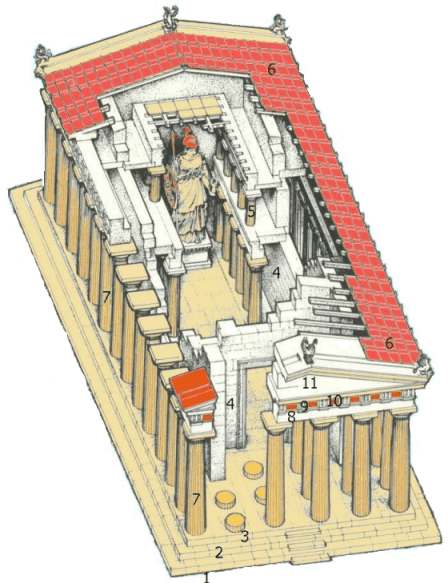
Think of the Parthenon structurally as a box inside a cage of 46 columns, originally with a lid running from one side of the cage to the other. Remember the lid.  That is how Iktinos and Kallikrates built it.  When you come through the Propylea and head for the Parthenon, you are heading for the west end, which the ancients considered the back side.

The original entrance was around at the east end. Visitors approaching from the east went through a cluster of columns and a recessed door to enter the
cella with the great ivory and gold statue (We are, I think, the better off for not actually seeing Athena Parthenos). Here is an imperfect but adequate view of the interior construction. Behind the statue was a wall with an entrance to the treasury. Remember that wall.

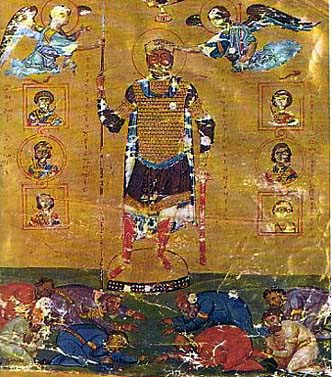
When it became a church -- probably in the 6th century -- an apse was constructed on the east end where the entrance was.  Evliya was informed that Plato used to hang a lamp in that dome with naphtha-soaked wicks that were lit in the morning through the heat of the sun on special stones.  Pilgrims reported an ever-burning lamp over the altar, and about 1020 Basil II had given a hanging lamp in the form of a golden dove.

A grand entrance was made in the west end, the treasury became the narthex, and the door between the treasury and the cella became the entrance to the church. Evliya described its finely carved cypress leaves "twenty yards high" which had once been gilded and still retained the insets that once held jewels. (In the late 14th century, Nerio Acciaiuoli needing cash had removed the silver covering Basil II had given for the doors, as well as the gold and jewels. He left money in his will for everything to be replaced but we do not know if it ever happened.) One of the ambones, pulpits, was constructed on six slender columnettes, which Evliya saw supporting a marble throne for Plato under its own dome.  When it was time for the cathedral to become a mosque, it served nicely as the mimbar.  Evliya much admired the colored marble of the furnishings, but essentially all that remains from the interior now is a few pieces like this -- a pretty carving from a world  very different from what had been 900 years before:


The ceiling Evliya saw was made of cypress, gilded and painted.  This was not the lid of marble coffers constructedby Iktinos and Kallikrates.  At some time in the unwritten history of Athens between about 250 and 550 -- Evliya said it was on the night of the birth of Mohammed * -- there was a catastrophic fire in the cella.  The gold and ivory Athena was consumed, and the marble lid came crashing down, bringing down most of the interior structure with the double levels of columns.  Essentially only the box was left.  Archaologist Manolis Korres has scraped off the calcined marble on what would have been the treasury wall behind the statue, and shown how frighteningly thin is the remaining supporting wall.  Athens is on an earthquake zone and it is remarkable that the wall did not collapse long ago, or come down in the incident of 1687.   The Christians took over a shell, not Pericles' Parthenon. Evliya knew of a second fire -- set by a mythical Egyptian sultan who looted the church of its treasures -- and said you could see "wounds" from that fire.  A second fire is quite possible.  [
Please read the subsequent entry for some corrections to this account of the fire.]

This mythical sultan is responsible for the disappearance of the jewels and treasures of the church to which Evliya keeps referring, though there were not many jewels and treasures remaining after the Franks of 1204 and the Catalans and the Acciaiuoli had made use of what Basil II had taken from his conquests in Bulgaria and given to Atheniotissa, the Virgin of Athens.

When Evliya saw the Parthenon, he saw a mosque with a minaret, surrounded by 46 columns, and for most of the way around, the space between the columns and the walls was open to the sky, not lidded over.
  He saw sculptured scenes on the metopes between the tops of the columns, and more scenes around the top of the cella. Our interpretations are dominated by archaeologists, but Evliya was under no such handicap.  The sculptures he saw contained fairies, angels, dragons, elephants, rhinoceri, giraffes, scorpions, crocodiles, thousands of mice, cats, ghouls, cherubs, and many many other kinds of creatures from this world and others in processions: one of the saved in Paradise, the other of those petrified in Hell.

Evliya says these sculptures are in the courtyard. In Evliya's experience of the classical Turkish mosque, the mosque is approached through a colonnaded courtyard, like the glorious Selimiye at Edirne.  The columns here, joined by lintels but almost completely separate from the interior structure ever since the fire and the collapse of the roof, allow him to interpret the Parthenon-mosque as a mosque
inside its courtyard.

He was fascinated with the holy water font in the narthex which he saw as a great goblet, large enough for a man to fit inside -- the men of old must have been mighty indeed to have been able to drink so much!  (Cyriaco had noticed the font, but little else.) He noticed that there had been a pipe organ over the door from the narthex into the church, but what fascinated him was a column supported by an arch. 

The mosque made use of the apse as a kibla, which he shows us covered with gold mosaics.  The arches and walls of the sanctuary were overlaid with multicolored mosaics which reminded him of the Dome of the Rock in Jerusalem. (Is there a reason there seem to be no good photographs of these mosaics on the internet?) I am imagining mosaics like these from Thessalonike.  

There was a gallery around the interior of the church, and the four columns closest to what would have been the altar were of porphyry.  So he said, Evliya always put the best possible interpretation on what he saw.  He counted 60 columns in all -- because of the gallery there would have been two levels -- all fluted and grooved. (An earlier Venetian visitor had said there were 80 -- this is the only known occasion on which Evliya produced a smaller number.) He doesn't mention the frescoes Basil gave, of which a few ghosts can still be seen, exposed to rain and Athens air for 450 years.

Evliya had seen the great mosques of Damascus and Edirne and Cairo and Jerusalem and Constantinople, but he said:

Presently there are well-constructed locations which have been disfigured by the wounds from the fire, but still, in the sphere of this ancient world, there is no such sparkling and luminous mosque since, no matter how often you enter it, on each subsequent entrance so many kinds of artful, individual and exemplary illustrations are evident and manifest. **


* You will recall that a fire the night of the birth of Alexander the Great brought down the great temple of Artemis of the Ephesians.
** Translation, Pierre MacKay. 

Notes:
  • Evliya's description of Athens and the Acropolis is to appear soon in a book of Evliya excerpts by Robert Dankoff.
  • An important new book is The Christian Parthenon: Classicism and Pilgrimage in Byzantine Athens byAnthony Kaldellis.   BMCR review. Bill Caraher's review. 
  • And thanks to  http://www.mlahanas.de/ for the Wheler image.

02 January 2010

Bessarion's Nazi


-->

-->I, Bessarion, while living, made this tomb for my body,
but my spirit will go to immortal God.

by Pierre A. MacKay, guest blogger and co-author on the Theodoros poems.

-->This is an account of two radically different personalities tied together over several centuries by a thread of scholarship. The earlier is the gracious and open-minded Cardinal Bessarion, whose sense of proportion and innate generosity, both material and emotional, makes him one of the most captivating humanists of the fifteenth century. The other was a small-minded, obsessive and, at best, mean-spirited scholar, Ludwig Mohler (1883–1943), who devoted much of his active life to studying the Cardinal.
The lifelong study of a sympathetic subject does not necessarily produce a sympathetic scholar. Mohler was not only one of the “Brown Priests” (Catholic priests who openly supported the Nazi party), he actually joined the party, one of a minority of even the brown priests. It appears that he did nothing worse than move into a Munich University position left vacant by the purge of its former occupant---he seems to have been an uninteresting Nazi and his party membership may have been largely opportune. It is still distasteful, and Bessarion himself would surely have found it distasteful.

At one point in an evaluation of the relations between the Greek and Roman churches, Mohler deplores the “outbreak of fanaticism (Fanatismus),” and one may wonder whether he felt any uneasiness about the Fanatismus of the party he belonged to.  It remains that he was explicitly a Nazi, and it must have been by his own choice.  Fifty of the hundred and thirty-eight known Brown Priests joined the Nazi party, nineteen of them on 1 May 1933, on the occasion of the first parade review for Adolf Hitler as Chancellor of Germany.  Mohler was one of those nineteen. 

Nonetheless, for the study of Bessarion, Mohler's work is the most thorough treatment we have, and the history of its thirty-year long composition is of interest, because he is subtle about some of his views in ways not always noticed by those who cite him, although they are essential for the interpretation of manuscripts which contain Bessarion's early writings.

Mohler went to Rome some time around 1910 to carry on research in the Vatican archives for a study of the revenues of Pope Clement VI 1342–52) and his successors. His work there, and in the libraries of Florence, Milan and Venice led to a broader interest the humanist world of the 14th and 15th centuries and eventually to a particular focus on Cardinal Bessarion, in whom he saw a distillation of all the best characteristics of humanists of the period. He did, eventually, finish the work on Clement VI in 1931, but his interest in Bessarion is seen in his 1920 doctoral thesis on Bessarion's early life and writings up through the council of Ferrara-Florence in 1347–48.

Bessarion remained the continuous undercurrent of Mohler's scholarlship, and he eventually published three volumes on aspects of the Cardinal's life. He announced a plan for these in 1923, but they were issued almost independently of one another in 1923, 1927 and 1942. By 1914, he was well started on the first part of the 1923 volume which he took it into the war with him—one assumes he served as a chaplain—and continued his philological research through the turmoil of 1919–20 in Munich with its quick succession of Communist and reactionary regimes.

--> -->
He managed to publish his doctoral thesis in 1920 and, in 1923, he saw the first, biographical, volume of his Bessarion studies through the press. Up to that year he still intended to publish the material that ultimately went into volume three as a second volume, a fact which complicates references to edited texts of Bessarion's letters in the footnotes to Volume One, because four years later he devoted the entire second volume to his edition of Bessarion in calumniatorem Platonis libri IV. (1927) .


Bessarion's treatise was occasioned by a comparison between Plato and Aristotle by Georgios Trapezuntios which strongly condemned Plato as a source of heresy, using arguments that distorted both philosophers by treating them as foreshadowers of Christian doctrines. Bessarion cited both Plato and Aristotle directly, discarding the Neo-Platonism of his teacher Gemistus, and cleverly dodging around those parts of Plato which were indeed incompatible with Christianity. 

Bessarion, “the most Greek of the Latins and the most Latin of the Greeks,” may have been the only person in either the Greek or Latin world who was familiar enough with the Platonic corpus to write such a treatise in his time. (It was surely this work, with its many long quotations from Plato, that helped to cure Bessarion of his youthful tendency to “a horribly over-ornamented style, (schrecklich verschnörkelten Sprache),” as Mohler describes it.) Scholars all across Europe recognized the value of Mohler's work and we learn, with some astonishment, that the director of the Marciana even permitted the principal manuscript of in calumniatorem Platonis to be borrowed for use in Münster.

Once the second volume was complete, there was a period of fourteen years when nothing more of the planned Bessarion corpus was published, although it quite obviously remained a significant part of Mohler's interests.

Mohler's third volume, Aus Bessarions Gelehrtenkreis. Abhandlungen, Reden, Briefe (1942) looks like a collection of much of the material Mohler had started on in 1914. The largest part of the book is given over to Bessarion but several contemporaries, Theodore of Gaza, Michael Apostolios, Andronikos Kallistos, Georgios Trapezuntios, Niccolò Perotti, and Niccolò Capranica, are also published here. 

One of the most interesting sub-collections in this volume is a collection of letters from a manuscript (Marciana, Cod. gr. 533) which contains a large part of Bessarion's youthful writings—some of them little more than school exercises—and others dating from his years spent at the court of Mistra, where he was a student of Gemistus Plethon and a friend of the Despot Theodore II and Kleopa. Despite their belonging to a genre that tends strongly to platitudinous ornament, these letters contain surprising indications of what the personal life of the court was like. They also contain three poems ascribed to Bessarion although they include phrases that could not possibly have been written by him. They are, in fact, the work of Theodore himself, as he makes very clear in one of them.


Bibliographical references to Mohler's Bessarion, expecially on the Web, can be quite confusing, so they are consolidated here.
The most accessible imprint is: Mohler, Ludwig. 1967. Kardinal Bessarion als Theologe, Humanist und Staatsmann. In 3 Volumes. Paderborn, Scientia Verlag Aalen Ferdinand Schöningh ( = Volumes XX, XXII, and XXIV of Quellen und Forschungen aus dem Gebiete der Geschichte). This printing is a photographic reproduction of three earlier printings:
Mohler. 1923. Vol. 1. Darstellung. Paderborn.
——. 1927. Vol 2. In calumniatorem Platonis libri iv. Paderborn.
——. 1942. Vol 3. Aus Bessarions Gelehrtenkreis. Abhandlungen, Reden, Briefe. Paderborn.

The photograph of Bessarion's epitaph comes with great appreciation from 
http://idlespeculations-terryprest.blogspot.com/2006/11/cardinal-bessarion.html


For portraits of Bessarion: http://nauplion.net/CP-BESSARION-portraits.html