12 February 2015

Oh best and wisest of friends, or George and the wolves


The best and wisest of friends, Nikeforos Prinkeps Cheilas, is one of the small group of intellectuals of mid-century Mistra, and probably the most enigmatic. Cheilas first appears in 1433, when he gave a monody at the memnosyne for Cleofe. It is an extraordinary work, highly emotional, and full of powerful metaphors, but it is his only surviving writing.  A number of letters to him have survived, which collectively give a strikingly detailed portrait of a complicated but valued personality. No letters of his survive. As Eugenikos wrote him in 1455:

Your letters are double treasures, O best of men, winged reminders of your dear countenance and our association, among us even when we have received nothing whatsoever.


It seems that Cheilas left Mistra with Theodoros in 1443 when he became Despot at Selymbria. This put Theodoros in Constantinople most of the time where he intended to pick up the throne from John. In the summer of 1448, John, seriously ill,  still had not named an heir. Theodoros had been quarrelling with him over money, and it appears that with the aid of family members and aristocrats in Constantinople, and his entourage, plus the prospects of foreign troops and the promise of a foreign bride, Theodoros was ready to attack Constantinople and seize the throne.  But there was a major epidemic of plague, he delayed his attack, contracted plague and died. His body was taken to Constantinople and buried at night in the Pantokrator. His friends and entourage – including Cheilas – sat by the tomb for seven days and nights in the traditional homage, in terror of what might happen to them.

Nothing happened. Too many important people had been involved, and details were covered over, except that everyone knew about it. Cheilas must have written a mound of mea culpas to everyone he had ever corresponded with. Bessarion received one, and responded with generosity in considering why Cheilas might have decided as he did.

You thought you were doing the right thing in deceiving us, having other considerations, and saying what was not the case, but you did not escape us in your attempt to conceal the truth in your concern for loyalty and good will toward our leader and despot, for his sake keeping his secrets truly secret. . . . It is no ordinary virtue for those who consort with dynasts to understand that they must hide the mysteries of those in power . . .Why would one not speak the truth to you and not praise acts worthy of admiration? Why would he not spare a friend from accusations or not supply the defense of one most dear to him. . . . We clearly do not blame you and we have acquitted you of any crimes already. Do not write your defense to us and give no thought to supplication. . . .

For you should view it as I do, that we were harmed by the loss of a brother and a wise friend, while we hoped that you would fare well, for by doing so you would clear away our dismay and comfort us that you were together with better companions. Or, if you willingly endured because you did not accept a division and separation from your benefactor, and were overwhelmed by love, that in itself was the better, and something for which--if you had not felt it--then you might need an apology, such as is not needed now, since you did feel it.

May you be in the midst of all good things, oh best and wisest of friends, and may you overcome all your griefs and, with the support of God, enjoy all the best of the great city. For the present, we wish you to cheer us with the occasion and beauty of your correspondence, and with better words about yourself. In the future, your brilliance will be seen brightly by us who love you. For they are well whenever and wherever your situation is better and pleasanter.

Scholarios was a man of many faces. Without revealing his support of Theodoros, and using language in keeping with his role as a judge, he wrote Cheilas:

Such is your case. We shall not believe you, and forget the evidence of your actions, and we shall not listen to you belittling your state when we have many fine witnesses who honor it, and justly so.


A good bit of the Scholarios letter to Cheilas comments on letters from him, overwritten and somewhat hysterical as was his style in distress (τοῖς γράμμασιν ἦν μετ´ὑπερβολῆς), but it also dryly indicates that their situations under Constantine had changed from what they previously had been under John:

You are abandoning us who have no wish to show contempt, and who respect the eagerness of a friend . . . Let this suffice us then. We share your happiness in the good will of our best leaders as we ourselves often enjoyed it in splendor, but now let us abandon and be free of it, thinking that we and you together with us are fortunate. We are enjoying this opinion equitably, and taking pleasure in a reputation for virtue in place of our former splendor. For we, along with them, shall celebrate the brother for his praiseworthy clemency -- don't you think? -- for through that all the best will come from both God and men.


Eugenikos wrote:

You are prevented from writing frequently by the crowd of problems that surround you . . . Write, then, whenever you find it easier for you. . . . Write something short: that will be dearer and more precious than the longer effusions of others, and show by this your longing and purest feeling toward us as from the beginning.

Cheilas eventually returned to Mistra where he then became mesazon for Demetrios. In a letter to the Gemistos brothers, when their father died, Bessarion concluded:

Be well, and speak to Nikephoros Prinkeps Cheilas for me, telling him to know that he is loved by me for his goodness more than ever before.

There is much evidence for the emotionality of Cheilas' personality, and when hostile gossip produced hurt feelings , Eugenikos had written:

I learned from one of your countrymen here, a warm supporter of yours, and the good son of one of my associates, that certain ill-wishers here have corrupted the good and wise information that you receive, announcing complete untruths and have claimed that I have condemned you frequently and to many people when, by the grace of God, what I do is just the opposite, fervently and continuously. You are, with the aid of God one of those we praise, and we are not given to slandering.

John Eugenikos left his estate in Cheilas' care during his trip to Trebizond in 1454-55. Then he had a letter from his son George (the deaths of his younger brothers were discussed in the previous entry). Eugenikos wrote Cheilas with such graciousness that it becomes difficult to discover that Cheilas had been negligent.  The wolves are a puzzlement: they are generally taken as raiding neighbors, but a mountain village on the slopes of the Taygetos range is likely to be a sheep-herding village and I suspect these are real wolves.

Not but that if you stood aside for a while from our common understanding and firm resolve for the better, something that happens to people who are distracted by many important things, as nature has it though it may be against their will, nonetheless keeping in mind the letter of warm mutual affection, and those bright hopes of ours for those around you, and what we set up for my son when I left, and you promised, what I begged from you in earlier letters for yourself and those under your care, a grant to us concerning everything where you are and whatever or ours there is. My son George needs help frequently, and the village along with him, which will provide for his and my survival when I, God willing, shall return. The village is frequently besieged, and excavations are dug under the fences by the wolves nearby, and who could be a better manager and a greater assistance for us than you, when you are led by God.  


Again, thanks to Pierre MacKay for his translations.


04 February 2015

The Eugenikos sons


Two and a half years ago, I wrote about the time Pepagomenos left his sons with the Eugenikos family in Mistra when he and his wife made a trip to Constantinople. This was probably in 1443. In a letter to him, John Eugenikos compliments the excellence of the two boys, calling them "that pair of ours, and especially Nicholaos." In another letter, Eugenikos describes a group that he had invited to read a letter from Pepagomenos. He included "our good Nicholaos" and his friends in the audience -- it looks as if Nicholaos was the older son. (I think the younger was Giorgos.)  After the formal reading, Nicholaos and his friends took the letter, "treating it lovingly," and tried to work it out for themselves. Their Greek had not yet become Byzantine.

So I was startled and saddened to find an exchange of letters between Bessarion and Eugenikos, written four years earlier, about the deaths of two of Eugenikos' sons. Bessarion was in Florence at the Council of Union. Eugenikos, profoundly opposed to any discussion of Union, had obtained permission to leave the previous September and had finally reached Constantinople in May 1439, nearly drowning in a shipwreck on the way. Eugenikos seems to have gone directly on to Mistra -- did he arrive in Constantinople to find his sons dead? The letters don't say. 

They had learned in Florence that there was plague in Constantinople. Bessarion, concerned about no letters from Eugenikos began to worry, but he could not imagine that his friend's household could be affected by plague. Then he learned from two boys just arrived in Florence from Mistra that the Eugenikos boys had died. The boys must have been travelling with the group from Mistra Eugenikos mentions at the end of his letter.

Here is Bessarion's loving and clumsily-written letter to John Eugenikos. The two men were polar opposites on the topic of Church Union, but they were the closest of friends. The last paragraph of Bessarion's letter indicates that the Council is still voting: given what can be worked out about travel, Bessarion letter must have been written in June of 1439.


* * * * * *
[Bessarion to Eugenikos]
I was believing that your house was safe and not afflicted by the disease, and that in your relief you would be glad to take part in the pleasures of life and so would not overlook what is right for us who left the great city and came here, and who beg for letters from there more than any other gift. When we were unable to discover them—how could we, when they did not exist—for my part I was eaten up at heart, being uneasy about your silence When I asked around, no one had even a suggestion that might dispel my ignorance until I learned directly from fellow townsmen, those who knew you best, and was told that terrible news, that the cause was much worse than anything we might have suspected, that you had lost the companionship of your children, those children whom even someone hostile to you would be ashamed not to mourn, whom an enemy, needing no truce, would have pity for, and about whom anyone seeing it would fall into the same grief as their parent. I shed bitter tears as soon as I heard of it. Those who announced it to me were of the same age, with the same beauty and symmetry of limbs, in the same first flowering of their life that gave witness to me what their condition was to be in future. I write you now with the same tears, aware of the despair that must exist in your soul, and how sharply you grieved as you sent these dear ones to the tomb before you had clearly witnessed their full heritage. And yet you know how to grieve while at the same time praising nature, and you understand philosophy, for you have in all times praised the mean as best, taught that thee fully-matured virtues lead us to the mean, and you walk along the royal road, as it is said, distancing yourself from the evils on either side.


Death, for those in hardship is a release from evils, while for those who have lived virtuously, and for children, in whom there is no villainy to be considered, being not yet aware of the unfulfilled pledges of life, it brings mourning to those left behind, as is right when they are distressed by the separation of bonds. May it be a consolation to you, that medicine of consolation that has often been to many, and in many circumstances. Contrast the life in this world with that one, as being by so much more, blessed. To have been snatched away before time is to escape the griefs of this life, which are the preponderance in it, perhaps even all of it. With not exulting in them because they have gone away despite one's prayers and the hopes that they might too become fathers of children, contrast the absence of grief and affliction of offspring who are unworthy of their parents, for, that may sometimes happen, and if the separation, and your no longer being called their father grieves you, you must remember that you must not grieve more for what you have had taken away from yourself than you must rejoice in the acknowledgement of what God has offered, for He as our Lord has taken his own, not what is ours. How could it not be so, when we have our very life from Him. If God can give us many times over what he takes from us then this is a sufficient comfort to us who remember those who have gone from us neither in a small-spirited way nor as if those departed had ceased to exist.


About you, many good things are are noted by those Peloponnesians who come here and who have voted for what is best with every vote. The law of friendship makes me regard your good reputation no less than my own with pleasure. I greet those about you who have voted with you as still being friends. But if we have lost you, and your true self, to be well-pleased with those, who take pleasure in you but are others, is to pursue the shadow and an image of pleasure, neglecting the true pleasure. Nonetheless, being deprived of this now in the tyranny of the present circumstances, we shall enjoy the second pleasure, that of hearing you well-famed, until we ourselves may more clearly enjoy your goodness. 


* * * * * *


 Bessarion wrote Eugenikos other letters about the deaths that have not survived, and Eugenikos wrote back immediately.  He does not mention the Council or the Act of Union, which had been signed on July 6, but there was a lot going on, with many letters crossing in transit.  In this next letter we learn that Bessarion's letters were carried by Gabriel, and that Eugenikos had written Bessarion (these were the letters that Bessarion was worried about because he had not seen them) letters taken to Florence by the stratopedarchos 
Frangopoulos (this is the man who built the Pantanassa at Mistra) and by Alexios Laskaris (the name shows up in other Moreote documents).  This is new information about Greeks in Florence, and it makes very personal what we already know about the transmission of letters.


* * * * * *

[Eugenikos to Bessarion]
This is clear to me, what is said by the philosophers that pleasures are fixed right next to griefs, in that no part of the present life remains unchanged, for since the joy of good men in infinite future ages will properly be matched by the grief of the unjust. Certainly, it follows that this is true for those allotted life in this uncertain order that will shortly cease to be. Just as many other opposite things occur simultaneously, as, like a wheel, the affairs of men, change and are borne along this way and that, so happiness and grief are to one another. With your good and wise letters, you have filled me with this immeasurable happiness, oh best and thrice desired friend, after I have known many distresses from many sides, and what a fresh sweetness you have poured over my despairing soul, what a medicine of consolation. 

 This is not only because of the great charm, and the longing for me in your soul, your unmixed love, and your recognition of me and disposition toward me evident for a long time before and especially now, to which I add the flowering grace and skill of your writing, but also your advice to me to offer thanks to God even for the loss of my dearest. Your letters have had such power over me that they have been longed for especially, honored when seen, and deeply treasured. It is right, according to the teachings of the church and your counsels, that we should give thanks to God from our souls, both when he gives and when he takes away, as much as it is in us, and we ask for your prayers and for the prayers of those with you who love us or, rather, who love God more than us, that they be safe and be left to us in place of the children and may be increased in accordance with His generosity to us. 

Thus as I said, following the anguish to ourselves, there was also joy for other good things, not the least of them being your wise letters in which while they lacked absolutely nothing of your kindness and honor, I found in addition to these benefits that they came together with the high-minded escort, that best and sweetest, that good and noble Gabriel, who to such an extent filled my ears with frequent praise of you that he made my longing for you, which had already reached a peak, increase and rise to an even higher peak.
So this is my joy over you and yours. 

But there is also with it a grief, and a very immediate one, heavy and great for me, that strengthens my delight in your letters and at the same time troubles and confounds it. This is that you did not receive my letters, a long one sent earlier, and one after that, owing to the indifference of those who took them. The calamity was made so much the worse because of what the most distinguished of our friends, to whom the letters were entrusted, have become. These were the good Frangopoulos, the grand stratopedarch, who took the long one, and after him, Alexios Lascaris, who took along with the one I addressed to you others for the spiritual father Isidore. If there was one more important than the other it is the one that went with the grand stratopedarch which would have been given into your two hands if he had not been indifferent to God and to the happiness of friends. If this is not the case ask him to look into his trunk, or the trunks of his closest associates, and perhaps they will appear somewhere. If not, let that stand as a part of my misfortune and wretchedness.


[The Bessarion letter is found in Mohler 3: #10; the Eugenikos is IN Lampros, Παλαιολόγεια καὶ Πελοποννησιακά, 1: 164-5. Pierre MacKay did the tedious work of translation.]


27 January 2015

In recovery: English double-headed eagles


The Luttrell Psalter was created between 1320 and 1340, at the commission of Sir Geoffrey Luttrell, lord of the Manor of Irnham in Lincolnshire. It is full of wonderful images which include the best dragon ever painted, and amazingly detailed pictures of daily life.

What I want to know is: Why did Sir Geoffrey want – did he want it or did the artist want it? – this painting with double-headed eagles? These look like imperial-central European eagles, and the double-headed eagle was also an emblem of the Hanseatic league.  Does the coach indicates a visit by central European royalty via the Baltic and North Seas to the Hanseatic port of Boston on the English coast (27 miles from the Luttrells), and then a Luttrell escort to London.


Can some reader answer this question?


20 January 2015

In recovery: St. Peter and the baby

\
Pietro Lorenzetti, 1310-1320.  Seattle Art Museum.

 Saint Peter and Saint Paul rarely, if ever, smile.  In fact, do people in paintings ever smile at the baby Jesus?  This triptych, however, shows a gentle merriment across the three panels.  The triptych also suggests that, even if presented on individual panels, some of this type of painting may have been done of people posing together, rather than alone.

Look at the baby.  He is cranky, tired, and about to snuggle into his mother, except that he has been distracted.  


Peter is jingling his keys and wiggling the fingers of his right hand. The baby looks back at him.  Their eyes connect.  The mother is tired, too, but she is trying to keep her pose for Lorenzetti.  She starts to glance at the keys. 


Now look at Paul.  He is grinning, and his eyes focus directly on Peter's keys.  The three panels are held together by the four sets of eyes.  


If you look at this panel, Peter and Paul's eyes are looking at Christ's hand, and the key and sword are much more prominent. Peter and Paul are the same type, but there is not the flash of a moment's interaction that we have in this triptych.


13 January 2015

In recovery: The woman in a hurry


This wonderful 17th-century Dutch painting narrates a fragment of a story about a woman in a hurry whom we cannot see. 

We are standing in a room that looks through the pantry, the front hall, and into a formal parlor. We see the elaborate wrought-iron handle and latch on the door we would go through into the pantry, the fine frame on the pantry door with a string of onions (there is another string of onions on the other side of the door, a towel, then the light from the front door into the hallway, and then the door which has just been unlocked opening into the parlor . 


The woman we cannot see is in a hurry, but we will take some time to look at the details she sees a hundred times a day.  Such as the backsplash tiles around the base of the pantry wall where the water splashes when someone is scrubbing the tiled floor with that broom.


17th-C tiles very like these are for sale on eBay. They have the common oxhead tile motif in the corners as do the backsplash tiles. 


The front door is hinged on the left, as you are coming in, and judging from the shadow it casts, the woman left it half-open.  She took off her shoes in the hallway and left them on the doormat, before going into the parlor.  


She is coming back immediately, as she did not take the time to put her shoes away, and she has left her keys in the parlor door. 


This is a moderately well-off household. They have a gilded leather chair -- possibly more than one of them, and at least one high-quality painting in which a lady possesses considerable affluence of her own. (Look at all that red fabric in the bed canopy, tablecloth, and upholstery.) She seems to be about to undress for the benefit of the gentleman to her left, but she will do so slowly. She has no need to hurry.


The unseen woman who is hurrying has left other signals of affluence and haste in the parlor.  She owns a cloth-of-gold table cover with a fringed and embroidered edge.  There is another painting whose content we cannot see.  Someone has put an open book face-down on the table, and whoever pinched out the candle flame knocked the candle crooked. 


The unseen woman will be back in a moment, lock the door to the parlor, slip on her outdoor shoes -- never glancing in our direction, and go back out, closing off the light from the hallway, and we will never know why she is in such a hurry.


06 January 2015

My left thumb


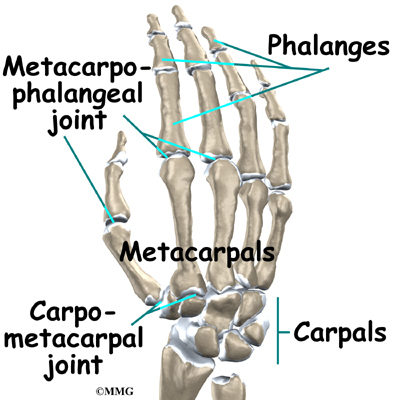
If all goes as planned, this blog will appear on 6 January to announce the surgery on my left thumb, a procedure called Resection Arthroplasty. As you can see in this X-ray, there is no padding, no cartilage, between the base of the metacarpal (the long bone of the thumb) and the corner of the trapezium at the carpometacarpal joint.  The thumb has slid to the right, there are bone spurs growing around it, and every movement is extremely painful.  The number of things I haven't been able to do with my hands has been increasing.  For more than a year, I have not been able to move my thumbs under the other fingers when playing the harpsichord.  Any pulling on clothes can become an agony. Picking up a book or holding a wine glass hurts. Tying a shoelace is like being a kindergartner again. It is a risk to try to lift a large pan for the oven.  I have three different kinds of gloves for protection and support.

I have been promised that once I recover from the surgery -- 2 weeks in a hard cast, 4 weeks in a splint, lots of therapy for 2-3 months -- I will have nearly complete use of the thumb again, and no pain.  Then I will have to schedule the same procedure for the right thumb, something that will be much more complicated, as I am almost exclusively right-handed.

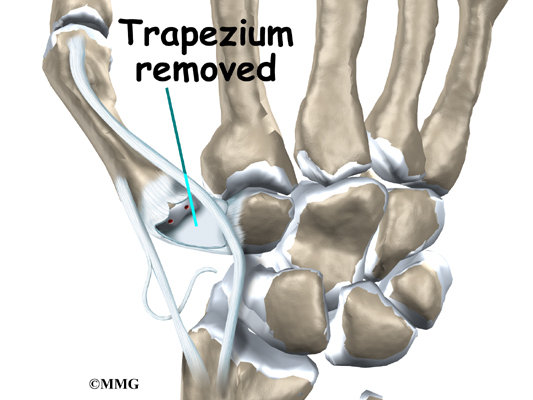
There is an ingenious technique involved in this surgery.  They will take some of the tendon that runs along the arm and up to the ball of the thumb, just beside those blue veins at the wrist.  Part of the tendon they attach to the metacarpal , and then to the next metacarpal to anchor it.  Then the rest of the tendon is made into a little pillow to fill the space left when they remove the trapezium.

The procedure takes about one and a half hours, then more time is required for going into and coming out of anesthesia.  I should be home in time for lunch.


Later: home well before lunchtime, but we ate early.


31 December 2014

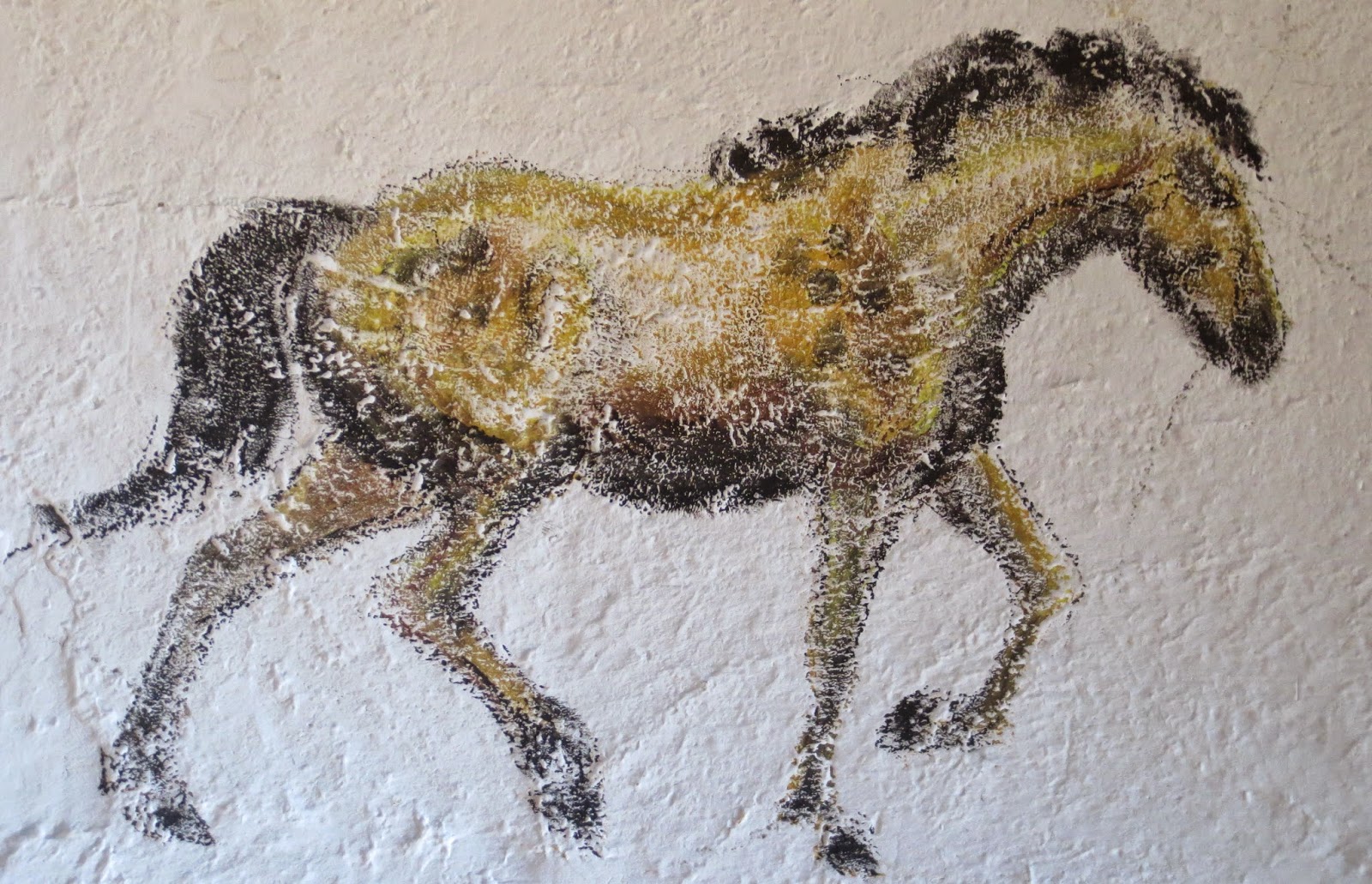
On our basement stairs


Altogether elsewhere, vast
Herds of reindeer move across
Miles and miles of golden moss,
Silently and very fast.

W. H. Auden


Fresco secco by Theodora S. MacKay.


24 December 2014

The journey of the wise men


The tracks at Plovdiv.

This contribution is by Pierre MacKay, about a train trip from Vienna to Istanbul in August 1973.  

* * * * * *

It was already evening when we passed through Niš, and I do not remember Sofia at all, but we came into Plovdiv in full daylight and the state police came pouring onto the train as soon as it stopped. There had been nothing sinister in the way we were treated during our time in Yugoslavia, but we crossed into another world in Bulgaria. From that moment on, my trip on what was ironically called ``The Marmara Express'' seemed to belong more to a 1933 Eric Ambler novel than to 1973. 

They were large and grim-faced and went through from both ends of the car, silently inspecting the passports of the passengers, all of them foreigners. Along the way they arrested an arbitrary lot of them, but the Czech couple in a second-class compartment next to the sole first-class compartment of which I was the sole occupant may have thought they were safe. Then, at the last moment before the train started up, a group of police stormed in on them and dragged the man off onto the platform. The train was already moving slowly forward as the woman heaved two suitcases out the compartment window and ran to the end of the car to jump off.

There were two more removals of passengers at stations along the way, and, just before the Turkish border, an English girl was hauled off the train at a halt where there was not even a station. At twilight, I caught sight of a sign reading "Hudut Kap
ısı," and as we passed it, I thought that the Turkish language had never seemed so reassuring.

I had chosen the Marmara Express as the last leg of a research trip to investigate Arabic Script manuscripts. It was supposed to go from Vienna to Belgrade, and then on to Istanbul, and
it was only when we reached Zagreb, some 15 hours late for the connection southwards that it was borne in on me that the Marmara Express consisted of a single rather decrepit wooden railroad car.

The train from Vienna had been diverted almost to Salzburg because of a spectacular oil-spill and fire along the Mur river, which threatened the very fabric of the rail bridge near Graz, and when we at last appeared at the Zagreb station there did not seem to be any decision what to do with us. The car in front of us ``The Salonica Express,” was fairly soon attached to a train going south but for some reason we had to remain in Zagreb where we sat in lonely isolation about six tracks away from the station platform, with no food, no drinking water and soon, no water of any sort. We were told nothing, and offered no opportunity to get food and water from the station.

There was a group of Engli
sh students in a second-class compartment a little way down the car, and we got together and took orders in sign language from families like the Iranians with two sickly children in another compartment who were struggling with the fact that there was no more toilet paper. We got out of the car, raced across the intervening tracks and clambered up on the platform to buy what we could carry, especially drinking water, and even a large flask of wine, which I was later to regret. We presented the Iranians with a large amount of water, at least, and made two more trips before we were informed that we would soon be attached to the end of a train going to Belgrade.

At Belgrade there was less room for us there than there had been in Zagreb, so our lonely car was shunted into a side area not far from the freight yards and we were left in the dark—in all senses. The wine from Zagreb had by now given me a splitting headache, so I retired to my first-class compartment and tried to sleep on a bench too short for me by about 18 inches.

Very early in the morning, the English students and I arranged a sort of relay, placing ourselves within shouting distance, so that we could be called back if the car was hooked up to some other train. I was the only one who read Cyrillic, so I got to make the purchases, which consisted of more water and a great deal of truly delicious bread, just out of the oven. I also read the schedule, and could see that there was no train we could be attached to before about 9:30, four hours later. Even so we were cautious about staying too long away from the car, and got back to it a little after 5:00.

Some half an hour later, a ``luxury'' train for upper-level apparatchiks was rolled in beside us and left totally unguarded. We raided it, and took away all the water we could carry, all the soap, and all the toilet paper, most of which we offered to the now desperate Iranian family.  Fortunately our car was hauled off into the main passenger area, and at some time in the late morning we were on our way, at no great speed, to Istanbul.


17 December 2014

Plethon's Cleofe

Angel, Ag. Nicholas, Mistra.


I recently discussed Bessarion's monody, one of four given at the μνημόσυνον for Cleofe Malatesta Palaiologina.  The memorial would likely have been held at Ag. Sophia, where she had been buried. There was a thunderstorm that day, and crowds of people -- family members, officials, clergy, women of the court, townspeople -- had shoved their way into the little church and its burial chapels and porches. There was a newly-painted portrait of Cleofe and her husband over her tomb, and some of the speakers gestured toward it and said, "You," as they spoke.  But we don't know which chapel the tomb was in.  

I spent some time in Ag. Sophia at the end of October, standing in each chapel, trying to envision the circumstances, trying to consider how well a speaker could be heard from various positions. Most of the people present wouldn't have heard the speakers, and most would not have understood the Greek the speakers used: what was important to them was that they were there.

Hints in the monodies allow us to work out the order in which they were given. Bessarion's was the last. The first was by George Gemistos Plethon. What we have is probably not quite the speech that he gave, but his edited written text.

The magic name of Plethon has preserved this monody in twenty or so copies (one is bound with the only copies of the Bessarion and Cheilas): the other monodies survive in one copy each. Plethon's has been used, or parts of it, a number of times by a number of writers, for what it says about the soul. What has been completely overlooked is that Plethon's discussion of the soul comes from his portrayal of a very specific soul, Cleofe's soul, and then from his portrayal of her husband's.

Gemistos began quietly, speaking of Solon's idea of goodness, and how one could not be sure of human fortune until death. "For this reason," he said, "one would consider epitaphs and funeral addresses to be more reliable than any other encomia . . . for they are concerned with matters already securely established . . . The Athenians . . . thought it right to use these addresses."  Gemistos anchored the storm-blown mourners firmly in the Athenian tradition: "We, likewise, have come forward in this commemoration, not only to speak for our most holy ruler's now-departed wife who achieved a good ending to life . . . but expressing thanks for the reverence and understanding she always exhibited."

He then reminded them that Cleofe had come from Italy whose Romans had ruled the best part of the settled world, from the Danube to the Tigris to Libya to the Atlantic, and that she came from heroic ancestors.  "She came here, lovely and good, to dwell with our most holy ruler . . . bringing with her shining adornment of body and soul, for she was tall and lovely, and had matured into every sort of goodness. . . She, however, exhibited, in addition to the beauty of her body, which was radiant, an even more radiant and holy quality of soul, and showed that her body was a sort of image of the beauty of her soul."

This is an extraordinary emphasis on Cleofe's body, however beautiful, and it should be remembered that Plethon believed that physical desire was a divine gift, and that it was through the body that we become like the gods.

He went on to list the qualities of her soul and then followed them with a brief statement about each: "For she adorned it with every sort of complete goodness: judgement, discretion (illustrated by her sober prudence in putting off her leisurely Italian ways and taking up the decorous restraint of our women”) , clemency, honesty, piety (illustrated by her worship with prayers and continuous fasting according to our custom"), married affection, and nobility, and having naturally acquired each from birth, she increased each through study and practice and proved herself a glory among women. (This discussion of qualities suggests that Plethon was working on Περι αρετων, "On virtues," earlier than generally thought.) 

"Living in this manner, and with such occupations, practicing and studying, always adding more good to good things . . . and I would add that she recently took part in the most sacred of our feasts and our mysteries." He would have known as well as any of Cleofe's anguished "conversion" to the Eastern rite.  "She departed this life from an affliction beyond the powers of all medicine, so that she seems so dear to God from all these to have been taken up by God, and she left despair in her subjects . . .." 

Leaving the subject of Cleofe specifically, Plethon went on to say that there is a part of us that is mortal, and a part that is immortal, the most important part. The body is a kind of garment, and when we take off this garment, it is wrong to mourn when the important part has moved into a better life. It is the life we live here that prepares us for that life, as did Cleofe's life, while a person who takes no care for the divine in this life will have no contact with it in the next.  Almost all people believe in this continuing life.  The creator, as a good master, would not have given us the longing for eternity unless there was an eternity to long for. Non-rational animals do not because they do not understand cause or infinity. The one who knows something about God must have something in common with him, and we could not know this everlasting life without a desire for it.   

Then Plethon moves to suicide, a peculiar topic in the circumstances, unless he knew something that made this topic relevant.  Many of us who have been widowed have had the experience of being carried along at first, perhaps by shock, but with the sense that we are managing remarkably well.  Then about a month along, there is a great crash and an all-devouring depression.  It is clear, from Bessarion's monody, and particularly from Plethon's conclusion, that Theodoros had fallen deep into a depression, to the point that it had become a political as well as a personal problem.  He had earlier written a poem to Cleofe that looked forward to a radiant reunion in the presence of God.  Had he mentioned to Plethon the possibility of anticipating this?  

It is difficult to think why Plethon would have otherwise brought up the subject, particularly in such public circumstances.  He explained that non-rational animals do not commit suicide because they cannot envision their non-existence.   Nothing seeks its own destruction, so a human would not consider suicide if it would have that result.  A person who is suicidal must feel that suicide just allows it to move out of the body.  Plethon clearly allows more understanding of someone who is suffering, than did -- and does -- church teachings.

Plethon concluded with a firm statement of comfort, correction, and encouragement.   Who else at Mistra could have spoken to the ruler so critically in public?  "If the belief is established as certain within us that the soul is immortal, we shall be nobler and better, and shall bear such losses more gently. And so, most holy ruler, consoling yourself with these words, give up despair, considering again that you were born to preserve the common good in the face of troubles, but despair will stand always in the way of such action. You see how the menace has progressed and requires great concern for recovery and return to safety. This rests on you, and only if you will take care of it appropriately will all the rest follow you so that, if God wills, we shall be saved. 

"But, if you are indifferent, our danger will increase. Consider that if some mischief occurs—may that not happen—all will place the burden of it onto you, while if something happens to rescue us you will carry off the fame of it. So, understanding that you will in either of these cases have the greatest credit and, as your duty to God, who entrusted you with governance over us, stand before us, stronger and more attentive, and God will give you the diligence to be the rescuer of our community and provide you with whatever is necessary. And it has to be that, since your actions bringing us toward salvation will be great, and never trivial that, as well as by us, among all the rest of humanity you will be held in high esteem.  


My thanks to Pierre MacKay for his work on the translation.

10 December 2014

Nauplion's fiefs


15th-century remains of fief boundary wall and tower at Myloi.


It is easier to think about fief churches than fiefs, because with churches you have a definite building in a specific place. For the fiefs of the Frankish and first Venetian occupations, you have in a very few cases the name of a general area. When the Franks divided up the Argolid as of 1212 or so, it is probable that they used the general divisions already used by the Byzantines. The Aragonese version of the Chronicle of the Morea says that two Greeks who knew the whole country helped the Franks with the division of the territory. 

All we find for the Argolid is that the Foucherolle family was given three fiefs or cavallerias in Argos and Corinth, and many others were given one and two cavallarias. It is not clear how much land was involved in a cavalleria but many Greeks received them, as well as Franks. To suggest possible numbers in the Argolid, Passava and Helos each had 12 fiefs, Patras 24, Escorta 22, Arcadia 8, Damala (considered part of Corinth) 6.  A report on fiefs from 1391 gives Clarentza and Kalamata 300 fiefs each, Vostitza 200, and says the despot has 40 in Mani.

For a completely different area, in 1500, Crete was divided into 391 cavallarias. Each fief or cavallaria in Crete had 50 boine or fields. A boina was the amount of land that could be plowed in a day, and each could support two families of villani or paroikoi. There is nothing to let us know whether the Cretan system was applicable in the Morea.


The Frankish system of privatized justice and privatized military fit well with the Byzantine rule in the Morea. We have no idea what shifts might have occurred as the culture of the Franks from north-western France became the culture of Franks from southern Italy during the next 180 years or so. Venice took over the Frankish Argolid in 1394 in a treaty with Theodoros I of Mistra, guaranteeing to protect the traditional rights of the inhabitants. What those traditional rights might have been in relation to the fiefs after 180 years of foreign rule, we have no idea. The significant change Venetian rule brought was that justice and the military came under the control of the governors of Argos and Nauplion, and the fief was a means of collecting taxes which apparently became more stringent.

In the Venetian land system, all the land belonged to the state. There seem to have been several categories of land-holdings. The fiefs which were comparatively large, and were heritable. Then there were large land-holdings that were rented out for 5, 10, or 29 years. My “fief” churches may have belonged to these landholdings as much as to fiefs. There is good evidence for substantial Greek ownership of these. Another division of land came in 40-stremmata plots, plus another 5 of vineyards, which were given to the immigrants Argos needed to repopulate its empty countryside. The 40 stremmata plus 5, allowed a family to make a basic living and pay the taxes required in cash and farm produce.  

Venice tended to make land divisions relate to the productivity of the land: we don't know if the Franks followed this system  in the 13th century.  Another division of land was the territory given to stratioti who were responsible for raising their own food and horses, and we know nothing about amounts of land there. It is unclear whether an appropriate unit of territory was assigned to a particular band of stratioti, or whether land was assigned individually. Argos seems to have assigned plots of land to individual stratioti, but that may have been a special case.

Essentially, we have minimal information about the Venetian land system, but Bartolomeo Minio's letters suggest that he considered the landworkers – villani or paroikoi – hard-pressed. He does give us a little information about fiefs, and what he does say suggests fairly large divisions of land. Given the locations of the fiefs he mentions, I would wonder if the areas farthest from Nauplion were made into fiefs, and lesser divisions of land were closer.

Minio only identifies the fiefs of Kiveri, Thermissi, and Kastri. After two difficult conferences that divided the Ottoman-held territory from the Venetian, Minio writes of “the feudatories who have recovered the lands of their fiefs.” The cumulative information about fiefs gives erratic information about productivity, owners, and local morals. 

The bishop of Nauplion (who never visited his see) held the fief of Thermissi which was administered through a local agent. The bishop had half the profit from the Thermissi salt pans, Venice the other half, from which 900 kilograms of salt was exported annually. There was a fief with a castle at Kiveri (the former name for Myloi) whose primary income was from water mills. The fief's boundary line is shown above. A fief of Kastri, held by Sier Francesco Alberto, had a fortification into which people could come when under threat. Sier Francesco seems to have lived primarily in Nauplion. In Crete, landholders had to have houses in one of the main cities – Candia, Chania, Rethymnon, or Sitia. There is no information as to whether this was the case with the Venetian Morea, though the case of Giovanni Cavaza (below), combined with Sier Francesco, suggests it might have been. 

Giovanni Catello had a half-fief of vineyards. Giovanni Cunia had a fief of 200 stremmata which he was required to plant half in vines and half in grain. He apparently grew linen and was also required to have a beating yard and a machine for smashing linen stalks, for which he had permission to obtain wood and materials from Venice. Damian Agrimi seems to have had a fief (or perhaps a land allotment) near Kastri from which he shipped cheese, as did Zorzi da Londa.

Giovanni Cavaza, who seems to have been doing a little embezzling in his job as castellan of Nauplion, came into possession of one of the Foucherolle fiefs which had been in that family for six generations. At least half the fief was in vines: he also had a solid business in linen and wool. He had a house on Akro-Nauplion, and one outside the walls which he willed to his wife and then his sister. He seems to have died about 1405.

 In 1412 the governor of Nauplion gave half the fief to Manoli Murmuri, from the leading Greek family of Nauplion. After three years of suits and counter-suits, the half-fief was transferred to Giovanni Catello, from the leading Venetian family of Nauplion. This half-fief was apparently worth killing for, and this is where the story gets complicated. 

In 1416, Giovanni's brother Michali, Nicolò Murmuri, and someone's brother named Gregorio tried to kill Giovanni, who was so badly injured that he lost his right hand. Eight years later, in 1424, these conspirators bribed a villano to kill Giovanni when he was out in the vineyards . Again he survived the assault, although he received five wounds. The villano disappeared, but his brother testified against him and Michali, Gregorio, and Nicolò. Giovanni made a complaint to the Venetian Signoria against the three: we have no further information, even though the story has gone on for at least nine years.