19 August 2010

Felix Fabri on Mediterranean Sailing


Felix Fabri is the guest writer for this entry.  He went twice as a pilgrim to Palestine between 1480 and 1483.  He was a Franciscan monk from Ulm, in the center of the Holy Roman Empire, and went by land from Ulm to Venice where he and his groups chartered space on pilgrim galleys.  A pilgrim galley was considerably bulkier than the light galley pictured here.  Below is a link to his fascinating account of his travels. Next month will be two entries on the miseries of winter sailing in the Mediterranean, but for late August his accounts of the joys of summer sailing seem about right.
* * * * * * 

Between these two countries [Morocco and Spain] the Mediterranean Sea flows in from the Ocean through the aforesaid strait, which is scarce a quarter of a mile in width. For washerwomen stand on either bank, pagan women in Morocco, Christian women in Spain, and abuse one another, and there Africa is divided from Europe. . .

These men [pilots] are all alike so learned in their art that by looking at the heavens they can foretell storms or calms, whereof they can also read signs in the colour of the sea,i n the flocking together and movement of the dolphins and flying fish, in the smoke of the fire, the smell of the bilge water, the glittering of the ropes and cables at night, and the flashing of the oars as they dip into the sea. At night they know all the hours by looking at the stars. Beside the mast they have one compass, and another in the uppermost chamber of the castle, and a lamp always burns beside it at night; nor do they ever turn their eyes away from it when sailing at night, but one always gazes at the compass, and chants a kind of sweet song, which shows that all is going well, and in the same tone he chants to him that holdeth the tiller of the rudder, to which quarter the rudder itself ought to be moved: nor does the steersman dare to move the tiller any whither save by the orders of him who looks after the compass, wherein he sees whether the ship be going straight or crookedly, or sideways. . .

. . . these [sailors] are the men who know how to run about the ropes like cats, who ascend the shrounds very swiftly up to the cap, run along the yard standing upright even in the fiercest storms, who weigh up the anchors, diving into deep water if they stick fast, and who do all the most dangerous work on board. They are in general very active young men, who are quite reckless of their lives, and are also bold and powerful in the galley like a baron's armed followers. Under these again there are others who are called mariners, who sing when work is gong on, because work at sea is very heavy, and is only carried on by a concert between one who sings out orders and the labourers who sing in response. So these men stand by those who are at work, and sing to them, encourage them, and threaten to spur them on with blows. Great weights are dragged about by their means. They are generally old and respectable men. . .

This fortunate wind and delightful run lasted all that day and the following night, during which we slept most peacefully, gliding swiftly and sweetly along, because the course of the galley was not sideways, but straight forward, which inclined us to slumber. For when the wind is quite fair, and not too strong, there is hardly any motion which those who are in the cabin can feel, because the ship runs along quietly, without faltering, and both the pilgrims below and the galley-slaves on deck sleep quietly, and all is still, save only he who watches the compass and he who holds the handle of the rudder, for these by way of returning thanks for our happy voyage and good luck continually greet the breeze, praise God, the Blessed Virgin and the saints, one answering the other, and are never silent as long as the wind is fair. Anyone on board who hears this chant of theirs would fall asleep, even though otherwise he could not sleep, just as restless crying children are lulled to rest by their mother's crooning song, when if all was still they would cry, and they go to sleep more because the song assures them of their mother's presence than because of its sweetness.

[At Modon] I took my lords and some other pilgrims to the church of the Preaching Friars, and there we heard high Mass. The prior of that place and the other brethren knew me well from my first pilgrimage. After Mass was over we went to the house of the bakers, where biscuits are baked for seafarers, wherein dwells an old German, and there we had our dinner cooked, and dined. The other pilgrims went over to the house of the Teutonic lords, and there provided a meal for themselves. After dinner we went up to the walls of the town and walked round upon them, and admired its impregnable fortifications. It is not an island, but part of the mainland, whereof the whole belongs to the Turks. On my return I shall tell you more about this . . . for the city of Modon is said to be midway between Venice and Jerusalem. About vespers both patrons blew their horns to call their pilgrims on board . . .

On the twenty-third, the eve of St. John the Baptist, we sailed before a very strong wind, and during the previous night sailed so fast that in the morning we saw no land, nothing but the . . . sea. When the sun set and it was growing dark, our sailors prepared to make St. John's fire on the galley, which they did as follows: They took many more than forty lanterns made of wood and transparent horn, and hung them one above the other on a long rope, and then, when the lamps were lighted, they hoisted them up aloft to the maintop, in such sort that the burning lanterns hung down from the maintop as far as the rowing-benches, and lighted up the whole galley. To see this sight all men came on deck from the cabin, the poop, and the innermost chambers of the galley, and stood round about it. Thereupon the trumpeters began to blow their trumpets, and the galley-slaves and other sailors sang, rejoiced, chanted, danced, and clapped their hands; whereat all who stood round about were wrought upon by the shouts of gladness and the clapping of hands to rejoice at the respect paid to the most blessed forerunner of our Lord. Before this show I never had beheld the practice of clapping the hands for joy, to which allusion is made in the forty-sixth Psalm, which saith: 'O clap your hands, all ye people; shout unto God with the voice of triumph.' Nor could I have believed at the same time, when done out of gladness, would have such great power to move the human mind to joy. So we rejoiced greatly on board of the galley until about midnight, sailing along all the while swiftly and quietly on our way. After this we laid ourselves down to sleep.


Excerpts are from The Book of the Wanderings of Felix Fabri (Circa 1480-1483 A.D.) trans. Aubrey Stewart. 2 vols. London: Palestine Pilgrims' Text Society, 1896. 
 For a very different view of Mediterranean sailing, read what happened to John VIII Palaiologos in the winter of 1437. 

13 August 2010

Otranto


-->
Bones of 1480, Otranto Cathedral

When I lived in Venice 12 years ago, the manuscript I was working on contained a number of references -- from 1479, 1480, 1481 -- to the seventy crossbowmen in Nauplion's Castle of the Franks who were much overdue to be paid and so who were close to starvation. They were unimportant in the manuscript as a whole, but I became fixed on the idea of these seventy hungry crossbowmen and it became very important to know who they were. Then I learned that there was a crossbow competition at San Sepulcro -- they have done this annually with another town since 1441 -- and went with delight because I could combine crossbows with Piero della Francesca.

I learned a lot about crossbows and crossbowmen that day. There were exactly seventy men in the competition, of all ages and physical types. They sat to shoot. The quarrel -- the bolt shot by the crossbow -- was terrifying. Those men gave me my seventy hungry crossbowmen, and I saw something of the period in which I was working.

Similarly, the bones of the eight hundred honored in the Cathedral of Otranto have stood witness in my mind -- quite apart from the respect due to their own history -- to the eight hundred of Davia, the  eight hundred of Methoni, the eight hundred of Negroponte. Eight hundred seems to be the chosen number for the summer executions after Ottoman victories, but when a city fell without surrender, all lives were forfeit. 

The siege began on 28 July.  Otranto had no cannon of their own for defense, but even today it
is littered with Ottoman cannon balls. They sent messengers to Ferrante of Naples asking for aid, and hunkered down.  The Ottomans offered a chance for surrender, but Otranto rejected it, filled an Ottoman messenger with a second offer with arrows, and threw the keys of the city into the sea. 

It was a very short siege. On August 14, 1480, the male survivors were executed.  Or massacred.  Or martyred.  These eight hundred have since been honored as martyrs who refused to exchange their religion for their lives.  John Paul II beatified the eight hundred there on this day in 1980, and in 2007 Benedict XVI formally authenticated their martyrdom.

According to the story, an elderly tailor named Antonio Primaldo, was the first to die.  A renegade priest in the employ of the Ottomans tried to persuade Primaldo  to convert, but he refused with a terrific speech.  Thus, all eight hundred males over the age of 15 were condemned to decapitation.  It would be a much more moving story did it not include the detail that when Primaldo was decapitated his corpse stood up, headless, and remained standing through the next 799 decapitations.

As a historian, I am uneasy with elements of the martyrdom because of what I think know about the Ottomans in the period of Mehmed II. I have neither the language competence nor the time to do the research I would like. The story is said to come from Francesco Cerra, one of four surviving eyewitnesses. The heroism of Otranto was magnificent and the story deserves honor as it stands.  Martyrdom gives meaning to the unbearable and I will not take away meaning from this extraordinary chapel and these bones.

Otranto was retaken a year and a month later, on 13 September 1481.  The brothers and relatives and friends of the eight hundred sorted through what the birds and the dogs had left. It must have been nearly unbearable.  The account of martyrdom made their work possible. Most of the bones retrieved were saved in the cathedral, some were sent to King Ferrante of Naples.  These are the bones in the picture above, three great cases heavy with them. Tourist information calls them "spooky," "Gothic," "gruesome." For these bones, such words are obscenities.

When we visited in January 2005, we spent a long time with the bones.  It was easy to spot wounds and fractures in skulls, smashed jaws, damage from abscesses, and after a while we were able to work out faces, some older, some very young. We were surrounded by a great crowd of witnesses to 14 August 1480, and we stood among them as witnesses ourselves.

06 August 2010

Blacks


-->
15th C. Ag. Nikolaos Orphanos, Thessalonike
Scene from the life of Ag. Gerasimos. 


 I have been saving images of blacks in Byzantine painting. I have not seen any work on this topic though surely there has to be something. I would be grateful for information, and for more images to add to the catalog here.  I have given what identifications I have, and would appreciate help with the ones that are not properly identified. This first image is unique because blacks are shown apparently in their own country, and two of them are possibly of higher status than the traveler who is going to be the beneficiary of a miracle by Ag. Gerasimos' lion.  

Otherwise, the blacks I have found -- nearly all by Cretan painters -- are with one exception slaves/servants or magi/kings. The images of slaves are reasonable.  That is how blacks would have, for the most part, been visible in the Greek-speaking world.  Since they are slaves, they get the unpleasant jobs: smashing things, cutting off heads, crucifying saints, massacring babies.

 [Ivrion ms.]

16th C Ag. Nikolaos, and do admire the slave's fashion sense.

Michael Damaskenos, 16th C.
Detail from Crucifixion of Ag. Andreas.

17th C Cretan Massacre of the Innocents
an enthusiastic combination of Herod's banquet, and Herod's massacre.

Blacks  are also shown as high-status servants, as in these details from a Crucifixion and two Adorations of the Magi.
Andreas Pavias, 3rd quarter, 15th C.
Alexander Tsoutsos Museum, Athens.

Ioannis Permeniatis, early 16th C.
Private collection, from Boulgaropoulou.


Ioannis Permeniatis, early 16th C.
Benaki Museum, Athens.
Similar icon in New York in a private collection.


But there is a second black in the Pavias icon, this one dressed like a wealthy Western merchant, completely outside the servant/king dyad of blacks in icons.  Unlike the surrounding faces, this is a portrait of a person known to the artist.
Andreas Pavias, 3rd quarter, 15th C.
Alexander Tsoutsos Museum, Athens.

In this next image, the black is the third Magus, following the pattern set in Western painting.  This icon is additionally interesting because of the inclusion of the man who seems to be portrayed as a stratiote.  I am tempted to think of him as the donor.  Donors frequently kneel, but here the first Magus is kneeling, again following the Western pattern, and standing shows the red trousers to best advantage.  There are a number of Venetian documents that refer to gifts of red cloth for the kapetanioi.

Early 16th C. Byzantine Museum, Thessaloniki.

Detail from late 15th C.  Alexander Tsatsos Museum, Athens.

A black Magus, in a late 16th C icon by Damaskenos is unusual in that the black is not the one most distant from the Child, common in Western images. It is also unusual in that there are black servants back holding the camels.
Michael Damaskenos, 16th C.
 Collection of Ecclesiatical Art, St. Catharine's, Heraklion.


A final Magus, this in a painting by Domenikos Theotokopoulos so indistinct he is best seen by his gift and stockings.
Mid-16th C. Domenikos Theotokopoulos.
Benaki Museum, Athens.

The next is a child at a Last Supper, and this is the first slave we have seen indoors.  That fits with what is known about slavery on Crete: normally, adult male slaves worked the land, or on ships.  The potential for violence in a violent culture was generally considered too great to risk male slaves in the home or the city.
Michael Damaskenos, 16th C.
 Collection of Ecclesiatical Art, St. Catharine's, Heraklion.

 
Finally, this manuscript image of the races of the world.  There is a problem with ink color, and reproduction.  Again, I need help with identification.


That makes twenty-two blacks.  All male.  I may have one more, but I cannot tell from the photograph if the dark skin is discoloration from aging, or if the man is really a black.  I speculate that there was an increase in the portrayal of blacks in post-Byzantine painting because of the new West African exploration and slave trade, in which Venice had a small part.

I found several of these images in the color catalog in Margarita Boulgaropoulou's dissertation [Thessaloniki, 2007] on the influence of Venetian painting on Greek art from the mid-15th to the mid-16th century. Επιδρὰσεις της βενεσιὰνικης ζωγραπηικὴς στην ελληνικὴ τὲχνη απὸ τα μὲσα του 15ου ὲως τα μὲσα του 16ου αιὼνα.
The other main source of images is the catalog, The Origins of El Greco: Icon Painting in Venetian Crete, edited by Anastasia Drandaki for the Onassis Foundation.

31 July 2010

The Lost Sons

Fresco from the Church of the Holy Apostles, Peć.  

I have just come across a document that gives information to supplement a recent post about Demetrios Laskaris Asan.  Asan was an exceptionally unpleasant individual -- perhaps not exceptional among Moreote archons -- but this shifts the perspective.

In Lambros' Παλαιολόγεια καὶ Πελοπονησιακά, Vol. 1, I discovered excerpts from a letter of consolation by John Dokeianos to Asan, and find that he  had lost three sons, two of them fighting against enemies and infidels.  I haven't been able to work out a satisfactory date for this letter and would be grateful for any information or suggestions.

Dokeianos weeps for the loss of these splendid sons: for the first who shared every wonderful quality, for golden-souled Alexios, for the third and most beautiful whose name reflected the grace with which he was endowed.  The first two died contending for the fatherland. The third, who died in the prime of his life, martyr to a principled decision, left behind children and a widow: he will be added to the choir of martyrs.

It is a very short document.

27 July 2010

Lady of Nauplion


There are no pictures of Maria, or Marie, d"Enghein, or d'Enguino, or any of six other spellings, but a hundred years ago, the occasional writer on medieval Greece and Nauplion tried to make some sort of romantic picture of her as Lady of Nauplion, summering in a pretty tower across the bay.  That tower was built by the Turks,centuries later, and although she did "own" Nauplion and Argos for a few years, there is no direct evidence that she actually was ever there.  But she may have been.  Modern historians rush right past her as unimportant.

Except that without her signature on a document, Venice might not have acquired Argos and Nauplion.   

Maria was born in 1364, the only child of Guy d'Enghein, Lord of Argos, Nauplion, and Kiveri, and his wife, Bonne de Foucherolles, daughter of the Enghein governor of Argos.  So it is very likely that Maria spent her youth in Nauplion and Argos.  She was betrothed at the age of 7 to a John de Lluria, probably the son of the Navarrese ruler of the Principality of Achaia. This marriage would have united the western near-half of the Morea with the Argolid, and would have intensely antagonized the Venetians in the south, the Byzantine Despotate of the Morea, and the Florentine Duchy of Corinth.

There are no documents for the interval, but one has to assume that Venice which had merchants in Nauplion and Argos had noticed the excellence of its port and the fine fortifications of both cities.  At some point Guy acquired citizenship in Venice, and possibly a house.  Guy died in 1377.

It should surprise no one to learn that two Greek archons with houses in Nauplion, a Kamateros and a Kaloethos, petitioned Venice for her to marry a Venetian, specifically Piero Cornaro, son of Frederigo, the wealthiest man in Venice, who had an abiding interest in the security of his trade interests in Greece. The petition was brought to Venice by Giovanni Gradenigo, one of the Venetian merchants of Nauplion.  It explained that everyone there was concerned lest Nauplion be taken over by Theodoros I, Despot of Mistra, or "that cruel tyrant" Nerio Acciaiuoli.  A Greek chronicler tells us that Kamateros and Kaloethos received large gifts for their concern.

Maria was married to Piero that same year in Venice.  The senate kindly provided a galley to take Piero out to govern Nauplion on her behalf.  She presumably remained under the supervision of her father-in-law.  In November 1381, the senate kindly provided a galley to protect Nauplion against the frequent Ottoman pirate raids.  There is another seven years of no information.

In 1388 Piero died. Maria was a widow at the age of 24. Nauplion petitioned that Venice take the Argolid into her tender care, since a young and grieving woman could not possibly be expected to manage such responsibility.

We have the contemporary Venetian copies of two documents that Maria signed on 12 December 1388, "in the house of the late Frederigo Cornaro."  One transfers her castles, places, fortresses, districts, pertinences, and jurisdictions of Argos and Nauplion on behalf of herself and any heirs,  to Leonardo Dandolo, "noble and wise man, knight, honorable procurator of S. Marco," acting on behalf of Venice. 

The second document said that Maria would receive for this an annuity in perpetuity of 500 gold ducats for herself and her heirs (and since her husband had been away for years the chances of heirs were fragile), and an additional annuity of 200 gold ducats for herself for life, and should she not have heirs, the right to bequeath 2000 gold ducats to anyone she pleased, payable out of the Venetian treasury, in her will.  And she would forfeit all of this should she marry anyone not a Venetian patrician.

Now, both these documents say that she is "over the age of fourteen and under the age of twenty-five."  She was twenty-four and everyone knew it.  What that means is that she was old enough to be married, but not of an age to legally transfer property.  Twenty-five was the legal age for a woman to transfer property.  This has not before been noticed by anyone writing on the subject, and it seemed not to be an issue for the notaries present, or for Dandolo, or for the Doge and commune of Venice.  All these legalistic public servants managed completely to ignore the law, Nauplion and Argos came under Venetian control, and 1388 entered the list of important dates in Nauplion's history. 

A young woman with 700 gold ducats a year of her own was highly desirable as a wife, and she shortly was married to Pasquale Zane, about whom we know nothing other than that he died in 1392.  We do not know why, nor do we know the cause of her death in 1393 at the age of 29.  Nor do we know what happened to that 2000 gold ducats she could bequeath.

However, in 1388, upon hearing of Piero's death, Theodoros of Mistra immediately came up with troops and occupied Argos.  He probably learned of the death within four days, while it would have taken a month, even two, for the news to reach Venice.  Theodoros did not move on Nauplion, having no ships of his own which would have been needed for defense.  [Late correction: he apparently did try a siege of Nauplion but Venice was able to keep it supplied by ship.] There were several years of mild war and bickering on the matter, which is a topic for another blog.

The last item in Maria's story occurred in August 1393, when the Venetian senate received a letter from her uncle, Englebert d"Enghein of Bruges, who said that he was technically Maria's heir, and he would like to have Nauplion and Argos.  The senate replied mildly that he could have them, just as soon as he reimbursed them for the expense they had been put to in the acquisition and defense of the territory.
 The picture above is Ruskin's watercolor of Frederigo Cornaro's house in Venice, now Ca'Loredan which, with Ca' Farsetti, is now the seat of the government of Venice and the Veneto.  This is where Maria lived.
 * * * * * *

Late comment:  An anonymous commenter -- and I have asked that comments NOT be anonymous, complains about my spelling.  It is a meaningless comment under the circumstances: spellings in contemporary documents include, but are not limited to: d'Erigano, d'Anguein, d'Enghein, Dagyhein, Daghein, Enquien.
 

21 July 2010

Poppies


-->
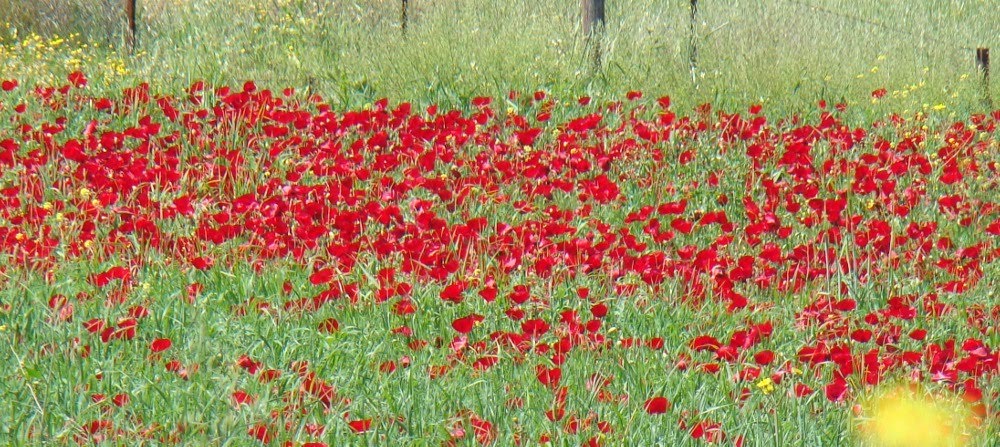
Five Greek poppies, three varieties

This blog began two years ago today.  At the time, I had no conscious intention as to where it was going, but I would have been quite certain that I couldn't have found 121 topics to write about.  I began the first in a garden, and I returned to the garden a year ago.  This year it is less a garden than a war zone.  I was unable to keep up with it for the most important two months of the growing season, what with Byzantine conferences in Australia and at Dumbarton Oaks, a new grandson, and two cataract operations, and now it is daily hand-to-hand combat.  It is profoundly disturbing to be aware that all the time I am weeding, the weeds are growing just beyond my reach.

It is quite obvious why God put humans into his garden, when you see what happens to a garden without them, and a garden is a poor place on which to base one's theology, if you consider the preponderance of strangling plants. That must be where the idea of the snake came from, though the person who made up the story knew little about gardening or snakes, either.  The best thing you can say about garden theology is that much of the real work is done on one's knees, and I am always fascinated with how respectful passers-by are of me when I am down there in the dirt communing with the weeds. And the tiny yellow-bellied spiders. And the beetles.  There was a magnificent beetle this afternoon in many-sectioned silvered armor.

This spring and early summer were unusually chill and wet, superior for the strangling plants, but very poor for almost everything else, and especially too cool for sitting under the grape arbor.  Most of the small cherry crop spoiled on the tree before it ripened. Nine-tenths of the iris failed to bloom at all. Several dozen large buds on the Abraham Darby roses aborted. The Pat Austin produced of two roses, neither of which could hold her head up. On the other hand, I thought the Tradescants had been ruined by black spot  but they have pulled themselves back splendidly.  The rugosas have been great -- especially the pale yellow that was up for eviction for non-production, and the weebly white rose that has looked like fainting for four years abruptly threw out half a dozen blooms before settling in to produce three new canes.

And the poppies! The poppies have been spectacular.  Glimpsing the small patches of poppies is like hearing laughter.  They have gone about their business, unaffected by the chill and the damp.  There are new ones this year -- large dreamy things like girls in floaty dresses -- mixed in with the cornflowers, each in a different shade of red, pink, orange, yellow.
 
But the faith and the love and the

-->
The giant poppies, both up by the house and down at the sidewalk, have been stupendous.  After several years of three or four begrudged blooms, they have erupted into dozens.


-->
We have identified three varieties of poppies resulting in the seeds brought back from Greece over the years, and here I have learned a profound lesson.  I had noticed in Greece that poppies tended to grow in land that had been turned over and I have been careful to dig up their patches every fall.  The poppies grew up full of tall grass and weeds, so I carefully over several days weeded between their slender stems and untangled their necks from the tall grass.  Weedless, the poppies lay down on the ground and declined to stand.  I carefully staked each one.  Staked poppies look like prisoners in the stocks.  


Then the Eureka! moment.  Greek poppies often grow in grain -- which of course needs the land turned over -- or tall grass.  As you can see in the picture below, the buds hang completely down (unlike the buds of the giant poppies above) and hook if they can onto whatever is nearby.  Thus they have the support of the grain or grass that is also growing up.  When they are ready to bloom, the heads have got up to the surface of the field, nicely propped, and then the hook straightens out for the full bloom.  Poppies need their weeds.  I will know this next year.  As with tomatoes and children, you cannot get lovely results by insisting on your own way.


-->
The color of the poppies changes as they age, or even as they move against the light.  We have little space in the yard, really, and I cannot help comparing my small patches with the fields  I saw last 16 April near Midea.


Some poppies photograph with more success than others.  We also have the lemon Icelandic poppies that appear individually in odd places, such as beside the posts of the arbor:


-->

or the so-called California poppies (not really poppies) that bunch in corners like piles of tangerines. 


The best picture, I think, is this that shows the extraordinary beauty, magnificent with spots like the great cats, of poppies that have been surprised by time.


-->

. . . there is yet faith
But the faith and the love and the hope are all in the waiting.
Wait without thought, for you are not ready for thought:
Wait  
-->
So the darkness shall be the light, and the stillness the dancing.
Whisper of running streams, and winter lightning.
The wild thyme unseen and the wild strawberry,
The laughter in the garden, echoed ecstasy . . .
From T. S. Eliot, Four Quartets:East Coker

15 July 2010

Fletcher


Fletcher is missing. There is no picture of William Fletcher.

Two hundred years ago this July, George Gordon, Lord Byron (left), and John Cam Hobhouse, Lord Broughton (right), were starting their travels in the Morea.

If you want the interesting things, read Hobhouse --it would make a great buddy-movie. Byron's reports in his diaries and letters are infuriatingly brief.  But something they both wrote about was Fletcher.  Fletcher was Byron's valet, but only in a technical sense.  What he was was their scapegoat.  Here is Hobhouse:


"We had only one English servant with us, who was my friend's valet; for I was fortunately disapointed the day before I left London, of the man who was to have accompanied me in our travels: I say fortunately, because English servants are rather an incumbrance than a use in the Levant, as they require better accommodation than their master, and are a perpetual source of blunders, quarrels, and delays. Their inaptitude at acquiring any foreign language is, besides, invincible, and seems more stupid in a country where many of the common people speak three, and some four or five languages."  

And here is Byron (he had finally sent Fletcher back to England): 

"I cannot find that [Fletcher] is any loss, being tolerably master of the Italian & modern Greek languages, which last I am also studying with a master, I can order and discourse more than enough for a reasonable man. ----Besides the perpetual lamentations after beef & beer, the stupid bigotted contempt for every thing foreign, and insurmountable incapacity of acquiring even a few words of any language, rendered him like all other English servants, an incumbrance. ----I do assure you the plague of speaking for him, the comforts he required (more than myself by far) the pilaws (a Turkish dish of rice & meat) which he could not eat, the wines which he could not drink, the beds where he could not sleep, and the long list of calamities such as stumbling horses, want of tea!!! &c. which assailed him, would have made a lasting source of laughter to a spectator, and of inconvenience to a Master. ----After all the man is honest and in Christendom capable enough, but in Turkey--Lord forgive me, my Albanian soldiers, my Tartars & Janizary worked for him & us too as my friend Hobhouse can testify."  

They had started out with "a Tartar, two Albanians, and interpreter, besides Fletcher," but it was Fletcher who received the abuse: "Fletcher too with his usual acuteness contrived at Megara to ram his damned clumsy foot into a boiling teakettle." "That timber-headed Fletcher. . .." "Fletcher is fat and facetious."  Byron was not a very nice person in those years -- "I have kicked an Athenian postmaster" -- not that Athenian postmasters, or the postmistress at the Kolonaki postoffice in particular, don't on occasion trigger such an impulse.  But read Hobhouse again and see what Fletcher was up against:


"Our baggage was weighty; but, I believe, we could not have done well with less, as a large quantity of linen is necessary for those who are much at sea, or travel so fast as not to be able to have their clothes washed. Besides four large leathern trunks, weighing about eighty pounds when full, and three smaller trunks, we had a canteen, which is quite indispensable; three beds, with bedding, and two light wooden bedsteads. The latter article some travellers do not carry with them; but it contributes so much to comfort and health, as to be very recommendable. We heard, indeed, that in Asiatic Turkey you cannot make use of bedsteads, being always lodged in the khans or inns; but in Europe, where you put up in cottages and private houses, they are always serviceable, preserving you from vermin, and the damp of mud floors, and possessing advantages which overbalance the evils caused by the delays of half an hour in packing and taking them to pieces.

"We were also furnished with four English saddles and bridles, which was a most fortunate circumstance, for we should not have been able to ride on the high wooden pack-saddles of the Turkish post horses; and though we might have bought good Turkish saddles, both my Friend and myself found them a very uncomfortable seat for any other pace than a walk.

"Whilst on the article of equipage, I must tell you, that as all the baggage is carried on horses, it is necessary to provide sacks to carry all your articles. These sacks you can get of a very useful kind in the country. They are made of three coats; the inner one of waxed canvas, the second of horse-hair cloth, and the outward of leather. Those which we bought at Ioannina were large enough to hold, each of them a bed, a large trunk, and one or two small articles; and they swing like panniers at each side of the horse.

"Some travellers prefer a large pair of saddle-bags, and to have a large chest or trunk, which they send round by sea to meet them, or leave at one fixed spot; but this is a bad plan: the saddle bags will not carry things enough for you; and then to have your wardrobe at any fixed spot, binds you to one route, and prevents you from taking advantage of opportunities."  

So if you are fortunate enough to be traveling in the Morea this summer, take a moment of silence for Fletcher.

09 July 2010

Nauplion: Spolia


Spolia mean "carvings from previous periods patched into later buildings," and you would think that there would be a lot to find in Nauplion -- it has been inhabited since Palaeolithic times. I have spent a lot of time looking for spolia in Nauplion and I think I have located very nearly everything in the old city that can be seen by the normal visitor, though I suspect there may be a few pieces embedded in private residences.  (Note: I didn't find them all.  Here are more.)

This is a catalog of my twelve public finds, not counting one whose photograph has gone missing. The first, and best, is the Byzantine lintel of the garden entrance you see above, at the right of the top of the stairs to Akro-Nauplion.  
You can see a similar usage of two pieces, one classical and one Turkish, over the door of the house under the platan tree on the plateia.  The initials of the builder of the house, and the date, 1878, have been added to the Turkish slab.

At the other end of the plateia are the four late-antique capitals of the columns of the little mosque built soon after the Turks acquired Nauplion in 1540.
A few doors down the main street from the mosque, you will find this small Turkish piece on the right: 
One I particularly like -- this is the picture I don't have -- is a house on the main cross-street where a Turkish block with carved rosettes has been sawn in half length-wise and the halves used to support windows.  The halving was not done at perfect right angles and the slight slant to each piece is beguiling. At the top of the the stairs on the hillside in the little neighborhood above the bus station is this classical lintel. It does not quite cover the whole space that it should, but the piece was more important than correct construction. The capitals are confusing.

On the north side of the Panagia church, beside the red cafe, a classical door step has been used for the lintel of a window, unattractive but significant -- significant building elements have been left uncovered all over the outside of Panagia.  You can see in this lintel the holes for the pivots of the doors. 

Behind Panagia, among the graves, is a stone I am unsure about, but it seems to be a Venetian shield to which Turkish cypress trees have been added.
 
Finally, two shields once used for fountains, one Turkish, one Venetian. The Turkish one has a little turban, and what appears to be a most remarkable smiling sun rising over clouds or rocks.  The Venetian dates from around 1700 and the surface has been uniformly chipped to remove any images.  I think the blue works well.

Should you find other spolia, please let me know.  A reader has sent his spolia collection and you can see them here.

03 July 2010

Wolf


Because one of our finest poets, W. S. Merwin, has just been appointed as Poet Laureate of the United States, I want to take the opportunity to print one of his finest poems, Piere Vidal. I have had it on my website for the last eight years. Piere Vidal was a troubador (d. 1205) and the text is based on his vida, his own account of his life.

Ezra Pound wrote another version of the Vidal text (p. 16 here), and although it retains some of the spirit of the original, it has Pound's typical self-indulgence, and nothing of Merwin's controlled fire.  It is worth comparing the simplicity of Merwin's vocabulary with Pound's use of the thesaurus.  Interestingly, it was Pound who told the young Merwin that he needed to study the troubadours.


PIERE VIDAL

I saw the wolf in winter watching on the raw hill
I stood at night on top of the black tower and sang
I saw my mouth in spring float away on the river
I was a child in rooms where the furs were climbing
and each was alone and they had no eyes no faces
nothing inside them any more but the stories
they never breathed as they waved in their dreams of grass
and I sang the best songs that were sung in the world
as long as a song lasts they came by themselves to me
and I loved blades and boasting and shouting as I rode
as though I was the bright day flashing from everything
I loved being with women and their breath and their skin
and the thought of them carried me like a wind
I uttered terrible things about other men
in a time when tongues were cut out to pay for kissing
but I set my sail for the island of Venus
and a niece of the Emperor in Constantinople
and I could have become the Emperor myself
I won and I won and all the women in the world
were in love with me and they wanted what I wanted
so I thought and every one of them deceived me
I was the greatest fool in the world I was the world’s fool
I have been forgiven and came home as I dreamed
and have seen them all dancing and singing as the ship came in
and I have watched friends die and have worn black and cut off
the tails and ears of all my horses in mourning
and have shaved my head and the heads of my followers
I have been a poor man living in a rich man’s house
and I have gone back to the mountains and for one woman
I have worn the fur of a wolf and the shepherd’s dogs
have run me to earth and I have been left for dead
and have come back hearing them laughing and the furs
were hanging in the same places and I have seen
what is not there I have sung its song I have breathed
its day and it was nothing to you where were you.


Both images here are manuscript "portraits" of Piere Vidal.  The original music and text of Vidal's vida can be heard on "Troubadors" by the Clemencic Consort (also from Amazon). Another Vidal song, "Pos tornatz sui em Proensa," is performed on Paul Hillier's Proensa. Both CDs contain the original texts.  W. S. Merwin has an elegant small book of essays on Provencal and the troubador Bernart de Ventadorn in particular,  The Mays of Ventadorn.