03 July 2013

O Palaiologos


 Ὁ Παλαιολόγος + ··
Partial signature of John VIII Palaiologos, 1439


In mid-June I had a letter from Daniel Moss, a London dealer in historical letters and manuscripts, asking for my help in confirming this partial signature of John Palaiologos. I say "partial" because the full signature is below:


 This is from the Laurentian copy of the Act of Union.   Ὁ Παλαιολόγος with the cross and two dots comes in the second line.  
+ Ἰωάννης ἐν Χριστῷ τῷ θεῷ πιστὸς βασιλεὺς καὶ αὐτωκράτωρ ῥωμαίων 
ὁ Παλαιολόγος+··
+ John Palaiologos, faithful ruler in Christ our God, emperor of the Romans +·· 


Here in the Venetian copy held in the Vatican, the signature line is broken in the middle of auto - krator.


I sent Moss the signature pictures I had, reading references, and a link to my blog on the Florence signing. We discussed the signature a little more, and the conversation seemed to have come to a natural end. Then four days later I received an e-mail from him in which he asked me if I would like to have it. Two weeks after Daniel Moss had first written me, I was holding John's signature in my hands.   

It is a large signature, 9 cm long, written with a quill pen. The ink is still red, red edging toward brown, but very red where it collected in the loops and down-strokes. 


At the bottom left of the paper is part of a watermark, an eagle with sun? a sphere on a rod?


At some point, the paper with the signature (16.8cm x 7.7cm) was glued at six places to a slightly larger, darker, stiffer paper.  Someone made a note on it that says:  The signature of the emperor Palaiologos to the Condordat / between Eugenius IV & the Emperor, made St. Maria / Novella in Florence 1439. In the Laurentian Library.


The signing was not done at S. Maria Novella: that is the Dominican convent where most of the Greek delegation was staying. Fra Angelico was working there at the time, and his assistant was the young Benozzo Gozzoli who later painted the Greeks into his frescos for the Medici chapel.  

The Act of Union should have been signed on July 2, but an error was found in the text and the whole thing -- in Latin and Greek -- had to be recopied, the Latin text on the left side, the Greek on the right.  The Greeks signed in the early afternoon of 5 July, a Sunday.  They signed at the Palazzo Peruzzi where John was staying, a palazzo where the Florentine government put important visitors, on the main route from the piazza to S. Croce, and quite a long way from the rest of the Greeks.  They signed in order of precedence, witnessed by three Latin bishops.  Then John sent the document with ten clerics and four court officials over to Pope Eugenius.  John said that Bessarion would make a speech when they got there.  Bessarion did, a long one, and after the speech everyone went into another room where the Pope signed Eugenius catholice ecclesie episcopus ita diffiniens subscripsi, followed by the Latins in order of precedence.  The next day, Monday July 6, was the formal day of Union.  A high mass was said at the Duomo.  Somehow, arrangements could not quite be worked out for an Orthodox liturgy. 

Later in the month, four or five more official copies were signed -- this was at the Pope's request.  John said, "Why five?  Two are enough -- we take one and you take the other" -- and then still more copies, with varying numbers of signatures, depending on who showed up, or who had left town. The cost of the gold for the Emperor's seals would have made seals for twenty-nine of them, looking at the footnote in Gill: seals for four, looking at the footnote in Syropoulos.


* * * * * *


On the back of the paper for my signature is written, very small (2.8 cm):  .


* * * * * *


Thank you, Daniel Moss


Thanks to Walter Andrews for his help.

26 June 2013

Demetrios fled to Galata


Constantinople and Galata, 15th C Florentine chest. MMA.

Sphrantzes writes:
In the summer of the same year (1423), the αὐθεντόπουλος Demetrios, accompanied by Ilario Doria and his son-in-law, George Izaoul, fled (ἔφυγεν) to Galata with the intention of going over to the Turks; if they did not get to them, to Hungary instead.

Syropoulos writes:
Matters were in a critical situation because of the war, and the despot Demetrius was forced, at the beginning of the second year of hostilities, to flee (ἀπέδρᾳ) to Galata with Doria, γαμβρός of the Emperor. His father and mother urged him to return, but he was unwilling. His intent was to go to the emperor of the Germans. They unwillingly allowed this and arranged his voyage in company with Matthaios Asan, Doria, and several other archons.

I have written on Demetrios before.  Nearly everything I wrote was wrong, and this is a reconsideration.

In 1423 Demetrios was sixteen and at loose ends.  His father had offered him Lemnos the previous year but he refused to go. Then his father had a devastating stroke, which made his brother John sole emperor. His older brothers Theodoros and Andronikos were despots (although Andronikos would give up Thessalonike in September).  Constantine had recently come of age and, although we know nothing about him until he became regent for John in November, he was undoubtedly demonstrating a sense of responsibility. 

Demetrios went across the Golden Horn to Galata.  Galata was a self-governing commune under the rule of Genoa, and so going to Galata meant Demetrios had left the Eastern Empire.  Other discontent young men went with him -- George Izaoul had been turfed out of Ioannina which replaced him with Carlo Tocco, and Demetrios Kantakuzenos of Trebizond who was in Constantinople because of family problems there.  Matthaios Asan went: he remained a close friend for the rest of their lives, later governing Corinth, then arranging a face-saving surrender to Mehmed.  Demetrios married Asan's sister. Izaoul's father-in-law, Ilario Doria, is more difficult to explain: he had married Manuel's half-sister, and perhaps he, too, felt he had been passed over once too often.

The two different accounts reflect, to a great extent, the prejudices of their writers.  Sphrantzes, writing fifty years after the event, showed consistent disapproval of Demetrios whenever he came into the narrative.  Syropoulos, writing an account of the Council of Union, was anxious to portray Demetrios in as good a light as possible because he had been a supporter of the anti-unionists during the miseries of Ferrara and Florence.

Ganchou (below) adds an important element to the story in printing a letter from Francesco Filelfo  to Cardinal Piccolomini.  Filelfo not only substantiates the Sphrantzes account, but says that John had sent him to Hungary to  tell Emperor Sigismund that Demetrios might be planning to go over to the Turks, and to ask his help in heading it off.  But Filelfo also says that there was trouble between the brothers. This is important to remember, even if we don't know what it was.

John was nearly double Demetrios' age, and his teenage years had been burdened with training for being emperor.  At present he was burdened with a dying father and his differences with his father, and overwhelmed with the threats to the City, the Morea, and Thessaloniki from the Turks.  

There is no information about Demetrios for 13 years.  He took up the rule of Lemnos in 1425 (once he was of age -- he had rejected the position earlier, when he would have had to have a regent), and later  married (probably) the sister of Kantakouzenos Stravoummetes, a governor of Lamia. She died.  He married Zoe Paraspondylos in the spring of 1436. Then in November 1437 he was required to accompany John to the Council of Union at Ferrara.  Syropoulos quotes John as saying, "Everyone knows why he has to come with us."  Disloyalty is assumed, but there is no evidence.

What we know about Demetrios at the Council depends for the most part on Syropoulos, and recall that Syropoulos appreciates Demetrios' position (although Demetrios had been extremely rude to Syropoulos in Ferrara), while trying to show John at a disadvantage.  John was very much at a disadvantage: quite apart from the humiliation of having to attend the council at all, if he had a chance of aid for Constantinople, he was was in severe pain from gout, bedridden much of the time he was there, and surrounded by several hundred orgulous Greeks.

Syropoulos shows us John's public humilations of Demetrios, and Demetrios flailing to assert himself.  Demetrios was 30 years old by the time of the council, married, a despot.  At least twice, Syropoulos tells of John asking Demetrios for his opinion in doctrinal discussions, calling him ἀδελφούτζικε.   John took Demetrios with him and the patriarch to confer with the pope, then ostentatiously left him to wait in a courtyard for three hours. Demetrios left Ferrara and went  to Venice.  

When the council was forced to move to Florence in early 1439 because of plague, John asked Demetrios to join him. It took the patriarch -- Joseph II -- to persuade him to come, but John waited in Florence for three weeks for Demetrios to arrive.  There was another episode of ἀδελφούτζικε.  Demetrios asked the patriarch to help him get permission from John to return to Venice.  The patriarch did, but then a delegation of cardinals came to see John and he complained about Demetrios.  The cardinals asked him to stay until the end.  The patriarch -- very ill at this point -- conveyed the information to Demetrios who responded, "I will stay but not because of the cardinals: I stay because of the imperial command. Personally I have no information or experience with matters of dogma. I know nothing about the subject."


Then the patriarch died on 10 June.  He was buried in the Domenican church of S. Maria Novella where many of the Greek delegation had been staying. Demetrios participated in the funeral service, then four days later left for Venice with Gemistos and Scholarios who could not bear to be present for the signing of the Act of Union. On the way back to Venice, a group of Latins tried to attack an elderly bishop in their group.  Demetrios protected him.  Syropoulos gives other incidents where Demetrios stood up for anti-unionists.  It was with this trip to the West that Demetrios built up his great store of credit with the anti-unionists, and why he had so much support in his later attempts to gain the throne.


This is enough for now.  Demetrios  is regarded as the black sheep of the Palaiologos family.  Sphrantzes is taken as the last word. Barker calls him "reckless and selfish," and "worthless": that seems to be the preferred view which disregards his apparently competent rule on Lemnos and at Mistra, his recorded acts of kindness, and his friendship with Gemistos. 


History prefers the sacrificial lamb to the black sheep.


T. Ganchou, "Giourgès Izoul de Ioannina, fils du despote Esau Buondelmonti, ou les tribulations balkaniques d’un prince d’Épire d’possédé," Medioevo Greco 8 (2008) 159-199. If you need a copy of this article, I will be glad to send it.  

See also, Ganchou, “IlarioDoria, le gambros Génois de Manuel II Palaiologos: beau-frère ougendre?" Revue des Études Byzantines 66 (2008) 71-94.

20 June 2013

How they died in Venice, Part Two


Detail from icon of church of S. Giorgio dei Greci.
Georgios Klontzas, 16th C. Complete icon, 47 x 71.5 m.
Museum of the Isituto Ellenico, Venice.


The necrology for the Greek community in the parish of S. Antonin lists 1766 names. I worked with the first 500 of them, from 1569 through 1655. One of the things you see is an increase in the annual listings, so that by the end of the 500, it appears that the Greek community of the parish has doubled in size.  Events in Cyprus and the current war in Crete would have been major contributions to that growth.

One of the things I noticed, in trying to relate names and identify families,  is that in the very few instances where the register records the deaths of husband and wife, there is a 17-20 year difference in ages. Of course, this does not allow for second or third marriages, but the register would not have information from which you could identify second marriages.

Another gender discrepancy is in the
diagnosis of vechiezza (old age) – as the cause of death. Nearly 4 times as many women as men die of old age. Vechiezza appears at age 70 – appropriately. What I find particularly interesting here is that a number of these elderly women are identified as calogerà (nun). Of the 13 nuns in the necrology, 8 are aged 80 and over.   Forty-nine women die after the age of 70, while only 32 men do. Three people live to be more than 100: I suspect that means "very very old and no one really knows how old," but someone might have had a record. 

* 1570, 4 March. Dona Marula, a Greek from Corfu, about 70, sick 10 days with fever, no doctor. * 1579, 2 April. Madona Anna, Greek, aged 80, ill since August from vechiezza; treated by the excellent Mr. Fabritio Rizi.
* 1630, 12 October.  The widow of Todero Profetti (see below), age 85, from vechiezza after 3 days.
There is a large gender discrepancy in deaths at younger ages. In their 20s and 30s, 65 men died compared with 36 women.  In their 40s, a few more women than men died, and then in their 70s and 80s, 25 men died compared with 33 women.  A great deal could be done with statistics from these 1766 entries by someone who actually knows how to work with statistics.

* 1594, 12 July.  Matteo, son of Agapito, carpenter, age 16, fell from a balcony in the night.
* 1649, 8 May. Gerolemo Karamani from Kefalonia, passenger on the ship Isabetta for Zakynthos. Went on the boat to Malamocco yesterday, found drowned today, about 30.
* 1651, 19 September.  Sacari da Schiera of Thessalonike, about 32, from a compound fracture, had fever for 6 days.  Doctor, the excellent Cortacci; surgeons, Sr.i Orfeo and Zuane Bongioti. 

The leading diagnoses for the first 500 reported deaths are: fever (110); consumption/etico (37); Catarrh/cataro (31); ponta (22); typhoid/febre maligna (17). I have put below a list of all the diagnoses I found.  Here are a few more of the dead.  I keep thinking of what Makryannis said: "He was only a Greek: there was no one to ask where he had gone."

* 1621, 3 January.  Zorzi from Cania, about 40, brought into the church of the Greeks murdered.
* 1621, 12 March. Sr. Todaro Profetti, age 75, bed-ridden for several years with gout. 
* 1630, 29 September.  Sr. Calogera, age 25, ill 5 days with malign fever and upset stomach.  Doctors were Agapito and Morattini. 
* 1640,  27 May.  Yanni, son of the late Piero from Cyprus, shoemaker, about 34, killed on the bridge of the Madonna on the way to S. Antonin. 
* 1643, 13 November.  Dona Marietta, Greek slave, age 70, sick for a month, died from catarrh.

Elizabeth was severely depressed:
* 1613, 12 May.  The magnificent Sr.a Elisabetta Cubli, wife of the magnificent Sr. Lorenzo, age 56, ill for 8 months with a melancholic humor; was seen by the most excellent Galdino and Savoian.

I have wondered if Yanni was a suicide:
*1613, 30 May.  Yanni from Nauplion, age 65, went swimming yesterday evening and drowned.

.
Diagnoses in death reports, 1569-1655.
amalata
anegato
apostemo
asmo
bruta
cancaro
cascata poplectica
cascato
cataro
cataro & vechiezza
cattaroi di gambe
dolor
dolor colici & febre
dolor de cuore per pauro
dolor di vita
ettico
ettico & anco
ettuci & sciatica
febre
febre & fredo
frebre maligna
febre maligna & ponto
feruti
ferito, amazzato
ferito, archibusada
ferito – molte
ferito – taglio & febre
ferito di testa


fersa
flusso
flusso di sangue
fersa
flusso
flusso di sangue
gotte
hidropisia
hipopletica
incurabile
lepre & febre
mal della lova
mal di marea
mal di pietra
mal d'orina
mal in gamba
humor malinconici
malaria
malaria – febre quotidiana
malaria – febre terzana
malatia longa
malcaduco
male interno
matezza
mazuco & petechie
morbo Gallico & febre
morte subitanea
natta sulla testa


parotide
parto
percosia
petecchi
piaghe
piaghe & cancrene alli piedi
ponta
porzano in stomaco
postema
resipilla nella facia
rottura
schena & febre
scontraura
siro & malcaduco
smilza & febre
spasmo
stomego
strettura de peto
strigada
subitanea
tossicato & febre
tumor & febre
variole
variole & stariole
variole & febre
vechiezza
venen
vermi

Οι Αποβιωτηριες Πραξεις Ελληνων στο Αρχειο του Ναου του Αγιου Αντωνινου Βενετιας (1569-1810) /
Gli atti di morte dei Greci nell'archivio della chiesa di Sant'Antonin di Venezia (1569-1810).
 2001.


13 June 2013

How they died in Venice, Part One


Detail from icon of church of S. Giorgio dei Greci.
Georgios Klontzas, 16th C. Complete icon, 47 x 71.5 m.
Museum, Istituto Ellenico, Venice.


Several years ago, the Istituto Ellenico published a necrology of the Greek community in Venice 1569 through 1810. This consists of the Greek listed in the death register of the parish of S. Antonin, which included the neighborhood of the Greek church, S. Giorgio dei Greci. The Council of Trent, in one of its wiser decisions, had required that each parish church was to keep a record of deaths in the parish, regardless of religion, and so as of 1569 we have names and causes of deaths for Greeks. 

* 1586, 4 September. Dona Maria Papadia died, age 40, in childbirth.
* 1598, 4 July. Piero, son of Mastro Andrea, tailor from Cyprus, 1 year old, from smallpox after 6 days.

I worked with the first 500 names in the necrology, from 1569 to 1655.  A little more than half of these names were of men. It is difficult to be confident the numbers for gender, but for children under a year, 48 boys are listed in comparison with 17 girls. I estimate at least 30 more girls.  Unfortunately, we have no idea whether all the Greeks who died in the parish of S. Antonin were included -- I think not. The register depended on someone's going to the parish clerk and reporting the death.  We have no idea how many Greeks lived in that parish or in Venice at any particular date. But the information we do have gives us glimpses into who some of these Greeks were and what kind of lives they had.

* 1583, 14 April.  Margaritta died, daughter of Sr. Balgian Sosomena, Cypriot, 1 year old, two months after a beating.
* 1611, 10 February.  Geronimo, son of Nicolò, Cypriot, about 22, took off with a boat, and fell in the water and drowned.

* 1617, 8 June. Stamatello Coliva from Corfù. He was sick for 8 days on the galley of the Most Illustrious Zorzi, and 4 days on land with fever. He was visited by the Most Excellent Sr. Costantin di Medici
.


Costantin di Medici was the attending doctor.  We know nothing about his abilities as a doctor -- his name only appears for deaths, but we learn that his own wife died in childbirth.  The doctor Pasqualin Giavanelli lost 2 sons in 6 months, and the doctor Hercole Stavrinos lost two newborn daughters in two years. 

The necrology shows that 16[6] newborns died out of the 500, 62[20] infants in the first year of life out of that 500. For the largest single infant death diagnosis, 28[14] died from tetanus: that is a common killer in the 3rd-4th-5th worlds today and can come from any injury, but especially from infection of the umbilical cord.  The next causes were smallpox and dysentery.

A number of children die from vermi, worms -- no adults.  Worms most frequently kill because they can cause lethal anemia.  Two of the children here died from "suffocation by worms" -- they may have strangled on their vomit, or this may describe the intestinal blockage that worms can cause, or the anemia and the ultimate inability to take in oxygen.  Malnutrition in a population makes its presence visible in intestinal disorders among the young, and intestinal disorders generally seem to be blamed on worms.  So what is interesting here is that the diagnosis may have more to do with ideas about worms, than with an actual medical reason.

What we get in these death reports, particularly with the deaths of the children, is the brutal reminder that they died mostly because of the lack of cleanliness.  We have to envision the near-impossibility of being clean in an urban environment before running water -- clean hands (and fingernails), clean cloths, clean water, clean utensils for food.  Nearly all the infant deaths relate to something readers here simply take for granted, but something that is not at all simple. 

* 1595, 5 December.  Yanni, son of mastro Zorzi, Greek tailor, age 3, sick from worms and smallpox for 6 days.
* 1596, 29 September.  Momolo, son of mastro Andrea, Cypriot tailor, infant of 16 months, sick for several months from worms.
* 1598, 8 May.  Christina, daughter of Sr. Zorzi, Greek tailor, age 4, sick from fever for a year.
* 1599, 16 November. Yanni, son of Zorzi, Greek tailor, born in the night.
* 1614, 31 August.  Veneranda, daughter of Bona of Constantinople, age 3, suffocated by worms yesterday evening at 4 hours of the night (10 p.m.).


To be continued:


Οι Αποβιωτηριες Πραξεις Ελληνων στο Αρχειο του Ναου του Αγιου Αντωνινου Βενετιας (1569-1810) /
Gli atti di morte dei Greci nell'archivio della chiesa di Sant'Antonin di Venezia (1569-1810).
2001.


06 June 2013

Evliya writes of the channels of Egriboz/Negroponte


The channels of the Euripos at Egriboz/Negroponte. 
Detail from Camoccio etching, ca. 1571.


Kiliç Ali Pasa became admiral of the Ottoman fleet shortly after this story took place. His personal story began when young Giovan Dionigi Caleni was taken captive from a coastal town in Italy, Capo Rizzuto at the SW corner of the gulf of Taranto,  and enslaved.   After some resistance, he converted to Islam, and his natural abilities allowed him to rise rapidly in the Ottoman fleet. He became famous as the pirate Occhiali, alternating periods as a corsair with naval service, and Capo Rissuto now has a memorial to him. .  He was the only Ottoman commander to escape from Lepanto, bringing out with him the remnants of the Ottoman fleet. He was a patron of the aged architect Mimar Sinan who built the  important Istanbul mosque named for him.

Evliya appears to be the only discoverable source for this story. Pierre MacKay is my source and the translator. 


* * * * * *

(SN VIII250a23) A wonderful story  
In the year … in the time of Sultan Khan the second, Kiliç Ali Pasa, the supreme commander on the island of Cyprus, came to the aid of Kara Mustafa Paşa and, with four galleys of his own Uluç Ali Pasa chanced on 10 infidel galleons. He fought a fierce battle with the infidel, lasting all day and all night, until finally, making it appear that he would easily be worsted, “he took flight from the pursuit of infidels,” and with a dash forward at full stroke came into the harbor of Kızıl Hisar. But right behind the place where he intended to drop anchor, up came the wretched infidels in pursuit, so Ali Paşa could not stay there. He went on into the gulf of Negropont and dropped anchor beneath the castle and lay there without fear or apprehension. But the infidel with his ten galleons came into the mouth of the strait and lay at anchor there, saying, “Whenever the Turk leaves, he is mine!" 


 Note "Molini" to the right of the little castle, and the mill wheels behind.
With the genius of an Aristotle, Ali Paşa took the marines and galley slaves out of his four galleys in the middle of one night and, at either side of the water in the channel that flows beside the mills of the castle bridge, the ones we have already mentioned, he massed a group of prisoners at the rock, with the picks of Ferhad in their hands. Then he had them cut away at the rock on either side until the channel was wide enough for a galley to pass through and, in the middle of the night, he took out the awnings from the four galleys they belonged to and set them up on land. Then he went out with the four ships through the afore-mentioned mill channels he had cut, on past the point of Oreos, at the far end of the island, and back down around the point of Kızıl Hisar. In the early morning, the infidels, seeing from their ships that the Turkish awnings still remained in the harbor, were off their guard but, at that very time of morning, while all the infidels lay drunk and besotted in sleep, Ali Paşa, with his four galleys, entered the infidel ships crying, "Allah! Allah!" and rounded up the infidels from both bow and stern.

Thus, Ali Paşa herded the infidels up into their own ships at sword’s point, in the twinkling of an eye and, by the will of God, he captured ten enemy ships with four galleys. When he returned victorious and successful to the royal palace, having overturned the idols of the infidels, with their crosses, he was received with a great celebration of cannon and musketry fire by Selim Khan himself. Afterwards he held the fully independent post of Grand Admiral, with three horsetails and, near the Arsenal, he built a luminous mosque out of the great booty he won. Even now, in the place where Ali Paşa cut away the rock, at the channel for the Egriboz mill, if it were desired, one could remove the mill wheels from the channel, and it would be possible for a (/5/) galley to pass through. So much for that.


Kiliç Ali Pasa's channel, much widened, is the channel now seen at Halkis.  The previous, main channel was closed up over several centuries, and the island castle and city walls destroyed in the late 19th century. Pierre MacKay is currently preparing a study of the history of the dual channels at Negroponte for which previous authors have made assumptions, mis-citations, and unsubstantiated claims.


02 June 2013

Our Lizzie


Sixty years ago this day -- 2 June 1953 -- I was in Nigeria, huddled with a group of Baptist missionaries beside around a short wave radio attached to a car battery, straining through the static to hear the occasional word or trumpet from the coronation of Elizabeth II.  She had become Queen in Africa, I lived in Africa -- it was too wonderful!

In January 1979, I flew from Greece to London to meet E. It was cold, cold to the bone, unbelievably grey after Greece. E kept saying he did not "get" the monarchy, so I took him to see the crown jewels at the Tower. When I had first seen them in 1953, they were in the Round Tower, and I remembered walking around the glittering mound of gold and jewels. In 1979 they were in a different space, set along a table as if for an estate sale, poorly lit, without glitter and glamour, over-determined tawdry gilded ostentation.  The exhibition room seemed nearly as grey and chill as outside.

We were in line behind a young schoolteacher and her class. The children were conspicuously poor, over-run shabby shoes, darned socks, patched elbows and knees, coats with mis-matched buttons and sleeves too short, but they and their clothes were very scrubbed and clean. They seemed very soft, very blond, like a flock of goslings.  They were so very good. They looked dutifully at each item, clearly no more impressed than were we. Then a girl stopped and gasped.  The children near her stopped and looked where she was pointing.

"Ooh, look!" the gosling breathed. "It's our Lizzie's crown!"

The children flocked, a soft shared "Ooh!" floated up, and for a moment the childrens' radiance made the jewels shine.


28 May 2013

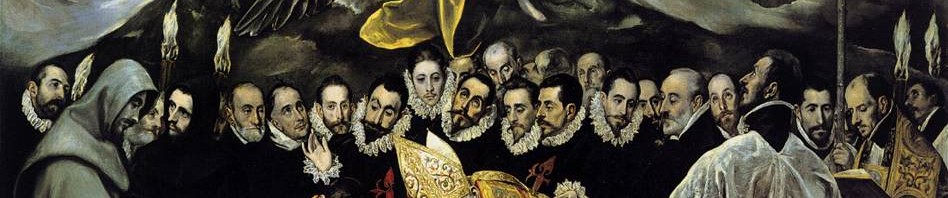
The Burial of Count Orgaz

The Burial of Count Orgaz, Santo Tomé,Toledo.
1586-1588. 480 x 360 cm.


This is the greatest painting I have ever seen. It is a very large painting -- more than fifteen feet high, and nearly twelve feet wide, and it hangs in the location for which it was painted.  There is a row of chairs where you sit in amazement, a very poorly-dressed extension of the witnesses to the miracle, witnessing Miracle.

The fourteenth-century Count Orgaz was noted in Toledo for his great charity to the poor. At his funeral, Saints Sebastian and Augustine appeared and themselves lowered his body into the tomb.  Notice the saints' tenderness in this detail, the protective shape formed by their bodies  as they lift the dead weight of the body encased in steel armor, themselves encased in cloth-of-gold. The detail will enlarge a little here, but go to the link above to look at the extraordinary details of the embroidery on their vestments.


 Look at the extreme contrast in the sheer fabric worn by the man to the right, the detail so important that you can see how the surplice was constructed -- the central seam, the backing around the neckline, and then its fragility contrasted with the weight of the cloths-of-gold.  If you follow his hands, his left -- turned up and full of light -- points to an open hand, a red embroidery, the warmth of Augustine's colorful robe. His right hand -- turned down and dark -- indicates the Death's head on the robe of the officiating priest, probably Andrés Núñez, priest of Santo Tomé, who commissioned the painting from his Greek parishioner.

At his death in 1323, Count Orgaz, Gonzalo de Ruiz, had bequeathed Santo Tomé an annual donation. This was supposed to be collected from the good citizens of Orgaz as the town belonged to his seignury.  They had, reasonably enough, stopped paying in 1562, but two years later, Andrés Núñez brought suit to have it collected again.  He won his case, and decided to use the money for the chapel.  Some years later, in 1584,  Núñez got permission from his archbishop for a painting, and in 1586 a contract was signed with Domenikos Theotokopoulos.  


The commission specified the burial, the saints, and then the witnesses, which Theodokopoulos made into an extraordinary frieze separating the heavens from the earth, their flaming torches rising to touch the heavenly light, and their hands like flames. (This picture becomes much larger when clicked.)  


The commission also specified the glory of the heavens with an open sky, but the winds of the Spirit were too strong and they have filled the heavens with whirling clouds of witnesses and angels and saints, and pull the torch flames upward. The heavens are not so much full of light as they are are illuminated by the light shining out of the holy ones.

But the astounding thing in this painting is the conception -- and this is not a pun -- of the entrance to heaven.  Theotokopoulos has taken the Orthodox representation of the soul as a new-born infant, though in them Christ holds the infant soul above the dead saint.  Here an exquisitely beautiful angel gently guides the infant soul of Count Orgaz from the womb of the world through a cervix of clouds into the heavens.  Waiting by a person who is dying is very like waiting beside a woman in labor, and the heavenly witnesses turn in the intensity of their excitement at the death-and-birth to Christ.  Except for the only woman present, Mary, who is waiting to help the infant be born.


21 May 2013

The Spanish princess marriages


 Alfonso V.


"Spanish Princess" came into the United States by the 19th century as the name of a scam, and it would be difficult to prove that it was not a scam used on the Palaiologues in the 1440s.  The phrase may derive from the "Spanish prisoner" scam of 1588 in which money was sought to free a high-ranking prisoner. A high-ranking lady was offered as part of the reward in that one.

From 1442 to 1458, Alfonso V of Aragon, Barcelona, and Mallorca, was also king of Naples and Sicily.  Many of the Catalan ships that turn up in Moreote history were his -- it was one of his ships that took Constantine to Constantinople to be Emperor. When Constantine briefly held Athens between 1444 and 1446, Alfonso asked for Constantine to give it to him so he could renew Catalan Greece. For at least a decade, Alfonso held out promises -- to Constantinople, to Constantine, to Theodoros, to Thomas, to Demetrios -- of financial aid, of ships and troops, of brides.  Brides were of some concern: there were no male heirs after their generation to the throne of the Eastern Empire, and Constantine and Theodoros were currently unmarried.

The
story of Alfonso V is much too involved to relate here but some very slight details from the Spanish-princess promises have survived.

The summer of 1443 the Neapolitan consul to Constantinople, Pere Rocafort, had taken the new King Alfonso a series of proposals he had worked out with John: in exchange for the support of twenty to twenty-five galleys, Alfonso could have his choice of Imbros, Lemnos, or Skiros. John's brothers in the Morea could produce 40,000 horsemen and 20,000 archers (again, the epenthetic zero appears). Alfonso was to have a consul at Patras.  Thomas was asked for a coastal castle, while Constantine was to give Alfonso the fief of Chalandritza, inland from Patras, for a colony.  Bessarion thought this would be a great help for the Morea and wrote Constantine, "It will be of great benefit to our power and our future hopes to give an enthusiastic welcome to volunteers from whatever part of the external world who wish to dwell in Peloponnesus."

In addition, Alfonso was to arrange marriages for Constantine and Theodoros to two Spanish ladies related to him:
 "la una, jermana de don Pedro de Cardona, l'altra, filla del comte Gilabert dels Exovars."  The one for Theodoros was Beatriu Coloira Caterina de Cardona i de Villena, daughter of the Catalan Count of Collesano in Sicily, but whatever happend, she was married to two other people.

From 1443 through the summer of 1448, Theodoros was Despot of Selybria, a two-day ride from Constantinople, and a position that allowed him to obsess about becoming Emperor himself. He must have been conducting his own negotiations as in 1444, the Prince of Taranto had contracted to give him his niece and heir, Isabella of Claramonte, as a bride. 

Isabella was heiress to much of southern Italy, and the titles of Prince of Achaia and Latin Emperor of Constantinople had belonged to several direct ancestors. Probably no heiress in western Europe was more suitable for marriage to an heir to the throne of Constantinople.  Unfortunately for Theodoros, Taranto's overlord, Alfonso V of Naples, stepped in very quickly and married her to his (bastard) son and heir, Ferdinand. Ferdinand had six children by her, eight by other women. 

Theodoros apparently continued to negotiate for a Spanish bride, but he died abruptly of plague at the end of July 1448, before anything could happen.  One of the eulogies for him says: 

O most holy despot, you sent out envoys to Iberia suggesting a most advantageous course for yourself, but time had different ideas and wedded you to a tomb. The returning messenger will carry a fine message, that you are dead, you have been committed to burial and that you have no further concern with life. How your betrothed will cry out, as instead of being surrounded by brilliance and splendor, she becomes dark and downcast. No wedding hymn will be sung for her, nor will the bridal lamps be lit; there will be only sad music, the shearing of her hair in mourning and wailing, prophetic of many evils, All this she has unhappily come to through your death.

That is all we know about that one. 


My great appreciation to Daniel Duran y Duelt for introducing me to this topic.


13 May 2013

The Tall Book


I still own, after 68 years, the first book that I remember, and in that memory I am in my crib refusing to be settled down for sleep if I don't have my book with me. The front cover is gone, and parts of many pages, but my favorite pictures survive.  The Tall Book -- this one is Mother Goose, and there are other Tall Books of fairy stories, of make-believe, of nursery tales, of Christmas -- was published in 1942, republished ever since. If you google on "the tall book" you can find an infinite number of original copies to buy, from $4.25 to $110 or so, as well as other books of the same name but not of the same character.


The artist, Feodor Rojankovsky, had only moved to the United States from Russia, by way of France, in 1941.   In my early years I had a stack of books illustrated by Rojankovsky.  He gave me -- and how many other children? -- the idea of an artist's style, the immediate sense of comfort and familiarity.  His images combine a quality I later learned to recognize as "European" with something else that could only be "American."  Like this boy who prepared me to meet Huckleberry Finn.  If his sweater was not American in 1942, his ears and sunburn certainly were.


It was only when I was reading The Tall Book to one of my own children that I recognized Humpty-Dumpty and could admire the slyness of the artist, or the publishers, who chose to publish this sequence in 1942.  


This lovely boy could be drawn from my grandson, Ryan:


A few more: