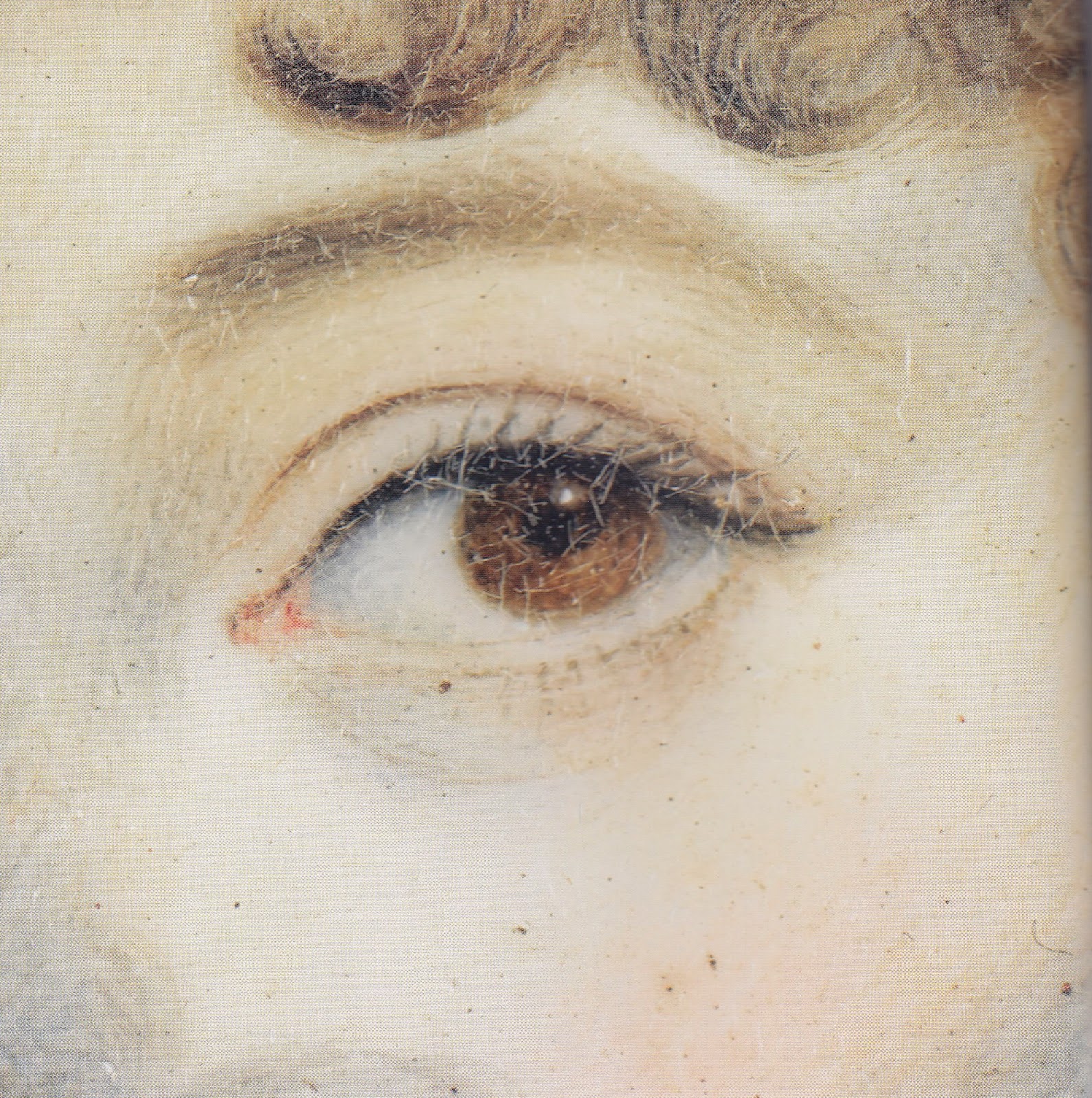
26 March 2012

Eyes


All the pictures are taken from the exhibition catalog,
The Look of Love.


I never knew there was a whole world of eye miniatures, but I have just encountered the catalog for The Look of Love, an exhibition currently at the Birmingham Museum of Art.  There was, apparently, for the short period of 1790 through 1820, an intense fashion for jewelry with a painting of the eye of your lover. Nan and David Skier of Birmingham have collected these miniatures for twenty years.  Ninety-eight of these miniatures are shown in the catalog.  I have selected eleven to show here, most of them set in pearls, to emphasize the enormous variation in presentation.

The word "miniature" should be emphasized. You are seeing pictures much larger than the originals. To judge from the catalog descriptions, very few of these eyes are half an inch long.  The detail is astounding.  More astounding is the unexpected intimacy and erotic power that can be conveyed by a single, painted, eye.

I was born in Birmingham, and the Museum of Art provided me a haven during some difficult times.  I hope they will take this as a note of gratitude.

* * * * * *


* * * * * *

The exhibition continues through June 10. The catalog can be ordered here.

20 March 2012

The Count of Paleopoli de Menelao

+ θεόδορος ἐν Χ(ριστ)ῷ τῷ Θ(ε)ῷ εὐσεβὴς 
δεσπότης Παλαιολόγος ὁ πορφυρογέννητος +
Signature of Theodoros II Palaiologos


On 29 May 1419, Theodoros II signed an argyrobull to Pope Martin V with a signature like the one you see here. Do appreciate the artistic Ts and enthusiastic accents -- they turn up in other family signatures.  A year earlier, Martin had signed a formal dispensation for the sons of Manuel II to marry Latin rite wives, and apparently the negotiators got right to work.  Theodoros' document begins, "Desiring the most serene lady, our dearest future consort, the lady Cleope Malatesta" and goes on to say that the gentleman, Mastino of San Sepulcro, has come with the marriage arrangements.

Theodoros promises that Cleofe will keep her religion ("in consueta devotione sua circa divinum cultum"), and the ceremonies of the Roman church in which she was raised, and that she can have a chaplain.  More than that, she can keep her Italian practices and customs ("mores suos ytallicos").  If he dies, she will be free to return home with all her possessions.  It didn't quite work out that way, but you can see that he was really quite enthusiastic at the beginning.

The gentleman, Mastino de Cattanei, of San Sepulcro -- a gracious city, home to the teenage Piero della Francesca -- is identified as Cleofe's "procurator and orator": he is authorized to speak on her behalf, or on her father's -- we don't know how old she was, we don't know anything about negotiations, we don't know how much leeway he had. He was probably suggested by the Pope. We do know that Theodoros seemed quite pleased with the result.

On June 19, a month after he wrote the Pope,  Theodoros signed an argyrobull -- that is the signature above, this time to Mastino de Cattanei, making him comes Paleopoli de Menelao -- Count of the Old City of Menelaus, or Count of Sparta.  This was a title that would be understood in Italy, and it turns up later in letters of 5 September 1420 and 19 June 1423 naming him as Senator of Rome. This is a grander title than it might seem: the Senator of Rome was its governor, though the term of service was a matter of months.  Another document written in Rome on 30 October 1423, commends Mastino's service as Senator. (Cleofe's father had been  Roman Senator twice, too.)  In the Cattanei palazzo in San Sepulcro, there was in the 1960s, may still be, a portrait of Mastino painted around 1600 which identified him as "Mastinus Cataneus eques, comes palatinus et senator Romae" -- Knight, Count Palatine, and Senator of Rome. Possibly he had received a title of count from the Pope, or possibly that referred to his title from Theodoros.

"Count" was not a title used in the Morea, and Theodoros probably asked Mastino or the person who wrote the document what would be a good Italian equivalent for a top-rank archon. The title went to Mastino, and his heirs.  They were permitted to make use of the double-headed crowned gold eagle in a red field on their insignia and shield, and they were free from taxes in the Morea. No one in the Morea noticed. Mastino did not actually receive possession of Sparta, or of any land: he got a title that turned out to be worth quite a lot to him in Italy.

These argyrobulls to Martin and Mastino are extremely interesting in that they are written in  Latin, rather than Greek.  Both needed to be understood in Italy.  The one to Martin has both Greek dating ("anno a creacione mundi sex milibus nonigentis viginti septem") and western ("millesimo quadringentesimo decimo nono, indicione XII, die vigessissima nona Madij"). That to Mastino is western, with slight variations ("millesimo quadrigenteximo decimo nono indicione duodecima et die decimanona junij"). Martin's was written "in palatio residencie nostre," while Mastino's specifies that it bears his silver seal with gold around hanging on a red cord, and is signed in Greek in red ink.

Who wrote these argyrobulls?


For the article and document on which this entry is based, go to:
"Un argyrobulle inédit du despote de Morée Théodore Paléologue," in
Revue des études byzantines 21 (1963) 208-220, here.

14 March 2012

Corcondille

Κροκοντηλος – Krokontēlos
Karitena
   

This is not the name Κροκόδειλος used in Mazaris and Sphrantzes for "crocodile," although most people then and now would not hear -- if articulated -- the difference between the sounds of -d- and -nt-. In fact, Sphrantzes wrote, "Κροκόντυλος , or rather, as his associates called him, Κροκόδειλος," making a distinction between the name and the animal.  Since Sphrantzes very probably knew Krokontulos Kladas -- both of them being associated with the despot Thomas in the Morea between 1453 and 1460, I have decided to use his spelling for the sake of avoiding as much as possible the automatic crocodile-association.

The man who paid for the inscription, a part of which is used as spolia at the church of Zoodochos Pigi, Karitena, is almost certainly not the Krokontulos of my concerns, but is probably in the family, even an ancestor.  This inscription -- I am told there are more pieces in a church but I have never been able to get access to the church -- identifies him as "servant of the basil---", probably the basilissa, Zampia Lusignan Kantakouzene of a century earlier.

I have recently been reading The Chronicle of Morea in the Greek, French and Aragonese versions, with the company of the splendid book by Teresa Shawcross,* examining the story of Corcondille.  Corcondille appears only in the French version, which looks like this:

Et trova .j. bon homme grec de la Grant Arracove que un sournom estoit appellés Corcondille, qui estoit la venue pour vendre sa soye: liquelz entra en paroles avec cellue chevalier. Sire monseignor Girars se corouça par yre que il ot. Si fery d’un tronchon de lance que il tenoit en sa main cellui Corcondille, ne say .j. cop ou .ij.
 or
There was a Greek man of standing at Great Arakova** whose surname was Corcondille who had come [to the fair] to sell his silk.  He had words with a certain knight.  Sir Girars struck him because of the anger he had.  He struck him a blow with the lance which he had in his hand, this Corcondille, I don't know, one or two blows.
[Notice it says "surname."  We know of several people named Ακροκόνδυλος in the 1370s.]

There was an annual fair, in June, in the broad grasslands just south of Nikli/Tegea -- beautiful country -- to which people came from all over the Morea. It was a Frankish fair but close to the Byzantine border.  Corcondille was a man of mature age, as we learn he has a Frankish son-in-law. He had public respect and owned a house in Great Arakova.  This public humiliation was untenable, and Corcondille felt he would die of shame if he did not make Sir Girars "die the bad death" -- "faire le morir de male mort."  He decided that the best way to go about it was to get the nearby castle of St. Georges into Greek hands.

Corcondille went up to see his kinsman, Leon Mavropapas at Chelmos in Mantinea.  Mavropapas commanded a contingent of Turkish mercenaries for the Byzantines.  They worked out a plan.  Corcondille went back south to his son-in-law, Amimo, who was cellarer of St. Georges, and his friend Bonifaces who was glad to share in any rewards. 

Mavropappas brought his Turks to a castle near the border, a hundred of them, travelling by moonlight.  The narrative is not perfectly clear, but it seems that Amimo managed to lock the look-out in the dungeon.  Crocondille and his friends came to the gate, overcame the guard and locked them up, and then lit a fire on the tower to signal Mavropapas who arrived at dawn with his Turks and took possession of St. Georges.

There is then a long narrative about the Frankish siege of St. Georges by Florent of Hainaut which involved building a second castle and importing a trebuchet expert.  The narrator sensibly says there is too much to relate, and that Florent died.  The narrative runs through 21 sections: Corcondille disappears after the 14th, and we never know if Sir Girors died the bad death.

Now, the version in the Aragonese chronicle omits Corcondille completely.  He tells of a commander of the Emperor going to the fair to buy horses -- whatever the price -- and arms.  Having done so he armed the Greeks who raided a celebration the Franks were holding at a church.  The commander apologized to the Frankish captain who rejected his apology.  So the commander went to the parallel Greek fair, and arranged for them to attack the Franks and then retreat.  The pursuing Franks were caught in an ambush, and the Greeks took the Frankish castle at Nikli and several others.

This is essentially the same story, told two ways -- the Greeks trick the Franks, using horses. (Does this story sound familiar?)


But there are three more stories in a very short chronicle accompanying the most important manuscript of the French chronicle that mention St. George.  Perhaps they are this story, perhaps not:


[Florent of Hainaut] fought with the emperor Quir (Kyr) Andronigo Paleologo which lasted 7 years after the taking of the castle of St. George of Scorta, which was in 1294.

In 1319, the 3rd indiction, on 3 February, at night, he took the castle of St. George of Scorta, by the treason of Mote--dou Liege and of  Nicolucho of Patras, who betrayed them and gave it to Sgoceco.*** 

In 1320, the 4th indiction,**** 19 September, the castle of St. George was given by Nicoluchus of Patras where he was castellan to Quir Andronico Assaigni (Asan).*****


The French chronicle is very clear that the castle of St. George was near the fair, toward the eastern side of the Morea, and that is what Scorta indicates.  It never tells us that Corcondille was given the castle.  This site cannot be identified on the ground.

The castle of Ag. Georgios that Krokontulos Kladas gave Mehmed II was toward the western side of the Morea, south of Karitena.  I deduce this from the routes and acquisitions of Mehmed given by the various chronicles. Additionally, Kladas was loyal to Thomas which indicates his land was in Thomas' despotate.  This site cannot be identified on the ground either  A third of the width of the Morea separates the two sites.

How does one link Corcondille and St. Georges with Krokontylos and Ag. Georgios?


*Teresa Shawcross, The Chronicle of Morea: Historiography in Crusader Greece (OUP 2009). 
 Review.  Amazon.  OUP.

** Possibly Karies. 
*** I don't know who "he" is and I don't know who Sgoceco is.
**** The indiction numbers are wrong for both years.
***** This section tells us that Asan also got Mathegriffon (Akova), Polyfengos, and Karitena.  They are too widely dispersed to be of any use in locating St. George.

08 March 2012

Giving up for Lent


Turkish wall photographed by Boryana Katsarova
National Geographic  


I keep being asked what I am giving up for Lent.

I am giving up.  

What I mean is this: For a period when my daughters were young, I went to New York one day a week for my job at Voice of America in Washington, DC.  I usually brought them back small presents.  One evening when I arrived home, the second daughter came tearing down the stairs and began pounding on me, "What did you bring me?"  I said, "I can't give you anything if your hands are not open," and then, stunned at the profundity of what I had just said, I dropped the presents.

 The gesture of giving up is hands upraised, open. The gesture of praise.  Or of prayer.  Or even of the presence of angels.


02 March 2012

On Vacation: Hawk Roosting

Bat Hawk, Joseph Wolf ca. 1860

                      HAWK ROOSTING                             
I sit in the top of the wood, my eyes closed.
Inaction, no falsifying dream
Between my hooked head and hooked feet:
Or in sleep rehearse perfect kills and eat.

The convenience of the high trees!
The air's buoyancy and the sun's ray
Are of advantage to me;
And the earth's face upward for my inspection.

 My feet are locked upon the rough bark.
It took the whole of Creation
To produce my foot, my each feather:
Now I hold Creation in my foot

Or fly up, and revolve it all slowly --
I kill where I please because it is all mine.
There is no sophistry in my body:
My manners are tearing off heads -

The allotment of death.
For the one path of my flight is direct
Through the bones of the living.
No arguments assert my right:

The sun is behind me.
Nothing has changed since I began.
My eye has permitted no change.
I am going to keep things like this.

     Ted Hughes


25 February 2012

On Vacation: There were four youths


This song by Nikos Gatsos was meant to be for the name-day of Theodoros Kolokotronis, but I have not been able to learn which Ag. Theodoros it was -- February 17 or March 3.


FOUR YOUNG MEN

There were four youths
Yiassou, Old Man of the Morea
You wrestled like a wild goat
teaching them constantly.

Swallows and swords
strung up in their hearts
high up over Karitaina
with the sun their neighbor.

There were four youths
Yiassou, Old Man of the Morea
no house held them
and time was on the march

Dark bitter years
on the bald heights
blood ran down
in the gorges.

When Easter came
they dressed like bridegrooms
and Death, the winged horseman,
rode behind.

There were four youths
Yiassou, Old Man of the Morea
no place held them
and time was on the march.

Road, road, and roads
it's written in the cards
they planted chrysanthemums
above the curse.

But when the time of orders came
like lightening on the earth
the ill-fated boys fell
like pine cones.

There were four youths
Yiassou, Old Man of the Morea
tell us if you saw them
 if you comforted them.


ΕΙΤΑΝ ΤΕΣΣΑΡΑ ΠΑΙΔΙΑ

Εἴταν τέσσερα παιδιὰ
γειά σου γέρο τοῦ Μοριᾶ
σάν ἀγρίμι πάλευες
κι ὅλο τὰ δασκάλευες.

Χελιδόνια καὶ σπαθιὰ
στὶς καρδιές τους ἀρμαθιὰ
πάνω στὴν Καρύταινα
μὲ τὸν ἥλιο γείτονα.

Εἴταν τέσσερα παιδιὰ
γειά σου γέρο τοῦ Μοριᾶ
σπίτι δὲν τά χώραγε
κι καιρὸς προχώραγε.

Χρόνια μαῦρα καὶ πικρὰ
στὰ βουνὰ τὰ φαλακρὰ
κι ἔτρεχαν τὰ ἅιματα
μέσ᾿ στὰ κλεισορέματα.

Κι ὅταν ἔφτασε ἡ Λαμπρὴ
στολιστῆκαν σὰ γαμπροὶ
πίσω τους κι ὁ θάνατος
καβαλάρης φτερωτός.

Εἴταν τέσσερα παιδιὰ
γειά σου γέρο τοῦ Μοριᾶ
τόπος δὲν τὰ κράταγε
κε ὁ καιρὸς περπάταγε.

Στράτα στράτα καὶ στρατὶ
ἔτσι γράφει τὸ χαρτὶ
πάνω ἀπὸ τ᾿ ἀνάθεμα
σπείραν χρυσάνθεμα.

Μὰ σὰν ἄστραπψε στὴ γῆ
τῶν καιρῶν ἡ προσταγὴ
πέσαν τὰ κακόμοιρα
σὰν κυπαρισσόμηλα.

Εἴταν τέσσερα παιδιὰ
γειά σου γέρο τοῦ Μοριᾶ
πέσ᾿ μας ἂν τὰ γνώρισες
κι ἂν τὰ παρηγόρησες.


Trans. DW.
Italian translation. 
Music, page 8.


 Drawing of Theodoros Kolokotronis  by Karl Krazeisen. 

For nearly all the poetry of Gatsos in Greek and English, go here.


19 February 2012

When the Palaiologos family visited Monemvasia


Dying child, fresco of King David
Voronet Monastery, Romania  


In 1400, Manuel and Helena Palaiologos left Constantinople on a Venetian galley.  Married in 1392, they now had five children and she was pregnant again. Manuel was on his way west to get aid for Constantinople, under desperate threat from Beyazid.  Manuel had come to terms with his nephew, John VII, and had left him in charge of the City, but unwilling to take the chance of his family becoming hostages, he had decided to take them to the Morea to stay with his brother Theodoros, the Despot.

There were rumor that John had already come to terms with Beyazid, that he had 10,000 Turkish horsemen, that he would give the Turks Constantinople in exchange for the Morea. Theodoros, fearful of another Turkish invasion -- there had been two in the past four years, had sold off Corinth, Kalavrita, and Mistra to the Knights of Rhodes, and had moved his administration to Monemvasia.

So when Manuel and his family arrived in the Morea -- it was a Venetian galley so they had to bypass Monemvasia which would, of course, have been a convenient stop and go on to Methoni -- Helena and the children and her suite had to travel back to Monemvasia.  I hope there was a ship they could travel on, rather than have to make that miserable trip by land, but the famous Monemvasia shipping disappears from the record in the 15th century whenever you need a ship.


These were the children: John, aged about 7; Constantine; Theodoros, aged about 3, and two sisters.  Sphrantzes tells us about the sisters, but no Byzantine -- or anyone else -- managed to write down the names of Helena's mother or of her daughters.  We know nothing about where they stayed in Monemvasia: I have climbed up that sun-blasted rock to the citadel three times in my life, though never pregnant, and I hope Helena was able to stay in the lower city.  A few people had great wealth in Monemvasia, but we know nothing of anyone's relationship to the imperial family at this point.  It would have been a fine city for small boys to explore, with swimming off the rocks, and perhaps the occasional day on a fishing boat.

Helena gave birth to a son whom she named Andronikos.  This means that she not only named him for Manuel's grandfather, Andronikos III, but she named him for the only emperor to have visited Monemvasia. Manuel's biographer, John Barker, who has an extraordinary taste for prurience, begins on Andronikos like this:
For Manuel's third son, however, we know no precise date of birth. Since Andronicus is not mentioned among the children left behind in 1400, assuming Ducas did not overlook him, he was presumably not born at that time. As there is no evidence to warrant suspecting Helena of misconduct during her husband's absence, there would thus be two possibilities for his birth date: either Helena was pregnant with him when Manuel left.
Well, duh.

Two years earlier, in 1398, the Eighth Death, as the chronicles called it, had broken out in the Morea.  In 1401, plague erupted again.  It is recorded in ports, in Methoni and Koroni.  It was still raging in 1402, so that the Venetians, planning for Manuel's return trip, would not take the responsibility of letting him stop in Methoni.  Manuel's return was delayed, and delayed again, so that it was well into 1403 before he left Venice and by that time, Methoni was clear of plague and his ship was free to stop there.


Plague had also appeared in Monemvasia.  Three of the Palaiologos children died -- Constantine, and the two little girls.  Plague is identified first of all by its devastating high fever, and their deaths would not have been clean and tidy like that of the child in the picture above. The children were buried in a church in Monemvasia. Despot Theodoros established a fund for liturgies and Manuel later gave the Metropolitan of Monemvasia the territory of Helikovounos so the income could provide  two liturgies each week -- on Thursday and Saturday -- for the children's souls. Plague would be a commonplace for the two older sons -- two of John's wives would die of plague, and so would Theodoros.

In any mention of Manuel's daughters, the subject of illegitimacy has to come up.  Barker cannot let the topic alone: "Manuel apparently had several other illegitimate children," and continues with a breathtaking sequence of assumptions about these dead daughters for which he can offer no evidence: "Whatever our ignorance about these children, however, it is still plain that they must have been illegitimate, though by whom is not known, and that they were sired by Manuel before his assumption of the throne and his marriage."* Sphrantzes is the way we know about these daughters, and nothing he says or does not say can be twisted to justify this twaddle.

Helena had to travel back to Methoni to meet Manuel, this time with three children.  The Venetians had agreed to transport a suite of 25-30 people along with Manuel, though by the time Helena and Manuel met up in May, they had a suite of 58 people. They then apparently sailed to Vasilopotamos, near Elos, at the end of the Eurotas River, and then traveled up to Mistra where Manuel and Theodoros discussed how Manuel was going to repay the Knights of Rhodes after the people of Mistra flatly refused to let them into the city.

In Feburary 1404, there was a new son who was named Constantine in place of the one who died.


The next time you are in Monemvasia, light candles for the unnamed daughters.


* No one should write me about Manuel's illegitimate daughters who has not read Thierry Ganchou's meticulous study on the subject:  “Ilario Doria, le gambros Génois de Manuel II Palaiologos: beau-frère ou gendre?" Études Byzantines 66 (2008): 71-94, which should put paid at least to the Zampia question.


14 February 2012

Koukoulofores


I have been sickened by events in Athens, and Agrinion and Lamia and Thessalonike and elsewhere. 

I remember a conversation with my grandfather, Eugene Crawford Jordan, of Birmingham, Alabama, in the late 1960s.  We called him Papa. You must understand that Papa was handsome and courtly, the consummate Southern gentleman, but being a Southern gentleman did not exclude an intense racism.  

The conversation moved to "7415" which was the number of the house where he had raised his ten children, and to which I was brought with my mother after I was born.  He recalled 1926 when he was having the house repainted.  That year people in Birmingham were joining the Ku Klux Klan in large numbers.  The neighbor in the house to the right joined, and invited my grandfather to join.  Mr. Bell, in the house to the left, joined, and invited my grandfather to join. The house painters said pressured my grandfather to join and added, "We'd sure hate for anything to happen to those purty lil' chirren."*

Now, a late justice of the Supreme Court, Hugo Black, Harvard graduate, was practicing law in Birmingham in 1926, and he joined the Klan. He more than made up for it many years later on the Supreme Court, but he was highly educated, Harvard yet, and he still found it possible to rationalize the Klan.

Papa had to drop out of school as a teenager to help support his family and he always nursed a bitterness at the deprivation of education.  So what with Justice Black and Papa's racism, I didn't know what to think.

I said, "Why didn't you join, Papa?"

He said, "Sugar," -- Southerners used to, some still do, speak in Shakespearean mode, as Othello when he said, "Honey, you shall be well desired in Cyprus."

He said, "Sugar, a man does not have to cover his face."

Ὦ παῖδες Ἑλλήνων, you murderous attackers who beleaguer a city, glykoi mou, a man does not have to cover his face.


* This is Southern for "pretty little children."

12 February 2012

8 ducats for aromatics


Two hundred and eighteen blogs ago, I wrote about the unfortunate situation of the Minio brothers. Alvise, Almoro, and Francesco Minio had been sued by their brother-in-law, Leonardo Malipiero, for the 8,000 gold ducats they owed their sister Lucretia from her dowry. Lucretia's mother, Maria de Molin, had left this to Lucretia in her will, and in Venetian law, the dowry was sacrosanct.

The Minio family was extremely wealthy in property, but not in cash, so 31 years after the original suit, after Lucretia had died, her second husband was collecting interest payments on the debt.

The original suit seems to have been brought when the father of the three brothers and Lucretia, Lorenzo Minio, died in July 1532 An inventory was made of his personal possessions. This is my translation of the inventory. The several occurrences of beds suggests that this inventory was made room by room, starting with the "best" room.  I found it interesting that it was easiest to find more contemporary images for the first of the list, more difficult the further I went down the list.


Two used beds
Three bolsters


Two pillows
One bedspread of yellow and rose cloth, old


One fox coverlet backed with rose wool
One red canopy


One pair of sheets
One cushion and one chamberpot
6 rugs, various


Three painted wall panels, 19 x 8 braza
One round table with bone inlay
One bedside chest
One painting of Our Lady, gilded, with a damascene lamp 
 

One gilded dressing-mirror
Two paintings on cloth with gold frames


One black gown, man’s, old-fashioned with sleeves, trimmed with vair


One gown of black cloth with sleeves, trimmed with fox
One velvet belt.

Two beds
Two feather bolsters
Two pillows
One bedspread of green &yellow cloth (old, torn).
One pair of cotton curtains with trim
Four wall-hangings painted with greenery of various kinds, 19 x 6


Seven carpets of various kinds, baled
Seven painted chests

One bed
One bolster
One panel painted with a figure, 9 braza square
One gilded dressing mirror


One small painting of Our Lady, gilded.


One gilded mirror
One black camel’s hair, gown, lined with black cloth
One black camel’s hair gown
One reddish-brown silk quilt with trimming
Three small cases
Four painted chests


 One walnut bench
Six chairs (in pieces)
One wooden dining table with base


 One clothes’ mannequin

One bed
One wool-stuffed mattress
One figured cloth
One brown bedspread


One white cotton bedspread
Seven wooden chests with the Minio coat-of-arms

One small bed for the servant


Four copper pots
One copper pot
Three copper pots
One copper water box

 
One copper box
One pair of iron fire dogs
One water basin


Five bowls
Two frying pans
Two graters and other kitchen item of little value


One copper bed-warmer


Four pewter bowls
One pair of brass fire-dogs with iron rounds


Three copper bowls
One brass basin
8 chairs

All these goods were estimated by Ser Alvise Brochetti
personally at D105, that is 105 ducats.
Note that from the above 105 ducats 21 ducats is subtracted
for the tomb of Ser Lorenzo D21, that is 21 ducats.

Item: for aromatics and aromatic wax, in total D8 —

Computed for the above-said dowry ducats seventy-six,
that is 76 ducats remaining.

Tranquillus Bivilaqua C. transcribed personally

* * * * * *

Seventy-six ducats would not have made much of a dent in the 8,000
ducats owed.  Recall that Lorenzo Minio died in July.  They were
going to need a lot of aromatics and aromatic wax for the funeral candles.