Showing posts with label Castle of the Franks. Show all posts

19 February 2015

Excavations at Nauplion's Castle of the Franks


The Castle of the Franks, Grimani map ca. 1712.

Wall and tower shown below directly in the center.


The Greek Archaeological Service has after many years taken up work again on Akro-Nauplion with large projects in the Castle of the Franks. In November, thanks to Ioanna Christoforaki, I was shown over the sites by archaologist Natassa Basileiou and two of her colleagues.  It could not have been a more inconvenient day for them because of organizational changes, but they were generous with their time and humor and information, and it is a great pleasure to know that these are the people who are the future of the Archaeological Service.


 Archaeologists Eirini Oikonomopoulou,  
Kostis Boundouris,and Anastasia Basileiou. 


Visitors to Akro-Nauplion have a certain familiarity with the great merloned Venetian cross-wall built in 1470 during the Venetian-Ottoman War because there the road is forced to turn abruptly right and go through a narrow bend to gain access to the bell tower and then the hotel further down. Up on the hill behind this Venetian wall is a cross-wall with a large square tower in the center built by the Franks probably 250 years earlier to defend against Greek Nauplion. The Archaeological Service has uncovered the remains of the square tower, and has identified remains of the cross-wall at the bell tower.


The Castle of the Franks, Francis Schaefer, 1936.
Cross-wall and tower, left; central tower with frescoes, right.
Bell tower, top left.


Remains of square Frankish tower. 
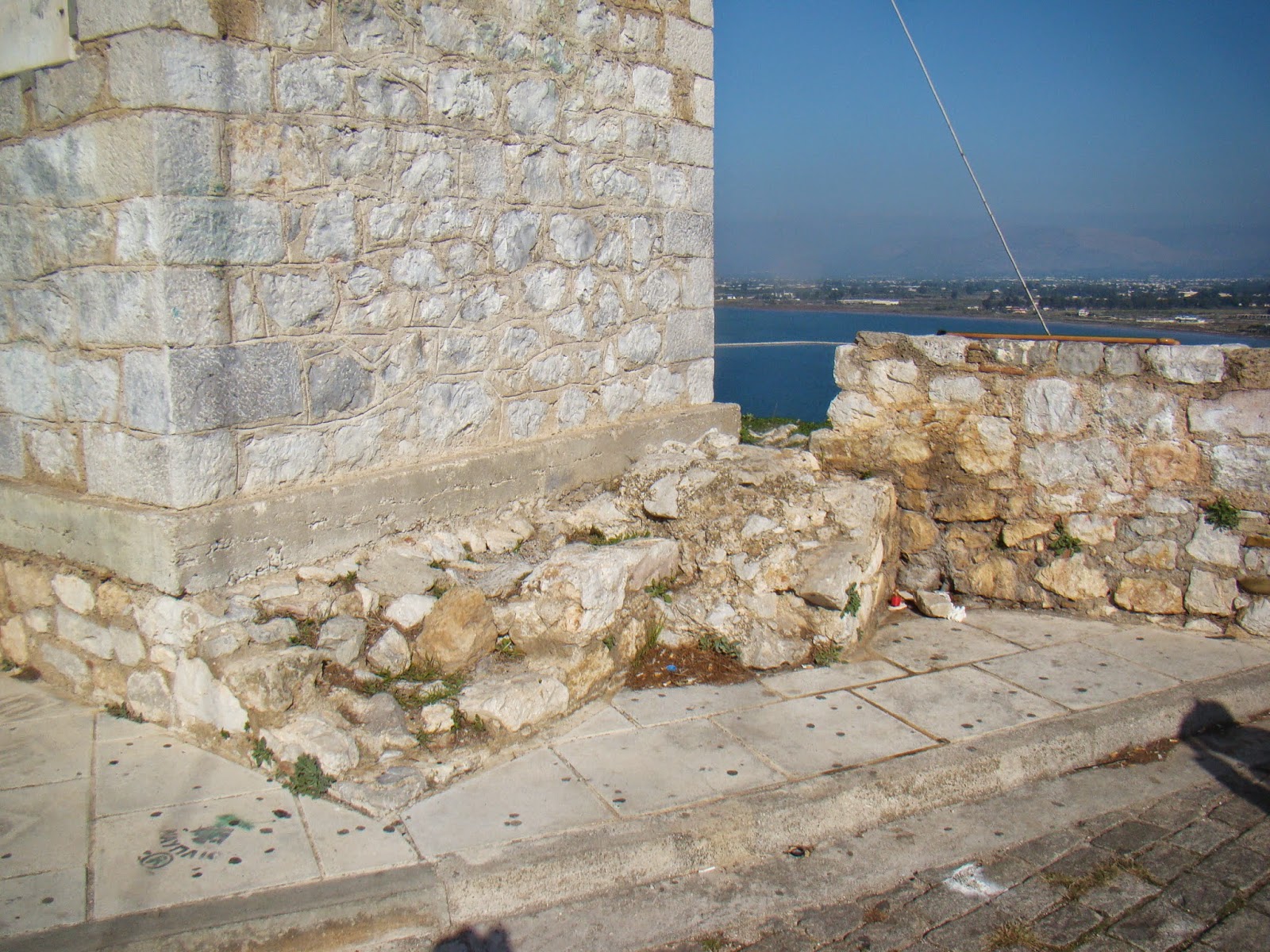


                                                                   End of Frankish cross-wall at bell tower.


Inner entrance to tower with frescos.


As part of the restoration project for the tower, the interior fill deposited over the centuries has been removed, and the inner approach to the tower cleared down to the base. I did not ask where Schaefer had found the child sacrifice but it was much on my mind.


View of frescoed chamber with Angel barely visible above
on plaster over arch of Roman brick.


When Francis Schaefer saw the tower frescos in 1956, he thought them in good-enough condition so as to need no restoration work. When I saw them first in 1977 – knowing only that they were “Frankish” – I could make out almost no details. That winter the tower chamber was sealed and the subsequent deterioration was rapid. In the last two years they have been restored to the extent possible -- and the photo above shows how very pale they are now.  None have the color or show the marvelous detail of the small Angel of the Ascension on the overhead arch.  

The photographs below that I was able to take are underwhelming, but they have been much brightened and the colors intensified with Gimp.  The identifications are those made by Francis Schaefer. The frescos are dated between 1291 and 1311, and were probably created by Greek painters for Frankish employers.


Ornamentation shown on right of previous photograph.


Warrior before Gimp.


Warrior after Gimp.


St. Anthony.


 Bishop. 


Saint.


Some information thanks to Monika Hirschbischler, “The Crusader Paintings in the Frankish Gate at Nauplia, Greece,” in Gesta XLVI/1 (2005) 13-30.


05 December 2009

Nauplion: Under the Threshold

In 1955, the German archaeologist Wulf Schaefer obtained permission for a a private excavation of the Frankish and Venetian walls on Acro-Nauplion.* During this time he meticulously  mapped the Frankish and Venetian fortifications of the Castle of the Franks.**  A major part of his excavations was concerned with the large entrance passage that the Franks had built in ther reconstruction of the Roman entrance to Acro-Nauplion.

In the late 260s, the Gothic Herulians from the Black Sea area were raiding islands and coasts of the Greek world.  They sacked Athens, Corinth, Argos, Sparta.  Greeks who had been living in the countryside to escape Roman taxes moved back inside what fortifications they could find -- a hundred years earlier Pausanias had said Nauplion was uninhabited -- and tried to rebuild their walls.

 Schaefer made two momentous discoveries on Acro-Nauplion during his excavations.  The first was the discovery, under the Roman threshhold of the rebuilt gate, of the skeleton of a child, about 6 or so.  This is his picture.  He calls it "my find of a sacrificed baby."  It is not done in Greek archaeology to suggest that there was such a thing as human sacrifice (with a single exception in Crete), but the myths and plays are full of it.  It is certainly not done to suggest that such could happen in a "civilized" age.***  So we will call this a "threshold burial," and remember that people who are scared tend to make decisions that hurt someone.


The small folded skeleton was found at the foot of the staircase from which you are looking down in this next picture, and you can see the Roman tiles that make up the arch.(A back yard in Nauplion has stacks of Roman tiles under the lemon trees.)  Schaefer's second momentous discovery, on the vault and lower walls, was of Frankish frescos from around 1300.  If you look at the map of the walls in the link below, this passageway-entrance is between the two large towers at the top of the image.


I saw these frescos in 1977 -- hadn't a clue as to what I was seeing -- and then they were mostly gone, flecked away from damp.  Twenty years of exposure seems to have undone the visibility of what Schaefer found. His photographs show a great deal more than I saw.  Monika Hirschbichler**** has written extensively on these frescos, using Schaefer's photographs, and may be the last person to have seen them.  She dates them between 1291 and 1311. They were closed up in late '77 and now there appears to be a permanent barricade.

Beginning in 1463, the Venetians involved in a long drag-out war with the Ottomans which was not ended until 1478. Starting in 1470, they made major modifications to the Frankish defense system they had inherited.  They filled the Roman-Frankish gate with rubble, and enclosed the towers with stone batters against cannon fire. The road in the photo dips around the remaining tower.  The southern tower was brought down in modern times to put through an access road.  The Venetians opened up new gate, still accessible, which required breaking through the Roman wall for a narrow, nervous approach from the precipitous cliff side.              


In 1981, Schaefer wrote friends -- I am copying his English accurately: "There have too many things I began in my life to be brought to a decent end.  When I look at the maps of drawings on the history of Nauplion, and the rows of manuscripts . . . I feel badly about my conscience regarding my whole studio full of excellent ideas, buried in manuscripts, nobody ever will read."

In another letter he wrote: "Maybe if I had not be killed somewhere in Albania, had become even a better archaeologist over there . . . So my proposal: To find a male person.  I will give him all my knowledge . . .."  The friend suggested a male person, but the male person, deep in his own momentous research, was not consulted before being volunteered.  Without waiting for confirmation, Schaefer enthusiastically wrote of his gratitude for this "eruditus of this medieval field . . . my rescuer."  The friend sent on Schaefer's three leters to the eruditus.


The eruditus recently discovered these three letters and gave them to me because of my work on Nauplion. They are sad letters.  I am haunted by Schaefer's grief over the unfinished work and unfinished papers, yet the favorite ideas and positive statements in his letters and two of his articles have long since been demonstrated unfounded.

Schaefer worked on the Corinth excavations from 1936-1939 as site architect.  Earlier he worked in excavations on Acro-Nauplion, clearing out what very little could be found of the Byzantine and Roman remains.  Most of those finds were destroyed in WW2 when the German military and Gestapo took over the museum buildings, and part of the excavation was destroyed by a gun emplacement.  In the summer of 1939 Schaefer had joined a team working at Mycenae when he received draft orders to return to Germany.  He was captured late in the war and was a POW for two years, returning home to a flattened Bremen in 1946.

This is as much as I know of his professional biography from these three letters and it surely needs a lot of fine-tuning.  I wonder what his experiences were in Albania.  But he recounted one incident of joy in letters to two people:
I will never forget this beautiful spring morning (Frůhling is a better word for it) which made the μοῦσαι τε χάριτες dance on Helikon and Parnassos opposite the Gulf over there, to share with that lovely girl (alas - only these few hours!) who represented to me all the charms of New England.
I did not 'print her features on my memory', but in fact, I do remember this exceptional beautiful morning on 'Acro,' augmented by the radiance of an extremely lovely girl.


*.  The central section of the Acro-Nauplion fortifications here.
** As far as I know this map was only published in Schaeffer's dissertation and I am pleased to make it available here.
*** Think of all the Romans did for civilization. 
**** Monika Hirschbichler, "The Crusader Paintings in the Frankish Gate at Nauplion, Greece," Gesta XLIV/1 (2005) 13-30.