Showing posts with label Plethon. Show all posts

25 September 2010

Stone Clamps

 Houses in Longanikos

Kostis Kourelis wrote recently about stone masons in the Morea.  He gives me the explanation for some photographs I took in the interior of the country after Jack Davis called my attention to the stone clamps on old houses:

"In summary, architectural labor from the 18th to the early 20th century was organized in itinerant groups of masons. They would specialize on the finer aspects of construction, such as the corners, quoins, the windows, openings and roofing and would hire local work for the unspecialized work, such as building infill walls."  Such construction is shown in the next pictures.

 Main street through Longanikos


Main street through Leondari


 Leondari

Stones were secured with iron clamps, and each group signed its work with its own design of clamp. You can see at least 8 of them around the large doorway -- click to enlarge --  in the photograph at the top, and at least 6 around the smaller. Similarly, you can find at least 8 clamps for the left-hand doorway in Leondari and 10 for the second.

Here are two such signatures from a group that worked in Tegea:

Tegea

Tegea

All the other towns here are mountain towns.  Mountains are made of stone.  Tegea is on flat, damp land.  These Tegea houses were immediately around the remains of the temple of Athena Alea and were built of its stones.  I was there two years ago with a learned group, and there was an interminably long lecture about the remaining stones of the temple.  No one seemed to care, or even notice, all the stone houses -- with their spolia.  Tegea houses are plumped full of spolia, like puddings with raisins.

Apparently a great deal has been written about these clamps, and many photographs taken, but they were new to me.  


South of Leondari

Ag. Nicholaos, Karitena


Dimitsana

Dimitsana bell tower

Dimitsana

Many of these itinerant groups were Albanians and there was a new wave of stone workers in the 1980s and 1990s.  These were the men I saw working on the palace at Mistra when I was there in 1995.


I like these continuities: so much of Greek history has been discontinuous.  In 1480 and 1480 when Bartolomeo Minio was rebuilding the walls of Nauplion, he could find no one who knew how to build in stone.  He had to have five masons and a master-builder sent out from Venice.  Travelers write about the shabbiness of Venetian towns in Greece and their proneness to fire.  I found good evidence that Venetian houses were for the most part wooden, at least above the ground floor, and standardized sizes of planks and nails were shipped out from Venice for their construction.

There was no Morea-made iron in the 15th century. Minio had to order clamps -- and nails, and anything of iron -- ready-made from Venice, again in standardized sizes. Already before 1420, Plethon had worried to Manuel II and Theodoros II about the lack of local skills and Moreote dependence on foreign imports,  In the 1440s, Bessarion wrote Constantine, concerned about the lack of Greek skills -- iron-working was one he particularly mentioned, along with ship-building and weaponry -- and suggested that eight young men be sent to Italy to learn. More on that later.

Diana Gilliland Wright, “The Wooden Towns of the Stato Mar: Medieval Construction in Nauplion,” 
 Studi Veneziani 40 (2000) 169-178.


06 May 2010

Pavane for a Dead Princess: Part Five

 
This image will represent Cleofe Malatesta.  It is painted on the wall of the throne room in her sister, Paola's palace in Mantua, and its features strongly resemble features in the portraits of her brother, Carlo, and Paola, below.   Compare the nose, chin, supraorbital arch. It is true that I once used another image of the same woman for Maria of Trebizond, but that was because I accepted the pronouncement of an Important Art Historian. We were wrong. 
I have written here on Sophia of Montferrat and how men talked about her face.  This entry is on how men talked about Cleofe's clothes.  Cleofe was an Italian woman of the early Renaissance, and brought with her to Greece manners and dress quite different from what was assumed appropriate for Greek women.  Certainly, her dress made more of her visible than Greek dress would have.  This is the sort of thing Cleofe may have worn on a formal occasion:

While this is what a woman of her class would have been expected to wear at Mistra, except for full-press court occasions.  You can see that the difference would have been noticed:


A year and a half before Cleofe arrived in Greece, Theodoros wrote the pope that she would be able to keep her Italian customs, and her religion.  She arrived in the fall of 1420 and the wedding was 19 January 1421.  Then she disappears from written records for six years, except for the information in Paola's account books that she was sending Cleofe an annual gift of Mantuan cheese.   

Six years later, in February 1427, Battista, their sister-in-law, wrote Paola that Cleofe was dressing as a nun.  This was a great shame. A fabric specialist  who worked on fabrics found in a Mistra grave wrote: "Most Byzantine fabrics are dense and relatively thick; it seems that the criteria of lightness and suppleness were not prevalent in Byzantium."

A mutual friend who had visited Cleofe reported that she said, "I have not become a nun because I was anointed with a little oil."  Far from it.  She had now achieved the status she should have had six years earlier, but only now did she tell her family that at the time of the marriage, Theodoros had announced that he would live with her for six years, only, without sex.  

At the end of the six years, before they knew this, there were worried letters from the family to the Pope fearing Theodoros would abandon her.  Then the next month there was the letter about dressing like a nun.  It does look as if, for his own complex reasons which he probably did not understand, Theodoros offered her a real, sexual marriage, in exchange for conversion to Orthodoxy and a change of dress.  A year later, in early 1428, there was a baby girl, and in April 1433 she died in giving birth to a son. 
That would be it, except that at the memorial service, the Mistra men talked about her clothes.  Plethon, who was for inexplicable reasons considered to be a great philosopher, spoke first.  He assured Theodoros that he could believe in the immortality of the soul because horses do not commit suicide. Then he complimented Cleofe's "sober prudence in putting off her leisurely ways and taking up the decorous restraint of our women."  He also commended her fasting. It is difficult for a modern, Western women not to think that he was pleased to think of the erasure of her body.

The next speaker was her doctor, Demetrios Pepagomenos.   He responded to Plethon, speaking obliquely, but disagreeing at length about clothes, and lamented

her youth, in which she had such grace, [and] the beauty, which has not been concealed, as might have been proper, but in a cruel way. . . . The wearing of clothes outside our habits of dress, beyond our temperament and sense of what, so to speak, is naturally required, was a matter of her unmaterial and spiritual nature. [Look at the untidy hair and imperfect posture in the top picture.] . . .  Not that there might ever be perfection more perfect than perfection, or that clothing will change character, but nonetheless, there was some length of time before the end, when, unless she was constrained by official ceremonies, she wore the fashion of those who live monastically (μονάζουσι) so that what was earlier unappreciated by outsiders, was now obvious to all.

In 1955,  a few fragments of the body of a young woman were found in a grave in the palace chapel of Mistra.  Among them were bits of fabrics from two gowns, with enough stitching in place to make the style of dress clear.  The outer gown was of a silk Italian brocade with a top styled like this: 
This V-necked gown was worn over a sheer silk gown very like the gown the Cleofe-stand-in  is wearing here.  The fabric expert noted how very soft and light these tomb fabrics were. 

The speaker after Pepagomenos was Nikeforas Cheilas.  He blasted Plethon's ego and then accused Pepagomenos of killing his patient.  He went on to describe Cleofe's death as being like "like the falling and shattering of a precious crystal." Going beyond clothing, he said:
Gone is the shrine of all virtues and graces, the most holy queen, the rainbow shining brilliantly in the beauty of her body, flashing out more intensely than any statue or image . . . [she] enjoyed a sort of splendor and radiance . . .

27 July 2008

On the Galley, by Lamplight


This image of Athena that fits into the hollow of your palm is the most beautiful object remaining to us from antiquity. The Berlin Staatliche Museen is privileged to hold it now. But in October 1445 at Candia, Crete, Cyriaco of Ancona was holding it.
. . . to tell you something very special, when Giovanni Delfino, that diligent and most industrious fleet commander, had displayed numerous coins and precious gems to me as I lingered by night with him on his flagship, he showed me, among other items of the same sort, a splendid crystalline signet seal the size of a thumb that is engraved in deep relief . . . When you hold up the thick part of the gem right towards the light, where the breathing limbs are seen to shine out in wondrous beauty with complete solidity, and with luminous crystal shadows in the hollows, we learn who is the maker of so splendid a thing by the Greek letters - very ancient ones - carved above.
After this, anything else, even involving Cyriaco is something of a letdown but the man was amazing. He knew everybody. He went hunting with King Janus of Cyprus. He attended the Council of Florence where he met Sigismund Malatesta, Giorgios Gemistos Plethon, John Palaiologos, Cosimo de'Medici, Filelfo, and just about everyone else..He had a laisser passer from Murad II to travel anywhere in his dominions "without vexation, taxation or any other injury." He corresponded with John Palaiologos, and went hunting with him. He stayed with Constantine Palaiologos in Mistra and went to the races with him. He discussed history and philosophy with Giorgios Gemistos Plethon. He discussed Union of the Churches and a campaign against the Turks with Pope Eugenius IV. He and Sigismund, the Holy Roman Emperor, strolled in Rome and tut-tutted about thedeterioration of modern values. In Florence, Brunelleschi explained to him his dome, currently under construction. Lionello d'Este invited him to see his newly-acquired "Entombment of Christ" by Rogier van der Weyden. He travelled with Memnon Tocco, a military man and son of the Duke of Cephalonia, all over Asia Minio and Thrace, looking at Turkish defences, and then all over the Morea looking at antiquities. He corresponded with Giovanni Dario whom he had met on the trip to Candia when he held that gem.

He is always described as a merchant, but what kind? On his first trading voyage, he started out from Ancona with a cargo of fruit and ended up in Alexandria. On another, he loaded a cargo of chestnuts and filberts at Castellamare and took them to Alexandria. Once he unloaded a cargo of fir trees at Palermo and then spent several days sightseeing at Monreale, returning to Palermo to find the ship had been sold for its owner's debts.. He shipped carpets and hides from Gallipoli to Ancona, along with a slave-girl named Clara for his mother. He bought mastic gum at Chios, and then became enchanted with the idea of it, listing the names of all the peoples and countries and cities where mastic would be bought--something like Henry Miller's account of Katsimbalis crowing on the Acropolis, hearing an answering rooster, and then calculating how far around the world roosters could pass along the crowing. He bought gold coins of Philip and Alexander at Phocaea in Asia Minor. Wherever he could, he bought manuscripts, small antiquities and objets d'art, selling some, giving some away, adding some to his collections.

He liked the good things of life: a white horse, a black manservant, an illuminated codex of the Greek New Testament (20 florins), gold and silver Damascene vases, a codex of the Iliad, an ancient sculpture of Venus (just unearthed), porcelain ewers from India ormamented with gold (which he gave to the Pope), Greek manuscripts and more Greek manuscripts, a gold coin of Trajan (which he gave to Sigismund),

He loved books, bought books, bought manuscripts, bought a handwritten and illuminated Greek codex of the New Testament. Becalmed at Chios, he translated a Greek biography of Euripides into Latin while everyone else went hunting and fishing. In Adrianople he bought a manuscript of Ptolomy that he found quite useful. He copied and bought manuscripts on Mt. Athos. He had himself taught Latin and Greek, but even before he had learned Greek he was meticulously copying every Greek inscription he came across. He came to feel that the stones he saw on the ground, the stones from ancient cities, offered more reliable information than what might be found in books, and so he made it his life's work to search out and record antiquities.

His passion for antiquities will be a topic for a later post.


23 July 2008

Pavane for a Dead Princess

This faceless, nameless woman is not Cleofe, but she is a woman from Mistra. She is wearing a gown similar to one Cleofe might have worn and she has been invited here to represent Cleofe because the Byzantines royals so rarely portrayed their wives and daughters.

Cleofe was
the youngest daughter of Malatesta "dei Sonetti" Malatesti, Lord of Pesaro, a bright young woman in a family of bright people, all raised with humanist tutors and books and languages and much music.She spoke Greek. She was quite beautiful: comments by her contemporaries sound convincing on that point. Her name is often rendered as Cleopa: possibly the humanists had suggested Cleopatra would be a nice name. [Late note: more probably she was named for Sta. Maria Cleofe, one of the three women to go to Christ's tomb.]

We know much more about her sister-in-law, Battista Malatesta de Montefeltro, daughter of the Count of Urbino, who married Galeazzo Malatesta in 1405, when Cleofe would have been quite young. Poised, superiorly educated as a humanist, she wrote hymns and poetry that have survived, and gave lectures at court on philosophy. But as a young woman she nurtured the toddler Cleofe along with her own daughter, helped her with her lessons, and talked to her about what young women marrying rulers of courts needed to know.

Cleofe appears in history with the arrangement of her marriage to Theodoros Palaiologos, second son of the Emperor of Constantinople--no great shakes, that position, those days--and Despot of the Morea (Despot was a title given royal sons as governors of provinces).Cleofe's uncle, Pope Martin V, had given permission for Western ladies of the highest rank to marry into the Byzantine royal family, one of his tactics for joining the Orthodox church to the Roman. The royal Byzantines were glad to marry Western ladies because any ties with the West could be useful in getting help against the Turks who had a strangle-hold on the Empire, and four princes married six (wealthy) Italians. One historian says that these were prestigious marriages for the princes: au contraire, they were prestigious marriages for Italian courts in the early Renaissance. The situation was rather like the heirs of great British estates in the late 1800s and early 1900s marrying American heiresses for cash to shore up their positions.

So it was a political arrangement, but well-born young ladies expected nothing else.
She traveled to Constantinople on a Venetian galley with Sophia of Montferrat who was to marry Theodoros' brother John. That marriage was a disaster: John disliked her intensely and they lived apart. That theme comes into Cleofe's small story.

When Cleofe arrived in the Morea--in 1420 or 1422--she was in her mid-teens. Theodoros was twenty-four. She had brought with her a large dowry, a splendid wardrobe, jewelry, and small furnishings to make her feel at home. The Pesaro composers had written motets for the wedding. Guillaume Dufay who was working for Carlo Malatesta, wrote a gentle, almost romantic, motet for a text that began Vasilissa ergo
Gaude -- Therefore, Queen, rejoice! --a nice blending of Latin and Greek for a marriage between a Greek and a Latin. Hugo de Lantins wrote one, too.

Across how many regions, does the sun moving so
turn and view with absolute confidence,
and see, O Sparta, none so happy as you.
You were the home of Queen Helen,
who through everything she did
drained the strength of all who ever wrote.
Now you possess something more divine,
Madona Cleofe,
born of the Malatesta, as you well know.
These are the glories and powers
you have added to the empire of Constantinople
with its many lords, so great and noble.
It was not, perhaps in the best of taste--that image of Helen draining her men. And there is no information as to when or where these offerings were performed, but if you have seen Mistra and know the music, you will see how it fits.

Cleofe lived with Theodoros for thirteen years in small, charming, provincial Mistra on the orchard-covered slopes of a snow-capped mountain, above a clear shallow river. Nothing much happened in Mistra, except that there were painters painting frescoes in pretty churches; Italian, French, Catalan, and Venetian merchants dropping by; and several outstandingly intelligent men doing philosophy and corresponding with Italian humanists. Cleofe's father came out once, to help negotiate a problem between the Despotate and Venice. Mistra's fashions in this period--clothes, art, ideas-- came from the West and Mistra was, all in all, a shadow Italian city-state.

Theodoros enjoyed philosophy--his father Manuel and his brothers John and Constantine did, too--but his particular interest was mathematics and he is said to have been one of the best mathematicians of his age. We know nothing of any work he did in those lines. What we do know is that his father had sent him away from home at the age of ten to rule the Morea from Mistra (a regent was sent along with him). He grew up a geek in a milieu of bullies and sycophants, with a certain amount of taste for things Italian.

Things should have worked out better than they did. As part of the marriage arrangements, he had signed a letter to the Pope promising that Cleofe would be able to keep her her religion and ritual, her chaplain, and her Italian customs. And that she would not be asked to change any of these, directly or indirectly.

The first thing that happened in her marriage was that Cleopa became Kleope--royal Byzantine brides routinely had their names changed far more than that. The next thing that happened was that Theodoros started demanding that she become Orthodox and stop paying attention to her Italian companions. In his clumsy way, the lonely boy was learning something about being loved.

In 1424, her brother Pandolfo--he could not be a warrior because of a deformed back, but he could be parked in the Church--was sent to Patras as Archbishop and ruler.
The Malatesta liked building, and Pandolfor rebuilt Patras' cathedral of St. Andrew. His friend Dufay wrote an elegantly meditative motet--Apostolo glorioso-- for its consecration. Kleope and a host of Italophiles from Mistra must have gone up to Patras for the ceremonies, and surely people she knew came over from Pesaro. Of this building and event, only the music survives.

It is probably during this period that the handsome Italianate palace of Mistra was built, a wing for public spaces with great windows looking across the orchards and wheat in the valley of Sparta, and the high round windows for looking at the snow on the mountain ridges. Perhaps Kleope's dowry helped pay for it, perhaps builders were brought over from Pesaro and Rimini, perhaps Kleope had a voice in the design. Perhaps not. There is no information about its bulding, no approximate date.

In public, the couple were gracious hosts to the philosophers and travellers, but privately, the marriage continued tense. There were arguments, fights
. The pressure to convert increased. Kleope wrote Battista. In 1425 Battista wrote to their uncle, the Pope Martin V who, against anyone's idea of pastoral care and avuncular affection, wrote a letter to Kleope full of fire and brimstone, promising her hell if she strayed from her Catholic faith. Kleope must have felt that hell on earth was worse than hell after earth, for at some point--the date, again, is one more unrecorded detail--she converted to Orthodoxy, altering her Italian fashions to the more covered-up Greek style. The year before, Leonardo Bruni had written Battista a letter, discussing the problems of giving women the kind of education that their constricted lives could not make fair use of. Unless he had written it earlier when Battista was teaching her. He may have heard of Kleope's problems.  [Late note:  I took someone else's word for the date of the letter.  I am now sure it was written about January 1427.]

Two years before Battista's letter, in 1423, Theodoros had started talking about retiring from the job of Despot and going into a monastery. He talked about it for years. People said it was because he hated Kleope, but no one blamed the rift on her. Far from it: people who knew her considered her "outstanding for beauty and for all other seemliness." After four years of it, his family finally took him seriously and sent Constantine to the Morea to take his place, and he arrived in Mistra the day after Christmas 1427.

That was enough for Theodoros who changed his mind. It may be only a coincidence, but Helena was born in 1428, named formally for her grandmother, but no one, from Mistra or humanist, could avoid the association with Helen of Troy. All three Helens (see that praise song above) were queens.


While Kleofe was pregnant, her brothers-in-law, Constantine and Thomas, trying to absorb all of the Morea into Palaiologue possession, attacked Patras. Theodoros declined to join them, possibly out of consideration for his wife. Her brother the Archbishop complained to the Venetians and ordered up as supply of powder for his cannon, and then left the country. But Constantine and Thomas attacked again, and in June 1429 Patras belonged to the Palaiologues and Kleofe's had lost a brother. The same year, the highest-ranking court official in Mistra began building the lovely Pantanassa, a church with Sicilian flavors, but it is something we can imagine Cleofe watching with pleasure.

She died in 1433. One historian has pronounced this an "obscure" death, but the Palaiologues weren't that kind of people. There is absolutely no information on this topic other than that she died. It could have been plague or malaria. Or she bled to death after a miscarriage. It was not an immediate death: there was time for Theodoros to hold her hand and weep. He loved her in his own, limited, way. Without her, there was no one other than his mother in Constantinople who loved him, and we can only hope that she did--there is no evidence of her emotional state.

A number of intellectuals gave glowing tributes at her burial. The young Bessarion who was going to be very famous spoke of her beauty, her intelligence, her piety. The very famous Plethon spoke of her piety, humility, intelligence, beauty, character, gentleness and generosity, commending her for giving up her "soft Italian customs" and dress, and adopting the Greek practice of fasting--thereby demonstrating that she had satisfied Greek male demands for a woman's behavior. It would have been inappropriate for him to mention the fashion for Italian dress among the upperclass women in Mistra. Then he told Theodoros to buck up, because Greece had real problems.

Fragments of a body dressed in Italian gowns were found in a grave at Mistra, in the church where she was buried. It may be Kleope, it may not be. It is allowed to hope that Theodoros had buried her in one of the dresses she preferred.

Despite Plethon, it is difficult to think of a Malatesta being humble, but the women of that family had learned to walk tightropes to survive. I see here a private diary in which she poured out--writing too fast for beautiful humanist penmanship--all the things she could not do or say if she expected a tranquil life. I also see this diary being burned by one of her household, about five minutes after she died. There is no evidence for this diary.

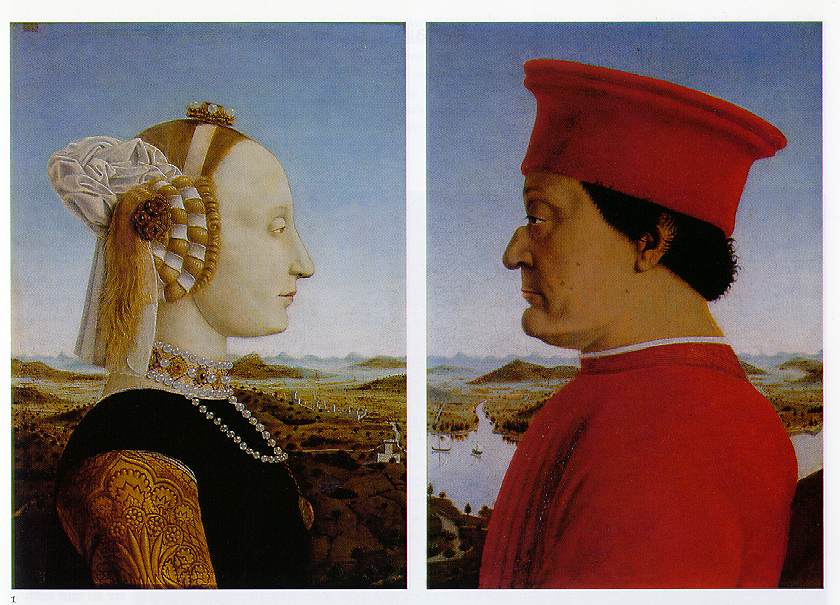
Little good happened to her immediate family, though nothing unusual for families in their position. Her brother Galeazzo, Battista's husband, was killed by their brothers in 1431. Battista's son-in-law, Pier Gentile, husband of her daughter Lisabetta, was imprisoned in a war among his brothers. She took her daughter and grandchildren and returned to Urbino. Trying to save Pier Gentile, she made a public speech about these events to the Holy Roman Emperor iwhen he stopped in Urbino in May 1433, but he was killed by a papal agent anyway. Battista raised her granddaughter Costanza so that she became one of the best-known, best-educated women of the Renaissance. Costanza named her daughter Battista (1446-1472). Battista was married before she was fourteen and died at the age of twenty-six, after giving birth to her son Costanzo, having produced at least six children for a very famous humanist condottiere.This is why she is so pale in her portrait.

Helena was married to John II, King of Cyprus in 1441. He was twenty-three, she was thirteen. A modern, otherwise reasonable, historian has called her "a violent, neurotic girl in permanent ill-health" without helping us out with corroborative illustrations, but the Renaissance thought marriage made up for child molestation. Helena died in 1458, having given birth to one, maybe two daughters, one of whom she named Kleopha. Kleopha died very young. But given Helena's ancestry, and the probability that she was mostly ignored after her mother died--she was five--and the probability that although philosophers and foreign intellectuals, including Cyriaco of Ancona, were all over the palace at Mistra, she was badly educated. She must have been desperately frustrated, desperately sad.

At my first visit to Mistra more than thirty years ago, knowing nothing of its history, enchanted by the apple and orange blossoms, the snow capped ridges of the mountain, I wandered in the ruins of the palace, hearing Ravel's Pavane in my mind. This, now, is why.

The narrative is continued in
Pavane for a Dead Princess, II
Pavane for a Dead Princess, III

Pavane for a Dead Princess, IV 
Pavane for a Dead Princess, V
Pavane for a Dead Princess, VI
Glory Days

Theodoros II Palaiologos 
Malatesta "dei Sonetti" Malatesti

The primary sources for the Cleofe and Theodoros story can be found here.