Showing posts with label Demetrios Laskaris Asan. Show all posts

05 June 2014

What are these stories about?


Sphrantzes wrote: "[In December 1453] the most impious and pitiless sultan, with his own hand, took the life of my dearest son John, on the grounds that the child had conspired to murder him. . . . My son was fourteen years and eight months less a day; yet his mind and body proclaimed a much more mature person."  

Doukas wrote a much longer account about another son.  It begins: "After the tyrant had traversed most of the City, he celebrated by holding a banquet on the palace grounds.  Full of wine and in a drunken stupor, he summoned his chief eunuch and commanded him, "Go to the home of the grand duke [Lukas Notaras] and tell him, 'The ruler orders you to send your younger son to the banquet.'"  The youth was handsome and fourteen years old."

The narrative goes on to report Notaras' refusal, and Mehmed's order to bring Notaras, his son and son-in-law for execution. Notaras'  made a stirring speech of encouragement to the young men, and requested to be executed last.  Their courage and dignity was outstanding. Doukas reports that this was followed by the execution of other chief nobles and palace officials.

Kritovoulos also writes about the execution of the Notarades.  He says, "But the arrows of envy laid that man and his sons low with mortal wounds, and they were condemned to an unjust death.  #285. For some men of great influence . . . moved by envy and hatred . . . persuaded [Mehmed] to put [the prominent Greeks] out of the way . . . those men would no longer hesitate to plot in their own interests . . . And they were all killed, and among them were executed the Grand Duke and his two sons." Kritovoulos goes on to describe their courage, and says that Notaras died with nine companions.   

These stories are problems. The most familiar one, that of Doukas, appears well within the Greek tradition -- dating back to Herodotos -- of seeing the Eastern tyrant through a lens of sex and violence. But it does not have to be. Perhaps sex was involved with John Sphrantzes, but if so and if he knew about it, Sphrantzes was congenitally incapable of writing about sex, and certainly in terms of his son. Certainly he feared it.  Kritovoulos' version of the Notaras story makes it difficult to accept the Doukas version, but then Doukas makes it difficult to accept Kritovoulos. Is it significant that the sons of the two highest officials under Constantine -- Notaras and Sphrantzes -- are killed?  Both Doukas and Kritovoulos say that other leading Greeks from the City were executed. That is to have been expected.

There is a third version of this story, in an anonymous 16thC chronicle (Philippides 1990).  "After five days had passed, they began a search for the magnates, the grand duke, the grand domestic, and the protostrator, the son of the mesazon Kantakouzenos, along with a few other prominent individuals. He had them all beheaded.  He slaughtered the sons of the grand duke in his presence and then he slaughtered him.  The grand duke's youngest son, Isaakios, he sent to the seraglio; shorly thereafter, he escaped from the seraglio in Adrianople and vanished; later he came to his sister [Anna Notaras] in Rome who had been sent there with a countless fortune by her father before the siege."

A third case of slaughter of the high officials, a third case of a specific son. But it wasn't Isaakios who joined his sister but Iakobo; and the son-in-law of Notaras in Doukas was a Kantakouzenos, while Kantakouzenos the grand domestic had been killed on the 29th.  This version clarifies little for my problem, except to add another story where a specific son has been singled out.

But there is another story, probably from 1460 or just after the surrender of the Morea and the transfer of upper-class hostages to Adrianople and Constantinople.  There is an excerpt from a letter originally written by John Dokeianos to Demetrios Laskaris Asan, recorded in mixed Latin and Greek. Dokeianos weeps for the loss of these splendid sons: for the first who shared every wonderful quality, for golden-souled Alexios, for the third and most beautiful whose name reflected the grace with which he was endowed.  The first two died contending for the fatherland. The third, who died in the prime of his life, martyr to a principled decision, left behind children and a widow: he will be added to the choir of martyrs.

Here is another son selectively executed, the son of one of the most powerful men in the Morea, but this time an adult son who is himself a father. Does it involve Mehmed?  Are sons a specific target, or are they primarily a narrative device?  Does it have to be one or the other?

I would be glad to learn of more stories like these, from the time of Mehmed. My ideas are fragmented.  

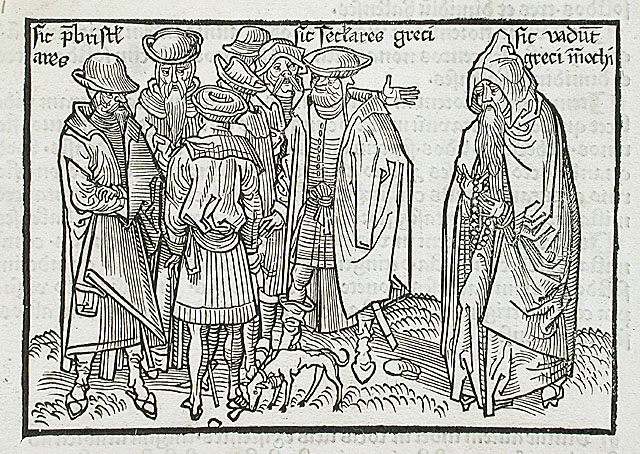
These frescos are Serbian, from Pec, and Jevandalist.


Several nights after I wrote this entry, I dreamed that I had found a new manuscript of Sphrantzes, one in which he had filled in all the descriptions and explanations he was too old and ill to write.  The young men were standing around me, pointing out the explanations of these stories. 


 [Late note in reply to the question below, as Google is not working properly.  Sphrantzes tells the story of his son in Chron. Min. 3 7.3.]

03 December 2012

The Philosopher and the Duchess

15th-C Greek philosopher


You know the Greek delegation at the Council of Union was in trouble from the git-go when George Amiroutzes was one of its leading minds. He, Scholarios, and Plethon -- all lay scholars -- had a better command of the issues and theology at hand than any of the 600-plus religious members of the delegation with the exception of Bessarion and Mark Eugenikos. Plus Amiroutzes and Scholarios read Latin, and Amiroutzes was one of the very few of the 600-plus who could speak Italian.

That Amiroutzes was a moral slug is amply demonstrated in Syropoulos' description of his taunting of Eugenikos during a major speech. On another occasion, in a discussion with Eugenikos, Bessarion, Isidore of Russia, Plethon, and the emperor, Amiroutzes was so aggressive towards Eugenikos that when Plethon came to his defense, Amiroutzes shouted Plethon down. Then there is the evidence from papal sources that he took a bribe for his vote. Scholarios voted for Union, too. And Bessarion. As did a great many of the delegation. Plethon had been warning them for 11-plus years that such a conference would be a disaster.

But few in the delegation had the social, political, or intellectual standing to be able to go back to Constantinople and claim so successfully that they had changed their minds. And there were not so many claims in mid-century to the position of "Greek philosopher" that Amiroutzes can be disregarded. In fact, if the intellectual accomplishment is hived off from his personal moral qualities, there is a great deal to be admired.

However, this entry is -- minimally -- about Amiroutzes and his private life, about which he showed no more taste than in his treatment of Eugenikos.

The lady in question was the daughter of Demetrios Laskaris Asan, kefali of Mouchli, who has been written about here before. There is no sure name recorded for her, although sometimes she is called "Maria" -- a reasonably safe name to assign a Byzantine woman, and sometimes she is called "Mouchliotissa." The fragile skeleton of a Byzantine church up on the Mouchli hillside is also called "Mouchliotissa" so I don't think this is very useful.

The lady was Duchess of Athens, wife of Franco Acciaiuoli, put in position by Mehmed after his cousin, Francesco, a minor, had come under the control of his mother and her lover who seem to have poisoned his father, Nerio II. When Mehmed took Athens in 1456, he also took the Duchess, Franco, and their three sons. The three sons eventually became janissaries, Franco became strangled, and the Duchess went into Mehmed's collection of high-status guests who were useful for negotiations.

Either in Constantinople or Adrianople, the married Amiroutzes met her and decided to marry her. Nothing is known of her feelings in the matter, and in fact nothing is known of her beyond her existence. Mehmed gave permission for the marriage -- a matter of Orthodox bigamy was not likely to concern him -- and the patriarch, Joasaph I, was ordered to perform the ceremony. Or to give permission for the ceremony.

There are various accounts of this, each worse than the others which variously claim that he was dragged, protesting, by his beard, and that he dropped down dead in chagrin. Or that Mehmed ordered the patriarch's beard and someone else's nose cut off, and that the patriarch tried to commit suicide in a cistern under the Pammakaristos. He was hauled out and exiled to Anchialos.  Much about this event and the patriarch is uncertain.

Amiroutzes and the Duchess seem to have been married, but this was not the last demonstration of his low moral character. He is said to have dropped dead with a dice-box in his hand, but this is probably not true.

What survives of this tawdry business are a couple of quatrains Amiroutzes is said to have written to the Duchess, very much in the tradition of medieval love poems from across Europe and the Middle East, and found not at all in Byzantine poetry, though many similar phrases show up in folksongs.


Shafts from your eyes strike the hearts
Alas, of those who see you. But, even so they adore
And rejoice as they burn; wounded, they love you.
Ah, what a love you beget, Ah what a passion you give birth to.

One time I saw you in the house, from below in the garden,
And by night, with your eyes leading me, I came;
A thrill took hold of me, astonishment and desire.
Ah what love you bear, who nurture as you conquer.

Βέλη ἐκ τῶν ὀμμάτων σου βάλλουσι τὰς καρδίας,
βαβαὶ, τῶν θεωμένων σοι. Οἱ δ'ὄμως ἀγαπῶσι
καὶ χαίρουσι φλεγόμενοι, φιλοῦσι τετρωμένοι.
Φεῦ οἷον ἔρωτα γεννᾷς, φευ οἷον πόθον τίκτεις.


Εἰς οἶκον εἶδον σε ποτὲ κάτωθεν ἐκ τοῦ κήπου,
καὶ τῇ σκιᾷ, τοῖς ὄμμασι σου προϊόντος, ἦλθον·
καὶ θάμβος ἔσχε με εὐθὺς καὶ πόθος σύν εκπλήξει.
Φεῦ οἷον φέρεις ἔρωτα, ἤ νίκας τρέφεις. 


Thanks to Pierre A. MacKay for the translation.

01 April 2012

Archons: Petro Bua

Drawing by Gentile Bellini, ca. 1480. 


When The City was taken in May 1453, the Morea went into panic.  It was said that both the despots, Demetrios and Thomas were leaving for Italy.  No one knew what was going to happen to the Morea. There was no identifiable authority.  This is when Petro Bua enters the written record.  He urged the Albanians to elect their own leaders, and they did, and despite Greek historians recording this as a revolt or uprising, they were in fact filling the void left by the total failure of the Greek despots.  

The Albanians in Thomas' despotate of the former Principality of Achaia chose Centurione Asan Zaccaria, claimant to the Principality and half-brother to Thomas’ wife. He had "escaped" from prison at Chlemoutzi where Thomas had held him since he had tried to join Murad's invasion of the Morea in 1446.  Those in Demetrios' despotate chose Manuel Kantakuzenos, Demetrios' governor of Mani, great-grandson of the emperor John VI Kantakouzenos, and grandson of Manuel Kantakuzenos, Despot of the Morea.  Both men, neither Albanian, were reasonable heirs to the territories for which they were chosen.  Sphrantzes said that essentially all the Albanians in the Morea were in revolt: the Venetians said thirty thousand.


Petro Bua was identified by Chalcocondyles as a man of rough manners and dishonorable character (Πέτρου τοῦ χωλοῦ, ἀνδρὸς τὸν τρόπον οὐκ ἀγαθοῦ), an identification that modern Greek writers have accepted without question and without evidence, because he was Albanian, although after all the time I have spent with Manuel Rallis and Demetrios Laskaris Asan (whom Chalcocondyles never criticizes), I am not clear how that description would distinguish him from a great many other archons.  In fact, in contrast to what the Venetians reported about Rallis and Asan, they reported Petro Bua to be a sterling character.
 
More specific information about him has survived than for most of the other archons in the Morea. [But see note below.] His great-grandfather, Ghin Spata, had been Serbian despot of Angelokastro ("Despot of Romania") and governor of Arta and Nafpaktos. His grandfather, Paul Spata, had been forced out of Angelokastro by Carlo Tocco in 1405 and then had handed over Nafpaktos to the Venetians in 1407. The family seems to have moved into the Morea then, along with a great many other Albanians, and may have been part of the immigration that Manuel II so praised. A clan-leader (the fall-back description for Albanian leaders), Petro Bua was probably a kefali for the despotate, though there is no evidence for where. When Manuel Kantakuzenos was chosen leader of the Albanians revolt against Demetrios, he took the name Ghin, the name of Petro’s father and the name Petro would have given a son of his own: this may suggest a particularly close relationship between them.

The 1453 attempts at leadership and organization quickly spun out of control, with the despots under attack and fighting each other for supremacy, and Ottoman forces being invited in to help or to tame the rebels.  Various individuals were in negotiation with the Venetians and the Genoese and the Neapolitans, and finally twelve archons  decided the only sane thing to do was to guarantee their own protection by Mehmed.   I have written on this before, and it need not be repeated, other than to say that Petro Bua (Petro end of first line below, Bua, misspelled,


beginning of second line) was one of the twelve.  The dean of Moreote historians, Denis Zakythinos, in his brief discussion of this document, lists the first eleven archons -- all Greeks -- and then adds "etc." for Petro Bua.  Bua is the outsider in this group of archons, not just as an Albanian, but also because to judge from surviving documents his family had apparently not intermarried with the families of the other archons on the list, although later in the century we find marriages of Buas with descendants of Manuel Rallis and Krokontylos Kladas.


By 1459 Venetian documents called him caput of all the Moreote Albanians, and he, with Manuel Rallis -- one of the twelve -- was fighting with the Venetians at the Isthmus in August 1463.  It is not clear what happened to their agreement with Mehmed: I speculate that Mehmed's land assignments in 1460 took little account of that document.

Bua was frequently noted as having sent written information when kapetanios in the 1464-78 war, and although all of the archons can be assumed to have had the Byzantine education of their class, of the twelve, it is Bua, the Albanian, who is recorded as owning important manuscripts.  Uncle of the famous condottiere, Mercurio Bua -- he had no sons of his own so Venice recognized his nephews Mercurio, Nicolò, and Petro as sons -- Petro Bua was still leading stratioti for the Venetians in the Ionian islands twenty-five years after the submission and as late as 1489 was being given a new contract by Venice.   I am not sure when he died: I find no mention after 1489 until May 1501 when he is "the late Petro Bua."

He was crippled (χωλος) but not so much that he could not ride a horse.  He was given a gift of fine scarlet cloth in 1464 in appreciation of his loyalty to Venice. He made at least three trips to Venice to get payment for his troops.  In 1476 Venice gave him triple the cash gift they gave Kladas at the same time. In 1478 the Doge made him a knight and gave him a gold robe. Thirty thousand Albanians regarded him as their leader.  This just about takes care of all the "facts" we have for Petro Bua: it is not enough.   


ADDITIONAL NOTE 4/3/12: On further reflection, I do not feel I can trust the genealogies I have seen for Petro Bua, in that if they give him sons, how can I believe in his father?  If anyone knows primary sources for family before 1454, I would be grateful to know about them.  Also, I have been looking at the Albanian names in TT10, part of the Ottoman cadaster for 1460-63.  I am finding clusters of names I know were used in his immediate family in the vicinity of Gardiki -- and of Chlemoutsi.  This suggests possibilities, but cannot prove them.


01 July 2011

Under the shade of Your Signoria

15th C Venetian lion, Negroponte

Last March at the Renaissance Studies Association, there was a series of panels on the Venetian stato da mar.  In a discussion on terminology, I suggested that  "protectorate" might appropriately be used at times to describe Venetian rule. I was told firmly that "protectorate" was unacceptable -- without being allowed to offer any evidence, and several people used the word "oppression" conflating the many varieties of administration in the stato da mar with that of Crete and going along with various trends in "post-colonial" studies.

Now a certain amount of oppression is in the eye of the beholder, and I think you have to accept that nearly everyone in the 15th century was, in 21st century terms, oppressed by someone else.  But the Venetian città or terre in the Morea, which is the part of the stato da mar on which I feel entitled to make pronouncements could not have survived with very much comparative oppression happening at all.  The ratio of Venetians to Greeks was very small indeed, and Greeks oppressed by Venetian rule were perfectly capable of voting with their feet and going to the Greek-ruled Despotate.

What you find is the opposite.  They slipped into Venetian territory on occasion and the Despotate regularly asked for them to be returned.  Venice tended to respond that all were welcome in Venetian terre. Massive evidence from the mid-1300s through the Ottoman conquest describes persistent exploitation, raiding of, and violence against Greeks in the Despotate by Greek archons, and the arbitrary infliction and collection of taxes. They raided Greeks in Venetian territories, too, and you get a snapshot of such an event in the Argos petition. 

You see Despots occasionally remitting taxes on the archons and frequently on Monemvasia and on monasteries, but never on those who worked the land and who paid their taxes to the archons.  A. Kontogiannopoulou has a horrific article in the 2009 volume of Revue des Études Byzantines detailing the tax burden extracted by the last Palaiologues. In contrast, quite a few edicts from Venice lift various traditional taxes on the land-working class for the terre of Methoni, Koroni, Nauplion, and Argos, and what you see over and over in the letters of Bartolomeo Minio is Venetian pacification of the Greek and Albanian residents, not oppression.

We have a number of instances in which people ask to be taken under Venetian protection, "under the shade -- sub umbra -- of Your Signoria" which my imagination, because of that wonderful lion above, changes to "under the wings of your lion." Here are some:

In 1388 citizens from Nauplion asked for Venetian rule as protection from Nerio Acciauoli, tirannus crudelissimus -- they had come into the hands of a young woman who probably had never seen Nauplion and who certainly could have given no protection (Venice wanted Nauplion anyway). In the summer of 1423, Adam de Melpignano, a baron of Achaia, asked to be taken into Venetian protection, as did Rosso Bua, leader of an Albanian clan.  In 1426 Theodoros II Palaiologos asked Venice to take the whole Morea under its protection. In 1428, Archbishop Pandolfo of Patras asked Venice to protect Patras against the Despotate. In 1456 Demetrios Laskaris Asan asked Venice to take over the territory of Mouchli, which Venice refused to do -- it was too far inland, and he had already given it to Mehmed in 1454.  At the same time Athens asked for Venetian protection-- also no go, and Joannis Spagnoli asked for protection of Damala, Fanari, and Ligurion.  Venice took those: Fanari and Damala were on the coast and Ligurion was a nice bridge between the coast and Nauplion territory. 

In 1465 archon Petro Bua put his territory and people under Venetian protection -- this was early in the Venetian-Ottoman war, and at the same time the Greeks governed by Micheli Rallis asked for Venetian protection from Rallis' harshness, as did the town and castle of Longanico. A group of Moreotes who took refuge on Tocco-ruled Zante during the war put up the flag of S. Marco in the face of an Ottoman assault. The Kladas brothers put Vordounia under Venetian protection, and when Kladas declared his private war against the Turks in October 1480, he carried the flag to claim that protection.  Much earlier, in 1410, Mauricius Spata used it in Arta.

It worked better at some times than others, and I am not arguing for Venetian benevolence in the stato da mar, though when you track through the records of the families of Greeks and Albanians who died for Venice and look at Venetian generosity to their children and grandchildren the word seems quite reasonable.  I am arguing for a more responsible use of evidence.  I go back to Bartolomeo Minio.  He was keenly aware of the burdens Venice placed on the people in Nauplion territory, and when he had to call a corvée, he labored with them, carrying stone and lumber.  He wrote, "I want to do what I can to help these poor people."  And he was remembered, 150 years later, in Greek tradition, as a protector:

At that time, the governor of the place, that is, the Venetian, with all the people of Nauplion, did all the building, and built the walls around, just as they appear today . . . and the governor of the place, the Venetian, gave benefits and many gifts . . .
Τότε ὁ Ἀφεντὴς, ἤγουν ὁ Βενετζιάνος, μὲ τὸν λαὸν ὃλον τοῦ Ἀναπλίου, ἔκαμε πᾶσαν οἰκονομίαν καὶ ἔκτισαν τριγύρον τὰ τείχη, καθὼς φαίνονται ἒως τὴν σήμερον . . . καὶ ὁ Αφεντης` τοῦ τόπου ὁ Βενετζιάνος ἔδοκεν εὐγερσίας καὶ χαρίσματα πολλὰ τῶν Χριστιανῶν ὅπου ἧρχονταν ἀπὸ ἐκατοικοῦσαν μέσα εἰς τὸ Ἀνάπλι καὶ ἔδωκε καὶ ταῦτην τήν χάριν.

29 March 2011

The Nauplion Petition

Detail from the Camoccio map of Nauplion,
showing the piers and the route up to Akro-Nauplion
(See Section 8 below)


The same day the Signoria answered the Argos petition, 26 July 1451, it answered a much longer petition from Nauplion. Nauplion had more money, and better grammar and spelling in its petition, but it, too, was also having a difficult time.

Venice acquired Nauplion and Argos in 1388, but then Theodoros I Palaiologos, the Despot of the Morea, occupied Argos. It took until 1394 to get him out without actually going to war. Argos had its own administration for three years, but after the Turkish invasion in 1397 (see Section 1 of the Argos petition) Argos was administered by Nauplion. In 1442, Argos was again given its own administration. You will see in the Nauplion petition how infuriating this was to them, the contempt they have for Argos, and how they have tried to get Argos back under control. You will also see how Argos has tried to fight back.

Again, this is my paraphrase of sections of the Venetian document.

* * * * *.


1. Your Signoria promised your subjects of Nauplion to observe their traditions, and the citizens consented to a tax from which you could collect a certain sum to pay the salaries of the podestà, the guard, and certain other positions, and the rest would go to repair the walls, and other needs, such as supplying the galley. Your Signoria has added the salaries of the rettor of Argos, the camerlengo, and castellan, and so the money that should be put into repair of the walls is spent on salaries. The city gate is in a dangerous condition and the walls of the suburb are crumbling. The port needs clearing, parts of the castle walls are earthen, and the rest near ruin. Your citizens are in danger because everything is open and anyone can go in and out at any time as they please. We are in the jaws of the wolf, by land and by sea. Your subjects and loyal citizens humbly supplicate and request that you will provide for the needs and necessities of this place. We ask you how the funds of this city can pay the aforementioned salaries since God knows the taxes that come in can in no way supply them.

Response: Since we desire the safety of the city and so the walls are repared, for the next 5 years the treasurer of Nauplion will retain from every salary 2 hyperpera out of every 10, and the fine from every judgement be paid to the treasury, and these used for construction and repair of the walls. We further desire that the podestà convoke the council and persuade them to contribute to the said work on their part.

2. Some of the rettori of Argos, and especially the one there now, against the will of Your Signoria and against custom, have taken new action harmful to your treasury. From ancient times to the present Nauplion and Argos were one place, joined, with one ruler, one treasury, one signoria, and the treasury always at Nauplion, but the present rettor wants to divide the territory between Nauplion and Argos, and have a treasury at Argos, and farm the taxes and do things never done with great prejudice to your treasury at Nauplion, and the rettor collects his salary from the treasury at Nauplion. We remind Your Excellency that Argos compared with Nauplion is a village and a warehouse, and no one lives there but people who work the land, all foreigners,* while Nauplion has good citizens, and has maintained its old traditions better than any other terra.

Your citizens and feudatories of Nauplion have their own land and collect their rents, and now the rettor of Argos will not let them collect, but insists that they must move from Nauplion and reside in Argos if they want to collect. There never was such injustice. We remind Your Signoria for the good and well-being of your place, so we can live openly, that it please you to direct the said rettor, and his successors, that there should be no such innovation but that things are to remain as they were; that the rettor does not collect his salary from Nauplion; and that he cannot make concession of or alienate or sell any land, but that it all should be handled in Nauplion as it was before; and that the administration of Argos should be under that of Nauplion as it was in times past.

Also, that the rettor of Argos cannot hold criminal proceedings without the consent and direction of the podestà of Nauplion, and that anyone who has a complaint should appeal to the administration of Nauplion, and in this way it will work to the honor of Your Signoria, otherwise manifest peril will follow one day when those of Nauplion are cut apart from those of Argos.

Response: 1. As of last June 27, we provided that the rettor of Argos may make no impediment to our taxes. 2. We write and direct the said rettor of Argos that he permit our feudatories to live in Nauplion and collect the rents they have in the territory of Argos. 3. We do not want to make innovations in criminal matters, but the liberty and authority of the rettor of Argos is to be preserved according to his commission.

3. We remind Your Signoria, for the good and well-being of your città, that because misser Despoto Greco [Demetrios Palaiologos] and his barons and subjects appropriated the territory of Santa Marina of Didymo, and castra, and other territories under the jurisdiction of Nauplion and Argos from the beginning, and also planted by the former treasurer, ser Giovanni Catello. This should come back under your jurisdiction and the treasury of Nauplion have the benefit. Also all the wheat and grain will be brought to Nauplion, so that we can give to your other places that have need.

4. We remind Your Signoria for the good and well-being of the Nauplion treasury that in the jurisdiction of Nauplion and Argos are a good number of Albanians who have taken an oath and have been subjects of Your Signoria for a long time with their families. They are forced into personal service and their crops taken by the zefali [κεφάλη, governor, Demetrios Lascaris Asan] of the Despot and the treasury loses the annual payment from them. We would remind Your Signoria that nothing has been done about misser Despot up to now, and because it is expensive to send a gentleman from Venice we would remind you that misser Priamo Contarini is provveditor and ambassador, and he could go to the Despot with great efficiency because he speaks Greek.**

Response: We will write the Despot Demetrios in appropriate manner that he should return the lands and castra, and that he should make no more attacks on our Albanian subjects.

5. Also, we remind Your Signoria for the good and well-being of your commune, that since the old men who knew the boundaries and fields of your commune are dead, a thousand conflicts have developed between Your Signoria and your feudatories. Please direct the podestà to make new descriptions and assignments so that everyone knows his own and the citizens of Venice have what is due them.

Response: With all consideration, we want the podestà and captain of Nauplion to correct the errors and to consign lands to the feudatories, keeping the records of all the lands in the Nauplion treasury.

6. We remind Your Signoria for the sake of good order, that traditionally when someone was banned from Nauplion for homicide he was banned from Argos, and when he was banned from Argos for homicide he was banned from Nauplion, but when the rettori came from Venice to Argos, this was not observed but if one committed homicide in Nauplion he went to Argos, and if in Argos he came to Nauplion. This is against honor, and it happens daily. Please direct that it be as before, so that one banned from Nauplion is also banned from Argos, and vice versa.

Response: It is our desire that a person banned from one place be banned from the other so that homicide and crime end.
. . .

8. We remind Your Signoria for the well-being of your subjects and also for the benefit of the treasury that the podestà here need firewood, and since there is no large gripparia here to send, so they have been sending the boats here. They unload at the port and the former administrators have demanded that the villeins here carry the wood on their mules to his residence, and then the gate is closed and they cannot go out to work. Considering that the administrators here are poorly paid, will Your Signoria assign 3 ducats a year from the treasury to transport the wood?

Response: We do not want to make any innovations: let the custom continue.

9. We inform Your Excellency for the well-being of your commune that in the territory of Nauplion, Thermissi has such remarkable salt wells that the whole Levante can dig out a well of gold ("un pozo doro"). This is not guarded and the Albanians and subjects of the despotate come take the salt. One could say that the whole Morea is supplied without spending a soldo.*** In this way your treasury suffers great damage. If Your Signoria sends an ambassador to the Despot and this matter is settled, your treasury would have great profit. We remind Your Signoria that ships go to Syria for salt and leave money there. It is more convenient to come from Candia for Nauplion salt, and the salt is better than that of Syria. This would be better and make a great profit, and benefit for your città.

Response: We are writing the Despot in the appropriate form and will let you know what happens.

10.When the Despot or his barons come to your territory, and the administration has to give them grain for their horses, and feed them, and they do the same thing at Argos, that is double the expense for your treasury, and makes a heavy tax on your poor subject who have to bear the expense. This is contrary to custom. We ask you to pay for the gifts.

Response: The Despot and his barons come rarely and the expense is minimal. We will not make any innovations.  

* * * * * *

* The 'foreigners' are primarily the Albanians, and some Greeks, from the Morea that Nauplion invited in to replace the huge number of Greeks taken away by the Turks.  

** Contarini's knowledge of Greek was extremely useful in handling the case of the Anonymous Naupliote.

*** A soldo was a very small coin.  A day laborer would earn perhaps 12-15 a day.

23 March 2011

The Argos Petition

Greeks, by Erhard Reuwich, 1455-1490.
 
This picture has been overused in blogs, but there are 

so few contemporary pictures available.  These men are consulting
 
together, which is indirectly what this blog is about.


On 26 July 1451, the signoria of Venice responded to a petition from the citizens of Argos that had been sent to them in late 1449.  The signoria was not often swift to respond.  It is informative on many levels, but it particularly illustrates that the citizens of Argos -- which had a population of fewer than 500 -- were having a very difficult time of it.  Longtime readers of this blog will recognize the incident of Section 6.

I am giving here my paraphrase of parts of the petition.  I have tried to keep the tone of the language, but my spelling and grammar are much better.  Each section has the signoria's response to the issue.

* * * * *

1. The commune of Argos asks that you recall that the Turks took Argos in 1397, 3 June, and took 14,000 souls, and burned the land and the castle and left. Nauplion was much harmed by the Albanians who raided. Your Signoria wanted residents in Argos and directed Nauplion to announce that anyone who wanted to come their with their families would be free persons, and free from payment of any dacio.* Each would get 40 stremmata of public land and 4 stremmata of vines, and a burnt-out house. There were 18 families from the Morea who took this privilege, then 7 more families, and these increased to 115. The houses were rebuilt and the vineyards are growing. These privileges misser Piero da Canal, the chamberlain, recorded, as did misser Zorzi Corner, the chamberlain who was captured by the Turks. The records were sent to Venice to the Corner house. So we ask that you please direct the relatives to give back the records to the Signoria, because Nauplion will not allow us to copy the ones they have. Please do right and not wrong, because we have expended our labor and money on these properties.

Response: We direct the podestà of Nauplion to read this petition carefully and to have a copy of the land records made.

2. Also, we who have lands and have worked them have to pay one half of the produce to the lord of the land and the person who planted has the other half for the work and expense he has made. If he wants to give a dowry to his daughter or a gift to his son, or sell the land, he needs a paper. Please let us have our share according to tradition.

Response: We want to preserve custom, and the rettor of Argos is to make descriptions of all the said lands, so that we do nothing against custom.
. . . .

4. Also, a band of Albanians attacks the place and does robberies and murders at the fair, and they waste the fields and vines and rob the gardens. There are no armed men here except the men they call the Greek stratioti and the rettori have given 15 of them land and paid 2 gold ducats apiece for a man and his horse, for the good of the communità.

Response: We don’t want to make any changes about this, as they get the land for service.

5. When the Greek despots come through Argos, we have to give presents.** Would you please pay for them?

Response: This is a small expense and we want to continue the usual practice.

6.  About the Albanians who live in the territory: He [Demetrios Laskaris Asan of Mouchli] orders them about and says they are his, not the Signoria’s. The chief of the catuna has to pay from 1 to 3 ducats a hearth, and if he does not pay immediately he is imprisoned. The Albanians want to be under Your Signoria, not under the Greeks. Asan came to trade at the fair of San Francesco at Kiveri. The Sunday of the fair we were going between Argos and Kiveri. He dashed past the toll post & we were seized and our horses taken. We were taken to Mouchli and imprisoned, and two people were executed. When the rettor of Argos sent a messenger to inquire he had the messenger’s horse taken. He also took the pigs of the brother of the Albanian he had in prison.***

Response: We are writing the Despot Demetrios in the usual form that he should see that similar incidents do not occur.

7. Every two years the rettor makes an announcement that anyone who holds land from the commune should show his papers, under penalty, and the landholders from Nauplion never come here to show theirs.

Response: We order the podestà of Nauplion that the landholders from Nauplion should immediately go to Argos with their papers so that they can be seen and the lands known.

8. Also, we ask that you will please send us 2000 ('duga migiara') arrows for defense, and since we are poor in cash we will pay you in grain.

Response: We will send 3000 arrows, and another 2000 from Crete, and you will give the storehouse in Nauplion grain for their value.

9. Also, we complain about misser Zan Contarini who was vice-rettor in Argos, when he assigned land he asked for cash gifts. We ask that the money please be returned.

Response: We want the rettor of Argos to diligently inform himself about the money acceppted by ser Giovanni Contarini for land concessions, and arrange that our loyal subjects have their money back.

* * * * *
* Dacio: annual payments to the lord for the house, and for each piece of land. 
** We don't know anything about presents for the despots, but when the Ottoman governors of the Morea visited Nauplion around 1480, Bartolomeo Minio's gifts usually included a silver cup, cloth, sugar, fresh fish, bread, and wine.  Most of these were given by landholders and merchants who had an interest in the prospective negotiations.
*** This is told more fully in Archons: Demetrios Laskaris Asan of Mouchli.

31 July 2010

The Lost Sons

Fresco from the Church of the Holy Apostles, Peć.  

I have just come across a document that gives information to supplement a recent post about Demetrios Laskaris Asan.  Asan was an exceptionally unpleasant individual -- perhaps not exceptional among Moreote archons -- but this shifts the perspective.

In Lambros' Παλαιολόγεια καὶ Πελοπονησιακά, Vol. 1, I discovered excerpts from a letter of consolation by John Dokeianos to Asan, and find that he  had lost three sons, two of them fighting against enemies and infidels.  I haven't been able to work out a satisfactory date for this letter and would be grateful for any information or suggestions.

Dokeianos weeps for the loss of these splendid sons: for the first who shared every wonderful quality, for golden-souled Alexios, for the third and most beautiful whose name reflected the grace with which he was endowed.  The first two died contending for the fatherland. The third, who died in the prime of his life, martyr to a principled decision, left behind children and a widow: he will be added to the choir of martyrs.

It is a very short document.

14 May 2010

Archons: Demetrios Laskaris Asan of Mouchli


This court official of Mistra  is standing in for Demetrios Laskaris Asan.  He was known to the Venetians in Nauplion and Argos as Demetrios Laskaris, and to the Greeks as Demetrios Asan, and it has taken a while to figure out that they were the same person.  Demetrios was the kefali, or governor of Mouchli, one of the Byzantine border fortresses, and he was not one of the glories of Byzantium.
Mouchli is this great bald peak, to the left of the highway from Myloi to Tripolis, just at the point where you begin to come down out of the mountain curves.  It has the same configuration as the peaks of Mistra and Karitena, and it is completely isolated from the mountains that chain down from west of Argos.


Mehmed II did not take Mouchli by blocking an aqueduct, as Kritoboulos claimed, because there is no place from which an aqueduct could have brought water to Mouchli. [Late correction: not Kritoboulos: Chalcocondylos.] There are still springs on the hillside, and they and cisterns would have been adequate for a city that probably never held even 2000 people.  Mehmed took Mouchli by a simple surrender from Demetrios Laskaris Asan because six years earlier he had already pledged his loyalty to Mehmed.  

Little is left of Mouchli now -- this photo shows the most interesting remains, though there are considerable traces of walls made from the local stone and the same color -- but there was never much of Mouchli.  Twenty-five years ago you could still find traces of a fresco on a wall fragment of what is called the Mouchliotissa, a church of the Virgin.


Like Mistra, Mouchli was a new city, founded for its defensive site at the end of a major mountain pass.  It was built by Andronikos Asan, Byzantine governor of the Morea between 1316 and 1322.  He was the son of Tsar Ivan IV of Bulgaria and Eirene Palaiologos, sister of Andronikos II who appointed him to the job.  Asan's daughter Eirene married John VI Kantakouzenos, whose daughter Helena married John V Palaiologos, which makes Andronikos Asan the great-grandfather of Manuel II and Theodoros I Palaiologos. From then until the final surrenders to Mehmed in 1460, Asans married Palaiologoi and held governorships.

It is difficult to think what would have supported the city of Mouchli, other than sheep and goats, and high-level brigandage --  waylaying travelers and merchants from Venetian Argos and Nauplion, raiding the Argolid.  We have evidence for both.  Last spring the apple trees were blooming across the hillside, and there is a nearby town named for pear trees, but fruit cannot have contributed much to the economy.  

Demetrios Laskaris Asan was a difficult person.  Anonymous of Nauplion went to him in 1449 to complain about Mouchli Albanians rustling his animals at the Fair of Ag. Demetrios, and Asan's response was to imprison and torture him for two months, before sending him home.  (Another Asan at Mouchli did this to Nicolò Catello of Nauplion in 1399 when he went to clarify a financial matter.  The Venetian governor had to write to the Despot, Theodoros I, to get him freed.)

The Venetian community of Argos wrote a complaint to the Signoria of Venice about Asan, about what happened at the same Fair of Ag. Demetrios that Anonymous attended:
Also, about the Albanians who live in the territory of Your Excellent Signoria -- [Demetrios Laskaris Asan] orders them about and attacks and beats them, and takes them by force and imprisons them, and judges them in his way and says that they are his and not the Signoria's.

And he makes the Chief of the Albanian catuna pay 1 gold ducat for each hearth, for some two ducats, and for some three according to the families that he has. The said Chief is called the primicerio, and if he doesn't pay immediately, his cow or horse or sheep is taken, and he is put in prison. Because of this they ask the favor that they be protected so that they want to be under Your Signoria rather than under Greeks. La chiefali of Mouchli is named Dimitri Laskaris.

He came to trade at the Fair of S. Francesco at Kiveri, that was last Saturday and that he should favor our journey, for we wanted to go to Venetian territory for the one at Nauplion since I trade with him. And the Sunday of which Dimitri was at the fair we were making our way between Argos and Kiveri. He dashed past the toll post, and we were surrounded, and we were seized and we were unhorsed and were taken with an Albanian from Argos who came with us to bring the horses back.

And he strikes to the ground and inflicted much dishonor on Messer the Rettor [Perigrino Venerio di Bernardo], and has horses given to us, pretends to let us go on our way, and he sends a man to say that we would be held in Mouchli. And because of that Messer the Rettor sends the horseman to see what was going to happen to us, and thus he was held as well. And he has the horse of Messer the Rettor taken -- the poor young man went on foot -- as far as Argos, where he ate, and ordered taken the pigs of the brother of the Albanian whom he had in prison. And he sent the Albanian to take the horse of the priest-teacher and [he said] “Give it to me and then I will give you your pigs!”

Answer. We are writing the Lord Despot Demetrios [Palaiologos at Mistra] in the usual form to satisfy custom that he should see that similar incidents do not occur.
This is only part of a fascinating document, and it gives us a lot of subsidiary information, such as the fact that there was a Franciscan monastery at Kiveri [now Myloi], and that pigs were raised in the territory.  But this makes two serious incidents -- the Anonymous affair, and this last, really a cluster of incidents -- involving Demetrios Laskaris Asan of Mouchli and the Fair of Ag. Demetrios of 1449, and we have no reason to think he was any worse than a number of other archons of the Morea.  People who lament the fall of Byzantium might bear in mind that the archon business was a very large proportion of that civilization for all of its thousand years, in Asia Minor and in Greece.

Demetrios Laskaris Asan was acquired by Mehmed at the surrender of Mouchli in 1460, and then was the intermediary who arranged for the surrender of Demetrios Palaiologos, Despot of the Morea, and Mistra on 29 May. [Late correction: Mouchli was surrendered in 1458, and it was Mathaios Asan of Corinth who dealt with his brother-in-law, Demetrios Palaiologos, on Mistra.] He would have accompanied Mehmed when he returned to Constantinople.  It was Mehmed's practice to keep the nobles of conquered lands close to him so he could keep an eye on them, occasionally putting them in governing positions in other territories with other languages.  But we don't know what happened to him after 29 May 1460. [Correction: after the summer of 1458.]

This last dramatic view shows what Anonymous and the assorted prisoners and merchants saw as they looked to Nauplion beyond the distant mountains, with Mouchli on the right.