Showing posts with label Guillaume Dufay. Show all posts

04 September 2014

Pavane for a Dead Princess: Part Eleven


Possibly Guillaume Dufay.

Cleofe probably never had a pavane –it was a slightly later development of a dance form she knew -- but at least two pieces of music were written for her wedding by two composers whom her father, Malatesta “di Sonnetti” Malatesta employed at his court. Guillaume Dufay, just beginning his career, wrote a motet. Hugo de Lantins wrote a ballata. These were written in 1419 or 1420, before Cleofe left in August for the Morea.

Listen to Vasilissa ergo gaude here or here or here. The performances differ greatly. My own recording, and the performance I heard of Vasilissa one week ago, is by Capella Romana, but I cannot find this one on the internet. However, you can hear it in person with Capella Romana in their extraordinary program of music around the Fall of Constantinople, if you can get to Utrecht for the afternoon of Sunday, 7 September.  Here is my translation of Dufay's motet for Cleofe, and then his Latin.:

Vasilissa, therefore rejoice,
worthy are you of all praise,
Cleofé, glorious from the deeds
of your family Malatesta
princes in Italy,
great and noble.

More glorious from your husband,
for he is nobler than all;
Despot of the Rhômaioi,
whom the whole world reveres;
born in the purple,
sent by God from heaven.

Radiant in youthful bloom
and in beauty,
fecund in your wits,
eloquent in both languages,
more glorious for your virtues
before other human beings.

The ruler has desired your beauty;
now that he is your Lord.
* * * * * *

Vasilissa, ergo gaude,
quia es digna omni laude,
Cleophe, clara gestis
a tuis de Malatestis,
in Italia principibus
magnis et nobilibus

Ex tuo viro clarior,
quia cunctis est nobilior:
Romeorum est despotus,
quem colit mundus totus;
in porphyro est genitus,
a deo missus celitus.


Junvenili estate
polles et formositate
ingenio multum fecunda
et utraque lingua facunda
ac clarior es virtutibus
prae aliis hominibus.

Concupivit rex decorem tuum
quoniam ipse est dominus tuus.


Text from Capella Romana: 
The Fall of Constantinople

I find the use of vasilissa fascinating – it suggests that the marriage arrangements included information as to her title. In the four letters that survive in Cleofe's hand, she uses the title only once, after the birth of her daughter Helen, when she is desperately depressed. I like the motet's suggestion that she knew Greek, and I particularly like the comment about her fertile wits. (Compositions in honor of brides never make a point of intelligence.)  Her family and friends commented on her cleverness, as did Bessarion. The last lines are ironic, given what we know about her husband's six-year refusal of a sexual relationship.

Hugo de Lantins' ballata for Cleofe seems not to have ever been recorded. I would appreciate being corrected on this. Here is my translation of Hugo, and then his version. Hugo was Franco-Flemish, working in a Pesaro where they used a variant of the Venetian dialect. Spelling was quite flexible in 1419  or so.

Across how many regions, does the sun so moving
turn and view with absolute confidence,
and see, O Sparta, none so happy as you.

You were the home of Queen Helen,
who through everything she did
drained the strength of all who ever wrote.

Now you possess something more divine,
Madonna Cleofe,
born of the Malatesta, as you well know.

These are the glories and powers
you have added to the empire of Constantinople
with its many lords, so great and noble
************

Tra quante regione el sol si mobele
Gira e reguarda cum intiera fede
Quanti ti, Sparta, beata non vede.

To fosti albergo di Elena regina,
Che per tanto che fe
Stancho le force de che scripse may

Ora possedi cosa piu divina
Madona Cleophe
De Malatesti, mata come say.
Quest'en le lode e le possance c'hay
Gionto a l'impero de Constantinopele
Cum tanta baronia si grande e nobele.

Text from Wikipedia.

It is not, I think, as interesting as the first, but it does show that he knows of Helen of Sparta, and he knows that Mistra is at Sparta. Both songs suggest that her family line is more than adequate to be matched with the imperial family of Constantinople.

Dufay also wrote a short composition for Cleofe's brother, Pandolfo, to celebrate his restoration of the cathedral of St. Andrew when he was Archbishop of Patras. You can hear Apostolo glorioso here. It is called an “isorhythmic motet” and is written for five voices. This will also be in the Utrecht concert.


Glorious Apostle, chosen by God
to preach to the Greek people
His incarnation, for it was blind to it,
and (who) did so without any blame,
and chosest Patras for thy resting-place
and for thy tomb this holy cave;
I pray thee, pray that I may find myself with thee,
by thy mercies, in the sight of God.

With thy teaching thou didn't convert to Christ the
whole country, and with the passion and death that
thou borest here on the cross above the olive tree.
Now it hath slipped into error and is made evil;
wherefore win grace for it again by prayer so strong
that they may recognize the true and living God.
****************

Apostoloso glorioso, da Dio electo
A evangelegiare al populo greco
La sua incarnacion, ché v'era ceco,
Et cusí festi senza alcu suspecto,
Et elegisti Patrasso per tuo lecto,
Et per sepulcro questo sancto specco:
Prego te, preghi me retrove teco,
Per li tuoi merci, nel devin conspecto.

Cum tua doctrina convertisti a Cristo
Tuto el paese, et cum la passione et morte
Che qui portasti in croce in su lo olivo,
Mo' è prolasso in errore et facto tristo,
Si che rempetraglie gracia sí forte
Che recognoscano Dio vero et vivo.

Andrea Christi famulus.

Text and translation, Capella Romana.  The second


 The second section is not politically correct, but Pandolfo's appointment, and Cleofe's marriage, had been arranged by Pope Martin V as part of his effort to bring about Church Union.  This piece was certainly heard in Patras, and was probably written in Venetian-Italian rather than Latin as that would have been the main language heard in Patras other than Greek.


A page of Dufay's music. The West had not yet agreed
on the number of lines to a staff.


23 July 2008

Pavane for a Dead Princess

This faceless, nameless woman is not Cleofe, but she is a woman from Mistra. She is wearing a gown similar to one Cleofe might have worn and she has been invited here to represent Cleofe because the Byzantines royals so rarely portrayed their wives and daughters.

Cleofe was
the youngest daughter of Malatesta "dei Sonetti" Malatesti, Lord of Pesaro, a bright young woman in a family of bright people, all raised with humanist tutors and books and languages and much music.She spoke Greek. She was quite beautiful: comments by her contemporaries sound convincing on that point. Her name is often rendered as Cleopa: possibly the humanists had suggested Cleopatra would be a nice name. [Late note: more probably she was named for Sta. Maria Cleofe, one of the three women to go to Christ's tomb.]

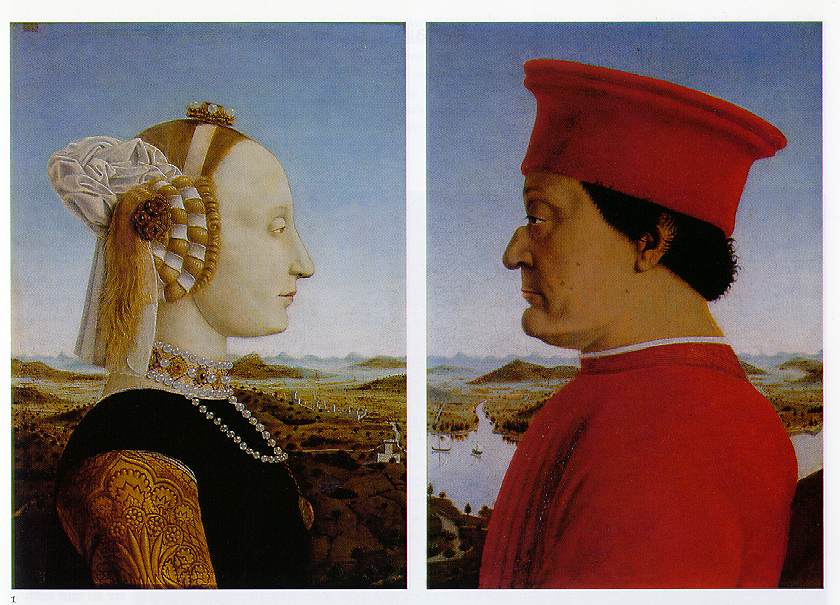
We know much more about her sister-in-law, Battista Malatesta de Montefeltro, daughter of the Count of Urbino, who married Galeazzo Malatesta in 1405, when Cleofe would have been quite young. Poised, superiorly educated as a humanist, she wrote hymns and poetry that have survived, and gave lectures at court on philosophy. But as a young woman she nurtured the toddler Cleofe along with her own daughter, helped her with her lessons, and talked to her about what young women marrying rulers of courts needed to know.

Cleofe appears in history with the arrangement of her marriage to Theodoros Palaiologos, second son of the Emperor of Constantinople--no great shakes, that position, those days--and Despot of the Morea (Despot was a title given royal sons as governors of provinces).Cleofe's uncle, Pope Martin V, had given permission for Western ladies of the highest rank to marry into the Byzantine royal family, one of his tactics for joining the Orthodox church to the Roman. The royal Byzantines were glad to marry Western ladies because any ties with the West could be useful in getting help against the Turks who had a strangle-hold on the Empire, and four princes married six (wealthy) Italians. One historian says that these were prestigious marriages for the princes: au contraire, they were prestigious marriages for Italian courts in the early Renaissance. The situation was rather like the heirs of great British estates in the late 1800s and early 1900s marrying American heiresses for cash to shore up their positions.

So it was a political arrangement, but well-born young ladies expected nothing else.
She traveled to Constantinople on a Venetian galley with Sophia of Montferrat who was to marry Theodoros' brother John. That marriage was a disaster: John disliked her intensely and they lived apart. That theme comes into Cleofe's small story.

When Cleofe arrived in the Morea--in 1420 or 1422--she was in her mid-teens. Theodoros was twenty-four. She had brought with her a large dowry, a splendid wardrobe, jewelry, and small furnishings to make her feel at home. The Pesaro composers had written motets for the wedding. Guillaume Dufay who was working for Carlo Malatesta, wrote a gentle, almost romantic, motet for a text that began Vasilissa ergo
Gaude -- Therefore, Queen, rejoice! --a nice blending of Latin and Greek for a marriage between a Greek and a Latin. Hugo de Lantins wrote one, too.

Across how many regions, does the sun moving so
turn and view with absolute confidence,
and see, O Sparta, none so happy as you.
You were the home of Queen Helen,
who through everything she did
drained the strength of all who ever wrote.
Now you possess something more divine,
Madona Cleofe,
born of the Malatesta, as you well know.
These are the glories and powers
you have added to the empire of Constantinople
with its many lords, so great and noble.
It was not, perhaps in the best of taste--that image of Helen draining her men. And there is no information as to when or where these offerings were performed, but if you have seen Mistra and know the music, you will see how it fits.

Cleofe lived with Theodoros for thirteen years in small, charming, provincial Mistra on the orchard-covered slopes of a snow-capped mountain, above a clear shallow river. Nothing much happened in Mistra, except that there were painters painting frescoes in pretty churches; Italian, French, Catalan, and Venetian merchants dropping by; and several outstandingly intelligent men doing philosophy and corresponding with Italian humanists. Cleofe's father came out once, to help negotiate a problem between the Despotate and Venice. Mistra's fashions in this period--clothes, art, ideas-- came from the West and Mistra was, all in all, a shadow Italian city-state.

Theodoros enjoyed philosophy--his father Manuel and his brothers John and Constantine did, too--but his particular interest was mathematics and he is said to have been one of the best mathematicians of his age. We know nothing of any work he did in those lines. What we do know is that his father had sent him away from home at the age of ten to rule the Morea from Mistra (a regent was sent along with him). He grew up a geek in a milieu of bullies and sycophants, with a certain amount of taste for things Italian.

Things should have worked out better than they did. As part of the marriage arrangements, he had signed a letter to the Pope promising that Cleofe would be able to keep her her religion and ritual, her chaplain, and her Italian customs. And that she would not be asked to change any of these, directly or indirectly.

The first thing that happened in her marriage was that Cleopa became Kleope--royal Byzantine brides routinely had their names changed far more than that. The next thing that happened was that Theodoros started demanding that she become Orthodox and stop paying attention to her Italian companions. In his clumsy way, the lonely boy was learning something about being loved.

In 1424, her brother Pandolfo--he could not be a warrior because of a deformed back, but he could be parked in the Church--was sent to Patras as Archbishop and ruler.
The Malatesta liked building, and Pandolfor rebuilt Patras' cathedral of St. Andrew. His friend Dufay wrote an elegantly meditative motet--Apostolo glorioso-- for its consecration. Kleope and a host of Italophiles from Mistra must have gone up to Patras for the ceremonies, and surely people she knew came over from Pesaro. Of this building and event, only the music survives.

It is probably during this period that the handsome Italianate palace of Mistra was built, a wing for public spaces with great windows looking across the orchards and wheat in the valley of Sparta, and the high round windows for looking at the snow on the mountain ridges. Perhaps Kleope's dowry helped pay for it, perhaps builders were brought over from Pesaro and Rimini, perhaps Kleope had a voice in the design. Perhaps not. There is no information about its bulding, no approximate date.

In public, the couple were gracious hosts to the philosophers and travellers, but privately, the marriage continued tense. There were arguments, fights
. The pressure to convert increased. Kleope wrote Battista. In 1425 Battista wrote to their uncle, the Pope Martin V who, against anyone's idea of pastoral care and avuncular affection, wrote a letter to Kleope full of fire and brimstone, promising her hell if she strayed from her Catholic faith. Kleope must have felt that hell on earth was worse than hell after earth, for at some point--the date, again, is one more unrecorded detail--she converted to Orthodoxy, altering her Italian fashions to the more covered-up Greek style. The year before, Leonardo Bruni had written Battista a letter, discussing the problems of giving women the kind of education that their constricted lives could not make fair use of. Unless he had written it earlier when Battista was teaching her. He may have heard of Kleope's problems.  [Late note:  I took someone else's word for the date of the letter.  I am now sure it was written about January 1427.]

Two years before Battista's letter, in 1423, Theodoros had started talking about retiring from the job of Despot and going into a monastery. He talked about it for years. People said it was because he hated Kleope, but no one blamed the rift on her. Far from it: people who knew her considered her "outstanding for beauty and for all other seemliness." After four years of it, his family finally took him seriously and sent Constantine to the Morea to take his place, and he arrived in Mistra the day after Christmas 1427.

That was enough for Theodoros who changed his mind. It may be only a coincidence, but Helena was born in 1428, named formally for her grandmother, but no one, from Mistra or humanist, could avoid the association with Helen of Troy. All three Helens (see that praise song above) were queens.


While Kleofe was pregnant, her brothers-in-law, Constantine and Thomas, trying to absorb all of the Morea into Palaiologue possession, attacked Patras. Theodoros declined to join them, possibly out of consideration for his wife. Her brother the Archbishop complained to the Venetians and ordered up as supply of powder for his cannon, and then left the country. But Constantine and Thomas attacked again, and in June 1429 Patras belonged to the Palaiologues and Kleofe's had lost a brother. The same year, the highest-ranking court official in Mistra began building the lovely Pantanassa, a church with Sicilian flavors, but it is something we can imagine Cleofe watching with pleasure.

She died in 1433. One historian has pronounced this an "obscure" death, but the Palaiologues weren't that kind of people. There is absolutely no information on this topic other than that she died. It could have been plague or malaria. Or she bled to death after a miscarriage. It was not an immediate death: there was time for Theodoros to hold her hand and weep. He loved her in his own, limited, way. Without her, there was no one other than his mother in Constantinople who loved him, and we can only hope that she did--there is no evidence of her emotional state.

A number of intellectuals gave glowing tributes at her burial. The young Bessarion who was going to be very famous spoke of her beauty, her intelligence, her piety. The very famous Plethon spoke of her piety, humility, intelligence, beauty, character, gentleness and generosity, commending her for giving up her "soft Italian customs" and dress, and adopting the Greek practice of fasting--thereby demonstrating that she had satisfied Greek male demands for a woman's behavior. It would have been inappropriate for him to mention the fashion for Italian dress among the upperclass women in Mistra. Then he told Theodoros to buck up, because Greece had real problems.

Fragments of a body dressed in Italian gowns were found in a grave at Mistra, in the church where she was buried. It may be Kleope, it may not be. It is allowed to hope that Theodoros had buried her in one of the dresses she preferred.

Despite Plethon, it is difficult to think of a Malatesta being humble, but the women of that family had learned to walk tightropes to survive. I see here a private diary in which she poured out--writing too fast for beautiful humanist penmanship--all the things she could not do or say if she expected a tranquil life. I also see this diary being burned by one of her household, about five minutes after she died. There is no evidence for this diary.

Little good happened to her immediate family, though nothing unusual for families in their position. Her brother Galeazzo, Battista's husband, was killed by their brothers in 1431. Battista's son-in-law, Pier Gentile, husband of her daughter Lisabetta, was imprisoned in a war among his brothers. She took her daughter and grandchildren and returned to Urbino. Trying to save Pier Gentile, she made a public speech about these events to the Holy Roman Emperor iwhen he stopped in Urbino in May 1433, but he was killed by a papal agent anyway. Battista raised her granddaughter Costanza so that she became one of the best-known, best-educated women of the Renaissance. Costanza named her daughter Battista (1446-1472). Battista was married before she was fourteen and died at the age of twenty-six, after giving birth to her son Costanzo, having produced at least six children for a very famous humanist condottiere.This is why she is so pale in her portrait.

Helena was married to John II, King of Cyprus in 1441. He was twenty-three, she was thirteen. A modern, otherwise reasonable, historian has called her "a violent, neurotic girl in permanent ill-health" without helping us out with corroborative illustrations, but the Renaissance thought marriage made up for child molestation. Helena died in 1458, having given birth to one, maybe two daughters, one of whom she named Kleopha. Kleopha died very young. But given Helena's ancestry, and the probability that she was mostly ignored after her mother died--she was five--and the probability that although philosophers and foreign intellectuals, including Cyriaco of Ancona, were all over the palace at Mistra, she was badly educated. She must have been desperately frustrated, desperately sad.

At my first visit to Mistra more than thirty years ago, knowing nothing of its history, enchanted by the apple and orange blossoms, the snow capped ridges of the mountain, I wandered in the ruins of the palace, hearing Ravel's Pavane in my mind. This, now, is why.

The narrative is continued in
Pavane for a Dead Princess, II
Pavane for a Dead Princess, III

Pavane for a Dead Princess, IV 
Pavane for a Dead Princess, V
Pavane for a Dead Princess, VI
Glory Days

Theodoros II Palaiologos 
Malatesta "dei Sonetti" Malatesti

The primary sources for the Cleofe and Theodoros story can be found here.