24 February 2011

Peacemakers

One of the galleries at Tiryns, Minio's Castellazo.

On 9 October 1480, the Greek kapetanios Krokondelos Kladas led a company of stratioti out of Koroni in a private war against the Turks in Mani. He carried a Venetian banner, to give the impression that he had serious backing, and he acquired Greek, Albanian, and Italian supporters as he went. Mehmed II wrote Venice that he knew they had nothing to do with it and sent two different military expeditions to bring Kladas down and punish his accomplices.

On 15 December, Captain-General Morosini of the Venetian fleet reviewed the troops in Nauplion -- he had already done this in Methoni and Koroni -- and fired most of the Greek and Albanian stratioti or reduced their ranks, without their back pay. In peacetime Venice had no need for so many troops. When they protested, he demoted some and had others beaten. One of the leading Albanian kapetanioi, Thodaros Bua, stormed out with some 60 followers. They attacked Turks farming outside Argos, killed three, and went south to join Kladas. (See Letter 23.)

Ottoman reprisals were terrific, towns were burned, hostages taken, a few prisoners sent to Constantinople where they were cut to pieces. The impression from the documents is that it was not those responsible who received the brunt of the punishment. Kladas and Bua fought over control, Bua pulled out. Avoiding the dragnets across the Mani, many of the rebels made their way toward the borders of Koroni and Nauplion territory and started operating as bandits. Nauplion's provveditore, Bartolomeo Minio, banned the bandits from entering Nauplion territory and prohibited the sale of their goods. Nicolò Navagero, did the same for Koroni territory. This was their only defense when they could not lay hands on the guilty.

In early March, Bua got in touch with his cousin, Ismail Pasha, voivode of Karitena (who had taken troops across Mani) and asked for pardon. On the 12th Ismail wrote Navagero, provveditore of Koroni, proposing that both sides grant mutual amnesty -- he knew Navagero well after spending three weeks with him the previous fall in negotiating the territorial boundaries, but Navagero replied that he was unable to take such an action. Bua, taking pardon for granted, went into Monemvasia where he was immediately recognized and jailed.

In April, Kladas abandoned his followers, perhaps a day before certain capture near Porto Quaglio, sailing away on a ship belonging to the King of Naples on which there was someone he knew. For nearly a year, what was left of the revolt remained in a limbo, with some of the rebels hiding in the mountains, some looting and attacking Turks.

In January of 1481/82, Ahmed Beg, the new Ottoman governor or sancakbeg, arrived in the Morea. On 13 February, he -- with 300 horsemen and his personal staff -- met Bartolomeo Minio -- with 500 horsemen, 200 foot, and half of Nauplion -- at Castellazo. Then the two of them, each with five attendants, withdrew to talk. After issues of mutual interest had been discussed, and much good will exchanged, Ahmed Beg took one of the voivodes as a translator, Minio took his secretary and his translator, and the five of them talked privately.

I chose the picture above of one of the galleries at Tiryns, as it seems a most likely place for them to have talked. It offers shelter from the February chill, and privacy.

Ahmed Beg said that he wanted to put the matter of the revolt to rest. One of his voivodes who was related to the Busichi clan, and Ismail Pasha, had been working on it (or maybe the voivode and Ismail were the same person), and he asked Minio if he would share in a joint pardon.

Minio said that he himself did not have the authority to pardon rebels against the Signoria, people who had violated their peace agreement with the Ottomans. Ahmed urged him again, saying that if he -- the offended party -- was willing to forgive them and Venice was not, it could be taken that they were willing for the rebels to continue. Minio saw his point and said that he would write to the Signoria.

It was agreed that, until they had the Signoria’s response, the rebels were to withdraw and remain quiet. The voivodes and some of the kapetanioi said they would speak with their rebel relatives and asked for three days to get an answer. By the end of the three days, the kapetanioi brought word that Mexa Busichi, Elia Sagan, and Canessi Climendi, the rebel leaders, were willing to accept that.

So Minio sent his secretary with two Nauplion citizens with the kapetanioi to meet the rebels and record their oaths to remain at peace. Minio wrote the sancakbeg about this, and received from him a pardon and safe-conduct for the rebels. 

Minio urged the pardon on the Signoria, pointing out all over again that the offended side had already given a pardon. Further, this was a matter of 77 men, all of them first-rate men with good horses that the Signoria could ill-afford to lose. He was taking a great risk: had his proposal been resented in Venice, he could have lost any future position and could have been hit with enormous fines. Then Minio wrote something else, something he had not written the Signoria before because loyalty to a senior officer was such a supreme Venetian value. Minio explained what had happened to prompt the Nauplion revolt:
The Magnificent Captain General, held a review . . . through the bad information given for their advantage by those who were close to his Magnificence, . . . many of the old and competent stratioti have been rejected and their appointments annulled, and other useless ones taken on. Mexa Busichi, a competent man, and personally more valuable than his other Busichi brethren . . . was downgraded and listed as a simple stratioto. . . . Elia Sagan, who was a kapetanios of the stratioti, a provisionato, and one of the old stratioti of this territory . . . and his brother who was also a kapetanios and provisionato and others of his family have died in Your Lordship's service . . . was not only discharged . . . by the aforesaid Misier Hieronimo, but was also beaten.

He said a great deal more than this. (See Letter 72) Minio’s sense of unfairness and his strong loyalty to ’his’ stratioti won him enormous loyalty in return. His arguments convinced the Signoria, and within six weeks the first pardons -- seventeen -- were issued. It took several months to get it all settled, and the Busichi had to be pardoned for assorted homicides as well, but it was done, and then Venice offered them all jobs fighting in the Ferrara war. How they were seen in Italy is described here .

In fact, the stratioti were so contemptuous of the leadership they got in Italy that they refused to fight if not assigned a leader of their own choice.  They were given Minio. The sequel to this story, and the Ferrara war, will be told in a few weeks.

Minio’s letters are dowloadable here.

The Greek Correspondence of Bartolomeo Minio:
Volume 1,
Dispacci from Nauplion, 1479-1483.
Diana Gilliland Wright & John Melville Jones
Unipress: Padua, 2008.

18 February 2011

Albanian Color

 
Nikolaos Onouphrious
ca. 1550

A correspondent sent me a link for for the eccentric site http://library.nu/ from which you can download a remarkable number of scholarly books (hint: on every page, scroll down for the button you need). Searching on this site for 'Byzantine,' I found on page 52  [Note:  this hasn't worked for a while.  Try this link from one of the authors.]   a remarkable book of icons entitled Icons from the Orthodox Community of Albania.* It is a catalog from a 2006 exhibition of the Museum of Byzantine Culture in Thessalonike, and represents a high-water mark of cultural cooperation.


In 1999 at a point when western civilization had gone beyond shame, the General Consul of Greece in Korçë, Nikolaos Garilidis, was asked by the Director of the National Museum of Medieval Art for assistance in saving the 6,500 icons in the collection from possible consequences of the Kossovo war. In an act that has held back the powers of darkness a little longer, Garilidis enabled a cooperative program between the Korçë museum, and the Museum of Byzantine Culture in Thessalonike, in which 88 icons were transferred, studies, and restored. I have found these icons astounding -- I can't recall ever seeing anything identified as Albanian icons -- and am giving here several, with details, for you to rejoice over.  But these are only two -- three with the cover image at the end -- and this book has many wonders.

All the images here ( except the last) are by the painter Nikolaos Onouphrious -- surely one of the greatest colorists and artists of all time -- whose painting seems to have happened mostly between 1547 and 1554.  (All of these images should enlarge when clicked on.)  I have never seen colors of the saturation and intensity that Onouphrious used  -- look, for example, at the detail below of bathing the Christ Child.  After the icons are three frescos, frescos that give forth their own silvery radiance.  

To begin with, look at the electrifying God-the-Father in this detail from the Baptism icon, the beard that becomes light and sound, the rocks that vibrate with light, the interlocking circles of the halos and go back and look at the construction of the whole painting, the universe splitting apart to show who Christ is, and the waves about to burst into new forms of life -- these waves echoed in the baby's bathwater. 


The Nativity appears to have the customary iconography but in this one -- again something I have seen nowhere else -- the womb of the mountain embraces both the Magi and the birth, and the infant and mother are facing in the direction opposite to their usual. The right-hand curve of the cave and the curve over the grisaille angels reflect the circle of heaven, but the emphasis here is on the realities of human life, and these are given the glorious color -- the women bathing the baby, the shepherd playing his bagpipes, Joseph who is somewhat left out and who has to explain to a stranger what is going on.  And then there is the rhythmical interchange among the curves of the Magis' horses' necks and their gestures and their billowing cloaks.


There are apparently a number of Onouphrious frescos in the area between Berat and Kastoria, and several others in Kastoria.  This is a palette of colors unfamiliar to me in frescos, and utterly luminous.

Saints at Berat, Michael at Kastoria 
 

 Signature of Onouphrios, Kastoria

Icons from the Orthodox Community of Albania.  Ed., Anastasia Tourta; text, Eugenia Drakopoulou.  Thessaloniki, 2006. Catalog from the Museum of Byzantine Culture.


Roman soldiers leading Constantine's triumphal procession.

Incantations

 Jane Carlyle by Thomas Lawrence

JENNY KISSED ME

Jenny kissed me when we met,
Jumping from the chair she sat in.
Time, you thief! who love to get
Sweets into your list, put that in.
Say I'm weary, say I'm sad;
Say that health and wealth have missed me;
Say I'm growing old, but add-
Jenny kissed me! 
 
Leigh Hunt


OVERHEARD ON A SALTMARSH

Nymph, nymph, what are your beads?
Green glass, goblin. Why do you stare at them?
Give them me.
                        No.
Give them me. Give them me.
                        No.
Then I will howl all night in the reeds,
Lie in the mud and howl for them.

Goblin, why do you love them so?

They are better than stars or water,
Better than voices of winds that sing,
Better than any man’s fair daughter,
Your green glass beads on a silver ring.

Hush I stole them out of the moon.

Give me your beads, I desire them.
                        No.
I will howl in a deep lagoon
For your green glass beads, I love them so.
Give them me. Give them.
                        No. 

'Strange Meetings' Poems by Harold Monro


These are the first two poems I ever discovered, which means, I found and read them for myself and was each time left breathless and with chills down my neck.  I still expect poetry to do that for me.  Jenny was Jane Baillie Welsh Carlyle, the wife of Thomas Carlyle, a tiny woman.  She jumped up out of her chair and kissed Leigh Hunt when he came to tell Carlyle that the publisher had accepted his French Revolution.  

I spent fifty years looking for green glass beads that looked like the beads I saw for the nymph and goblin.  I finally found them, inexpensive soda glass from Africa.


12 February 2011

These I have shored against my ruins


This is one of the five bookcases in my workroom, one of at least twenty-five or so in the house, but it is difficult to be definitive because a couple of rooms have them on three or four walls and under the windows. These are our warmth against the chill of an increasingly vulgarized culture, our tools, and our companions.

The bookcase closest to my desk hold books most used for current work -- several by friends, and the 15th-century historians: Sphrantzes, Doukas, Kritobulos, Chalkokondyles.  And of course, other things have fetched up there, like a stack of dissertations on top. The middle bookcase is books on Nauplion, Athens, Mistra, and Crete, plus 3 shelves of dictionaries, and one of other peoples' offprints. And other things.

 Some Athens, and a reminder of my roots.

The one nearest the door, the one pictured at the top, is art and architecture, while behind me and bumped when we open the door is Pierre's enormous collection of Greek texts.  The fifth is small and has more library books, books that should be shelved somewhere else, files and books for the next shared writing project.  Inter-library loan books unstack themselves on the floor among seven file boxes. There is also a bed, usually blanketed in books, so it hardly counts as a bed, though I managed to get it usable for visits from Nick Nicholas and Michael Pettinger, my authorities for medieval Greek and Latin.

My reminder from Theocritus: "It is not easy to find."
The "emeralds" are a 32-year family joke.

The floor has a very nice Persian-style carpet, though the degree of niceness is irrelevant as it is mostly covered by the boxes of files I am using for the Kladas book* which is processing slowly but surely.  Slowly, because I have been surprised by time.  Slowly, because I have written several long articles in the past year, most on material that I use in the book, and four speeches.  Slowly, because the fifteenth-century Morea was such a spirit-sucking culture that I find myself frequently drained. The accepted level of peacetime violence, the frequency of plague, the exploitations by the archon class, the corruption of a church organization that possessed one-third of the land and thus removed it from the tax base, the cultural misogyny, the evident despair of the Palaiologoi and their withdrawal from responsibility (always with the exception of Constantine), the dreariness of the Mistra intellectuals who could do little more than harp on the Procession of the Holy Spirit, the Ottoman threat always present like a bad smell in the drains --these devour psychic energy and must have done so in the fifteenth century.

 Yeats wrote:
Consume my heart away; sick with desire
And fastened to a dying animal
It knows not what it is; and gather me
Into the artifice of eternity.
.
 John, the Merbaka Virgin, the Palaiologoi,
a horseshoe from the barn my great-grandfather built in Alabama,
and my dear Ephraim Boms,** in a coma in Athens since September.

Nevertheless, I now know the Palaiologoi  at least as well as my own family.  Kladas I know no better than I did when I first wrote about him in my dissertation 13 years ago.  I have found previously unused information, and I have evolved ideas I have seen nowhere else, but the man himself resolutely remains a stranger to me.  I have gained no access to him through his peers though I have become admiring of Petro Bua. I have a sense of Demetrios Asan and Manuel Rallis, despite their repugnant personal activities; I have a certain sympathy, though dislike, for Demetrios Palaiologos, and a deep affection for Demetrios Pepagomenos. The great Bessarion, Cyriaco of Ancona (after all I have written about Cyriaco, I have no sense of him, either), and Giovanni Dario, have become my private Trinity.***  But there is a shell surrounding Kladas -- perhaps in compensation.


* The Knight and Death: The Kladas Affair and the Fifteenth-Century Morea.

** Ephraim Boms, after nearly a year in a coma, died on August 7, 2011. A Reader at St. Paul's Anglican Church in Athens, he had been preparing to study for ordination as a minister.  He leaves a wife, and daughter and son in Nigeria.

*** I notice that these are all people for whom I have contemporary portraits, though Cyriaco looks nothing like I had pictured him.  I wonder how much that matters?

06 February 2011

Cyriaco's Kore


In the early spring of 1430, in Adrianople, Cyriaco of Ancona purchased Chaeonia who had been taken in an Ottoman raid.  Chaeonia may not have been what she thought her name was: it means "woman from Epiros" in a literary sort of way and that is exactly the kind of name Cyriaco was capable of making up. I am sure she was beautiful: he bought beautiful things. He had spent that winter in Adrianople and that is when he had his first lessons in Greek. He wrote that he began Greek with the Iliad, but he may have begun Greek with Chaeonia.

Later he renamed her Clara, but soon after he bought her, he took her to Gallipoli where in March he sent her to his mother in Ancona, along with bundles of skins and carpets, under the care of his cousin, Ciucio. (Cyriaco constantly writes "we" in his letters and diaries: might his cousin have been part of the "we"?)  Then he and his black freedman, Niccolino, went down to look at the lovely ruins of Philippi, and then Thessaloniki.

Freeing a slave in the medieval Mediterranean did not necessarily mean what we would like to assume it meant.  Often, documents have a condition: "You will nurse my child for three years." "You will stay with my mother until she dies."  "You will work for me for two -- or five -- years."  "You will stay with my daughter until she marries." One record of a woman's emancipation, at Methoni -- I treasure this one -- was followed on the next day by the record of her marriage to her "owner."

So what was Chaeonia/Clara in Cyriaco's life?  It is, I think, impossible to saturate yourself in his writings and then think of him in terms either of love or lust.  One biography of Cyriaco fills out this part of his life with several pages of discussion of the functions of slave girls in the medieval household, and calls her Cyriaco's concubine.  And it could well have been that way. He was 39 years old when he bought her.  He was a person to be kind, and he also -- let us take this a little further -- though not a handsome man, would have had better personal hygiene than most: he dealt in mastic from Chios, valued everywhere as a breath freshener.

But.

Cyriaco, the man who collected epigraphs wrote one for the tomb in which he intended to be buried in Ancona.  He was buried instead in a plague grave in Cremona, but when he was able to plan ahead he wrote:

D. I. S.
MASIELLAE. K. F.
SILVATICAI
MODESTAI MVLIERI
KYRIACVS  PH.F.
PICENICOLLES
PARENTI PIENTISS.
ET SIBI
CLARAEQ. L. KORE
H.M.H.N.S.

Roughly translated, this reads:

To the immortal god(s).
[This is the tomb of]
Masiella Cyriaco,
daughter of the Silvaticai,
chaste mother,
Cyriaco  son
of Philippo Pizzicoli
 most pius parent
and his
kore, Clara, freedwoman.

Was he thinking in terms of a family tomb, and including Clara because she had become an integral member of their household?  Surely, if a man is planning on mingling his bones with his lover's in the tomb he does not include his mother . . . 

Kore. It means "maiden." Had Cyriaco collected a kore the way he collected manuscripts, damascened ware, and the occasional sculptured head, as a lovely possession among his other possessions? Or was she much more? Think: was possession of a kore -- one he had freed from the Turks -- in whatever way you interpret possession -- the way he could most truly possess his beloved Greece?

Was she actually buried in the tomb, with his mother long dead and after Cyriaco had died away from home?

02 February 2011

Only soldiers are dying, not the officers

The Bavarian Lion memorial near the Nauplion cemetery.
Photo, DW.


Brigitte Eckert translates Bettina Schinas' view of events around the creation of the Bavarian lion.

* * * * *
Diary, 28 November 1834.

Walk to hill behind Pronia. Sitting outside with S, reading, the sun so hot at the rock we were sitting on we had to take our coats off. 

Opposite from us Bavarian soldiers were again digging another grave in the graveyard which is meant for them, the last one which was filled has not yet dried on the simple hill which covers it. I counted 160-170 tombs. It is one of the many graves where these poor foreigners, sent here from abroad, rest from all their work. I feel deeply distressed for these poor humans. It is odd though that only soldiers are dying away, not the officers. I especially can't understand it as their lodgings are much more spacious and better fitted out for them than those of the French, when many fewer men died. Good care is taken for their food, they get the best meat etc.

Probably it is also a result of the immoderate drinking of wine which is very cheap here, and the excessive eating of the superb and cheap fruit, which both are very attractive to them as they are very expensive in countries like Bavaria. 


To her parents, 29 November 1834.

At this moment it is horrible in Athens, according to the unanimous witnesses of different persons. The information about the decision to move (the capital) there was given so late that building the most needed accommodations before the arrival of the regency was impossible.

To get the necessary number of lodgings from the inhabitants measures were taken which were pleasant to no one: those who had to give away their homes are mostly pitifully accommodated and unhappy, all of them who were given are discontented, specially because they can't afford the exorbitant costs of moving, the lodgings terribly expensive, very small, and all that trouble in the bad season of the year. . .

Many soldiers can not be accommodated at all, have to bivouac, diseases must be expected. Mr. von Falbe, the Danish ambassador, traveled ahead to outfit the lodging for his wife, Bavarian soldiers tried violently to seize hold of his house, he defended himself until police came to help him.

People here say that a Greek coming home found his wife and children in the street and Bavarian soldiers sitting in his house, he killed one of the soldiers in the fight -- this still needs confirmation. I'm mentioning this because cases like this might be related abroad and give rise to wrong impressions. 

* * * * * 
Memorial plaque for the Bavarian Lion.
Photo, BE.
Copyright © Brigitte Eckert 2011.
SEE Ruth Steffen: Leben in Griechenland 1834–1835. Bettina Schinas, geb. von Savigny. Briefe und Berichte an ihre Eltern in Berlin. Verlag Cay Lienau, Münster 2002.   ISBN 3-934017-00-2.

27 January 2011

Pavane for a Dead Princess: Part Six


At the forty-day μνημόσυνον after Cleofe's death on 18 April 1433, the intellectuals of Mistra came together to give their monodies. The four monodies that we have (there is a fifth, one page and negligible) are long, often moving, and indirectly full of information. I have been interested lately in their view of Cleofe as a political figure.

She was obviously a great help to Theodoros, and apparently participated in discussions with his advisors. Her doctor, Pepagomenos, spoke as if she were still present among them:
For there was nothing that was not communicated to your judgment and thus some difficult problems were solved, while matters of greater moment, of holy governance and of the (soul’s) ascent were determined by the superiority of your virtue.

Nikeforas Cheilas, about whom we know nothing, provides a little more information, though not enough:
She was not, in her mind, in competition with women, even as she worked to surpass the best of them, both ancient and modern, but although she was counted among women, she possessed a truly masculine intelligence, adorning her spirit with gentleness, adorning the constitution of her character with the guidance of philosophy and the practice of all the virtues and graces, and presenting herself as one belonging to a royal race . . . In the midst of turmoil, when present among the imperial councilors she gave virtuous advice of every sort and made herself available to help everyone . . .

This was not in itself exceptional: political participation was a normal activity of Palaiologan and Malatesta women. Much more striking is the fact that -- allowing for exaggerations implicit in imperial eulogy -- she was regarded as so valuable that George Gemistos used the word "salvation" (τήν τῆς ἀρετῆς ἄχρι τελευτῆς σωτηρίαν) in speaking of what her virtue had done for them. 

The men don't tell us much. Apart from that brief mention of her political skills, Cheilas spoke of her great generosity, Bessarion referred to her philanthropy and patronage -- but of what he fails to tell us. Pepagomenos was a little more specific, speaking of her great concern for the poor, visiting them in their hovels, bringing them firewood and cooking for the sick. (One wonders how a Malatesta-Palaiologina learned anything about cooking.) He also suggests that her arrival -- after twenty-five years of no imperial woman in the palace -- much improved the lives of women there and made it possible for a number to be married.

This, though is the kind of behavior to be expected of the women of her family, all of them tremendously educated and given extensive political authority -- her sister Paola Gonzaga of Mantua, her sister-in-law Battista Montefeltro Malatesta of Pesaro, their cousin Elizabeth Malatesta of Rimini. In the well-ordered court of the early Renaissance, the ruler's wife was the social security and public assistance administrations.

This, though, is not what Pepagomenos was talking about when he said:
The queen of the Romans is dead, the very eye of the people, the shared ornament of the inhabited world, the steadfast pillar, while all our present fortune totters. How the death of our queen has turned the expectations of the Romans upside down and has left none of the hopes of our race intact. The bond of union of the monarchy is gone, all is dead and nothing remains, not just of the present for the Romans but of what is to come as well, and it persuades us to prophesy the worst and to expect no end of distress. This horror has run through us like a thunderbolt, burning everything out and turning it to ash, threatening never to give up possession until it consumes all of what is left of the Romans. All the best for us came with your settling among us, and our congenital misfortune has taken away all this, and more besides, in your being gone from us in such an unnatural way.

This conveys -- again allowing for rhetoric -- an extraordinary sense of the doom that must have saturated the educated of that culture, if not the general population. Theodoros had, ten years earlier, unsuccessfully tried to give away to Venice the Morea that he could not defend, and his brother had given the Venetians Thessalonike which they could not defend either. A generation earlier, Adam of Usk reported that Greeks whom he had met in Rome told him that "their empire is almost worn out by the attacks of Turks and Tartars," and Kydones had written Manuel Kantakuzenos as early as 1353 that the Byzantines could not ultimately withstand the Turks.

Pepagomenos kept returning to the idea of doom:
What greater disaster might come than what has destroyed the whole world of the Romans . . . leaving behind sorrow not only to us, her subjects, but to all who are accounted as Roman.

How was it that Cleofe was seen, even rhetorically, as the Byzantine’s sole bulwark against the Turks? The sources give us no way to answer this question. How was it that Pepagomenos could conclude his monody with this statement?

It would be in your power, either with your prayers to the divine, as you stand immediately beside God, to alleviate the distress of our ruler, and through this the misfortune of the entire Roman people---you can do this, I know, with a mere nod of assent---or to leave us to mourn and lament throughout life, as long as the sun sends its rays over the earth.


Cleofe in the position of both Zeus and the Virgin is a stunning image!

ZeusNational Museum, Athens


The Cretan icon is signed Κὺρ Πακσύου ΑΨΙ μαεον η ετελιοθη το παρον - This was completed 8 May 1710 by Kyr Paskuos.


My great appreciation to Pierre A. MacKay for the translations of the monodies. The monodies can be found here.

22 January 2011

Houses

 
Detail from a view of the Acropolis, before 1680, from a drawing in Bonn.

 Pierre A. MacKay spoke at the Archaeological Institute of America on 7 January about Evliya's view of the Parthenon and the Acropolis.  He gives here one detail of that talk, his discovery of an extraordinary and previously unnoticed detail of early modern Athens written down by Evliya alone.  

 * * * * * *
An earlier blog, using a larger expanse of this image of the Acropolis, discussed Evliya Çelebi's description of the Parthenon from his visit to Athens in 1668. This is the best, and it may even be the only 17th century drawing of the Acropolis to represent what the artist saw, rather than what he thought he ought to see. It is uniquely important for our understanding of the Parthenon's appearance before the disastrous explosion of 1687, but it shows us more than that. Between the Parthenon and the edge of the fortress is a cluster of smaller buildings, which correspond with the private residences Evliya Çelebi described:  
There are three hundred houses built like those of Sheddad, fine masonry palaces, roofed all over with tile, houses like castles in their own right.  They have no gardens, but from the arches over the seats in the windows and screened balconies of all the houses, the gardens and orchards of the plain, and all the cultivated fields and trellised melon patches can be seen.
At least two of the houses in that image have balconies, most have arched windows, and the artist has indicated the tiled roof on one. 

Evliya also notes that:

There are . . . hundreds of thousands of kinds of pictorial creation of marvels and wonders, images in the Frankish taste, which leave the viewer amazed and distraught, his brain in a boil, and his body without senses. The pupils of his dear eyes are dazzled and filled with tears, as if each of these representations were a living thing causing a dread confusion in a man’s mind. These images laugh and smile at the man who views them and some, which are depicted as being caught up in anger and rage, look off askance at a man. 
 This could be an advance summary of what he says a bit later about the Parthenon, but it is more likely to refer to paintings and frescos on the walls of some of the richer houses, painted at the latest 210 years earlier.  The grand rooms built into the Propylaea to serve as a palace for the original Frankish lords are supposed to have been frescoed, and the same sort of decoration could have been applied to private houses. 

 Model of Frankish-Florentine palace in the Propylaea.


Evliya writes about houses in the lower town:
There are 7,000 tile-roofed houses, of both Muslims and Christians. They are sturdy houses, like castles with battlements and loopholes, and built completely of stone---there are no wooden houses or houses with earthen roofs or mud-brick walls, but only splendid houses with stone walls set with mortar and lime.
Evliya is quite clear that these houses are distinct from others in Greece, and in comparison with his descriptions of neighboring cities in regions both north and south of Athens, the specific features such as cut stone construction and battlements stand out sharply.  Among the possible models for these Athenian houses, the closest similarities are with Florentine private residences of the 13th and 14th centuries. Cyriaco of Ancona would have stayed in these houses with Florentine friends on his visits to Athens.

The Duchy of Athens, officially established under Neapolitan sovereignty in 1395, remained in the hands of the Florentine Accaiuoli family until Mehmed II suppressed the duchy and removed the last duke, Francesco, in 1458. The duchy left a considerable cultural memory in western Europe ("A Midsummer Night's Dream," Chaucer's "The Knight's Tale" for two examples), perhaps more than it deserved, but we have had little evidence until now of the cultural influence of the Dukes on Athens.  The Accaiuoli are known to have fostered close commercial relations with Florence, even when they were subject to rival powers, such as Venice, but this evidence suggests that they reinforced these relations by recruiting Florentines into Athens, probably by offering them significant privileges in the administration of the city and its territory. 

The number of houses, whether on the acropolis or in the lower town is a typical Evliya exaggeration. Except in rare instances, numbers have a flavor, rather than a factual content in his style. The Accaiuoli seem to have got along rather well with Greeks, at least with better-off Greeks, so there is no reason to think that Greeks were disposessed to make room for Florentines. On the other hand, there is little reason for Greeks to have abandoned their own styles of housing to adopt a foreign style. Evliya remarked on the houses he found most interesting, and simply passed over the remainder which were probably in the majority.

Our one slight hope of finding proof of this is in the lower city, where there might still be a fragment of Florentine wall built into a surviving structure. It will be an interesting challenge for the next generation of archaeologists to see whether anything remains.


House with double-fold windows
surviving in 1765-66, which can be compared with a typical Turkish house, below.
W. Pars, Museum Worsleyanum, 1794.


16 January 2011

Here, more than anywhere else, patience

The view from Bettina's front windows.
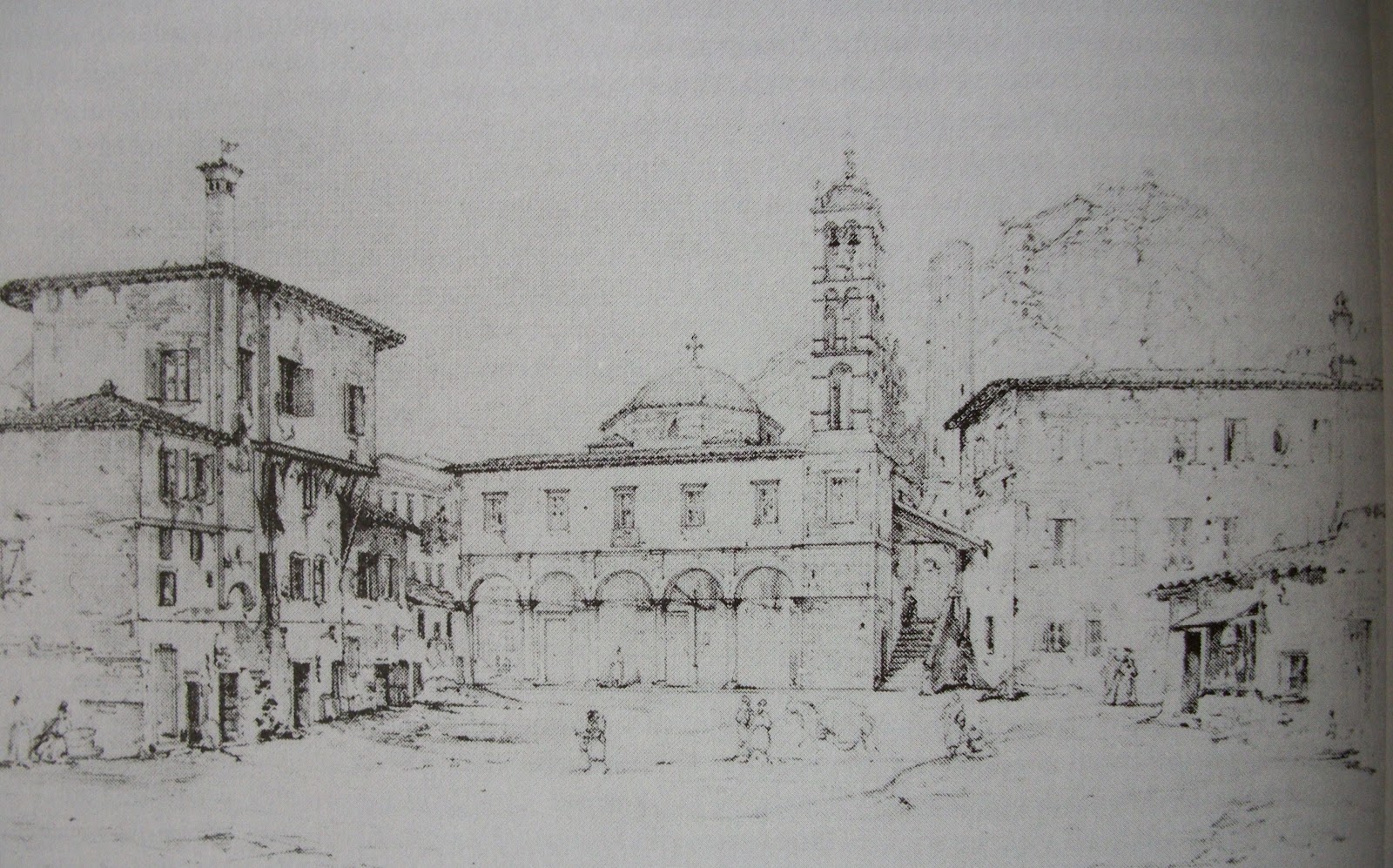
Ag. Giorgios, Nauplion, drawn by Leo von Klenze, 1834

This continues Brigitte Eckert contribution of excerpts from her translation of Bettina Schinas' letters from Greece in 1834-1835. Here Bettina writes with keen and gentle observation of her first weeks in Nauplion.  Bettina was the daughter of Friedrich Carl von Savigny (1779-1861), prof. of Roman Law at the Berlin University and one of the developers of the new (Humboldt) university, and Gunda Brentano, from the Brentano family. She married one of her father's students, Konstantinos Schinas. Bettina went with her husband to Nauplion in 1834, where they lived in a house at Ag. Giorgios (above), and then moved with the government to Athens in 1835. An letter from Bettina about Athens is here.

* * * * * *

To her parents, 2 November 1834:

First visit to Countess Armansperg who was very polite and kind, coming back home I found an invitation for the same evening. . .
The Armansperg house, 2010,
the first house in Nauplion to have a piano.

I must report about the evening at the Armanspergs. Beautiful rooms nicely decorated, filled with all kinds of people, diplomats, officers, dressed in Bavarian uniforms, as palikaria or French; also the ladies dressed French or Greek. The countess in mourning because of the Duke von Altenburg’s* death. She received me very kindly, complaining there would be no dancing because of the death. The daughters very pretty, very modest and polite, offered me conversation as they noticed I didn’t know anybody. The older played the piano later very skillful. The many rooms were crowded -- tea, ice cream, lemonades were offered. When the Countess saw me speaking with Kolettis, (I was standing up because he is so tall) she came and offered us 2 chairs next to each other so we could speak seated; the daughter played the piano, so we stopped our conversation. 
 Ioannis Kolettis
Prime Minister, June 1834 - June 1835

To her parents, 5 November 1834:

Some hundred steps before our road met the big road to Argos we saw the king, 3 officers and 2 followers on horseback, and more 8 or 10 soldiers following. 

Otto of Bavaria,
King of Greece 1832-1867

 
In Pronia (Nauplion suburb) we got off the horses and let the luggage be taken to town. At 4 ½ we reached our house facing Ag. Giorgos cathedral. Mr. Praidis (provisional Minister of Justice) who was still living in the rooms which the workers had finished did not expect us yet but moved out immediately. While he packed I waited in the room of the landlord, the archbishop who had watched us arriving came in, a colossal venerable man, indescribably warm towards S. [Bettina's husband] , and stayed with me though we couldn’t speak to each other. 
 
Facing Ag. Giorgios, the front door of Bettina's house.

. . . Our lodging exceeds my expectations by far. At the front side facing the square a big room and a little boxroom, from there a big hall with a kitchen and larder at one side, at the end it meets in right angle a wide corridor with 3 spacious rooms; a 4th one longer than the corridor’s width, as big as our blue room at home, has 3 windows. 
 
Ag. Giorgios and the L-shaped footprint of Bettina's house across the street.

To her parents, 31 December 1834

In front of the cathedral facing our house is, as I told you before, kind of a loggia, 3 doors open into the church, at one side is the bell tower, surely unique, like a top decoration of a cake, 2 bells hanging toneless between the little columns, a piece of string attached to them is just hanging down and tied to a nail, even small street urchins can reach it (to my despair). Behind the campanile rises a Turkish minaret of the same height, broken down to half size so as not to darken the campanile completely. A staircase which led to the minaret leans to one side of the campanile, and maybe for the sake of symmetry a second one has been added at the tower under the loggia of Orcagna,** which joins the first one behind the tower, and these attract the boys to run up and down. Next to this stair, in front of the side door, under the loggia lies the noble Ipsilanti whose memory is generally kept sacred. No stone, no sign of any kind indicates his tomb -- children play all kinds of games on it. Yesterday a priest emptied a big bucket of dirty water (from the construction works on the inside which are not yet finished) onto the tomb. Though there is so much more to do for the living it hurts that this tomb does not receive more respect. A splendid memorial would be unsuitable to the wishes of the dead, but some kind of sign is just missing. I did not know the man personally but I miss it when I look there or pass by.


To her parents, 7 December 1834:

. . . Using a large map you will see that the big half-moon shaped plain of Argos is bound at one end by Nauplia. The suburb of Pronia, very clean, pretty new houses, wide streets, lies at the foot of Palamides where the steep high bold rock slants towards the other mountains, it stretches to the mountains and the last houses are placed almost imperceptible higher. From Pronia to the by is the large drill-ground, up to a bridge which leads over a kind of moat to the gateway, the only one the town can have considering its location. The small door in the fortification which leads to a troublesome rocky footpath along the seashore can’t be considered a gateway.

On the water’s edge are many houses with kind of an embankment in front of them like a harbour, from which you can put to sea. The smell here is horrible because the water is low and the dirt of the town is brought here. Even now it smells marshy. S used to live here and each time I visit his sister and his former rooms I am glad that they are not mine. The drill-ground extends along the base of Palamidi, which has a front side aligned to town and sea. It is brusque, most picturesque, descending so steeply that an extremely arduous stair, supported fantastic by walls, leads upwards in a zigzag. A public garden about 80 steps wide lies between the drill-ground and Palamidi. From the steep rocky wall of Palamidi stretches like a spit of land, about half as high as Palamidi, the rock on which Itshkale (Acro-Nauplion) sits and the towns leans at and fills the space till the seashore.

Leaving the town by the bridge a wide footpath at the right side rises a bit between Palamidi and Itshkale, like a pass. This road leads up half the height of Palamidi for a rather long way where one can see on the right the clear sea, beyond the gulf the most beautifully shaped mountains one can think of, many layers of different forms, sizes, distances behind each other, each moment a new landscape by illumination. Many of these mountains are as high as being covered by snow two days after my arrival while the heat here was still going on, the snow staying for two days.

. . . The wealth of picturesque views existing here anyway is constantly increased by the changes of light and perspectives while moving along; this is the most significant when I walk through the hills at Pronia. Some rocky hills lie visible to their roots in the plain, like at Salzburg. The colour of hills and mountains (except of Palamidi, where the rock is brownish) gives at first sight the impression of unfertile and barren ground, a dead grey sometimes a bit yellowish. Several of these closer hills call the Lilienstein near Dresden to mind, rising gradually, then steep till the top where suddenly and wonderfully stratified completely naked grey rock appears and mostly ends flattened like the Lilienstein. Viewed from the plain the terrain seems to ascend regularly and it looks monotonous. But as soon as gaining a little height one finds unexpectedly deep and wild gorges torn by the waters in spring, now completely dried except some marshy spots where the young fish lie till they get washed down.

. . . One can see how all the mountains were cultivated, because the descending area is originally terraces built for fields or olive plantations, which only gradually flattened out. The ground is so fertile you need only a plough and seed without any further preparation to get an overflowing harvest. Heideck once picked an ear from a full field, it contained almost 100 grains, 3 ears growing from the same root, so 300-fold bears the corn without big effort and cost, fertilizer is hardly needed. With very thinly spread sheep’s dung the ground gets black and heavy like hotbed soil.

When H was Commander of Nauplia 1828 he found a significant part of the town in ruins - the buildings, not the streets, the sewerage marshy, weeds, thistles, thorny bushes lush at many places. The inhabitants, but only women and children as the men had been carried off by the war or were not back yet, lived in great numbers in straw huts like the plantation guards at home, all built close to each other, no pavement -- chicken, ducks, pigs and their dung next to the huts. When it rains here, the waters keep standing as there is no draining and it does not seep away; so the huts were surrounded by green mud ½ -1 foot high. H ordered the construction of the first houses of Pronia, just 4 walls, insisting the families move out of their huts, then tear them down and top the walls with a roof of these materials. In the beginning the women didn’t want to move of fear of the palikaria. But after they did the sewerage was opened, cleaned, the marshy placed were laid dry. In Pronia the people who moved in were mostly ill but they became well, as health generally improved gradually in Nauplia. 
 
. . . The streets are paved, cobbled or macadamized except some spots filled with ruined remains of or left without buildings. Some newly built streets wide, straight, pretty friendly houses on both sides, more streets are older and therefore narrow, here stand new, renovated, old and partly collapsed buildings side by side. The new houses look like at home, not only roughcast but many painted like square stone blocks, decorations at the friezes etc.. In front of the windows, shutters or venetian blinds, painted green; windows with big panes, to open or to raise like we know them in Germany. Roofs not very high, with pediments and tiles, many houses roofed partly with a flat terrace where laundry can be dried. Balconies with beautiful wrought iron railings. The corridors and staircases are small in our terms. The staircases are made of stone or wood.

The doors don’t close, not even in new houses, probably because the wood is used too fresh or because the measurements of the doors coming ready-made from Trieste don’t fit exactly into the already built openings for the doors. At Armansperg’s house one can stick a hand through the doors. Thresholds don’t seem to be known to improve this trouble. I already decided my future doors will be closing one or another way. Stoves get set like in Italy -- at the beginning of winter next to a window, a pane is taken out and replaced by a piece of tin and the pipe stuck through it. Till today, Nov. 19th, I have no fire, not even with writing I don’t need to wear more than my brown merino woollen dress, no jacket, shawl, which are just bothersome. In traditional Greek pubs there is no stove, but a big copper coal machine in the middle of the room, like you know them from Italy. Floors are generally made of wood. The ceilings are also covered with wood (our ceilings are painted with oleo colour topped by a pattern of a different colour, though it is an old house, but belongs to Miaoulis, a Hydriot to whom cleanliness and neatness is essential.). With some Germans here you can find wallpapers, but generally walls are whitewashed or painted one colour. I gave you an idea of an old house and its furniture and fittings by the description of the Bey's house. Differences depending on poverty or wealth can be imagined.

. . . Some Greeks have an amazing mixture of poverty and splendour. The splendour is shown off with a silver salver for the preserved fruit sweets, a precious Turkish shawl, real pearls, diamonds etc. are remains of old wealth lost forever. A chest of drawers, solid mahogany, heavy bronze attached, marble cover, nothing else in an empty room or just surrounded by most simple thatched chairs; a precious modern table in front of a couch made of boards, covered by a mattress and cotton; or a big beautiful mirror in tasteful gold-painted frame at the same wall where single household appliances are hanging at nails because of the lack of drawers etc.; indicate the owner is not in poverty at all ( i. e. now or in the past has earned a pay which made the purchase possible, but which can end any day and put him vis à vis de rien). Otherwise he could not have bought the expensive things, but is as well evidence of the practical impossibility to buy here at the spot what is needed and reminds one in each moment that here more than anywhere else in the world patience is indispensable.


* Grandfather of King Otto of Greece.

** Bettina uses "Loggio of Orcagna" for the front of Ag. Giorgios, using a reference to the great loggia in Florence to give her family a sense of the architecture.

* * * * * *

Copyright © Brigitte Eckert 2010.
Photographs by Brigitte Eckert.

SEE Ruth Steffen: Leben in Griechenland 1834–1835. Bettina Schinas, geb. von Savigny. Briefe und Berichte an ihre Eltern in Berlin. Verlag Cay Lienau, Münster 2002.   ISBN 3-934017-00-2.