30 March 2009

A chapel with vestiges

The picture is of a chapel with vestiges--here a classical column built in, just right of the lower center. William Gell noted this site as he passed by, one eye on his watch, the other on his notebook.


Gell (1777-1836) was a wonderfully obsessive traveller, documenting his modern Greece of the 1810s against Pausanias, and then noting the minutiae of his modern Greece for the travellers he hoped would follow him, and then writing up his interesting experiences and candid descriptions for people who were sensible enough to stay at home, grateful for the blessing of being English, instead of Greeks or Turks..

In the introduction to his Itinerary of Greece, he writes:
To those who may consult this volume as their guide on the road, the advantage of noting every well, rivulet, mill, or farm-house . . . will soon be apparent, in a country which does not abound in water, where every stream has its history, and where every object assists in determining the direction to be pursued, when the road is nothing better than a track frequently interrupted.
This program was fulfilled in the next volume, Itinerary of the Morea. Suppose you were, inadvisedly, wanting to go from Mistra to Krabata, these would be part of your instructions. The numbers refer to minutes:
11 The last sign of Mistra. This road is the same as that to Leondari.
15 A ruined aqueduct, with two ranges of arches, with a stream under it.
10 End of the hill of Papiote, and another piece of the aqueduct
. . . . .
3 The road turns back a little, and a river falls into the Eurotas.
13 Following the glen of the last river, ascend. R. across the stream, a rock with the appearance of antique vestiges.
. . . . . .
9 Very bad road, on a summit. Descend. A church r.
5 Vestiges. A few trees. Bare hills. A stream from r.
2 A fount r in a field.
5 Vestiges r.
5. A red mountain, Krabata, l.
15 Stream r. of the road.
4 A tumulus of stones r. See r. a fine mountain with pines.

At the end of this route you learn that to go from Mistra to Krabata takes 3 hours 48 minutes, a time that assumes you are riding a horse and have a companion-servant-translator who is walking. I personally think you want a happy translator and should have got a horse for him, too, but Gell travelled constantly and seems to have known what he was doing. In fact, all of his measurements of routes and times were taken from the same horse in order to give them consistency.

The traveller needed a Firman
or order from the Sultan, permitting him to pass unmolested, and recommending him to the attention of the . . . Pashas of the Morea . . . An order for post-horses may be annexed to this, by which, wherever the post is established, good horses may be had, nominally free from expence, but presents ought to be given . . . This firman should be procured by the ambassador at Constantinople and sent to . . . the first port hwere the traveller enters the country. If this does not arrive . . .
And so on.
. . . horses seem the best mode of conveyance. Some prefer mules, from an idea of their caution in dangerous or rocky situations, but the horses of the country are equally accustomed to the roads, and are not only more docile, but free from the trick of lying down in the water with luggage, which is frequently the practice of the mules.
Horses could be got for five or six pounds each at the beginning of the journey, and sold at the end. It was necessary to hire Greeks or Turks to care for them and the baggage. So, realistically, the trip from Mistra to Krabata would likely to take somewhat longer than the 3 hours and 48 minutes that you and a single attendant would require.

The baggage to occupy the attending Greeks and Turks would include: a mattress, and a piece of oilcloth to wrap it during the day, and to put on the ground at night; a small carpet for sitting on the ground; a knife, fork, spook, plate, cup, and a pot for boiling water; an umbrella with an iron spike for fixing it in the ground; silk curtains for protecting the bed from mosquitos.

The baggage would also contain presents for the hosts who might offer you a place to spend the night. Depending on circumstances, a watch or cut glass cup might be appropriate, but ordinarily one could do just as well with imitation jewellry such as red glass beads, and particularly imitation pearls.
17 The glen opens into the plain of Argos. R are ruins, on a projecting hill.
8 The plain, covered with stones, some of which have been collectd into a large heap, 400 yards r.
20 A peribola, or garden, r. L. on a hill, a pyrgo. Villages; churches; two wells, and the fragment of a column.
7 Two villages, r.
8 Village, r. L. a church. Ancient foundations r.
15 Three villages r. Pass through a village.
7 A church r. Cross a road from Argos to Epidaurus. On hill l., a church and tumulus. L. rocks. Enter a
grove of olives.
3 Ruins of Tirynthus, and a well.
30 Enter Nauplia, having turned r. at an angle of the bay.

At Nauplion -- fortunately you are not in the mountains where you may have to stay at the wretched khan if the tower is occupied, and the boys at Argos throw stones at strangers (this happened to us, too, in another century) -- and if you are coming from Corinth you should watch out for the chapel with the guard who will check to see if you are bringing plague with you -- have a bath. Preferably not when the bath is crowded.
The first apartment has a fire in the centre, and around the walls are several sofas . . . which have clean sheets and blankets . . . the bather is stripped, a cotten cloth is wrapped round him, and he is conducted in wooden pattens through several vaulted rooms, each hotter than the last, to a chamber, where he is placed upon a wooden platform about the size of a door, and raised four inches from the pavement. His profuse perspiration is rubbed off by one of the attendants . . . After this, a bason full of lather is brought, and the baqther is rubbed with a soft brush made of an oriental plant . . . On clapping the hands, the attendant brings a fresh dress of cotton cloth, which is wrapped round the waist, and another in the form of a turban is placed on the head. He is then . . . placed between the sheets, and drinks a cup of coffee while he is drying.

Those only who have tried can judge of the wonderfuly cleansing and refreshing effect of this custom.


24 March 2009

Annunciation

Today, March 25, is the Feast of the Annunciation. The images that come to mind have their origins, not in the Gospel of Luke, but in the Protoevangelium of James, written at some point around 150AD, and not accepted as canonical. This is how the Protoevangelium tells the story

X

1 Now there was a council of the priests, and they said: Let us make a veil for the temple of the Lord. And the priest said: Call unto me pure virgins of the tribe of David. And the officers departed and sought and found seven virgins. And the priests called to mind the child Mary, that she was of the tribe of avid and was undefiled before God: and the officers went and fetched her. And they brought them into the temple of the Lord, and the priest said: Cast me lots, which of you shall weave the gold and the white and the fine linen and the silk and the hyacinthine, and the scarlet and the true purple. And the lot of the true purple and the scarlet fell unto Mary, and she took them and went unto her house. . . . Mary took the scarlet and began to spin it.

XI

1 And she took the pitcher and went forth to fill it with water: and lo a voice saying: Hail, thou that art highly favoured; the Lord is with thee: blessed art thou among women. And she looked about her upon the right hand and upon the left, to see whence this voice should be: and being filled with trembling she~ went to her house and set down the pitcher, and took the purple and sat down upon her seat and drew out the thread.

2 And behold an angel of the Lord stood before her saying: Fear not, Mary, for thou hast found grace before the Lord of all things, and thou shalt conceive of his word.


Orthodox icons have consistently shown Mary spinning, though the painters and mosaic workers may not have been perfectly clear about distaff and spindle, but as here, there is some indication of purple or scarlet wool, usually scarlet.

The idea of the Queen of Heaven doing manual labor was no problem to the Orthodox of the Eastern Roman Empire -- they had inherited the Homeric tradition where Penelope--a queen--weaves; Arete, another queen, spins purple; Helen weaves, and spins purple; and goddesses weave.


As images of the Annunciation became more popular in the West where queens did not work and the idea of spinning made no sense, despite what the Protoevangelium said, the wool disappeared, to be replaced by a red book. In church symbolism, Mary represented the Old Testament and the Book of the Law, but she was also literate and of good family. Sometimes she sat to read, and sometimes she knelt to read from her prayer book, and someone has written on the theory that in Florence the size of the book suggested the degree of popular participation in government. Possibly the image of the book was reinforced by the comments in Luke that Mary asked questions and thought about things.

The image of a queen began to drift away and another image began to appear: that of a lady in a bedroom. The image of a woman alone in a bedroom implies the rise of a class of people who were literate and who could afford these paintings--often private devotional images--and the development of the idea of privacy. The image also suggests the affluence of a household that could give over a room to a young woman. The painters were making their statements of theology, possibly they sometimes painted a room in their clients' house, and they were also suggesting that this private room in their clients' home could be a sacred space.


But the bed has another implication--very simple, really--and that has to do with where babies come from. The painters were not arguing with the Gospel of Luke and the Protoevangellium. They and the people who bought the paintings and who said what they would like to see in their paintings were simply being realistic, and possibly the painters were painting the rooms, or rooms like the rooms, in which their paintings might hang. And possibly the annunciation of a baby in a bedroom offered hope that the people who used that bedroom would have their own baby.

16 March 2009

Resting Places

KYMHTHPI
ONANACCTA
CIAC
kymeterion anastasias

resting place of Anastasia

Greek Christians of the 5th and 6th centuries mostly didn't spell very well. Their grave markers were smaller than a piece of typing paper and the lettering on this is much better than most. All we can say about Anastasia is that her parents were Christian because they named her for the Resurrection.

Christian epigraphs sometimes mention occupations, so that among those from Corinth we get teamster, deaconess, servant, pickle-maker, bath attendant, guardsman, city council member, and goatherd. Argos has produced less than a tenth of the epigraphs of Corinth, but among those are anothe rmember of the city council, a maker of lampwicks, and a silentiarios who was a court official from Constantinople but his stone is misspelled and badly carved, and it is difficult to think what he was doing in Argos.

resting place
of Elpid
eforos silenti
arios wherein is
laid the lady of
his house Viola

In Argos there are fewer than twenty Christian epigraphs--"resting place" identifies a Christian grave--and two Jewish, and sometimes small narratives are implied. One tiny stone suggests that Theodote died, and her parents had a stone carved for her, its inscription beginning and ending with a cross. Then her sisters died and their names had to be added. Perhaps there is another explanation, but I think of the shock of parents who have lost three daughters.


†The grave of Theodote † and Agatha
and Theotekna

Rhoda lost a daughter, too, one she had named for Sunday, and that she was poor is suggested by the fact that she had to make use of a stone worn down by use possibly as a stepping stone. Rhoda could, at best, have earned about 5 solidi a year, and she could have made the choice to sell Kyriaki to a brothel for that much. If she had had to buy a gravesite it would have cost her about 3 solidi. Still, her stone suggests something disturbing about Argos. We are talking about survivals, not actual original numbers, but survivals are all we have to work with as historians and archaeologists. There is a higher percentage of anti-Semitic epigraphs from Argos than from any other late antique city.

† The resting place of Kyriaki
daughter of Rhoda if anyone
opens it except for her
heirs let him have
the anathema of Judas†

Which may explain some of the anxiety on the stone of these Christian Jews that requires three crosses and two assertions of payment:


† resting place
of Arabanna paid
for † the pur
chaser Salomon †

Another anti-Semitic inscription was found in the burial space of a monastery that had been established in one of the underground passages of he great baths in Argos:
† these resting places belong to the holy monastery of
the most holy church - - - - - - - - - if anyone should
dare to remove these things from those living in solitude
in this holy monastery, he will have from God his portion with
those saying crucify him †

The monastery was dedicated to the Apostle Paul, and the surviving stones and inscription from the small sanctuary are so beautifully carved that I am tempted to think that Ariadne had been their benefactor. There is something else, quite provocative.

Two generations after establishing their monastery, the
monks seem to have acquired part of one of the houses next to the baths, which they used for an entrepreneurial effort. The private bath of the house (attached to a working aqueduct) has produced vast numbers of lamps marked with crosses, and some three hundred glass vials marked with A and a cross.

It looks as if the monks in the Argos baths were selling, or giving in exchange for contributions, water in these vials purported to come from the great spring near the basilica and monastery of the Apostle Paul at Kefalarion. This is perhaps an unfair assumption, based on too little evidence, but Argos had for centuries depended on tourists for income, monks were supposed to be self-supporting, and they did have this stock of three hundred vials, too big for perfume and too small for wine. And they had running water. It is difficult to know what to think.

05 March 2009

Dressed in Gold like a Greek

Zorzi Cernovich was, said Sanudo, "a most handsome man, tall, and dressed in gold like a Greek." This is not Zorzi, but he is dressed in gold like a Greek, and suggests how marvellously exotic Cernovich must have appeared to the Venetians that wet grey day in December 1496 when he and his wife Isabetha, also in gold and covered with jewels, were introduced to society by Alvise Pasqualigo, the ship owner, at his home.

Cernovich had escaped with Isabetha and his sons and court from the province of Montenegro which the Cernovici had ruled under the Venetian aegis until Ottoman pressure became too strong. Once in Venice, Cernovich was strategically removed from public access and assigned to command a troop of horsement stationed at the winter camp in Ravenna. Ravenna was wet and marshy, and Cernovich who was used to command everyone else had to obey orders.

He was there for a year and a half. Ravenna was put under quarantine because of plague. The two rivers flooded the fortress. His soldiers were miserable from lack of pay. Venice had a war going on with Florence and he was not allowed to participate. There was another episode of plague. Half his soldiers decamped and went to fight for Florence which was currently paying.


Cernovich finally got back to Venice in June, a year and a half after leaving, and made a complaint, several complaints. It was reported that he used "blasphemous" language. Nothing happened. He left, collected a band of armed soldiers from Ravenna, and reappeared with them in the piazza in Venice on July 1.


This was tantamount to revolt. He was seized and put into prison. On July 4 the Dieci met and ordered him transferred to the Toreselle, a tower where the Bridge of Sighs is now. Imprisonment was not too severe, and he was allowed visitors.

Then on July 12 Cernovich escaped. He left behind him his two guards, hands bound to their testicles. He walked out of the prison just before sunset and got into a boat there by the palazzo. A Greek guard who recognized him commented to the oarsman to take note of where they went, in case it was important.

The oarsman took him to the north end of Lido, perhaps a half-hour journey, where he managed to acquire the garb of a Dominican friar.
Meanwhile, the escape was officially discovered. The Dieci sent out boats across the lagoon in the dark Cernovich was recognized again, by a tax official who had been in conversation with the oarsman, who agreed to sail him across to Trieste for 16 ducats and a silver cup. He persuaded Cernovich to hide below the deck, and then sailed him back into Venice.

Within four hours of his escape Cernovich was in the torture chamber. What happened there was not recorded, but Sanudo was able to go and see the friar's robe. Cernovich was held for eight days--public opinion thought a great deal of fuss was happening over very little--and then officially imprisoned for several months.

In October, the Doge received a letter from Louis XII expressing deep interest in the Cernovich case--Louis was working with Cernovich's uncle Constantine, regent of Montferrat, on a possible war against the Turks. The Doge passed the letter on to the Dieci. In November Louis received a gift of furs and falcons from Venice with a comment that Cernovich had been released. He left town. He was seen again in August, dressed again like a Greek, and then joined his uncle and Louis XII in the attack on Milan.

It was in Milan that he wrote his will in October 1499.
This will was written as a letter to Isabetha, and it may be the earliest dated Venetian love-letter, not that it was either Venetian or a love-letter.

More of the Cernovich story another time.

01 March 2009

The Emperor in Pain

+ Ἰωάννης ἐν Χριστῷ τῷ Θεῷ πιστὸς βασιλεὺς καὶ αὐτωκράτωρ ῥωμαίων ὁ Παλαιολόγος +

This is the signature of John Palaiologos on the Document of Union in 1439 -- presumably uniting the Roman Catholic and Eastern Orthodox churches--and it indicates that he signed under extraordinary duress.

John was a slight man, often ill, burdened since childhood with the responsibilities of being the oldest son and "young emperor" of an empire that had been disintegrating for generations before he was aware of his own responsibilities for it. His private life was complex and sad.

When he was forty, he was struck with a sudden illness that was desperately painful and apparently paralyzed his limbs for a while. He was moved from his shabby palace--he and his wife and attendants were crowded into a few rooms of a huge rambling collection of buildings in desperate need of repair--to the Monastery of Ag. Giorgios Manganas where the monks apparently excelled at nursing. After forty days there, more or less, but the story wants forty, he was well enough to ride his horse in the Palm Sunday procession. Other writers on John said he had gout, but this sounds more like rheumatoid arthritis, and some of the subsequent medical reports fit the profile of rheumatoid arthritis.

He was unwell in the summer of 1439 in Florence, when the Council on Union was grinding to an end, and he made a pilgrimage to nearby shrines at Pistoia and Prato. Pisanello referred to the pilgrimage on the reverse of the medal he designed. Returning to Florence, he was exhausted and needed to rest, and the account here (scroll down) was written by Giovanni di Jacopo di Latino de' Pigli whose unexpected guest he was. It is a charming account--John made his own salad and slept in the garden, but de' Pigli also says that he rode into the house on his horse because he had trouble walking. A historian who should have found more evidence wrote that this was the traditional way Byzantine emperors entered, but this was a man who was not well and he couldn't walk.

The Council was pure hell for him, but his only chance of saving Constantinople from conquest by the Turks was with Western military aid, and the only way Western military aid was going to happen was if the Eastern Orthodox church joined the Roman Catholic: Popes since 1274 had used this promise to batter one emperor after another, and yet the aid had never quite appeared. The papacy claimed, generally, that the Eastern Orthodox church hadn't joined the Roman Catholic, only the emperors had, and that didn't count.

So John took a delegation of just under 700 Greeks to Ferrara, then Florence, in 1437 for a church council--winter voyages by ship on the Mediterranean going and returning, near ship-wreck, and a stop on a deserted island for several days until John could get over his seasickness. They spent a while in Venice, being dazzled by the lovely palazzi along the canals, the evident public and private wealth, and the treasures from Constantinople they saw in Venetian churches. But when John arrived in Venice, he was unable to manage the formal welcome on the Doge's galley, and the Doge came on board his. Accounts of the voyage to and from the council, and of the council, are stippled with reports of times when John could not walk.

At Ferrara, there was endless wrangling about protocol and processions and who would sit where and whose seat would have the most prominence--WWJD was not an idea that ever concerned church councils. The council opened in Holy Week of 1438. John wore a purple robe, and a great white skiadion with a large jewel on the back.

He hunted almost constantly at Ferrara that summer. Perhaps one reason for that was that he could sit a horse when he couldn't walk, and hunting was something he could enjoy. And perhaps hunting was just about the only acceptable means he had of letting loose his anger--anger over the empire, anger over the church council, anger over Western promises, anger over the ritual humiliations of this council.

In October John could barely walk and wanted the hall cleared while he was brought in. This was not permitted. He was in such pain that the only way they could get him into the council hall, while maintaining his dignity--John was desperate for dignity, was for the core of the Greek delegation to surround him--everyone else was taller than he--and then they carried him in by his elbows.

By December he was bedridden from pain, too much pain to walk. The old Eastern Orthodox patriarch was bedridden, too, with heart trouble, and the two had to have their beds carried into the same room so they could discuss matters of the Greek delegation.

Then there was the arrival in Florence after a winter journey over mountains from Ferrara and after many delays caused by incompetence in the Italian arrangements for rental horses. His formal entrance was on February 15, the Sunday of carnevale.

John wore a white robe with a red mantle, a skiadion with a large ruby, and other jewels. The ladies of Florence were dressed in their finest, the balconies along the processional route were decorated and crowded with onlookers, people were climbing on roofs to watch, more were running along with the procession, and five cardinals were leading and following the imperial horse. All along the route bells were ringing and trumpets sounding.

It had been sunny all day, but in the afternoon clouds began to gather, and as the Emperor neared Florence a light rain began. As he entered the gate of San Gallo there was a huge thunderclap and then the deluge. The spectators vanished, the Italian members of the council ran for shelter, the canopy-bearers let down their poles, water sheeted off the canopy and drenched him. John continued riding through the city until he reached the house where he was to stay. The surrounding cardinals were drenched, the Greeks in his entourage were drenched, and anyone who saw the Emperor saw a man whose aching body was weighted down by cold sopping wet clothes and a ruined hat. Then as John stepped across the threshold of his house and out of sight, the rain stopped.

There was another incident, recorded by no one, but it can be deduced from the man's signature on the Document of Union.
+ Ἰωάννης ἐν Χριστῷ τῷ θεῷ πιστὸς βασιλεὺς καὶ αὐτωκράτωρ ῥωμαίων ὁ Παλαιολόγος+
+ Iōannēs en Christō tō Theō pistos basileus kai autōkratōr rōmaiōn o Palaiologos +
+ John Palaiologos faithful ruler in Christ our God, emperor of the Romans +

A comparison with other signatures of his makes it very clear what is happening. Physical suffering, Elaine Scarry wrote, destroys language. As John began to sign, he could barely control his pen which he could not lift for the omegas and their accents. For pistos through the first part of autōkra- he clenched his pen, printing, rather than signing. By -tor Romaiōn he was losing control again,. He forced ho Palaio- but the -logos is unreadable and he stabbed it on to the paper past where it belonged. Later signatures to duplicate copies of the document, written in private, were quite normal: it is this public signature that was forced.

[LATE NOTE: I should have mentioned here that there are other signatures to copies of the Act of Union where his signature is less disturbed, and a signature which is quite clear and different from this first formal signature to the Act of Union.  These other signatures emphasize the difficulty he had with this one.]

When he returned home to Constantinople, he found his beloved wife, Maria of Trebizons, had died two months earlier of plague, as had the wife of his brother Demetrios, who had accompanied him. The city was nearly in rebellion against him for signing the Document of Union, and the leaders were the new patriarch and his own mother. The churches dropped his name from the diptychs, which contained the names of those for whom it was required to pray. His mother, Helena, refused to pray for him. When he died, the patriarch refused him the usual church rituals. His brothers saw to it that he was buried with Maria.


For more about John's physical misery, read about his trip to Italy.

20 February 2009

The Alikianos Horror

There is a stone hand on either side of a door in the Venetian town of Maroulas, south-east of Rethymon. The town has few inhabitants: mostly it is walls and carved arches, and two massive fortified towers with entrances that have to be reached by ladders. One dates from the 1300s, one from the early 1600s.

Venetian Crete is mostly seen by tourists, and seen as madly, charmingly picturesque. But there are other sides to this colonial culture, complex and often disturbing. The fact that some Venetians colonists felt they had, even in a town, to live as if under siege is in itself disturbing. The reasons why are far more disturbing.

Nothing is known about Maroulas, but the guidebook tells the story of what happened at Alikianos. The story comes from a Venetian chronicle and one can hope that at least some of it is untrue.

A group of towns in the province of Chania rebelled in the late 1500s and set up their own governor by the name of George Gadhanole. Gadhanole presently came to the tower of Francesco de Molin who held one of the Chania fiefs, and asked for a marriage between the de Molin daughter and his son Petros, "the best and the bravest of all my sons." He might have reconsidered had he been able to read Latin: over the de Molin portal was inscribed OMNIA MUNDI FUMUS ET UMBRA. Everything of this world is smoke and shadow.

The marriage was arranged. The de Molin guests arrived from Chania in droves. There were presents--fabulous fabrics the Chania patrician merchants had acquired in Egypt and Syria and Constantinople. Dozens of pigs and bulls were roasting. The Gadhanole family arrived with three hundred men. The celebrations began in the morning and continued into the evening.

Then they spotted a fire from Chania. This was the signal for the de Molin guests to turn on the Gadhanole guests. By the time the troops arrived from Chania, the rebel Gadhanole and his three hundred men were trussed for slaughter. At dawn the troops hanged George Gadhanole, his son Petros, and another son. Others of the family were shot. The three hundred were divided into four groups. One group was taken to Chania and hanged. Another group was hanged at Gadhanole's home village, Chrystogerako, which was then burned and flattened. The other groups were hanged at Apokorona and on a mountain near Lakki.

That was the first act of reprisals against the rebels. The Venetian chronicle recorded that this was greatly consoling to those who had been faithful to their God and their Prince.

The second act began with the appointment of a new governor for Chania, named Cavalli, with full authority to extirpate the rebels -- "l'estirpazione degli uomini seditiosi." Cavalli took troops at night to the nearby rebel village of Fotinakko and set fire to it. At dawn they hanged the twelve leading men, and to be sure the lesson was learned, ripped open four pregnant women and battered their infants. The chronicle said that this spread terror across the countryside, and that they deserved worse.

For the third act, Cavalli sent word to the rebel villages that anyone who wanted to make submission and avoid the same or worse was to bring him the head of his father, or son, or cousin, or nephew. In due time, a priest of the Pateri-Zapa family arrived with two sons and two brothers. They threw down five heads before Cavalli: one belonged to a son of the priest, one to a brother, one to his father-in-law, and two to his nephews. The identities were attested to by witnesses.

Cavalli cancelled his decree.


The story is from
Candia Veneziana, M. Buonsanti & A. Galla (Heraklion, 2004). Carvings from Francesco de Molino's Chania palace can be seen in the Byzantine/Post-Byzantine Museum in Chania.

12 February 2009

Ariadne's Brother

This is de Chirico's sleeping Ariadne, perhaps not perfectly appropriate, but a sleeping Ariadne is needed.

At some time in the 6th century, Ariadne's brother had a gravestone with an inscription carved for her in Constantinople and brought out to a basilica near a magnificent spring on the road near Argos. It was a magnificent spring for thousands of years, the spring of Kefalarion, and was magnificent until nearly thirty years ago when greed and the spirit of modern Greek progress required that it be pumped dry for irrigation purposes.

This basilica, carefully ignored since it was excavated nearly 40 years ago, was dedicated to the Apostle Paul, located near where Pausanias had seen the worship of Dionysios and Demeter. It must have been a splendid place, large enough--45.5 m long and 23m wide--and elaborate--with walls lined with coloured marble, gold tesserae, frescoes, stained glass, and carved sarcophagi--enough to have been an imperial or consular bequest.

Ariadne's brother was Doulkitios. A Dulcitius, proconsul in the sixth century of either Africa or Achaia, is commemorated in a sixth-century epigram by an unknown poet included in the Cycle of Agathias:
“At the high point of his life, the Powers led Doulkitios forth from excellence and glory as a proconsul to bliss.”
This Doulkitios can be dated, within a rather broad period. The writers included in the Cycle have been dated as writing between 530 and 565, which may then suggest the earliest and the latest reasonable dates for his death, and so for Ariadne’s.

Ariadne's Doulkitios provided--and very likely wrote himself--her metrical epitaph with echos of epic verse. It was the way the intellectuals wrote then. One fragment, in the Greek, seems quoted from Andromache in Book 6 of the Iliad: "You, Hektor--you are my father now, my noble mother, a brother too," while two other words seem taken from "willows whose fruit dies young" at the entrance to the world of the dead in the Odyssey--an image one would expect Christians to avoid, but the area of the basilica was thick with willows. "Sleeping Ariadne" itself makes reference to myths of Dionysios, whose worship had been expelled from Argos and Kefalarion about a hundred and fifty years before.

It is tempting to think of Ariadne as young and, naturally, lovely: no evidence compels us to assert that she was not, but she is more likely to have been a mature woman when she died. She had a strong connection to Argos -- the inscription calls her "of the Argeians." Her bones were buried elsewhere first, then moved to an osteotheke in the apse of the Kefalarion basilica.

I prefer to think, with no further evidence, that the proconsul Doulkitios was Ariadne's Doulkitios, and so proconsul of Achaia. Any proconsul had to know the area: going from Corinth to Sparta, which a proconsul would have to do, he would travel the road past the spring, and would certainly stop to cool off there, maybe visit friends. Remains of Roman villas have been found in the vicinity.

This is, in translation, what remains of Ariadne's epitaph.

† Blessed Paul, holy Apostle . . .
sleeping Ariadne [ - - - - - ]
of the Argeians destroyed . . .

taken by the ill fate
of a most noble family

even so her brother - - - - -]

Doulkitios [ - - - - - ]

those I[ - - - - - - ]

fruit of my[ - - - - - ]
] IAISS [ - - - - - - ]

[ - - - - - - - - - - - - - - - - - - - - ]

04 February 2009

Pavane for a Dead Princess: Part Two

The story of Kleope Malatesta and Theodoros II Palaiologos has already been told here, a version of it with what the research had shown up to that point. It used a borrowed portrait to represent Kleope. The child here is Theodoros, painted when he was about six years old, in a formal family portrait. It is the only picture that has survived of him, but he tells us below that there was another, of him and Kleope together, at Mistra. It has been ravaged, as was so much else there, by time.

Kleope
died on April 18,1433, the Saturday after Easter, following a long illness. They had been married just over twelve years. She was buried in the church of Agia Sophia just up the hill from the palace at Mistra.

There is a poem in the Bessarion manuscripts in the Marciana in Venice long thought to be a poem by him on the tomb of Kleope. This only shows that no one has ever paid any attention to the poem at all, and that the fact that it is in Bessarion's handwriting was considered by scholars who should know better an adequate reason to consider him the author. But it is impossible to read the poem and not think that it comes from her grieving husband.

It is a striking poem, if only because the Byzantines almost never wrote romantic personal poems, and this one is to a woman in heaven who is guiding the writer on earth, a woman whose body the writer knows. The poem is written on the Italian model--Dante's Beatrice, Petrarch's Laura are easy associations, and there is that famous poem by Petrarch supposedly written to be put into Laura's tomb, as this one surely was put into Kleope's.

Kleope's father was a well-known poet, Malatesta dei Sonetti, and his father had been a friend of Petrarch. Everyone in her family wrote poetry: it was what humanists did. Beyond that, this poem suggests that this Byzantine prince, known for his qualities as the quintessential geek, had been reading and writing poetry with his Italian wife. It suggests that the marriage reported to have been miserable had in reality developed into a union of intellect and body.

Theodoros had been reading Theocritus--she knew Greek as well, and the ending of the first section of his poem with its reflection that the one thing left for consolation in his heartbreak is song alludes to the opening of Theocritus' poem on Polyphemus, which is framed by a teasing remark to a physician that some diseases are beyond the healing power of medicine and for them the only remedy is the effort of composing poetry. (And one of the eulogies for Kleope had mentioned the failure of medicine, and her doctor had himself written a lament.)

Theodoros was a mathematician, and this poem makes quiet reference to that with its structure based on the number five, thinking of the five senses, identifying five ways he and Kleope could be together. Possibly he set out to write one example for each sense, but then after Touch, Hearing, and Sight, found himself unable to match the final ways and senses.

He gives us one other valuable piece of information: he tells us that her tomb is marked by a dual portrait. There are other such portraits of husband and wife on Mistra tombs, and the image used to stand for Kleope is half of such a portrait--but it was found in a church other than the one where Kleope was buried.

Before this poem was buried with her, the monk Bessarion, who was the same age and a fellow-scholar, and who thought she was lovely, must have asked to be allowed to make a copy for himself.


Here is Theodoros' poem for Kleope:

Although we were before, my dearest, brought together
being one flesh, the word of God says
that it is better now to be with the spirit,
as you, in pure intelligence, look down from Heaven
on my life, my words, and all my thought,
as it is right that you should
while I am torn apart, ah, painfully,
calling out for you with scalding tears,
one thing is left for me, one good thing, song.

In this way, picturing you in this image,
I have added myself to the image,
wanting to join myself with you in a third way.
so as to quench the terrible fire of longing
and to empty out the agony from my soul.

But, you who have died and live, as you deserve, with God,
when in the same tomb necessity brings
my bones together with yours in a fourth way
showing me what lies outside the five senses
join with me in a fifth and greater way
to share in the delights of Heaven and the sight of God.
My courage lies with you, who possess and indeed
give me, my fellow-poet, this song.


A scholarly discussion of this poem, written with Pierre A. MacKay, will be appearing later this year.

The Greek poem and the other primary sources for the Theodoros and Cleofe story can be found here.

 The narrative is continued in

Pavane for a Dead Princess, III

Pavane for a Dead Princess, IV 
Pavane for a Dead Princess, V


Pavane for a Dead Princess, VI

Glory Days

Theodoros II Palaiologos 
Malatesta "dei Sonetti" Malatesti
 

29 January 2009

Ag. Anastasios of Nauplion

This is the olive tree from which Anastasios was hanged. That is the story that was told in the little book sold in the church next to the tree, and the story I was told by people in town thirty years ago. The story has become quite elaborated since then, but I am going with tradition. Besides, you can still see nails in the tree that had something to do with something, so it might as well be the hanging.

The most interesting thing about this Anastasios who was born and bred here, and who died in Nauplion on the first day of February in l655, is the almost total absence of information about him. Perhaps the fragility of his claim to sainthood is intuited, for in the selection of icons, the faithful have chosen to remember him as a rather near‑sighted, tender young man: a young man with an overpowering sort of mother who raised him so that she would have a son on whose sensitivity other mothers would compliment her, and so a son who inevitably chose disastrously when he came to fall in love.

Anastasios is said to have been a painter, although it is not remembered whether he painted icons or frescos or the sentimental wreaths and flowers which wealthier Turks and Greeks were pleased to have painted on their ceilings. During his short life, before and after, Nauplion was known as a center of icon and fresco painting, even though under Moslem rule which, characteristically, managed to be both extremely legalistic and extremely indulgent.

Anastasios fell in love with a Moslem girl. Local tradition says that she and her mother, witches both, had cast a spell on him. The girl might have been Greek: numerous Greeks found that conversion to Islam coincided with a lower tax rate.

Anastasios would not have been the first young person to confuse the surgings of immature sexuality with those of religious fervour, but however it happened, or under the influence of this spell, Anastasios abjured his Christianity, and announced his conversion to Islam by putting on the turban. The turban, by law either white or green, was restricted to Moslems: merely wearing a turban was accepted as evidence of his changed status. Two hundred years earlier, he would have gone before a Muslim priest, raised his right forefinger, and said, "There is no God but Allah, and Mohammed is his Prophet," the priest would have put a turban on him, and then there would have been general public celebration and a parade surrounding a circumcision ceremony. It is not known if Anastasios enjoyed this kind of attention, or if the Moslem community in Nauplion took special note of conversions.


Eventually he discovered that, in the gentle expression of a Nauplion guidebook, "she was not faultless in her morals," and he became insane. A variant of the legend says that the local authorities, seeing he was unwell, shipped him off to an island reserved for the insane. Either on the island or in Nauplion, he came, miraculously, to his senses, stripped off the turban, and ran about the streets shouting, "I am a Christian, I was a Christian, I will always be a Christian."

Whereupon he was seized by an outraged mob and lynched. It was, in fact, a capital crime for a Moslem to convert to Christianity, regardless of his spiritual heritage: accusation alone was adequate for execution, but it is to be hoped that he was passed through the proper judicial procedures before being executed by strangling. His body was left to hang in chains from the olive tree to encourage the others.

From shame at its role in the martyrdom, the olive tree refused to bear any more fruit. It must be admitted that this part of the legend does not hold up under examination, and this last fall there was a very large crop of olives. Anastasios, or what was left of him, was buried in the town cemetery, outside the town wall and across from the silted‑up moat, close to the present former train station.

Forty years later, around 1700, Nauplion had come under the brief and uncomfortable period of Venetian rule during which the present Panagia was built. In Greece it has always been the custom to clear out graves every three years, or whenever space is needed. When the bones of Anastasios were dug up in their turn, it was noticed that they gave off the odor characteristic of saints and of sweet basil, and that, taken in connection with the circumstances of his death, made someone think them worth saving. They were put in a box in a corner of the new Venetian church and forgotten.

They remained forgotten for two hundred years. In the early part of the twentieth century, Nauplion was suffering a cholera epidemic, and all hope had been abandoned. When it seemed as if the city might perish within its crumbling walls, a priest remembered something about old bones, and suggested that there would be no harm in trying them. There was a procession around the walls of the town, with priests and chanting and incense, and the bones, and of course, the cholera vanished. This is true: I had it from the nephew of a man who saw the whole thing.

Ever since that time, Anastasios has been regarded as one of the New Martyrs, a term which refers to Orthodox saints of Turkish production. His Feastday is observed on the anniversary of his martyrdom, February l, and that day is the high point of the whole Nauplion year.

Or it was thirty years ago. This is what happened in 1979:

Two days before, the streets around Panagia were cleared of cars and swept, the neighboring buildings and the Hotel Otto hung with Greek flags and blue and white bunting. The day before, an old man from the country arrived with a donkey and a mule laden with laurel branches, or oleander, which he strewed on the streets and the little Plateia Anastasiou before the shrine. On the Eve of the Feastday, the Liturgy of Agios Anastasios was celebrated: four or five visiting bishops were enthroned on a dais, looking for all the world like Amahl's night visitors; the seats in the church were filled with the town officials and their wives, and all the fur coats owned in Nauplion.

The Feastday itself began at seven in the morning with the firemen's band marching through the streets of the old town making a splendid racket. Troops from the local army base ‑‑ inductees served their first three months in Nauplion ‑‑ were trucked in much too early and shouted into lines outside Panagia by a small man with the chest of a pouter pigeon who stomped up and down. When the service in Panagia finished, huge baskets of bread blessed in the service were distributed to the gathering crowd. Each piece had been wrapped in pastel‑coloured paper so the impression was of enormous baskets of angular Easter eggs. Several gypsy girls with identically-withered hands pushed through the crowd, asking for money in a peculiar droning whine, "Drachmi, se parakalo, drachmi." Miraculously, the hands always healed at the touch of a coin. All the balconies around the Panagia and plateia were jammed. The procession began to form.

Altar boys in peach brocade carried poles with hanging lamps which no one remembered to light; no one had remembered to light them the year before, either. The local clergy wore brocades and samites: combinations of green and gold, blue and pink, red and gold, blue and gold, white and gold, blue and red and gold; gold with towering black hats. The Bishops of Nauplion and Argos and Corinth and Patras, and the Metropolitan from Athens, head of the Orthodox Church in Greece, all with jewelled dragon‑headed staves, and jewelled onion‑dome crowns, grouped together, each offering precedence to the others.

The Fire Department, wearing shining helmets and white gloves, carried out the great gilded icon of Agios Anastasios, a sort of Ark of the Covenant, supported on poles; the four most senior priests held ribbons that trail from the upper corners of the icon which provided a Maypole effect. A monk followed behind the icon bearing against his breast a silver reliquary with all that was mortal of the little painter. The chanters followed, just ahead of the firemen's band. There was a military unit with Sam Brown belts and shining helmets and the newest in American bazookas, then several groups of soldiers with distinctive sets of weapons, and the army band. The army band played something quite different from the firemen's band, and all proceeded from the Panagia to the waterfront.

The bells rang from Panagia's Venetian tower where half a dozen small boys had been slugging each other for the past hour to work out who should have the honor of ringing. The ships in harbour blew their whistles; both bands played different tunes as loudly as possible; bells from all the other churches in town pealed out; the bells in the clock tower on the hill joined in; all was magnificent cacophony, and obviously the little painter was quite a saint indeed to have generated such a gloriously satisfying moment.

The procession curved along the waterfront, turned right past the high school ‑‑ following the city walls of 1481 which stood until the 1930s ‑‑ turned right again to follow the main street up to the central square with the bank and the museum. The main street was one person narrower than the official procession: the banners waved and ducked to avoid the balconies. Looking headlong into the procession from the vantage of the square, there was a fore‑shortened jumble of hundreds of flag‑draped balconies where people stood with lighted candles and bowed heads, of waving flags and poles and banners and swaying crosses and icons and jiggling bayonets, and the glorous din of chanting and bells and brass reverberating in the narrow street.


At the square, the procession paused for prayers, and for the girls' choir; the Bishop of Nauplion in turquoise satin delivered a homily. Going back to the Panagia, the procession deteriorated completely, snaking around the museum to end up at the shrine of Agios Anastasios for closing prayers, and an abrupt dissolution of the crowd. The little plateia that had been so jubiliant an hour before was nearly empty, strewn with trampled laurel and field flowers, and a thousand pastel‑coloured wrappers drifting in the breeze under the olive tree.

24 January 2009

Girl with a Pearl Earring

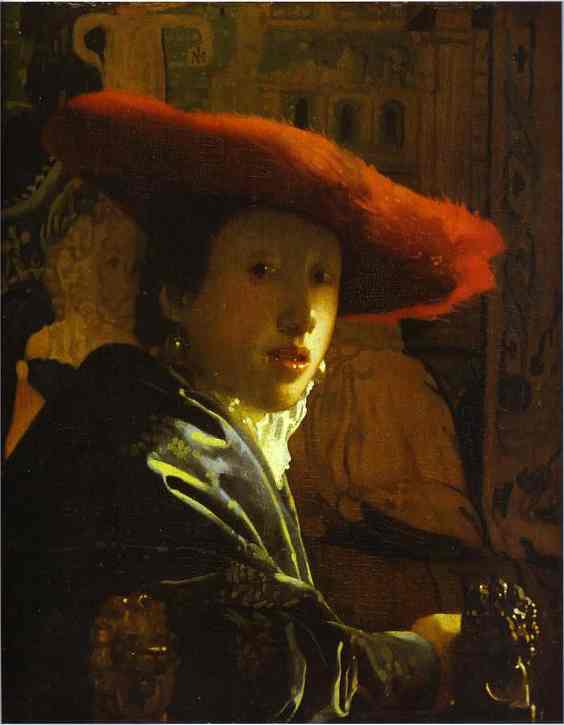
This may be the loveliest picture in the world. Not the greatest, for which Count Orgaz is my current candidate, and Vermeer has a greater portrait with the Red Hat, but this tender girl is surely the loveliest.

When people talk about this painting, they immediately use the word "luminescent," mention how perfectly the pearl is painted, and go on to how the girl herself looks like a pearl. But that is how Vermeer painted. He is incapable of painting without luminescence and all his women look like pearls. The luminescent quality of his paintings is simply what you see when the Dutch air holds the sun in its fine mist.

We know the gold jacket and the earrings. They or others very like have served Vermeer well in other paintings. Here, the jacket calls attention to the slightness of the girl's body. It is a woman's jacket and this girl's breasts have barely begun to develop.

Unlike Vermeer's usual meticulous reportage of linen coifs and hair ribbons and braids and hats, this headdress is a fantasy--the blue wrap, the blue and gold scarf, that signal that this is not the world you think you know.

Unlike nearly every other face from the centuries before and after, and unlike every other Vermeer, this one has no background to give a sense of that world. The girl is backed by a dark panel, so dark as to be almost black, cut off from any recognizeable world, blocked from retreat, and from that she turns into this present world, almost shocking in her vulnerability.

You need to see the painting itself to understand it, that is, if you can find a place to stand in the midst of the tour groups and all the people who have to wear earphones to hear the portable lectures. The clue to this painting is in the mouth. Reproductions give an impression of a pink smudge. What you see in the original is that this girl has just been kissed, kissed long and firmly, so that her mouth is slightly swollen and blurred in definition. Vermeer has painted her in the instant after the kiss before she has had time to move her lips or blink her eyes.

The girl with her luminous skin and her pearl earring is on the verge of discovering desire. She is beginning to soften and open, and she has not quite assimilated what is happening in her body and her imagination. Look again at the nearly absent breasts--she is very young, she is in the thrall of the kiss, and there is no going back from the previous moment.


The viewer is in the position of the person who has just lifted his head and stepped back. The viewer stands in the same relationship to her as with Antonello da Messina's Virgin, and there the viewer is supposed to say "Fear not!" Perhaps the person who has just moved back is about to tell her the same thing. Perhaps this luminescent girl should be afraid. It is difficult to think about the picture independently if you have read the novel or seen the movie, but the story they relate is plausible, and even so, any girl of 1665 could only look into her future with reasonable fears.

The viewer is at risk of falling in love with the tenderness of her face. But then the girl with uncombed hair and brown anorak sitting in the row ahead on the Amsterdam train turns around for a moment and you see that the girl with the pearl earring does not have such an unusual face after all. This painting is not about a face: it is not a portrait. It is about a young girl overwhelmed by feeling, a young girl in the fraction of an instant before her future happens.

[For another young woman in a painting, go here.]