Theodora Palaiologina died at Stameron in November 1429, in the throes of labor. "She left behind," wrote Sphrantzes, her husband's close aide, "much grief for her husband and for all of us, because she was really lovely."
Kleope Palaiologina died in April 1433 at Mistra from the results of childbirth. "She was outstanding," wrote Chalcocondyles who knew her,"for her beauty and all other seemliness." In an eloquent eulogy, Kleope's doctor, Demetrios Pepagomenos, said that her residence among them had made them better, and mentioned an infant born too soon, a daughter, her companionship with her husband.
When their father-in-law, Manuel II, whom neither woman had ever met, visited the Morea in 1415, Pepagomenos was with his suite. He was a specialist in gout. He was left in Mistra to serve Theodoros II as court physician.
The author of Mazaris, a book of upper-class male humor written for Theodoros, was also traveling with Manuel. He said Pepagomenos was a skilled poisoner, and had even poisoned himself and someone's secretary by mistake. There are a lot of doctors in Mazaris, and the author gives them all a rough time. Byzantine humor when not scatological involved satire at the expense of others who were usually present. Humans have always and ever joked about doctors killing their patients: we need not take any of this as courtroom evidence. This was written as humor and the Mistra intellectuals were probably rolling on the floor, howling with laughter.
We are told Pepagomenos had two sons. The younger, Theodosios, nicknamed "Little S**t," was driven by ambition to rise at court, while the older, nicknamed "Lizard Eyes," had also entered the ranks of licensed killers. This, too, was found hilarious.
Pepagomenos means "frozen." Mazaris missed a chance to joke about it. That is irrelevant here. And the eulogy makes it difficult to connect the man with any idea of frozen.
What is relevant is that he was Kleope's doctor. Given the intense conservatism of the last Palaiologoi in regard to the aides they employed, it is very likely that he was also Theodora's doctor. And most medical knowledge and practice was based on sources 1500 years old.
In Florence in those years, one could expect one maternal death for sixty-nine childbirths. Ultimately, one woman out of five would die as the result of childbirth, But here in the imperial family, we have two maternal deaths for three childbirths.
Kleope had successfully given birth to a daughter in the winter of 1428-1429. One of her letters indicates that she was worried about the birth, but there is no way to know whether she knew of a problem, or whether it was normal concern. Her mother had died in childbirth, after at least five successful pregnancies. Still, Kleope had that intimate loss behind her concern. That first birth went well: she had a daughter Helena who in turn had daughters, Charlotte and Cleope.
There is evidence over many centuries that a radicalization of death rates happened whenever men moved into midwives' territory, and got hands-on where midwives knew better than to interfere. A fine book, A Midwife's Tale, based on a diary written in the early 1800s, before penicillin and before the germ theory of disease, records a single maternal death for Martha Ballard out of 1000 deliveries. It also relates what happened when a doctor settled in the area and the status effect drew patients she had successfully delivered to him, a decision. often taken by the husband.
All this may be traducing a good man. Kleope and Theodora might well have died without him. We cannot blame Pepagomenos for a premature birth, but it was not a good thing to be an imperial lady in the medieval Morea.

 Old images of Nauplion raise more questions than answers. Take the column.
In 1834, just after the capitol of Greece had been moved to Athens, a German artist produced this watercolord sketch (left) of the main plateia at Nauplion, showing a column. The column stands beside a former mosque, and has the base of a minaret, but the rest is a fluted Greek column, and a fluted column of extraordinary size. This image was much reproduced in various forms.
The same year, another German artist produced a sketch of Ag. Giorgios -- a former mosque -- at another plateia, with this same column and base beside it (right). This is what artists did then, before, and after -- cut and paste, rearrange, enlarge, blur -- to make their point. And in both of these sites, remnants of a minaret base can be located, but another contemporary image of the first site shows no base or column.
[Note: 27 February 2012. This column has been solved and has nothing to do with what follows. A Bavarian woman who lived across from Ag. Giorgios in 1834 wrote this:
In front of the cathedral [Ag. G.] facing our house is, as I told you before, kind of a loggia, 3 doors open into the church, at one side is the bell tower, surely unique, like a top decoration of a cake, 2 bells hanging toneless between the little columns, a piece of string attached to them is just hanging down and tied to a nail, even small street urchins can reach it (to my despair). Behind the campanile rises a Turkish minaret of the same height, broken down to half size so as not to darken the campanile completely.
* * * * * *

The question, one question, is, does this column have anything to do with the huge column that appears in the Camoccio image? It is the first known image of Nauplion, from 1571, much used in this blog already. Camoccio did not commit himself to the type of column, and though there is a crescent on the column, he shows no mosques or minarets. The Ottomans controlled Nauplion, but he was working from an older Venetian image, adding crescents to indicate the situation. He never actually saw Nauplion, so there may have been a column in the picture he copied, or he may have reasoned that Greece has columns, so he should include one. Except that he didn't include such columns in his other images of former Venetian cities in Greece. So one suspects an earlier artist drew the column first.
No source before 1571 mentions such a column, but sources before 1571 hardly mention any structure but the defense walls.
 In fact, it is almost a certainty that an earlier artist produced a column because an image drawn a year earlier by one Zenoi ( a Greek living in Italy?) shows a construction in the same position, but one apparently borrowed from an image of the Hippodrome in Constantinople. The Hippodrome had assorted columns and constructions down the center, and presumably this attenuated pyramidal shape is what could be expected "over there" in Greek-speaking lands.

Italian artists took to Zenoi's idea, rather than to Camoccio's, and Valeggio employed it in 1576, making the column-pyramid a little more vertical and giving it some tiny people.

Rosaccio used it in 1598, working both from Camoccio and one of the other pyramid people. He replaced the tiny people with helmeted soldiers and added a rider with helmet and sword.
None of the written sources ever got around to mentioning a column, or a pyramid.
A whole slew of Venetian images of Nauplion came out of the 1686 reconquest (see the previous blog) and the subsequent thirty-year Venetian Occupation. While these often showed minarets, none of them showed a column.
And there the column problem could be left, except that it reappears in those images up above produced just after Independence. There is probably no connection between those German drawings and the Italian engravings, beyond the idea that Greece = columns. Still, there is one more, really problematical picture that takes the column in a completely different direction,
In this excerpt from a 1839 watercolor of Nauplion -- a huge blurry watercolor from a vantage point that never existed of a city with a degree of grandeur that never was-- Skene paints a tall tower on the slope of the hill. This tower has windows, and rises five stories above the three-four story houses around it. No pre- or post-Independence sources on Nauplion -- and there are a lot -- mentions a tower, or column, or pyramid.
 Just asking.
Once again, thanks to The Nauplion of the Foreign Travellers by Aphroditi Kouria for the pictures.,
 Thirty years ago and more, cycling home on the back road from Tiryns, I came across a wall behind the bed of a winter stream, with cannon embrasures, such as you see in the picture to the right. This year I found it again. The picture on the left shows that the ground level is a bit higher, but that the big stone on the right has not been touched. The stonework looks a lot like the embrasures on the fortress of Palamidi, which means that this wall was built by the Venetians about 1700.
 Thirty years ago there was also a small Venetian-built chapel to Ag. Pareskevi, and well-posts that looked remarkably like the little obelisks on the Venetian staircase up the front of Akro-Nauplion. I assumed it had been a Venetian estate with its own fortifications, and on occasion wondered just what two cannon and the wall were supposed to defend against.
My last day in Nauplion, I bought a splendid book, The Nauplion of the Foreign Travellers by Aphroditi Kouria, and on the bus back to Athens discovered in it three Venetian maps showing the troop disposition of the 1686 Venetian conquest. All three of those maps showed a zig-zag advance defence wall for the conquest.
 This is a detail from one of the maps, and I will just comment in passing that the three cypress trees are still there -- you can see them far to the left of the road, coming from Argos, just before the high-security prison. Here is another view of the wall in relation to Nauplion -- more or less -- and notice the hill on the right.
 A couple of things to notice here, before we get back to the wall itself. Behind the wall are little rectangles showing the disposition of troops, there is a glimpse at bottom left of the Venetian fleet at Karathona beach, and at the bottom right is the beginning of an alphabetized list of the military units referring to the little rectangles. This is a German map: it lists Papeliner, Maltezer, Sclavonier, Bataillon Italianer, Bataillon Saxen, and so on. The Venetian map lists Maltese, Papalini, Sassoni, Venetiani, Fiorentini, Milanesi, and marinari. This was a massive effort, intended to recreate the Venetian empire lost to the Ottomans, and it was led by a Swedish count Königsmark. After accomplishing Nauplion, the army went to Athens and a gunner from Luneberg blew up the Parthenon. These maps are not perfect on geography. They are propaganda maps showing the various participants in a victorious, and excessively brutal enterprise, but they are good enough on the important details.
Look at the map again. The zig-zag wall leads to a hill, and off the right of the hill you see a stream or river, or a stream bed. There is a bridge over it now but water is a seasonal thing. Thirty years ago I bounced down across the dry bed and back up on the cycle, this year I drove across the bridge. Now look at this image from Google Earth:
 That is the hill at bottom left, Profitias Elias beside the security prison. The green line makes a zag and a zig and follows the line of the stream to a white blotch which is where I photographed the cannon embrasure. From that point the stream continues distinctly visible in the aerial view, but that is all of the zig-zag I have been able to find so far. Prison construction would have obliterated anything to the left. The wall that I know runs between the two parallel roads on the right. I am proud of this discovery: wall, maps, photograph. The next trip, I will walk that zig-zag and see what happens, unless someone reading this does it first and writes me. Please send photographs.
 On 17 December 1432, Bertrandon de Broquière went to Ag. Sophia for the service of the Three Hebrew Children in the Fiery Furnace but he spent the service watching John VIII with his mother Helena, his wife Maria, and his brother Thomas, Despot of the Morea. Actually, Bertrandon wasn't interested in anyone but Maria, a "tresbelle dame." He thought she was a honey.
Five years later, Pero Tafur was invited several times to go hunting with John and Maria several times. He left a brief description:
The Empress rides astride, with two stirrups, and when she desires to mount, two lords hold up a rich cloth, raising their hands aloft and turning their backs upon her, so that when she throws her leg across the saddle no part of her person can be seen.
Although Pero Tafur had other, conversational, encounters with Maria, that is the most he does in the way of description. Compare it with Bertrandon's account. He was clearly hoping to see her legs:
I went all day without food and drink, almost to vespers, very late, to see the Empress who had rested in a residence nearby which seemed to me as beautiful as a church, to see her come out and how she mounted the horse. She only had with her two woman and two or three elderly men, and three of the kind of people the Turks have to guard their women. When she came out of the residence someone brought a bench from which she could mount and then they brought out a very beautiful roncey draped with rich and beautiful bardings. Going beside the bench, one of the elderly notables took a long mantle which she carried and then went to the other side of the horse and raised up the mantel with his hands as high as he could. She put a foot in the stirrup and then mounted the horse like a man, and then he threw the mantel on her shoulders.
There are several elements in this narrative that raise questions, such as why wasn't there a more private place where she could do this, but it is difficult to find information with which to approach the questions. The other thing thing Bertrandon mentioned is that she wore one of those long pointed Greek hats
on the point of which she had three golden plumes which suited her very well. She seemed as beautiful to me as she had before. She came so close to me that someone said I should follow behind, and it seems there is nothing to say, except that her face was made-up, which was not necessary because she was young and fair. One her ears, hanging from each one, was a large flat earring with many stones, more rubies than anything else. It appeared, when the Empress mounted her horse, that the two women with her were equally beautiful, and they wore mantles and hats.**
So riding astride, the Empress and her two women rode the length of the city of Constantinople, from Agia Sophia to the Blachernae Palace up a steep hill overlooking the Golden Horn, in the December dark. Accounts in this period offer intriguing glimpses of a combination of formality and informality among the royals. Take Pero Tafur again:
At the entrance to the Palace . . . is an open loggia of marble with stone benches round it, and stones, like tables, raised on pillars in front of them, placed end to end. Here are many books and ancient writings and histories, and on one side are gaming boards so that the Emperor's house may always be well supplied. Inside, the house is badly kept, except certain parts where the Emperor, the Empress, and attendants can live, although cramped for space.
A little more can be said about that hat, but only a little. Extensive hat-searching turned up three images of pointed Greek hats. This first is from an early 15th-century Italian painting which I have not been able to identify, but it is surely based on an impression of Manuel II when he was in Italy and Paris between 1399 and 1402.
Artists were fascinated by Manuel and his hats, the way the Italians were fascinated by John and his hats five years after Bertrandon saw the hat with golden feathers. They took up Manuel's beard and curled hair and imperial outfits with great enthusiasm, using him to portray ancient philosophers and wise men and one of the Three Kings.
 There is another pointed hat, found in the Très Belles Heures, in another image of Manuel, when he was visiting in Paris. Only one other pointed Greek hat has turned up for me, painted by Carpaccio more than eighty years later in St. Stephen Preaching at Jerusalem, but no one would wear it with golden feathers and ruby earrings. I am seeing Maria's hat as being made of elaborate fabric like that of the philosopher-king, but of the style of the Belles Heures which seems much more suited for riding.
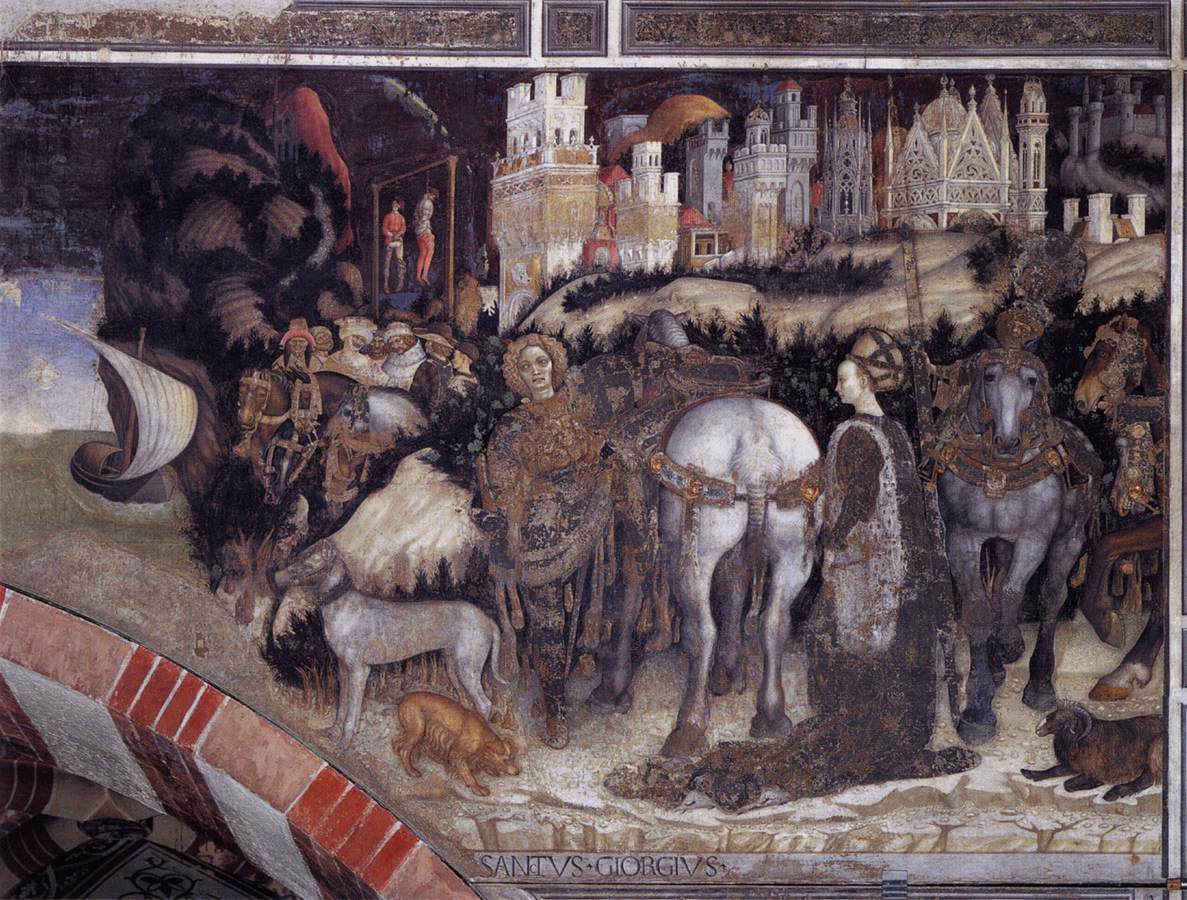
 I have already used the picture of the lady above to represent Maria. It is by Pisanello, and appears to be the same lady as the Princess in his fresco of St. George and the Princess of Trebizond. She, too, is young and fair, almost as if seen in a dream, and does not look at all like young women in Italian paintings. Pisanello drew, modeled, and painted John extensively, and I like to think John had a portrait of Maria with him.
[Later comment: I do not think this is a portrait of Maria, although an Italian art historian does. I am much more inclined to think it based on women of the Malatesta-Gonzaga family and originally intended as a portrait of Cleofe Palaiologina. See here and here for partial thoughts on this. I have not yet published my reasons for this, as I am still in the process of gathering evidence for AND against.]
** Go here for a little more on Maria's wardrobe.
 This blog began under the arbor just over a year ago. Since then I have spent ten months in Athens, with a month in Nauplion, and weeks traveling in the Morea. Now I am back to the arbor again. We are cooking dinner early today, before the heat becomes too weighty, for Ben from Athens. We have had Athens temperatures here this week, higher than Athens -- in the high 90s rather than in Seattle's accustomed summer mid-70s. But there are breezes and we will eat under the arbor with the bunches of lavender drying, the grapes two weeks from ripening, the dolphins from Nauplion.
"A needle of dolphin" comes from Nikos Gatsos' wonderful Amorgos. In March, we made a pilgrimage to his home town of Asea, on a hillside off the road from Tripolis to Megalopolis. Gatsos left Asea as soon as he could. I have other friends -- Stavros, Nancy -- whose families left Asea, and driving up and down the hill on its rutted roads, we could see why. We had wanted at least to have a little wine in Asea for remembrance, but if there was a cafe, we missed it. Gatsos' remembrance of Asea's bleakness shows here and there in the rich imagery of his songs with real affection:
We who have survived will go out one evening
to sow grass in the bare lands
and before night takes us for good
we will make this land a shrine
and a cradle for children yet unborn.
* * *
A little tree little house an empty sky
was our whole world was our whole life.
The pitcher on the windowsill
the well in the yard,
mother's courage father's counsel
This was our life and no other
small and humble but great
if we used to be bitter – hey!
With cold with snow
with a tear in the heart
bread divided small and damn little else
for earth the first mother, great thanks
This was our life and no other
small and humble but great
if we used to be bitter – hey!
The town has a memorial to Gatsos, an exceptionally stiff bust with the sides flattened as if to assure the viewer that this poet and compulsive gambler had finally been compressed into the respectability of a mortgage banker. Gatsos is dear to me, I have translated all his poems, and this bust is painful. Still, the bleakness of Asea had something to do with the most evocative lines of his poetry, possibly the most famous, and it was these lines that inevitably came to me as I watered the flagstones under the arbor.

It is enough if a plow is found,
a keen sickle in a cheerful hand
it is enough if a only little wheat ripens
a little wheat for the holiday
a little wine for remembrance
a little water for the dust . . .
 If this were a folktale, the youngest brother would end up with the princess, the throne, and live happily ever after. But even though the Palaiologue jewels and robes have appeared in one folktale or another for 600 years, the Palaiologos family did not live in a folk tale. Nor did any of them live happily ever after: the family simply unraveled.
The youngest Palaiologos brother, Thomas, is the most enigmatic of the brothers. The Italians who knew him in his last years noted his fine appearance, his dignity, his melancholy. Melancholia. Depression.
Depression is understandable, even normal: he had left the Morea in July 1460 with his family, pursued by Mehmed. He had not surrendered his Despotate or dowry lands, and he spent his last five years waiting on the kindness of strangers. Pius II was going to lead a crusade to retake the Morea and, ultimately, Constantinople, and make him the eastern emperor, but Pius died in August 1464, just before the crusade sailed, the crusade went wrong in the Morea almost immediately, and Thomas died in May 1465.
He moved into history at the age of 8, when he was shipped off to the Morea to join his brother Theodoros. It was normal practice for the Palaiologos family to hive off its sons very young. His introduction to Italy probably came a few years later through his brother's wife Cleope and her Italian companions, not to mention a steady stream of Italians -- merchants, colonists, diplomats, curiosity-seekers -- I almost said, people like Cyriaco of Ancona, but there was no one like Cyriaco.
In his teens, Thomas joined his brothers, Theodoros and Constantine, in a series of small military campaigns to take over the non-Byzantine lands of the Morea. The campaign against the Principality of Achaia was settled when he was 21, with marriage to Catharine Zaccaria, daughter of the last Prince of Achaia, and more than a third of the Morea as dowry -- western Morea across to Karitena and down to Kalamata, Vostitsa nearly to Corinth, and the eastern Argolid. John sent an emissary from Constantinople to tell him that he had been awarded the title of Despot over Achaia. There seems to have been a pattern in the family of formal titles coming with marriage, and like Theodoros, John and Constantine, he married a Latin woman in conformance with his father's strategy that marriage in the Latin church would bring Western aid.
We know of little he did in his role as Despot beyond signing the occasional grant of land. He lived primarily in Patras and Leondari. One account mentions his giving an order to have someone blinded. This may not tell us anything about him: it was normal Byzantine judicial practice and we know of a similar order from his brother John. A foreign writer commented that you saw a lot of mutilated people in Greece.
Despite his apparent affinity for things Italian, he did not go to Italy until his late 20s when his brother Constantine sent him with a message to John at Floremce, and Florence must have been overwhelming -- Brunelleschi's dome was half-way along, Fra Angelico was frescoing the convent of S. Marco where many of the Greek delegation were staying, the Gates of Paradise were dazzling in the summer sun. But this is a problem. We know of nothing Thomas did or sponsored in the Morea that would indicate he had seen or enjoyed Italy, or that he had learned anything there, and when he had to live in Italy, he was an outsider and a subject for art. He is reported to have had beautiful manners, but this was reported of most of his family.
He becomes more problematic after Constantine moved to Constantinople on the death of their brother John, and Demetrios was sent out to hold the position of Despot of Mistra. That is when the vocabulary comes in and one chronicler describes them as "those brothers who swallowed their oaths like cabbages," and another, "those brothers who ate each other's hearts." (These were quoted in the entry on Demetrios, but they are eminently quotable descriptions by people who knew them better than we do.) Demetrios was with reason jealous: Thomas had been in the Morea for nearly 32 years, he had acquaintances and alliances, and he would have liked the whole thing. Even though Demetrios was older he was the new boy.
After the Fall of the City the brothers were left flailing at each other, surrounded by revolts, needing Ottoman aid to maintain their titles, needing Venetian aid to balance off the Ottomans. Several of Thomas' followers offered their allegiance to Mehmed. Then after five years, Mehmed demanded the surrender of Constantine's cities -- Corinth, Patras, Kalavryta -- which Thomas held. They were formally surrendered on his behalf, but the next year he went to war with 300 soldiers sent from the west, and took Kalavryta and some few territories back. But he found that his followers were now ruling, not on his behalf, but were treating these lands as their personal conquests, and the 300 were were rampaging and out of control. He and Demetrios continued to tear at each other, encouraged by various archons who changed sides with the weather. What could any of them have thought would happen?
Inevitably, in 1460 Mehmed came into the Morea, took the surrender of Mistra and added Demetrios Palaiologos and his family to the numbers who traveled with his camp. He set out next for Leondari and Thomas, but Thomas worked his way south with his family. He never surrendered. He took ship at Porto Junco/Pylos for Corfu where he left his family and went to Italy to obtain Papal assistance. He was dependent on others for his support, and while he shows up often enough in art, and even on the central doors of St. Peter's in Rome, he is essentially unknowable.
His last years were a litter of losses, failures, waiting, dependency -- all done with beautiful manners. Melancholia. His wife died on Corfu. He never saw his children again though he left detailed instructions for their education -- daughter as well as sons-- with his friend Cardinal Bessarion who became their guardian. He had no more knack for fatherhood than his own father who also suffered from melancholy.
He died on 12 May 1465, aged about 56.
 Gina Margarita told us about the Metamorphosis, except that she said it was a church with a moat. Gina was an Englishwoman living on a tiny pension in a tiny caravan near Asine beach. It took us a long time to realize how very poor she must have been, but she frequently came up our stairs at lunchtime crying, "AL-lo it's GI-na!" She had red hair and green toenails ("I was born in Sherwood Forest, like Robin Hood, you know!), and she believed she was the reincarnation of Isadora Duncan. German hikers had taken her to see the Metamorphsis -- it was in their hiking guide. In fact, she was frequently taken off on expeditions by vacationing foreigners or invited to dance for parties.
She told about being invited to dance for a large estate outside Argos, where people came down from Athens and engaged in behaviors they said were the restoration of the worship of the ancient Greek gods. Everyone back then had just read The Magus and wanted to try it out themselves, and at some point a great many people with inadequate clothing were arrested for what the police who had no theological training said was an orgy. Gina said the parties did get a bit naughty, and she found it tiresome having to wait until someone was sober enough to drive her back to her caravan. A daughter said I should not put much about Gina in here, and she was right: Gina tends to lead the topic astray.
Thirty years ago I walked to the Metamorphosis by going up the hill above Tolo, through the garbage dump, and down into the valley on the other side. (The Tolo and Nauplion --above Karathona --garbage dumps have the most spectacular sites and views in the Argolid). Then it was a long walk either out to the Asine-Lefkakia road, or on across two more lines of hills to Nauplion. Now there is a long and winding, but simple road right to the church. The valley has been planted with orange trees and farmers need access.

 The Metamorphosis -- in English that would be "Transfiguration" and locally it is called. Ag. Sotira -- is a medieval chapel that at some point became a monastery. It has a 15th-century tower on the north side, originally at least 4 floors, but in thirty years it has lost the indications of the fourth, and the guidebook says it had three. You can compare the before- and after- pictures, though different angles, and there wasn't a tree 30 years ago. Other parts of the walls have gone missing, but there is a vaulted room down to the left. The enclosure wall, somewhat restored, remains along the south side of the propery.
The most interesting aspect of the church, apart from the roof that looks as if it is melting, is the spring house. The church was built against a spring. On the south side by the apse, slippery steps go down to a chill dark enclosure where a metal cup hangs. It was hanging there 30 years ago, and probably for 30 before that. The water is fine, not as good as that from the Agia Moni, but better than that from Profitias Elias. The water flows under the apse of the church and emerges on the south side where it feeds a large open tank -- this must be Gina's moat -- and an irrigation channel. Under the apse, in a niche beside the flowing spring, is a hiding place, used during the Revolution, and WW2 and the Civil War. In recent years, large protective walls have been built around the spring, not damaging, but they do alter the somewhat absent-minded effect of the old roof.


Like all the other chapels of the Argolid, this has a great cool porch with benches and a table (and a place for trash). Interestingly, there is also a great marble structure which appears to be an altar for outdoor use as the porch can hold at least four times the number of people that could squeeze into the airless interior. The picture at the beginning is the little window that looks out on the porch, and you can see that this window has been rebuilt at least three times.
The interior of the chapel is densely frescoed in mostly 16th-century frescos, not terribly exciting individually and difficult to make out from the damage of age, and my inability to find out how to turn on the electricity, but some about women are prominent on the left -- Salome, the wedding at Cana. The apse has a fine Virgin andChild with a damaged Annunciation just above. At various places you can glimpse frescos under frescos, and there is a fresco on the soffit of the large arch over the front door which was filled in at some point with the fresco left in place. Many of the frescos have been covered with a clear varnish -- this cannot be a good idea and the reflectivity makes them nearly impossible to photograph -- and there is a nice inscription dated 1570 on one wall from the donor of the frescos. The lightbulb wasn't there thirty years ago.
 There are two arcosolia, one with a Deisis -- this was another burial chapel for a fief at one time, though we can't now know if the fief was private or belonged to the church. A couple of late 15th-century documents from Nauplion refer to the hermitage of the Franciscans of Sta. Maria di Valverde, a Venetian order with a name descriptive of the location. But we don't know if it belonged to them.
If you follow the route of the little creek from the spring, you will go on down the hill to a small valley opening onto a private beach. It is difficult not to think that at one time, or at different times, it served as a hiding place for one of the small pirate boats that in medieval times infested the coast of the Argolid like mosquitos. That broken tower would have been a good place from which to watch the bay and perhaps to signal.
[More on a fresco here.]
 Cleofe -- that is how she signed her name in three of the four letters we have from her -- may not have dressed like this Greek bride. Her Italian dress was one of the problems that came up. But perhaps she allowed herself to be adorned for the wedding celebrations at Mistra in February 1421. Was that before or after she learned that her bridegroom had made a vow to live in chastity for six years (and not eat meat which, presumably, would inflame his sexual desire)?
Was the vow made before he met her, or after? Everyone agreed she was beautiful and very bright. She is reported to have been tall. Theodoros was probably shorter than average, like his father and brother John. He was awkward and immature, raised by clerics and professional intellectuals who taught him mathematics and theology. He knew nothing about women, except that they were occasions for sin. One can imagine him pudgy, possibly a little nearsighted, and absolutely terrified by the gaiety and charm of this young woman they had shipped in for him for the benefit of his father's political arrangements. Perhaps the wedding night was a disaster and he found a vow a great relief.
We don't know. We do know that Cleofe was miserable because her letters say so, and the women in her family wrote each other that she was. Four of her letters survive, as well as one from her sister Paola, and two from their sister-in-law Battista. These were highly literate women: there must have been many more and our view of her life and marriage might be profoundly changed if we had them. Finally -- despite the letter Theodoros had written the Pope guaranteeing she could maintain her religion and her Italian customs -- she, after much pressure from him, took to wearing Greek dress and was received into the Orthodox church. She took up fasting according to Orthodox practice.
This is where it gets complicated. Jacomo de Sancto Angelo from Padua talked to Cleofe when he was in Mistra, and reported to her brother in Patras that she had said, "I have not become a nun, just because I was anointed with a little oil. My heart is as free as it ever was." And Christofano, another friend of her brother, commented that she could dispute religion so well she could corrupt a lamb, and that she was the most perfidious Greek in the world.
Most writers misunderstand this last phrase and take it that she had "betrayed her faith," but Greek perfidy has been a catchphrase ever since the Trojan horse, and everyone who has studied Latin, and many who haven't, knows "Timeo Danaos et dona ferentes." Cleofe made such a performance of being a devout Orthodox woman that her husband and his courtiers were deeply impressed. He had grown up without women and couldn't have been expected to know better, but it also suggests that the Greek aristocratic male mindset saw categories of women rather than individual people. Or perhaps no one who caught on to the truth wanted to make more difficulty for her.
Whatever the tensions between Cleofe and Theodoros, she was allowed much personal freedom. She had books and music. She wrote. She talked at great length with various men who visited Mistra, and gave them intimate information to take back to her family. Her letters told Paola and Battista that Antonio da Fossombrone, Conte Ricardo, the Mega Kartophylax, were bringing messages.
She was moody. In three of the four letters -- no longer than would fit on a postcard -- she says she does not have time to write more. The four letters date from October 1426, January 1428, March 1428, July 1428.
The marriage was complex, more complex than I have seen recognized in print, and the period of abstinence was not one of calm. Her sister-in-law Battista wrote the Pope about "internecine warfare" and wanted him to interfere. This is a clue that Cleofe was not simply a victim. She remembered that she was a Malatesta. The Malatesta did not go as lambs to the slaughter. She threatened to leave him, delivering literary tirades, or being ominously silent. Everyone knew that his brother John's wife had left him because he ignored her: John, in fact, wanted her to leave.
Perhaps Cleope threw Theodoros' math manuscripts out the window. One hopes so. But Theodoros must not have actually wanted her to leave. A year after the six years of abstinence were completed, in the January 1428 letter, Cleofe refers with anxiety to her pregnancy. She was very close to delivery. She may have been normally concerned, or she may may have been aware of potential difficulties. The second pregnancy killed her.
The March letter is a long and wrenching train-of-consciousness. She was desperately lonely for her sister. She begged for letters, about the children, about anything that has happened. She asked as a favor, but if she doesn't get letters from home, she will die. She hoped God would confine her unhappiness to this world. Her life was bitter, she was worthless. She could not stop crying. There was not enough paper to record her unhappiness. The only consolation she had is from her baby daughter -- this a bare mention at the end of the letter-- but no consolation comes through to the reader. If there ever were a portrait of post-partum depression, this letter is it. The letter has not previously been read with this interpretation.
The letter has one more point of interest, and that is the signature. Her usual signature was "La vostra sorella Cleofe Paleologhina," but this one she signed as "La vostra sorella Cleofe Paleologhina. Deo gratia, vasilisa della Morea." Theodoros gave her a title when Helena was born, βασιλίσσα, and she was proud of it, and she spelled it the way it is pronounced with a V for the B.
Theodoros must have been frightened. They were parents and he knew that should have been a source of joy for both of them, but he was afraid and she wouldn't stop crying. He couldn't handle the situation. The intensity of his own emotions was too much, and he talked about retiring into a monastery. He had been talking about it ever since she became pregnant. The monastery would have been pretty much the same kind of life he had at Mistra before Cleofe arrived, only without the burdens of ruling and having interpersonal relations.
This is at least the third example we know of his choosing retreat when confronted with crisis. When they were making him into a boy ruler and intellectual, no one considered that his heart needed education, too. Several years earlier, in the summer of 1423, when an Ottoman army invaded the Morea and came all the way to the walls of Mistra, he had thought he would go into a monastery. This most recent time, his family took it so seriously, that his brother Constantine had arrived in December to take over.
He decided not to retire. He hung on, and during the next year and a half, his brothers conquered their rivals for power in the Morea and doubled the size of the Palaiologos holdings in the Morea. The family had acquired glory and apparently considerable wealth. Theodoros became wonderfully exhilarated and thought ruling had definite appeal. Cleope's father came to visit. One can imagine that when he went back to Italy he sent Theodoros an architect, because this was the period when the great Italian wing of the palace was built at Mistra.
Somewhere in here, things changed between Cleofe and Theodoros. Perhaps planning for the new palace allowed them to discover how well they could work together. They studied poetry together, wrote it. Her father was a well-known poet, Petrarch had been a family friend. Theodore developed an interest in Italian poetry.
She became pregnant again in 1432, probably in August or September. It is not clear just what happened -- probably the foetus died before it could be born, perhaps Dr. Pepagomenos interfered more than his skills warranted and gave her puerperal fever. Cleofe suffered for days. Theodoros sat with her, holding her hand until she died on 18 April 1433.
Theodoros' heart was broken. He wrote a poem to go in her tomb and from it we get hints that whatever the fears and furies that had been between them, they had become lovers and companions.
The primary sources and a bibliography for the Theodoros and Cleope story can be found here. The poem and its sources can be found here.
 This dim and damaged painting is from the eave of a house in Nauplion -- take the street to the left of the bus station, first corner to the right -- to my knowledge, the only remaining 19th-century house with eave-paintings left in the city.
Other houses, much restored, have these curved eaves but they show stenciled ornamentation: pre- and post-independence ornamentation made extensive use of stencils. This house, built shortly after 1830, has hand-painted swags of flowers, a parrot, and this exceptional view of the walls of Nauplion with columned buildings that were never there. At that date, Nauplion's walls were mostly wrecked, and the remaining towers were of a different design. In fact, most pre-modern views of Nauplion show buildings that no one who lived there would ever recognize: Venetian images have Venetian houses from the terraferma, and later artists show Ottoman fantasies, but the eave painting seems to have been influenced by an image from a popular book.
 This book published by G. N Wright in 1840 and called The Shores and Islands of the Mediterranean included a steel-engraving of a view of Nauplion from the water -- a detail here. When the image is enlarged, you can see a number of white-columned buildings, pediments, acroteria -- the various signals of classical Greek architecture. A Nauplion painter, then, saw the picture -- or the owner of the house had a copy of the picture -- and it was used for the wreathed cartouche over the front door of the house.
A second image, or one of the many derived from it, possibly contributed a tower to the cartouche -- the Camoccio map excerpted here several times previously. The artist of Shores and Islands never saw towers like this at Nauplion: this is a 15th-century design for defense against small shipboard cannon. Those towers were built about 1700 for a different kind of defense, when the harbor was too shallow for the high-decked ships of the period to come in close enough to be of danger.
 Those small black keyholes in the towers are sighting blocks for small cannon. You can see several of them in the walls at Methoni, but Nauplion has only one left and that one is upside down, in a tower by one of the swimming clubs past the end of the waterfront. But it is possible that the tower of the cartouche was painted from one of the towers up on Akro-Nauplion.
The configuration of the largest street in Nauplion follows the line of the walls in this engraving. The street that ends at the Bibliotheke Palamidi occupies the space where this (actually, straight) harbor wall stood. Where the print shows water and wooden piers, there are now schools, hotels, Hermes Car Rental, the Peloponnesian Folklore Museum, Savouras Restaurant, and others. Much of Nauplion is built on landfill, intentionally as of 1480 and the Venetians, from silt brought down by a stream that disappeared in the 19th century, and in the last decade from a vigorous program of fill and construction.
That is all concrete and corners and has nothing to do with this small proud crumbling cartouche of an idealized city, the capital city of a free Greece with its mighty protective walls and the columns of its glorious heritage.
Dimitrios Antoniou called my attention to the content of this cartouche, an image I had photographed but not thought about. The 1840 Nauplion engraving is found in The Nauplion of the Foreign Travellers by Aphrodite Kouria, a 2007 publication of the National Bank of Greece available in, among other places, the gift shop of the Peloponnesian Folklore Foundation in Nauplion.
There is no image for this posting because photography was forbidden but imagine a wonder dancing, to unheard music.
The Acropolis Museum is being opened during a series of carefully orchestrated receptions and lectures. It is a remarkable building and details can be read elsewhere. What appears to be the main point of the openings is the emphasis on the Elgin Marbles, and this is demonstrated visually by placing plaster copies of them amid the carvings that have survived in situ.
The Elgin Marbles are a problem I will not solve: at least they can be seen. I am much more concerned with Greek marbles, in Greece, kept unseen.
A few months ago, a group of us had the priviledge of seeing an extraordinary collection of sculpture in the apotheke of the museum of Astros. Despite guidebook recommendations, this museum has been closed for a number of years and the Greek Archaological Service seems to have no interest in reopening it, so the very real treasures it contains might just have well been left in the ground.
We had 10 minutes in the apotheke, thirty of us in a crowded humid space too low for some to stand up straight, photographs were forbidden, and there was too much visual wealth to grasp in too little time. The apotheke houses the best of the treasures found at the villa of Herodes Atticus in nearby Eva-Douliana by archaologists George and Theodore Spyropoulos over the last seventeen or so years. It is a singularly unattractive site for a villa. Four years ago the Supreme Archaological Council (who makes up these names?) announced that this villa was to become an open-air museum: it has not happened.
This Astros apotheke holds the surviving marbles from the villa. Two are especially memorable.
The first is an amazing stone that appears to be the casualty list from the battle of Marathon. The inscription is written in boustrephon and diagonally, and was acquired by Herodes Atticus when he honored his home town of Marathon by constructing a great tumulus over the burial site of the Athenian dead.
This is to make a point. Herodes Atticus, who had more money than God, did a great deal of building across Greece which allowed him innumerable sources of art for the swollen collections at his various villas, including those at Marathon and Kefissia. These sources for his collections included the Acropolis of Athens.
The second marble in the apotheke is a dancing girl so lovely that there was a pain in my heart for the rest of the day, so fiercely did it leap in response to her. She whirls, one foot up for an instant, and I have never seen lovelier motion in marble. In about 420, the sculptor Callimachus carved her as one of a dozen dancing girls for a stoa on the Acropolis opposite those rather hunky caryatids. Herodes Atticus selected the girls for his villa. It is possible that she is not as wonderful as I remember: the lighting was bad, the time short, but I truthfully cannot say that in his place I would have left them alone.
This wonder of a dancing girl, surely one of the loveliest of the Acropolis marbles, remains unseen in a back corner of the humid apotheke.
 Theodora Palaiologina died at Stameron in November 1429, in the throes of labor. "She left behind," wrote Sphrantzes, her husband's close aide, "much grief for her husband and for all of us, because she was really lovely."