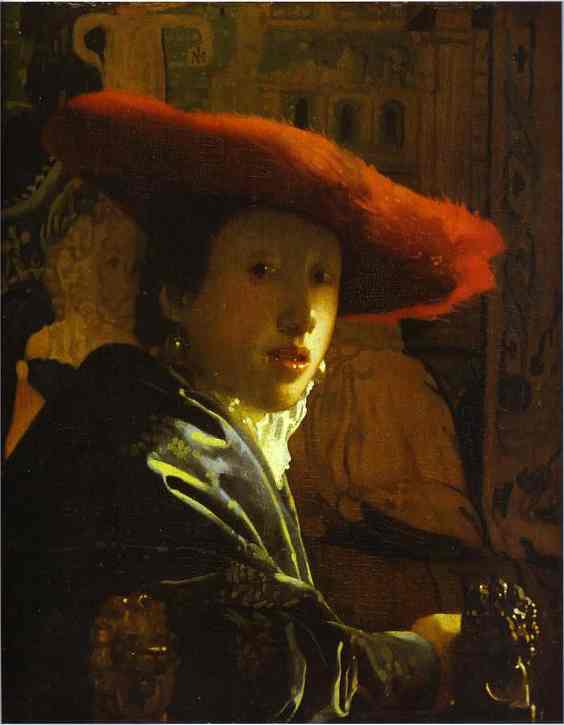
05 March 2009

Dressed in Gold like a Greek

Zorzi Cernovich was, said Sanudo, "a most handsome man, tall, and dressed in gold like a Greek." This is not Zorzi, but he is dressed in gold like a Greek, and suggests how marvellously exotic Cernovich must have appeared to the Venetians that wet grey day in December 1496 when he and his wife Isabetha, also in gold and covered with jewels, were introduced to society by Alvise Pasqualigo, the ship owner, at his home.

Cernovich had escaped with Isabetha and his sons and court from the province of Montenegro which the Cernovici had ruled under the Venetian aegis until Ottoman pressure became too strong. Once in Venice, Cernovich was strategically removed from public access and assigned to command a troop of horsement stationed at the winter camp in Ravenna. Ravenna was wet and marshy, and Cernovich who was used to command everyone else had to obey orders.

He was there for a year and a half. Ravenna was put under quarantine because of plague. The two rivers flooded the fortress. His soldiers were miserable from lack of pay. Venice had a war going on with Florence and he was not allowed to participate. There was another episode of plague. Half his soldiers decamped and went to fight for Florence which was currently paying.


Cernovich finally got back to Venice in June, a year and a half after leaving, and made a complaint, several complaints. It was reported that he used "blasphemous" language. Nothing happened. He left, collected a band of armed soldiers from Ravenna, and reappeared with them in the piazza in Venice on July 1.


This was tantamount to revolt. He was seized and put into prison. On July 4 the Dieci met and ordered him transferred to the Toreselle, a tower where the Bridge of Sighs is now. Imprisonment was not too severe, and he was allowed visitors.

Then on July 12 Cernovich escaped. He left behind him his two guards, hands bound to their testicles. He walked out of the prison just before sunset and got into a boat there by the palazzo. A Greek guard who recognized him commented to the oarsman to take note of where they went, in case it was important.

The oarsman took him to the north end of Lido, perhaps a half-hour journey, where he managed to acquire the garb of a Dominican friar.
Meanwhile, the escape was officially discovered. The Dieci sent out boats across the lagoon in the dark Cernovich was recognized again, by a tax official who had been in conversation with the oarsman, who agreed to sail him across to Trieste for 16 ducats and a silver cup. He persuaded Cernovich to hide below the deck, and then sailed him back into Venice.

Within four hours of his escape Cernovich was in the torture chamber. What happened there was not recorded, but Sanudo was able to go and see the friar's robe. Cernovich was held for eight days--public opinion thought a great deal of fuss was happening over very little--and then officially imprisoned for several months.

In October, the Doge received a letter from Louis XII expressing deep interest in the Cernovich case--Louis was working with Cernovich's uncle Constantine, regent of Montferrat, on a possible war against the Turks. The Doge passed the letter on to the Dieci. In November Louis received a gift of furs and falcons from Venice with a comment that Cernovich had been released. He left town. He was seen again in August, dressed again like a Greek, and then joined his uncle and Louis XII in the attack on Milan.

It was in Milan that he wrote his will in October 1499.
This will was written as a letter to Isabetha, and it may be the earliest dated Venetian love-letter, not that it was either Venetian or a love-letter.

More of the Cernovich story another time.

01 March 2009

The Emperor in Pain

+ Ἰωάννης ἐν Χριστῷ τῷ Θεῷ πιστὸς βασιλεὺς καὶ αὐτωκράτωρ ῥωμαίων ὁ Παλαιολόγος +

This is the signature of John Palaiologos on the Document of Union in 1439 -- presumably uniting the Roman Catholic and Eastern Orthodox churches--and it indicates that he signed under extraordinary duress.

John was a slight man, often ill, burdened since childhood with the responsibilities of being the oldest son and "young emperor" of an empire that had been disintegrating for generations before he was aware of his own responsibilities for it. His private life was complex and sad.

When he was forty, he was struck with a sudden illness that was desperately painful and apparently paralyzed his limbs for a while. He was moved from his shabby palace--he and his wife and attendants were crowded into a few rooms of a huge rambling collection of buildings in desperate need of repair--to the Monastery of Ag. Giorgios Manganas where the monks apparently excelled at nursing. After forty days there, more or less, but the story wants forty, he was well enough to ride his horse in the Palm Sunday procession. Other writers on John said he had gout, but this sounds more like rheumatoid arthritis, and some of the subsequent medical reports fit the profile of rheumatoid arthritis.

He was unwell in the summer of 1439 in Florence, when the Council on Union was grinding to an end, and he made a pilgrimage to nearby shrines at Pistoia and Prato. Pisanello referred to the pilgrimage on the reverse of the medal he designed. Returning to Florence, he was exhausted and needed to rest, and the account here (scroll down) was written by Giovanni di Jacopo di Latino de' Pigli whose unexpected guest he was. It is a charming account--John made his own salad and slept in the garden, but de' Pigli also says that he rode into the house on his horse because he had trouble walking. A historian who should have found more evidence wrote that this was the traditional way Byzantine emperors entered, but this was a man who was not well and he couldn't walk.

The Council was pure hell for him, but his only chance of saving Constantinople from conquest by the Turks was with Western military aid, and the only way Western military aid was going to happen was if the Eastern Orthodox church joined the Roman Catholic: Popes since 1274 had used this promise to batter one emperor after another, and yet the aid had never quite appeared. The papacy claimed, generally, that the Eastern Orthodox church hadn't joined the Roman Catholic, only the emperors had, and that didn't count.

So John took a delegation of just under 700 Greeks to Ferrara, then Florence, in 1437 for a church council--winter voyages by ship on the Mediterranean going and returning, near ship-wreck, and a stop on a deserted island for several days until John could get over his seasickness. They spent a while in Venice, being dazzled by the lovely palazzi along the canals, the evident public and private wealth, and the treasures from Constantinople they saw in Venetian churches. But when John arrived in Venice, he was unable to manage the formal welcome on the Doge's galley, and the Doge came on board his. Accounts of the voyage to and from the council, and of the council, are stippled with reports of times when John could not walk.

At Ferrara, there was endless wrangling about protocol and processions and who would sit where and whose seat would have the most prominence--WWJD was not an idea that ever concerned church councils. The council opened in Holy Week of 1438. John wore a purple robe, and a great white skiadion with a large jewel on the back.

He hunted almost constantly at Ferrara that summer. Perhaps one reason for that was that he could sit a horse when he couldn't walk, and hunting was something he could enjoy. And perhaps hunting was just about the only acceptable means he had of letting loose his anger--anger over the empire, anger over the church council, anger over Western promises, anger over the ritual humiliations of this council.

In October John could barely walk and wanted the hall cleared while he was brought in. This was not permitted. He was in such pain that the only way they could get him into the council hall, while maintaining his dignity--John was desperate for dignity, was for the core of the Greek delegation to surround him--everyone else was taller than he--and then they carried him in by his elbows.

By December he was bedridden from pain, too much pain to walk. The old Eastern Orthodox patriarch was bedridden, too, with heart trouble, and the two had to have their beds carried into the same room so they could discuss matters of the Greek delegation.

Then there was the arrival in Florence after a winter journey over mountains from Ferrara and after many delays caused by incompetence in the Italian arrangements for rental horses. His formal entrance was on February 15, the Sunday of carnevale.

John wore a white robe with a red mantle, a skiadion with a large ruby, and other jewels. The ladies of Florence were dressed in their finest, the balconies along the processional route were decorated and crowded with onlookers, people were climbing on roofs to watch, more were running along with the procession, and five cardinals were leading and following the imperial horse. All along the route bells were ringing and trumpets sounding.

It had been sunny all day, but in the afternoon clouds began to gather, and as the Emperor neared Florence a light rain began. As he entered the gate of San Gallo there was a huge thunderclap and then the deluge. The spectators vanished, the Italian members of the council ran for shelter, the canopy-bearers let down their poles, water sheeted off the canopy and drenched him. John continued riding through the city until he reached the house where he was to stay. The surrounding cardinals were drenched, the Greeks in his entourage were drenched, and anyone who saw the Emperor saw a man whose aching body was weighted down by cold sopping wet clothes and a ruined hat. Then as John stepped across the threshold of his house and out of sight, the rain stopped.

There was another incident, recorded by no one, but it can be deduced from the man's signature on the Document of Union.
+ Ἰωάννης ἐν Χριστῷ τῷ θεῷ πιστὸς βασιλεὺς καὶ αὐτωκράτωρ ῥωμαίων ὁ Παλαιολόγος+
+ Iōannēs en Christō tō Theō pistos basileus kai autōkratōr rōmaiōn o Palaiologos +
+ John Palaiologos faithful ruler in Christ our God, emperor of the Romans +

A comparison with other signatures of his makes it very clear what is happening. Physical suffering, Elaine Scarry wrote, destroys language. As John began to sign, he could barely control his pen which he could not lift for the omegas and their accents. For pistos through the first part of autōkra- he clenched his pen, printing, rather than signing. By -tor Romaiōn he was losing control again,. He forced ho Palaio- but the -logos is unreadable and he stabbed it on to the paper past where it belonged. Later signatures to duplicate copies of the document, written in private, were quite normal: it is this public signature that was forced.

[LATE NOTE: I should have mentioned here that there are other signatures to copies of the Act of Union where his signature is less disturbed, and a signature which is quite clear and different from this first formal signature to the Act of Union.  These other signatures emphasize the difficulty he had with this one.]

When he returned home to Constantinople, he found his beloved wife, Maria of Trebizons, had died two months earlier of plague, as had the wife of his brother Demetrios, who had accompanied him. The city was nearly in rebellion against him for signing the Document of Union, and the leaders were the new patriarch and his own mother. The churches dropped his name from the diptychs, which contained the names of those for whom it was required to pray. His mother, Helena, refused to pray for him. When he died, the patriarch refused him the usual church rituals. His brothers saw to it that he was buried with Maria.


For more about John's physical misery, read about his trip to Italy.

20 February 2009

The Alikianos Horror

There is a stone hand on either side of a door in the Venetian town of Maroulas, south-east of Rethymon. The town has few inhabitants: mostly it is walls and carved arches, and two massive fortified towers with entrances that have to be reached by ladders. One dates from the 1300s, one from the early 1600s.

Venetian Crete is mostly seen by tourists, and seen as madly, charmingly picturesque. But there are other sides to this colonial culture, complex and often disturbing. The fact that some Venetians colonists felt they had, even in a town, to live as if under siege is in itself disturbing. The reasons why are far more disturbing.

Nothing is known about Maroulas, but the guidebook tells the story of what happened at Alikianos. The story comes from a Venetian chronicle and one can hope that at least some of it is untrue.

A group of towns in the province of Chania rebelled in the late 1500s and set up their own governor by the name of George Gadhanole. Gadhanole presently came to the tower of Francesco de Molin who held one of the Chania fiefs, and asked for a marriage between the de Molin daughter and his son Petros, "the best and the bravest of all my sons." He might have reconsidered had he been able to read Latin: over the de Molin portal was inscribed OMNIA MUNDI FUMUS ET UMBRA. Everything of this world is smoke and shadow.

The marriage was arranged. The de Molin guests arrived from Chania in droves. There were presents--fabulous fabrics the Chania patrician merchants had acquired in Egypt and Syria and Constantinople. Dozens of pigs and bulls were roasting. The Gadhanole family arrived with three hundred men. The celebrations began in the morning and continued into the evening.

Then they spotted a fire from Chania. This was the signal for the de Molin guests to turn on the Gadhanole guests. By the time the troops arrived from Chania, the rebel Gadhanole and his three hundred men were trussed for slaughter. At dawn the troops hanged George Gadhanole, his son Petros, and another son. Others of the family were shot. The three hundred were divided into four groups. One group was taken to Chania and hanged. Another group was hanged at Gadhanole's home village, Chrystogerako, which was then burned and flattened. The other groups were hanged at Apokorona and on a mountain near Lakki.

That was the first act of reprisals against the rebels. The Venetian chronicle recorded that this was greatly consoling to those who had been faithful to their God and their Prince.

The second act began with the appointment of a new governor for Chania, named Cavalli, with full authority to extirpate the rebels -- "l'estirpazione degli uomini seditiosi." Cavalli took troops at night to the nearby rebel village of Fotinakko and set fire to it. At dawn they hanged the twelve leading men, and to be sure the lesson was learned, ripped open four pregnant women and battered their infants. The chronicle said that this spread terror across the countryside, and that they deserved worse.

For the third act, Cavalli sent word to the rebel villages that anyone who wanted to make submission and avoid the same or worse was to bring him the head of his father, or son, or cousin, or nephew. In due time, a priest of the Pateri-Zapa family arrived with two sons and two brothers. They threw down five heads before Cavalli: one belonged to a son of the priest, one to a brother, one to his father-in-law, and two to his nephews. The identities were attested to by witnesses.

Cavalli cancelled his decree.


The story is from
Candia Veneziana, M. Buonsanti & A. Galla (Heraklion, 2004). Carvings from Francesco de Molino's Chania palace can be seen in the Byzantine/Post-Byzantine Museum in Chania.

12 February 2009

Ariadne's Brother

This is de Chirico's sleeping Ariadne, perhaps not perfectly appropriate, but a sleeping Ariadne is needed.

At some time in the 6th century, Ariadne's brother had a gravestone with an inscription carved for her in Constantinople and brought out to a basilica near a magnificent spring on the road near Argos. It was a magnificent spring for thousands of years, the spring of Kefalarion, and was magnificent until nearly thirty years ago when greed and the spirit of modern Greek progress required that it be pumped dry for irrigation purposes.

This basilica, carefully ignored since it was excavated nearly 40 years ago, was dedicated to the Apostle Paul, located near where Pausanias had seen the worship of Dionysios and Demeter. It must have been a splendid place, large enough--45.5 m long and 23m wide--and elaborate--with walls lined with coloured marble, gold tesserae, frescoes, stained glass, and carved sarcophagi--enough to have been an imperial or consular bequest.

Ariadne's brother was Doulkitios. A Dulcitius, proconsul in the sixth century of either Africa or Achaia, is commemorated in a sixth-century epigram by an unknown poet included in the Cycle of Agathias:
“At the high point of his life, the Powers led Doulkitios forth from excellence and glory as a proconsul to bliss.”
This Doulkitios can be dated, within a rather broad period. The writers included in the Cycle have been dated as writing between 530 and 565, which may then suggest the earliest and the latest reasonable dates for his death, and so for Ariadne’s.

Ariadne's Doulkitios provided--and very likely wrote himself--her metrical epitaph with echos of epic verse. It was the way the intellectuals wrote then. One fragment, in the Greek, seems quoted from Andromache in Book 6 of the Iliad: "You, Hektor--you are my father now, my noble mother, a brother too," while two other words seem taken from "willows whose fruit dies young" at the entrance to the world of the dead in the Odyssey--an image one would expect Christians to avoid, but the area of the basilica was thick with willows. "Sleeping Ariadne" itself makes reference to myths of Dionysios, whose worship had been expelled from Argos and Kefalarion about a hundred and fifty years before.

It is tempting to think of Ariadne as young and, naturally, lovely: no evidence compels us to assert that she was not, but she is more likely to have been a mature woman when she died. She had a strong connection to Argos -- the inscription calls her "of the Argeians." Her bones were buried elsewhere first, then moved to an osteotheke in the apse of the Kefalarion basilica.

I prefer to think, with no further evidence, that the proconsul Doulkitios was Ariadne's Doulkitios, and so proconsul of Achaia. Any proconsul had to know the area: going from Corinth to Sparta, which a proconsul would have to do, he would travel the road past the spring, and would certainly stop to cool off there, maybe visit friends. Remains of Roman villas have been found in the vicinity.

This is, in translation, what remains of Ariadne's epitaph.

† Blessed Paul, holy Apostle . . .
sleeping Ariadne [ - - - - - ]
of the Argeians destroyed . . .

taken by the ill fate
of a most noble family

even so her brother - - - - -]

Doulkitios [ - - - - - ]

those I[ - - - - - - ]

fruit of my[ - - - - - ]
] IAISS [ - - - - - - ]

[ - - - - - - - - - - - - - - - - - - - - ]

04 February 2009

Pavane for a Dead Princess: Part Two

The story of Kleope Malatesta and Theodoros II Palaiologos has already been told here, a version of it with what the research had shown up to that point. It used a borrowed portrait to represent Kleope. The child here is Theodoros, painted when he was about six years old, in a formal family portrait. It is the only picture that has survived of him, but he tells us below that there was another, of him and Kleope together, at Mistra. It has been ravaged, as was so much else there, by time.

Kleope
died on April 18,1433, the Saturday after Easter, following a long illness. They had been married just over twelve years. She was buried in the church of Agia Sophia just up the hill from the palace at Mistra.

There is a poem in the Bessarion manuscripts in the Marciana in Venice long thought to be a poem by him on the tomb of Kleope. This only shows that no one has ever paid any attention to the poem at all, and that the fact that it is in Bessarion's handwriting was considered by scholars who should know better an adequate reason to consider him the author. But it is impossible to read the poem and not think that it comes from her grieving husband.

It is a striking poem, if only because the Byzantines almost never wrote romantic personal poems, and this one is to a woman in heaven who is guiding the writer on earth, a woman whose body the writer knows. The poem is written on the Italian model--Dante's Beatrice, Petrarch's Laura are easy associations, and there is that famous poem by Petrarch supposedly written to be put into Laura's tomb, as this one surely was put into Kleope's.

Kleope's father was a well-known poet, Malatesta dei Sonetti, and his father had been a friend of Petrarch. Everyone in her family wrote poetry: it was what humanists did. Beyond that, this poem suggests that this Byzantine prince, known for his qualities as the quintessential geek, had been reading and writing poetry with his Italian wife. It suggests that the marriage reported to have been miserable had in reality developed into a union of intellect and body.

Theodoros had been reading Theocritus--she knew Greek as well, and the ending of the first section of his poem with its reflection that the one thing left for consolation in his heartbreak is song alludes to the opening of Theocritus' poem on Polyphemus, which is framed by a teasing remark to a physician that some diseases are beyond the healing power of medicine and for them the only remedy is the effort of composing poetry. (And one of the eulogies for Kleope had mentioned the failure of medicine, and her doctor had himself written a lament.)

Theodoros was a mathematician, and this poem makes quiet reference to that with its structure based on the number five, thinking of the five senses, identifying five ways he and Kleope could be together. Possibly he set out to write one example for each sense, but then after Touch, Hearing, and Sight, found himself unable to match the final ways and senses.

He gives us one other valuable piece of information: he tells us that her tomb is marked by a dual portrait. There are other such portraits of husband and wife on Mistra tombs, and the image used to stand for Kleope is half of such a portrait--but it was found in a church other than the one where Kleope was buried.

Before this poem was buried with her, the monk Bessarion, who was the same age and a fellow-scholar, and who thought she was lovely, must have asked to be allowed to make a copy for himself.


Here is Theodoros' poem for Kleope:

Although we were before, my dearest, brought together
being one flesh, the word of God says
that it is better now to be with the spirit,
as you, in pure intelligence, look down from Heaven
on my life, my words, and all my thought,
as it is right that you should
while I am torn apart, ah, painfully,
calling out for you with scalding tears,
one thing is left for me, one good thing, song.

In this way, picturing you in this image,
I have added myself to the image,
wanting to join myself with you in a third way.
so as to quench the terrible fire of longing
and to empty out the agony from my soul.

But, you who have died and live, as you deserve, with God,
when in the same tomb necessity brings
my bones together with yours in a fourth way
showing me what lies outside the five senses
join with me in a fifth and greater way
to share in the delights of Heaven and the sight of God.
My courage lies with you, who possess and indeed
give me, my fellow-poet, this song.


A scholarly discussion of this poem, written with Pierre A. MacKay, will be appearing later this year.

The Greek poem and the other primary sources for the Theodoros and Cleofe story can be found here.

 The narrative is continued in

Pavane for a Dead Princess, III

Pavane for a Dead Princess, IV 
Pavane for a Dead Princess, V


Pavane for a Dead Princess, VI

Glory Days

Theodoros II Palaiologos 
Malatesta "dei Sonetti" Malatesti
 

29 January 2009

Ag. Anastasios of Nauplion

This is the olive tree from which Anastasios was hanged. That is the story that was told in the little book sold in the church next to the tree, and the story I was told by people in town thirty years ago. The story has become quite elaborated since then, but I am going with tradition. Besides, you can still see nails in the tree that had something to do with something, so it might as well be the hanging.

The most interesting thing about this Anastasios who was born and bred here, and who died in Nauplion on the first day of February in l655, is the almost total absence of information about him. Perhaps the fragility of his claim to sainthood is intuited, for in the selection of icons, the faithful have chosen to remember him as a rather near‑sighted, tender young man: a young man with an overpowering sort of mother who raised him so that she would have a son on whose sensitivity other mothers would compliment her, and so a son who inevitably chose disastrously when he came to fall in love.

Anastasios is said to have been a painter, although it is not remembered whether he painted icons or frescos or the sentimental wreaths and flowers which wealthier Turks and Greeks were pleased to have painted on their ceilings. During his short life, before and after, Nauplion was known as a center of icon and fresco painting, even though under Moslem rule which, characteristically, managed to be both extremely legalistic and extremely indulgent.

Anastasios fell in love with a Moslem girl. Local tradition says that she and her mother, witches both, had cast a spell on him. The girl might have been Greek: numerous Greeks found that conversion to Islam coincided with a lower tax rate.

Anastasios would not have been the first young person to confuse the surgings of immature sexuality with those of religious fervour, but however it happened, or under the influence of this spell, Anastasios abjured his Christianity, and announced his conversion to Islam by putting on the turban. The turban, by law either white or green, was restricted to Moslems: merely wearing a turban was accepted as evidence of his changed status. Two hundred years earlier, he would have gone before a Muslim priest, raised his right forefinger, and said, "There is no God but Allah, and Mohammed is his Prophet," the priest would have put a turban on him, and then there would have been general public celebration and a parade surrounding a circumcision ceremony. It is not known if Anastasios enjoyed this kind of attention, or if the Moslem community in Nauplion took special note of conversions.


Eventually he discovered that, in the gentle expression of a Nauplion guidebook, "she was not faultless in her morals," and he became insane. A variant of the legend says that the local authorities, seeing he was unwell, shipped him off to an island reserved for the insane. Either on the island or in Nauplion, he came, miraculously, to his senses, stripped off the turban, and ran about the streets shouting, "I am a Christian, I was a Christian, I will always be a Christian."

Whereupon he was seized by an outraged mob and lynched. It was, in fact, a capital crime for a Moslem to convert to Christianity, regardless of his spiritual heritage: accusation alone was adequate for execution, but it is to be hoped that he was passed through the proper judicial procedures before being executed by strangling. His body was left to hang in chains from the olive tree to encourage the others.

From shame at its role in the martyrdom, the olive tree refused to bear any more fruit. It must be admitted that this part of the legend does not hold up under examination, and this last fall there was a very large crop of olives. Anastasios, or what was left of him, was buried in the town cemetery, outside the town wall and across from the silted‑up moat, close to the present former train station.

Forty years later, around 1700, Nauplion had come under the brief and uncomfortable period of Venetian rule during which the present Panagia was built. In Greece it has always been the custom to clear out graves every three years, or whenever space is needed. When the bones of Anastasios were dug up in their turn, it was noticed that they gave off the odor characteristic of saints and of sweet basil, and that, taken in connection with the circumstances of his death, made someone think them worth saving. They were put in a box in a corner of the new Venetian church and forgotten.

They remained forgotten for two hundred years. In the early part of the twentieth century, Nauplion was suffering a cholera epidemic, and all hope had been abandoned. When it seemed as if the city might perish within its crumbling walls, a priest remembered something about old bones, and suggested that there would be no harm in trying them. There was a procession around the walls of the town, with priests and chanting and incense, and the bones, and of course, the cholera vanished. This is true: I had it from the nephew of a man who saw the whole thing.

Ever since that time, Anastasios has been regarded as one of the New Martyrs, a term which refers to Orthodox saints of Turkish production. His Feastday is observed on the anniversary of his martyrdom, February l, and that day is the high point of the whole Nauplion year.

Or it was thirty years ago. This is what happened in 1979:

Two days before, the streets around Panagia were cleared of cars and swept, the neighboring buildings and the Hotel Otto hung with Greek flags and blue and white bunting. The day before, an old man from the country arrived with a donkey and a mule laden with laurel branches, or oleander, which he strewed on the streets and the little Plateia Anastasiou before the shrine. On the Eve of the Feastday, the Liturgy of Agios Anastasios was celebrated: four or five visiting bishops were enthroned on a dais, looking for all the world like Amahl's night visitors; the seats in the church were filled with the town officials and their wives, and all the fur coats owned in Nauplion.

The Feastday itself began at seven in the morning with the firemen's band marching through the streets of the old town making a splendid racket. Troops from the local army base ‑‑ inductees served their first three months in Nauplion ‑‑ were trucked in much too early and shouted into lines outside Panagia by a small man with the chest of a pouter pigeon who stomped up and down. When the service in Panagia finished, huge baskets of bread blessed in the service were distributed to the gathering crowd. Each piece had been wrapped in pastel‑coloured paper so the impression was of enormous baskets of angular Easter eggs. Several gypsy girls with identically-withered hands pushed through the crowd, asking for money in a peculiar droning whine, "Drachmi, se parakalo, drachmi." Miraculously, the hands always healed at the touch of a coin. All the balconies around the Panagia and plateia were jammed. The procession began to form.

Altar boys in peach brocade carried poles with hanging lamps which no one remembered to light; no one had remembered to light them the year before, either. The local clergy wore brocades and samites: combinations of green and gold, blue and pink, red and gold, blue and gold, white and gold, blue and red and gold; gold with towering black hats. The Bishops of Nauplion and Argos and Corinth and Patras, and the Metropolitan from Athens, head of the Orthodox Church in Greece, all with jewelled dragon‑headed staves, and jewelled onion‑dome crowns, grouped together, each offering precedence to the others.

The Fire Department, wearing shining helmets and white gloves, carried out the great gilded icon of Agios Anastasios, a sort of Ark of the Covenant, supported on poles; the four most senior priests held ribbons that trail from the upper corners of the icon which provided a Maypole effect. A monk followed behind the icon bearing against his breast a silver reliquary with all that was mortal of the little painter. The chanters followed, just ahead of the firemen's band. There was a military unit with Sam Brown belts and shining helmets and the newest in American bazookas, then several groups of soldiers with distinctive sets of weapons, and the army band. The army band played something quite different from the firemen's band, and all proceeded from the Panagia to the waterfront.

The bells rang from Panagia's Venetian tower where half a dozen small boys had been slugging each other for the past hour to work out who should have the honor of ringing. The ships in harbour blew their whistles; both bands played different tunes as loudly as possible; bells from all the other churches in town pealed out; the bells in the clock tower on the hill joined in; all was magnificent cacophony, and obviously the little painter was quite a saint indeed to have generated such a gloriously satisfying moment.

The procession curved along the waterfront, turned right past the high school ‑‑ following the city walls of 1481 which stood until the 1930s ‑‑ turned right again to follow the main street up to the central square with the bank and the museum. The main street was one person narrower than the official procession: the banners waved and ducked to avoid the balconies. Looking headlong into the procession from the vantage of the square, there was a fore‑shortened jumble of hundreds of flag‑draped balconies where people stood with lighted candles and bowed heads, of waving flags and poles and banners and swaying crosses and icons and jiggling bayonets, and the glorous din of chanting and bells and brass reverberating in the narrow street.


At the square, the procession paused for prayers, and for the girls' choir; the Bishop of Nauplion in turquoise satin delivered a homily. Going back to the Panagia, the procession deteriorated completely, snaking around the museum to end up at the shrine of Agios Anastasios for closing prayers, and an abrupt dissolution of the crowd. The little plateia that had been so jubiliant an hour before was nearly empty, strewn with trampled laurel and field flowers, and a thousand pastel‑coloured wrappers drifting in the breeze under the olive tree.

24 January 2009

Girl with a Pearl Earring

This may be the loveliest picture in the world. Not the greatest, for which Count Orgaz is my current candidate, and Vermeer has a greater portrait with the Red Hat, but this tender girl is surely the loveliest.

When people talk about this painting, they immediately use the word "luminescent," mention how perfectly the pearl is painted, and go on to how the girl herself looks like a pearl. But that is how Vermeer painted. He is incapable of painting without luminescence and all his women look like pearls. The luminescent quality of his paintings is simply what you see when the Dutch air holds the sun in its fine mist.

We know the gold jacket and the earrings. They or others very like have served Vermeer well in other paintings. Here, the jacket calls attention to the slightness of the girl's body. It is a woman's jacket and this girl's breasts have barely begun to develop.

Unlike Vermeer's usual meticulous reportage of linen coifs and hair ribbons and braids and hats, this headdress is a fantasy--the blue wrap, the blue and gold scarf, that signal that this is not the world you think you know.

Unlike nearly every other face from the centuries before and after, and unlike every other Vermeer, this one has no background to give a sense of that world. The girl is backed by a dark panel, so dark as to be almost black, cut off from any recognizeable world, blocked from retreat, and from that she turns into this present world, almost shocking in her vulnerability.

You need to see the painting itself to understand it, that is, if you can find a place to stand in the midst of the tour groups and all the people who have to wear earphones to hear the portable lectures. The clue to this painting is in the mouth. Reproductions give an impression of a pink smudge. What you see in the original is that this girl has just been kissed, kissed long and firmly, so that her mouth is slightly swollen and blurred in definition. Vermeer has painted her in the instant after the kiss before she has had time to move her lips or blink her eyes.

The girl with her luminous skin and her pearl earring is on the verge of discovering desire. She is beginning to soften and open, and she has not quite assimilated what is happening in her body and her imagination. Look again at the nearly absent breasts--she is very young, she is in the thrall of the kiss, and there is no going back from the previous moment.


The viewer is in the position of the person who has just lifted his head and stepped back. The viewer stands in the same relationship to her as with Antonello da Messina's Virgin, and there the viewer is supposed to say "Fear not!" Perhaps the person who has just moved back is about to tell her the same thing. Perhaps this luminescent girl should be afraid. It is difficult to think about the picture independently if you have read the novel or seen the movie, but the story they relate is plausible, and even so, any girl of 1665 could only look into her future with reasonable fears.

The viewer is at risk of falling in love with the tenderness of her face. But then the girl with uncombed hair and brown anorak sitting in the row ahead on the Amsterdam train turns around for a moment and you see that the girl with the pearl earring does not have such an unusual face after all. This painting is not about a face: it is not a portrait. It is about a young girl overwhelmed by feeling, a young girl in the fraction of an instant before her future happens.

[For another young woman in a painting, go here.]

15 January 2009

Byron under Glass

Ioannis Gennadios, who referred to Cyriaco of Ancona as a looter, may have known what he was talking about.

In the reading room of his library in Athens -- splendid columns, dark red portico -- where the books are under glass, a large exhibition cabinet holds Byron memorabilia under glass.

More Byron memorabilia is under glass in the National Historical Museum, in an exhibition space that looks remarkably like a chapel, centered as it is on a table surrounded by icons of Byron. That space holds, among other things, Byron's travelling trunk that unfolded to make a bed, his helmet, and three portraits: beautiful in adolescence, romantic as a poet, bloated in his maturity.

Byron is a national hero of Greece and every town has a street and a hotel named for him, something like you will find for Lord Alexander Fleming in Spain (think: bullfighting, gored bullfighters, infection, penicillin). Had Byron lived, they would have tried to make him king, but he died miserably of malaria and iatrogenic infection, soaked in sweat, his mouth saturated iwth bile.


So it is not completely unreasonable that Ioannis Gennadios -- or some other wealthy Greek interested in literature and history -- would have shown up on Wednesday, 18 August, 1880, at the Sotheby's auction of Byron memorabilia. This is what Gennadios bought for the coffin-case, according to the labels in it:
  • A matching set of a very small inlaid mahogany tea caddy and watch stand that belonged to Byron's half-sister Augusta Leigh.

  • A piece of deep blue silk exquisitely embroidered with flowers by Augusta Leigh.

  • A small black leather pocket folder and a small red leather-bound notebook, with her name and initials.

  • An Italian silk scarf of pale green and ivory with narrow deep red lines, given to Augusta by Byron.

  • A thick scrapbook of "portraits, pedigrees, biographical notes and autographs of Byron, and a small collection of mememtos inluding a lock of his hair."

  • A miniature portrait of Theresa Makri copied in 1834 by Bate from the 1812 Allason portrait.

  • A piece of a dreadful plaid of green, black, and whitem from one of Byron's jackets.

  • His rosewood holder for playing cards.

  • A cameo portrait of Byron.

  • His marvellous small gold and blue enamel pocket watch.

  • Four seals -- two shaped like hands; one ivory, one amethyst, one mother-of-pearl -- with various romantic mottos of the period.

  • Two examples of the Byron arms marked out on canvas for embroidering.

  • A homemade drawing case -- cardboard laced together with green ribbon, with a cover picture of plums and leaves and a worm pasted on -- with watercolors by Byron's daughter Ada and her friends, from 1826-27.

  • And finally, a heart-breakingly fragile, dried wreath of bay leaves and flowers sent by the people of Mesolonghi that was laid on Byron's coffin.

So it is difficult to know what to think about defining looting, but I know that if given the choice between free and full possession of either the Elgin Marbles or Byron's memorabilia, I would take Byron.


Here in this detail from a famous bad historical painting, a much too-young Byron is shown arriving at Mesolonghi, being welcomed by the beleagured defenders Notice how his travelling cloak has been disposed to give the impression of classical Greek dress.

08 January 2009

Lady 'Reen, the Little Bird, and the Pirate


The Skleroi's lovely lady 'Reen and Doukas' Areti,

and Goldilocks, three fairest maids ever in Napoli,
went out one day to take a walk, they went to take a bath.

Katsi Rini, was the name mother Skleraina used,
her father said, "My 'Rini, go. I worry for your care.
To help us all, I have a plan, I'll set up lookouts three.
The first I'll put uo on the mount, the second by the sea,
the third and best I'll place below to guard the gate for thee."


And so the story moves along and so the crisis breaks:
the tower on the mountain cries, "A sail, there comes a sail,
it cuts the white foam on the waves, it nears the platan tree!"


The tower on the sea cries out, "And now two fustas sail,
they've set their prows right toward the baths, they come onto our shore."
The tower cried, the third and best, "O maidens, be aware!"


Areti she changed her steps and 'Rini turned around,
and Goldilocks threw down her bag, and ran back into town.
some crawled in the window, and some dashed in the gate,
the darling of the Skleroi froze and waited for her fate.


The Turkish youth, he swept her up, clad in her golden hair,
he fiercely seized her fair white hand, he took her to his ship,
he kissed her mouth amidst her cries, he wrapped her in his arms.


The bird flew fast and sat him down, he perched high on the mast,
it did not call out like a bird or twitter like a swallow,
it only cried and spoke aloud, it cried out like a child.


What dreadful thing, Skleraina dear, you suffer, on this day
with dearest 'Rini, best-belov'd, your sweetly-perfumed child,
where goes the brother, there, you see, the sister 'Rini goes.


It's not a crime, it's not a shame, it's not a route to hell
if brother hold his sister close pressed up against his chest,
but like a bride he kisses her, he sees her like a man.


"Hark, hark, o hark, Turkopoulo, what does the small bird say?
It's just a bird and yet it cries, a bird and still it speaks!
I say to you, Turkopoulo, who are you, what's your name?
I had a brother long ago, he loved to travel far,
some told us once that he had died, some told us he had drowned,
some told us he became a Turk in places hot with sand."


"Tell me, o tell me, maiden mine, how does your lineage run?
"What can it matter now to you how does my lineage run?
since now it brings anathema, it brings the hurricane."


"Tell me, o tell me, lovely girl, your birth and your descent?"
"My father is from Napoli, my mother from Corinth,
The name Skleros is known by all, they call me Lady 'Reen."


"My sister, hold me out your purse, and hold me out your shoe."
The purse he filled with florins gold, her shoe he filled with coins,"
"Go, 'Rini, you go home at once, go find our family dear,
and I will follow close behind to see how you will wed."


She kissed him like a brother dear, again she pressed his brow,
he kissed her like a sister dear, and then she took her bath.


***************************

This old folksong was collected in Nauplion in the 19th century. There is no way the geography of Nauplion can be reconciled to the narrative. The jogging translation fairly reflects the jogging of the Greek. The theme of brother-sister incest appears frequently in narratives of the Ottoman and post-Ottoman period, reflecting anxieties raised by the Ottoman child tax (which was never in effect in Nauplion). The little bird is a persistent inhabitant of Greek folktales and songs. The names Skleros and Doukas are known from the Byzantine period.

01 January 2009

Along with the Bishop and Huntsmen . . .

A recent blog mentions a book by diplomat and bibliophile Ioannis Gennadios on the looting of Greek antiquities, which he apparently identified as starting with Cyriaco of Ancona in 1440. (How did he ever miss the Romans?)

Now I sit in Gennadios' library and it is a pleasing place, but Gennadios is unjust, and to use a word like 'looting' surely indicates nationalist assumptions rather than information about what Cyriaco himself recorded.
Earlier notes
here tried to indicate the richness of Cyriaco's personality.


This is what Cyriaco felt about taking things, recounting a visit to Cyzicus:

But alas! How unsightly a structure we returned to, compared to the one we inspected fourteen years ago! For then we saw thirty- one surviving columns standing erect, whereas now I find that [only] twenty-nine columns remain, some shorn of their architraves. . . . ruined and dashed to the ground, evidently by the barbarians.

He did something about it: he visited the Ottoman governor of the area, who was a Greek, and talked with him about the need to preserve such treasures. The governor promised to help.


Cyriaco loved antiquities, and everywhere he went, he copied inscriptions -- it is only because of him that we have information about hundreds of Greek inscriptions now missing, drew carvings and buildings -- the drawings here are of three grave markers and a statue of Dionysios he saw in Nauplion, now missing. His drawings of antiquities at
Merbaka allow us to compare what he saw with what survives, though the large panel is missing -- might a cleric, or a Turk, have thought a carving of an undressed couple on a bed unsuitable for public viewing, even if they were accompanied by the family, the horse, and the snake?

I cannot find, rereading what survives of Cyriaco's diaries and letters, anything that might be considered looting, although he did buy a secular manuscript on Mount Athos. This is what he did in the libraries on Athos:
. . . we examined . . . we took pains to copy . . . he showed me numerous books . . . I purchased this splendid volume from him . . . I picked out a selection of books and noted down the incipits . . .
That is the way he travelled, always finding local Greeks and resident Italians who cared about antiquities, and making notes:
  • "we did take care to record here the most important inscriptions"
  • "I investigated more closely"
  • "we also observed"
  • "guided by [the sailor] we first looked at the ancient walls"
  • "we observed numerous sculptured dancing nymphs"
  • [at Ainos] "these princes and distinguished men . . . expertly showed me all of the city's important sites"
  • "I made sure to record here"
  • "we saw . . a number of marble sarcophagi at the port that had been demolished and thrown together . . . to serve as a mole"
  • "we viewed the ancient walls of the city"

Travelling in Imbros with the historian-to-be Michael Kritoboulos, the two of them composed an inscription and had it carved in Attic letters and set at the main gate of the new citadel that the governor had constructed out of older stones.

He made his notes and explored with joy. Read, finally, this description of his searches on Crete:

13 July 1445. . . . we settled down in the bishop's country house near Miscea, at the foot of White Mountain . . . we saw on the banks and reverenced another small, old church of the Blessed Virgin enclosed by trees laden with fruit. But, to see what we came to see . . . those famous mountain-cypress trees -- and to inspect certain antique remnants of towns that I had heard still exist . . . on the next day, Jove's lucky day, along with his excellency the bishop and accompanied by a number of rustics and huntsmen from the neighborhood, we climbed through rocky, steep hills to the White Mountains themselves. There we first inspected the towered, scattered walls of a certain very old town . . . There the bishop chose to linger, to study the walls, which were composed of huge stones, and to render to God due glory; whereas I, accompanied by a local, Basil, climbed to higher, wooded summits of the mountains, steep, unfamiliar trail, my feet clad in sandals of Hyrcanian hide; and, under the personal guidance of our wing-footed Mercury, we saw at last the object of our quest, numerous cypresses, tall, fragrant conifers menacing the sky with their foliage, ever green, the distinguished glory of the forests . . . But first I made sure to record here a fine, intact marble statue base that I found in a garden near the sea.


Church of Merbaka which Cyriaco visited.

Review
of the best Cyriaco book yet, by E. Bodnar, S.J.