Showing posts with label Argos. Show all posts

29 April 2012

Diplomatic Expenses


Detail from Carpaccio, Triumph of St. George. 


Bartolomeo Minio twice had to negotiate the dividing line between Argos and Nauplion territories with the Ottomans. The first was in August 1480, to fulfill the terms of the peace settlement between Venice and Mehmed II.  The second was in April 1482, because Mehmed had died and all agreements had to be renegotiated with Beyazid II.

This 1480 commission was the first territorial definition in a very long time, certainly since 1460 and the period of the despots when borders between the despotate and Venetian territories had been extremely porous.  At Methoni-Koroni, the lands of several Italians who had fiefs over the borders -- Marin Sisani, Nicoli Romagni, the Ca' Gezzo family, and Jacopo Testa
-- had been included in the Venetian limits because they had given gifts to the Ottoman negotiators.  At Nauplion, Minio reported giving the lead negotiator, Sinan Bey, 30-40 ducats as a gift to ensure things went well, as well as providing the housing expenses for him and his suite.  In fact, between gifts and expenses, Minio paid out 100 ducats before they ever got to the negotiations He was going to collect a quarter of that from the citizens, but he was concerned about the burden it would be for them.

In 1482, Minio wrote, after the territorial agreement had been written out, the sultan's slave (who had accompanied the emin who conducted the negotiations) refused to hand it over until he had received a present, which amounted to 30 ducats and 6 braccie ("arms") of scarlet cloth for a robe.  Minio gave the emin 40 ducats, and 6 braccie of scarlet.  The scrivan who wrote up the agreement (and who had been most generous) got 10 ducats, the emin's three servants 5 each, and the translator 2, for a total of 97 ducats.  This did not include the cost of the cloth, or the candy, or the expenses for food.
The governor at Methoni wrote Minio that they had spent a total of 300 ducats on various gifts that year.

Certain Naupliots got more benefits out of the boundary settlements than others: the holders of the castelli at Castri (a Palaiologos) and Thermissi (including the bishop), and the mills of Kiveri/Myloi. Then there was the land held by the church of the bishop, and assorted other less important fiefs.  Minio decided to prorate a good share of the expenses for gifts according to how much each of these had profited.  Things must have improved for the fiefholders considerably in the past two years, after the first definitions of boundaries, as Minio did not this time seem concerned about burdening them.

No one thought these diplomatic expenses at all unusual.  Minio wrote in other letters about making gifts of wine, fish, sugar, bread, honey, candles, white cloth, and silver cups to various Ottoman officials, and told of being given camels' hair cloth and a blue sash.  These were more the sort of gifts exchanged between visitors or neighbors, and it is interesting that he is in the position of providing basic goods, as well as small luxury gifts.


Read and download the letters of Bartolomeo Minio from Nauplion.
http://www.nauplion.net/MINIO.html 

09 November 2011

Determining the Dividing Line: 1480 & 1482

Aerial view of the (modern) Venetian Argolid.

Once the peace settlement for the Venetian-Ottoman war had been put in writing, it had to be worked out on the ground -- literally. The 14th provision of the settlement provided for lands taken by the Venetians to be returned to the Ottomans, and the 15th provided for lands taken by the Ottomans to be returned to the Venetians.  This meant that, in many cases, both sides had to determine what actually belonged to whom.  There were two main issues for the Argolid.

1. The Ottomans held Argos: Argos had not actually been taken in the war, but before the formal declaration of war, so it was not covered by the 15th provision. 

2. The Ottomans held the entire Argolid peninsula as the result of the surrender of Demetrios Palaiologos in 1460.  It had been agreed in correspondence between the Doge, Giovanni Mocenigo, and Mehmed, that the boundaries were to be those boundaries.  However, Demetrios had appropriated the territory in about 1449 (#3 here) despite the treaty made by his uncle Theodoros in 1394 which assigned this territory to Venice, and the matter had been in negotiation when the Morea disintegrated.

A third issue was that the sançak-bey of the Morea, Suleiman, had arbitrarily set Nauplion's boundary at the stream of Profitias Elias, on the road to Tiryns, and Nauplion was strangled for land for its food.  The governor, Bartolomeo Minio, had had two tense and unsatisfactory encounters with Suleiman on this matter.  Whatever the attitude of the sançak-bey, Minio's letters show that he was tense, legalistic, and hostile.

The official boundary commission arrived in Nauplion on 12 August, 1480. The Venetian representative was Giovanni Dario, and the Ottoman was Sinan Bey, protogero of Greece, the official over the sançak-beys of Greece. Minio was less than a week out of sickbed after nearly dying from an attack of malaria.  He was not ready for all this, but he found a house for Dario and another for Sinan -- "the best that I could manage, considering the condition of the place" -- making him a gift of 30-40 ducats "so that Your Lordship's affairs will prosper."

Sinan sent for the sançak-bey, and the cadis of Karitena and Kalavrita.  When the Turks arrived, Sinan, Minio, Dario, and their staffs met them at Argos where they were joined by the cadi.  They seated themselves in the sançak-bey's pavilion -- a great tent -- and went over the main issues to be settled, the castles of Kiveri (actually, Myloi), Kastri (Hermione), and Thermissi and the salt pans. 

Minio immediately said he had documents demonstrating Venetian ownership.  The Turks said they had documents demonstrating Turkish ownership: these territories were listed in Mehmed's cadaster of 1460 and had already been assigned.  

They spent two days arguing this.  The Venetians produced witnesses, beginning with the Greek bishop (possibly Demetrios Pigasi), and then the oldest citizens.  All the witnesses testified for the Venetian position, and the testimonies were written down in Greek and Turkish and compared for accuracy.  The Turks agreed with them and said that Mehmed made the final decision.

Then there was the boundary between the actual cities of Argos and Nauplion.  Minio said he had documents and witnesses: more important was the fact that Nauplion territory had 20,000 people and Argos fewer than 200 households (or about 800 people).  Nauplion needed a fair share of land.  This was fine with the Turks, but they wanted to leave the Albanians out of the population numbers, since they were foreigners. (This would have reduced the Nauplion population by at least 4000 people and possibly several thousand more.) There was an impasse.  Finally, they decided to ride the boundaries while the oldest citizens from both sides pointed out where the line had traditionally been.

They began across the bay from Nauplion, at the White Tower by the shore and "the river which is ours," went up to Kefalari, then started east across the plain. No problems were found and, coincidentally, Nauplion fiefholders in the area had made more gifts to Sinan and the sançak-bey.  As they went along, a secretary for each side noted descriptions, wells, trees, points of significance, drawing out a map. Once they encountered an Albanian settlement which had been paying taxes to both the Ottomans and the Venetians, in the hope of being left alone.  

A problem came up when they got to the monastery of Osios Theodosios (Minio called it San Theodosio).  

Osios Theodosios at the end of the road, quite isolated even now. 
Google maps (click to enlarge). 

Osios Theodosios was in Ottoman territory, but Minio argued for it to be given to Nauplion, as the Greeks thought it was a miraculous shrine. (They still do, and I have a bottle of holy water from the well on my iconostasis.)

Another problem came up when they got to the end of the bay of Drepanon, and the mountain pass giving access to the narrow coastal road to the plain of Candia.

Google's version of the enclosed bay of Drepanon (center)
and the triangular plain of Candia (right). (Click to enlarge.)

Nauplion's stratioti had been given the land at Candia to support themselves, and pasture their horses.  Further, this land gave access to Kastri and Thermissi. The Turks produced two witnesses "of the vilest sort" who testified that, on the contrary, this land had always been despotate territory.  Minio said he had documentary proof of possession.  The Venetians asked for their own witnesses to be heard on this matter.  Then Sinan said he had no authority to hear witnesses, and that this territory had not been mentioned in his commission. It may or may not be relevant that there were no fiefs in this area whose fief-holders could make gifts.

It was August.  It was hot. Minio was still weak, and Dario had chest pains.  We don't know how Sinan and Suleiman felt, but at this point they had spent 10 days on horseback and matters were not going well at all.  There was a great crowd of concerned citizens, potential witnesses, and the curious, trooping along with the dignitaries and their staffs.  No one seems to have noticed that the beach at Drepanon was lovely and that they could all do with a swim.  Instead they broke up and went home.  Dario, however, went back to Argos with the Turks.

Dario spoke Turkish, liked Turks, and he and Sinan were well-acquainted.  The next morning Dario sent Minio a note to say Sinan had agreed to Osios Theodosios, and to leaving a route to Thermissi.  Candia was still at issue.  Minio called in the citizens and showed them the proposal.  It was generally agreed to accept Sinan's proposal, but keep Candia open for discussion, and they offered a few modifications of the dividing line.  Minio sent a messenger to Dario.

Dario sent back the messenger with a note suggesting that representatives from both sides go look at the two sets of proposed boundaries one more time.  So six men from Nauplion met six men from Suleiman and they went out to look again.  They came back and reported that they all agreed with the Nauplion lines. Sinan said Nauplion could have Candia until further notice. 

It should be noted that these discussions had been primarily between the two governors involved, Suleiman and Minio, with Sinan and Dario mediating. So Dario acquired, without Minio, everything that Minio wanted.  The agreement had to be submitted for Mehmed's approval.  Mehmed sent a letter saying that, although Kiveri, Thermissi, and Kastri had been given as timars to his people, he was returning them to Nauplion for the sake of peace. 

Mehmed died three days later and it all had to be done again.  People from Beyazid's new sançak-bey met with Minio's people and went over the lines in April 1482, very quickly.  April in the Argolid is a delight -- yellow flags grow in the coastal streams, the fields are full of poppies, the nights are cool. There was a period of delay while various timar-holders argued against the former lines, and once again Minio started bringing out witnesses and documents,  but they were confirmed without too much difficulty.  Again, the agreement had to be submitted to Beyazid, and again, approval was given.

Both times, the details of the boundaries and the agreements were written down by the Turkish scribe and Minio's secretary, and two copies made in Greek which were compared for accuracy.  The documents for Constantinople were signed by the Venetian side, and the documents for Venice signed by the Turkish side.

Somewhere in Venetian archives is the boundary commission's map of the Argolid boundaries.  I have examined every unidentified map in the Archivio di Stato, trying to find it.  There are more archives, more papers to be discovered.


Read about the boundary commissions in more detail here.  

Minio's letters reporting the boundary commissions can be found here, particularly in letters 5, 21, 22, 74, 77.

12 August 2011

The Duke of Athens makes his will


A recent post by Kostis Kourelis mentioned the fifth Duke of Athens' will. I couldn't find the fifth duke's will but I did find the that of the sixth duke and it is fascinating.  He was Gautier (or Gauthier, or Walter) de Brienne who was got out of Athens at the age of 9, in 1311, just after his father committed suicide-by-Catalans at the Kephissos debacle.  He spent the rest of his life at war.

He was made  leader of an Angevin army to retake Athens.  They took Epiros for Robert of Anjou for a while, and made several efforts to obtain financing to retake Athens.  In 1342 Gautier was called in to manage the city of Florence, but was so harsh a ruler that the Florentines chased him out after two months.  His first wife was the niece of the King of Naples, his second -- Jeanne, 1344 -- was the daughter of the Constable of France.  In 1346 he was part of the disastrous defeat in the mud at Crecy (the French had learned precious little since the mud at Kephissos, and still hadn't learned it for the mud at Agincourt in 1415).  He was made Grand Constable of France in 1356 and was killed at the battle of Poitiers fighting the Black Prince.  You can buy a Gautier VI de Brienne toy.


His surviving lands in Greece -- the Argolid was under Athens but was never taken by the Catalans -- were inherited by his sister, Isabeau d'Enghien, whose son Guy eventually left them to his daughter Maria, who sold them to Venice.  

Gautier VI made his testament in 1347, before he went.  A Michael Hanon, clerk  in Therouanne, wrote it out. There are 145 clauses, 141 of them bequests.  Here are some of the bequests:


18. To the orfelins and poor of Brienne, 300 pounds.'
[There are many specific bequests to the poor, and local clergy.]
26. To the poor of Saint Marc, 40 pounds.
27. To the abbey of Mousterander, 10 pounds.
41. To my chaplain, messire Pierre de Mousterander, 100 pounds.
43. To my shieldbearer, 50 pounds in land for him and his heirs.
55. To my valet, Philippe de Mareuil, 50 pounds.
56. To our barber, Renaudin, 30 pounds.
57. To our tailor, Sabinet, 20 pounds.
59. To the butler, Jehannin Mignon, 20 pounds.
66. To the Brienne herald, 10 pounds.


Where it really becomes interesting is in his bequests to his Greek territories. Notice how he changes from French money to Greek.

128. On the commerce from the fustians [cotton cloth] of Argos, 60 hyperpers a year to the chapel of our chateau at Kiveri.

129. For books, chalices, and ornaments for the chapel at Kiveri, 50 hyperpers.
130. To the church at Argos, 100 hyperpers.
131. To the chapel at our castle of Nauplion, 20 hyperpers.
132. To the Friars Minor [Franciscans] at Patras, 12 hyperpers.
133. To The Friars Minor at Clarenza, 20 hyperpers.
134. To the constables and sergeants at our chateaus of Argos, Nauplion, Thermissi, Bondonitza, and St. Maura, a month's wages.


Now, what did this man know about the Argolid?  And why the distinction between the friars of Patras and Clarenza? Was it because Clarenza had been an essentially French port? What about Kiveri?  That fortress is the top of the most unrewarding climb I have ever made -- the view does not compensate.  And who knew that Argos had such a profitable commerce in cotton?

And did you know that Francis of Assisi once went to war, and in 1205 was en route to joining the army of another Gautier de Brienne when he had a dream that sent him back to Assisi, and ultimately into the spiritual crisis that made him St. Francis?


 Gautier III de Brienne


Gautier IV de Brienne


Gautier V de Brienne

Despite his fame, I cannot find a shield for Gautier VI 

01 July 2011

Under the shade of Your Signoria

15th C Venetian lion, Negroponte

Last March at the Renaissance Studies Association, there was a series of panels on the Venetian stato da mar.  In a discussion on terminology, I suggested that  "protectorate" might appropriately be used at times to describe Venetian rule. I was told firmly that "protectorate" was unacceptable -- without being allowed to offer any evidence, and several people used the word "oppression" conflating the many varieties of administration in the stato da mar with that of Crete and going along with various trends in "post-colonial" studies.

Now a certain amount of oppression is in the eye of the beholder, and I think you have to accept that nearly everyone in the 15th century was, in 21st century terms, oppressed by someone else.  But the Venetian città or terre in the Morea, which is the part of the stato da mar on which I feel entitled to make pronouncements could not have survived with very much comparative oppression happening at all.  The ratio of Venetians to Greeks was very small indeed, and Greeks oppressed by Venetian rule were perfectly capable of voting with their feet and going to the Greek-ruled Despotate.

What you find is the opposite.  They slipped into Venetian territory on occasion and the Despotate regularly asked for them to be returned.  Venice tended to respond that all were welcome in Venetian terre. Massive evidence from the mid-1300s through the Ottoman conquest describes persistent exploitation, raiding of, and violence against Greeks in the Despotate by Greek archons, and the arbitrary infliction and collection of taxes. They raided Greeks in Venetian territories, too, and you get a snapshot of such an event in the Argos petition. 

You see Despots occasionally remitting taxes on the archons and frequently on Monemvasia and on monasteries, but never on those who worked the land and who paid their taxes to the archons.  A. Kontogiannopoulou has a horrific article in the 2009 volume of Revue des Études Byzantines detailing the tax burden extracted by the last Palaiologues. In contrast, quite a few edicts from Venice lift various traditional taxes on the land-working class for the terre of Methoni, Koroni, Nauplion, and Argos, and what you see over and over in the letters of Bartolomeo Minio is Venetian pacification of the Greek and Albanian residents, not oppression.

We have a number of instances in which people ask to be taken under Venetian protection, "under the shade -- sub umbra -- of Your Signoria" which my imagination, because of that wonderful lion above, changes to "under the wings of your lion." Here are some:

In 1388 citizens from Nauplion asked for Venetian rule as protection from Nerio Acciauoli, tirannus crudelissimus -- they had come into the hands of a young woman who probably had never seen Nauplion and who certainly could have given no protection (Venice wanted Nauplion anyway). In the summer of 1423, Adam de Melpignano, a baron of Achaia, asked to be taken into Venetian protection, as did Rosso Bua, leader of an Albanian clan.  In 1426 Theodoros II Palaiologos asked Venice to take the whole Morea under its protection. In 1428, Archbishop Pandolfo of Patras asked Venice to protect Patras against the Despotate. In 1456 Demetrios Laskaris Asan asked Venice to take over the territory of Mouchli, which Venice refused to do -- it was too far inland, and he had already given it to Mehmed in 1454.  At the same time Athens asked for Venetian protection-- also no go, and Joannis Spagnoli asked for protection of Damala, Fanari, and Ligurion.  Venice took those: Fanari and Damala were on the coast and Ligurion was a nice bridge between the coast and Nauplion territory. 

In 1465 archon Petro Bua put his territory and people under Venetian protection -- this was early in the Venetian-Ottoman war, and at the same time the Greeks governed by Micheli Rallis asked for Venetian protection from Rallis' harshness, as did the town and castle of Longanico. A group of Moreotes who took refuge on Tocco-ruled Zante during the war put up the flag of S. Marco in the face of an Ottoman assault. The Kladas brothers put Vordounia under Venetian protection, and when Kladas declared his private war against the Turks in October 1480, he carried the flag to claim that protection.  Much earlier, in 1410, Mauricius Spata used it in Arta.

It worked better at some times than others, and I am not arguing for Venetian benevolence in the stato da mar, though when you track through the records of the families of Greeks and Albanians who died for Venice and look at Venetian generosity to their children and grandchildren the word seems quite reasonable.  I am arguing for a more responsible use of evidence.  I go back to Bartolomeo Minio.  He was keenly aware of the burdens Venice placed on the people in Nauplion territory, and when he had to call a corvée, he labored with them, carrying stone and lumber.  He wrote, "I want to do what I can to help these poor people."  And he was remembered, 150 years later, in Greek tradition, as a protector:

At that time, the governor of the place, that is, the Venetian, with all the people of Nauplion, did all the building, and built the walls around, just as they appear today . . . and the governor of the place, the Venetian, gave benefits and many gifts . . .
Τότε ὁ Ἀφεντὴς, ἤγουν ὁ Βενετζιάνος, μὲ τὸν λαὸν ὃλον τοῦ Ἀναπλίου, ἔκαμε πᾶσαν οἰκονομίαν καὶ ἔκτισαν τριγύρον τὰ τείχη, καθὼς φαίνονται ἒως τὴν σήμερον . . . καὶ ὁ Αφεντης` τοῦ τόπου ὁ Βενετζιάνος ἔδοκεν εὐγερσίας καὶ χαρίσματα πολλὰ τῶν Χριστιανῶν ὅπου ἧρχονταν ἀπὸ ἐκατοικοῦσαν μέσα εἰς τὸ Ἀνάπλι καὶ ἔδωκε καὶ ταῦτην τήν χάριν.

06 June 2011

Cyriaco discovers Polykleitos

Roman copy, Polykleitos, Diadumenos
National Archaological Museum, Athens 


Cyriaco has not been a guest here for too long so I have invited him back for a brief visit.  I think we make a great many assumptions about Cyriaco and his friends when it comes to antiquities. He -- and they -- were making discoveries with great excitement, but they were not seeing what we see when we look at the same things.

Take Polykleitos. 

Polykleitos was a sculptor from Argos of the late-fifth, early-fourth century.  A bit too ripe for my taste, but the Romans loved him and fortunately made a great many copies so we have some idea of what his work looked like, even if what we see has an Italian accent.


On 23 March 1448, Cyriaco's very good friends, the Nauplion merchants Pietro Rangano and Joannes Bendramon, took him to Merbaka to see "images of outstanding beauty that had been removed in the past by Christians from a very old temple of Juno, thought to be from among the masterpieces of Polyclitus, to adorn later churches of our religion."

The church under consideration is the lovely 13th-century Church of the Dormition of the Virgin at Ag. Triada, which is the modern choice for a non-colonial name to replace that of Merbaka. This is what Cyriaco saw, rather, his drawings and what we now see.


Ny Carlsberg Glyptotek
Copenhagen


Cyriaco and his very good friends seem to have been blissfully under the assumption that any sculpture found near Argos must have been carved by Polykleitos, the great sculptor from Argos.  Therefore, Cyriaco pronounced, these late, conventional Roman tombstones are images of outstanding beauty.

Discovering Polykleitos made him very happy, and that is good.  


But, seriously, he had by that time seen hundreds of Roman tombstones, he had seen some pretty good sculpture on Samothraki and Paros, and he had seen the metopes, triglyphs, and most of the west pediment of the Parthenon several times, and those really should have figured into his estimate of what he was looking at on the church at Merbaka.


29 March 2011

The Nauplion Petition

Detail from the Camoccio map of Nauplion,
showing the piers and the route up to Akro-Nauplion
(See Section 8 below)


The same day the Signoria answered the Argos petition, 26 July 1451, it answered a much longer petition from Nauplion. Nauplion had more money, and better grammar and spelling in its petition, but it, too, was also having a difficult time.

Venice acquired Nauplion and Argos in 1388, but then Theodoros I Palaiologos, the Despot of the Morea, occupied Argos. It took until 1394 to get him out without actually going to war. Argos had its own administration for three years, but after the Turkish invasion in 1397 (see Section 1 of the Argos petition) Argos was administered by Nauplion. In 1442, Argos was again given its own administration. You will see in the Nauplion petition how infuriating this was to them, the contempt they have for Argos, and how they have tried to get Argos back under control. You will also see how Argos has tried to fight back.

Again, this is my paraphrase of sections of the Venetian document.

* * * * *.


1. Your Signoria promised your subjects of Nauplion to observe their traditions, and the citizens consented to a tax from which you could collect a certain sum to pay the salaries of the podestà, the guard, and certain other positions, and the rest would go to repair the walls, and other needs, such as supplying the galley. Your Signoria has added the salaries of the rettor of Argos, the camerlengo, and castellan, and so the money that should be put into repair of the walls is spent on salaries. The city gate is in a dangerous condition and the walls of the suburb are crumbling. The port needs clearing, parts of the castle walls are earthen, and the rest near ruin. Your citizens are in danger because everything is open and anyone can go in and out at any time as they please. We are in the jaws of the wolf, by land and by sea. Your subjects and loyal citizens humbly supplicate and request that you will provide for the needs and necessities of this place. We ask you how the funds of this city can pay the aforementioned salaries since God knows the taxes that come in can in no way supply them.

Response: Since we desire the safety of the city and so the walls are repared, for the next 5 years the treasurer of Nauplion will retain from every salary 2 hyperpera out of every 10, and the fine from every judgement be paid to the treasury, and these used for construction and repair of the walls. We further desire that the podestà convoke the council and persuade them to contribute to the said work on their part.

2. Some of the rettori of Argos, and especially the one there now, against the will of Your Signoria and against custom, have taken new action harmful to your treasury. From ancient times to the present Nauplion and Argos were one place, joined, with one ruler, one treasury, one signoria, and the treasury always at Nauplion, but the present rettor wants to divide the territory between Nauplion and Argos, and have a treasury at Argos, and farm the taxes and do things never done with great prejudice to your treasury at Nauplion, and the rettor collects his salary from the treasury at Nauplion. We remind Your Excellency that Argos compared with Nauplion is a village and a warehouse, and no one lives there but people who work the land, all foreigners,* while Nauplion has good citizens, and has maintained its old traditions better than any other terra.

Your citizens and feudatories of Nauplion have their own land and collect their rents, and now the rettor of Argos will not let them collect, but insists that they must move from Nauplion and reside in Argos if they want to collect. There never was such injustice. We remind Your Signoria for the good and well-being of your place, so we can live openly, that it please you to direct the said rettor, and his successors, that there should be no such innovation but that things are to remain as they were; that the rettor does not collect his salary from Nauplion; and that he cannot make concession of or alienate or sell any land, but that it all should be handled in Nauplion as it was before; and that the administration of Argos should be under that of Nauplion as it was in times past.

Also, that the rettor of Argos cannot hold criminal proceedings without the consent and direction of the podestà of Nauplion, and that anyone who has a complaint should appeal to the administration of Nauplion, and in this way it will work to the honor of Your Signoria, otherwise manifest peril will follow one day when those of Nauplion are cut apart from those of Argos.

Response: 1. As of last June 27, we provided that the rettor of Argos may make no impediment to our taxes. 2. We write and direct the said rettor of Argos that he permit our feudatories to live in Nauplion and collect the rents they have in the territory of Argos. 3. We do not want to make innovations in criminal matters, but the liberty and authority of the rettor of Argos is to be preserved according to his commission.

3. We remind Your Signoria, for the good and well-being of your città, that because misser Despoto Greco [Demetrios Palaiologos] and his barons and subjects appropriated the territory of Santa Marina of Didymo, and castra, and other territories under the jurisdiction of Nauplion and Argos from the beginning, and also planted by the former treasurer, ser Giovanni Catello. This should come back under your jurisdiction and the treasury of Nauplion have the benefit. Also all the wheat and grain will be brought to Nauplion, so that we can give to your other places that have need.

4. We remind Your Signoria for the good and well-being of the Nauplion treasury that in the jurisdiction of Nauplion and Argos are a good number of Albanians who have taken an oath and have been subjects of Your Signoria for a long time with their families. They are forced into personal service and their crops taken by the zefali [κεφάλη, governor, Demetrios Lascaris Asan] of the Despot and the treasury loses the annual payment from them. We would remind Your Signoria that nothing has been done about misser Despot up to now, and because it is expensive to send a gentleman from Venice we would remind you that misser Priamo Contarini is provveditor and ambassador, and he could go to the Despot with great efficiency because he speaks Greek.**

Response: We will write the Despot Demetrios in appropriate manner that he should return the lands and castra, and that he should make no more attacks on our Albanian subjects.

5. Also, we remind Your Signoria for the good and well-being of your commune, that since the old men who knew the boundaries and fields of your commune are dead, a thousand conflicts have developed between Your Signoria and your feudatories. Please direct the podestà to make new descriptions and assignments so that everyone knows his own and the citizens of Venice have what is due them.

Response: With all consideration, we want the podestà and captain of Nauplion to correct the errors and to consign lands to the feudatories, keeping the records of all the lands in the Nauplion treasury.

6. We remind Your Signoria for the sake of good order, that traditionally when someone was banned from Nauplion for homicide he was banned from Argos, and when he was banned from Argos for homicide he was banned from Nauplion, but when the rettori came from Venice to Argos, this was not observed but if one committed homicide in Nauplion he went to Argos, and if in Argos he came to Nauplion. This is against honor, and it happens daily. Please direct that it be as before, so that one banned from Nauplion is also banned from Argos, and vice versa.

Response: It is our desire that a person banned from one place be banned from the other so that homicide and crime end.
. . .

8. We remind Your Signoria for the well-being of your subjects and also for the benefit of the treasury that the podestà here need firewood, and since there is no large gripparia here to send, so they have been sending the boats here. They unload at the port and the former administrators have demanded that the villeins here carry the wood on their mules to his residence, and then the gate is closed and they cannot go out to work. Considering that the administrators here are poorly paid, will Your Signoria assign 3 ducats a year from the treasury to transport the wood?

Response: We do not want to make any innovations: let the custom continue.

9. We inform Your Excellency for the well-being of your commune that in the territory of Nauplion, Thermissi has such remarkable salt wells that the whole Levante can dig out a well of gold ("un pozo doro"). This is not guarded and the Albanians and subjects of the despotate come take the salt. One could say that the whole Morea is supplied without spending a soldo.*** In this way your treasury suffers great damage. If Your Signoria sends an ambassador to the Despot and this matter is settled, your treasury would have great profit. We remind Your Signoria that ships go to Syria for salt and leave money there. It is more convenient to come from Candia for Nauplion salt, and the salt is better than that of Syria. This would be better and make a great profit, and benefit for your città.

Response: We are writing the Despot in the appropriate form and will let you know what happens.

10.When the Despot or his barons come to your territory, and the administration has to give them grain for their horses, and feed them, and they do the same thing at Argos, that is double the expense for your treasury, and makes a heavy tax on your poor subject who have to bear the expense. This is contrary to custom. We ask you to pay for the gifts.

Response: The Despot and his barons come rarely and the expense is minimal. We will not make any innovations.  

* * * * * *

* The 'foreigners' are primarily the Albanians, and some Greeks, from the Morea that Nauplion invited in to replace the huge number of Greeks taken away by the Turks.  

** Contarini's knowledge of Greek was extremely useful in handling the case of the Anonymous Naupliote.

*** A soldo was a very small coin.  A day laborer would earn perhaps 12-15 a day.

23 March 2011

The Argos Petition

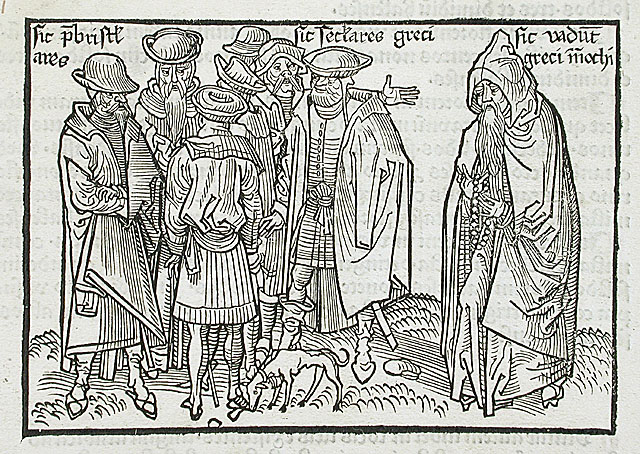
Greeks, by Erhard Reuwich, 1455-1490.
 
This picture has been overused in blogs, but there are 

so few contemporary pictures available.  These men are consulting
 
together, which is indirectly what this blog is about.


On 26 July 1451, the signoria of Venice responded to a petition from the citizens of Argos that had been sent to them in late 1449.  The signoria was not often swift to respond.  It is informative on many levels, but it particularly illustrates that the citizens of Argos -- which had a population of fewer than 500 -- were having a very difficult time of it.  Longtime readers of this blog will recognize the incident of Section 6.

I am giving here my paraphrase of parts of the petition.  I have tried to keep the tone of the language, but my spelling and grammar are much better.  Each section has the signoria's response to the issue.

* * * * *

1. The commune of Argos asks that you recall that the Turks took Argos in 1397, 3 June, and took 14,000 souls, and burned the land and the castle and left. Nauplion was much harmed by the Albanians who raided. Your Signoria wanted residents in Argos and directed Nauplion to announce that anyone who wanted to come their with their families would be free persons, and free from payment of any dacio.* Each would get 40 stremmata of public land and 4 stremmata of vines, and a burnt-out house. There were 18 families from the Morea who took this privilege, then 7 more families, and these increased to 115. The houses were rebuilt and the vineyards are growing. These privileges misser Piero da Canal, the chamberlain, recorded, as did misser Zorzi Corner, the chamberlain who was captured by the Turks. The records were sent to Venice to the Corner house. So we ask that you please direct the relatives to give back the records to the Signoria, because Nauplion will not allow us to copy the ones they have. Please do right and not wrong, because we have expended our labor and money on these properties.

Response: We direct the podestà of Nauplion to read this petition carefully and to have a copy of the land records made.

2. Also, we who have lands and have worked them have to pay one half of the produce to the lord of the land and the person who planted has the other half for the work and expense he has made. If he wants to give a dowry to his daughter or a gift to his son, or sell the land, he needs a paper. Please let us have our share according to tradition.

Response: We want to preserve custom, and the rettor of Argos is to make descriptions of all the said lands, so that we do nothing against custom.
. . . .

4. Also, a band of Albanians attacks the place and does robberies and murders at the fair, and they waste the fields and vines and rob the gardens. There are no armed men here except the men they call the Greek stratioti and the rettori have given 15 of them land and paid 2 gold ducats apiece for a man and his horse, for the good of the communità.

Response: We don’t want to make any changes about this, as they get the land for service.

5. When the Greek despots come through Argos, we have to give presents.** Would you please pay for them?

Response: This is a small expense and we want to continue the usual practice.

6.  About the Albanians who live in the territory: He [Demetrios Laskaris Asan of Mouchli] orders them about and says they are his, not the Signoria’s. The chief of the catuna has to pay from 1 to 3 ducats a hearth, and if he does not pay immediately he is imprisoned. The Albanians want to be under Your Signoria, not under the Greeks. Asan came to trade at the fair of San Francesco at Kiveri. The Sunday of the fair we were going between Argos and Kiveri. He dashed past the toll post & we were seized and our horses taken. We were taken to Mouchli and imprisoned, and two people were executed. When the rettor of Argos sent a messenger to inquire he had the messenger’s horse taken. He also took the pigs of the brother of the Albanian he had in prison.***

Response: We are writing the Despot Demetrios in the usual form that he should see that similar incidents do not occur.

7. Every two years the rettor makes an announcement that anyone who holds land from the commune should show his papers, under penalty, and the landholders from Nauplion never come here to show theirs.

Response: We order the podestà of Nauplion that the landholders from Nauplion should immediately go to Argos with their papers so that they can be seen and the lands known.

8. Also, we ask that you will please send us 2000 ('duga migiara') arrows for defense, and since we are poor in cash we will pay you in grain.

Response: We will send 3000 arrows, and another 2000 from Crete, and you will give the storehouse in Nauplion grain for their value.

9. Also, we complain about misser Zan Contarini who was vice-rettor in Argos, when he assigned land he asked for cash gifts. We ask that the money please be returned.

Response: We want the rettor of Argos to diligently inform himself about the money acceppted by ser Giovanni Contarini for land concessions, and arrange that our loyal subjects have their money back.

* * * * *
* Dacio: annual payments to the lord for the house, and for each piece of land. 
** We don't know anything about presents for the despots, but when the Ottoman governors of the Morea visited Nauplion around 1480, Bartolomeo Minio's gifts usually included a silver cup, cloth, sugar, fresh fish, bread, and wine.  Most of these were given by landholders and merchants who had an interest in the prospective negotiations.
*** This is told more fully in Archons: Demetrios Laskaris Asan of Mouchli.

20 February 2010

Anathema

 
-->
τοῦ Ἰούδα [καὶ τῶν λέγοντων]
ἆρον ἆρον σταύ[ρωσον αὐτὸν]
. . . of Judas [and those saying]
Away with him! Cru[cify him!]
John 19:14

-->
A year ago I wrote about a late antique tombstone found near Argos. It is now Lent in both the Eastern and Western rites, and a good time to revisit the Argos tombstones at a more serious level. 

The image here is from the Byzantine Museum in Athens, but it represents six of the fourteen or fifteen Christian epigraphs from the 5th and 6th centuries in Argos. It is a small thing: all but one of these Argos epigraphs are somewhat smaller than a piece of printer paper, 2/3 the width of my computer screen.  

In the ancient world, grave-entering -- robbing or using someone else's grave -- was an impious act of major importance, and the guilty were to pay fines to the municipal treasury. For a thousand years before Christianity, Jewish, Greek, and Roman epigraphs had called on the gods of the Greeks and Persians, on enraged Apollo, and on the iron broom and the flying sickle to punish the guilty. Constantine's divorce law of 331 considered grave-entering grounds for divorce. In 447 a law of Valentinian said that one who would harass the buried dead was an enemy of light itself. Some thought the clergy were particularly guilty of grave-entering, others said it was the people who carried the body to the grave.

Christian gravestones took up their own warning, often the anathema, or the curse of God on Judas and on those who cried Crucify him! when Pilate asked what to do with Jesus. Significantly, they used the form found in the Gospel of John, the most anti-Semitic of the gospels, and a longer form than those used in the other three. This anathema was quite popular in the Justinianic period, with the Greens using it in their court oaths and shouting it at the Blues. Justinian included the anathema in his law about perjury in 535.

What is striking here is the percentage of Christian epigraphs from Argos that use the anathema -- 6 out of fourteen or fifteen.  There is another from Hermione, in the Argolid.  None have been found at Sparta. We are dealing with survivals, but counting the Corinth epigraphs, I found only 2 out of 162, and at the Argos rate there should have been 50.  I found three from Athens, and at the Argos rate there should have been dozens. The anathema shows up very rarely in epigraphs from Italy, twice out of the thousands from North Africa, one from Asia Minor. [I did this work 10 years ago: it is likely that many more epigraphs have been discovered since, but someone else will have to do the numbers.] 

The Argos use of the anathema crossed class boundaries.  It is found in a monastic burial vault; on the grave of Rhoda, daughter of Kyriaki who must have been poor; on the grave of a member of the city council; on the grave of a Syrian resident; and on two other working-class graves. We know nothing about what was going on in Argos in the 6th century, except that there may be a clue on the epigraph for a Christian of Jewish origin. It says
-->
+ κοιμητήριον
Ἀραβάννας ἀγό
ραστον + ὁ ἠγό
ρασεν Σολομών +

+
[this] resting place
of Arabanna [is] paid
for + Salomon,
bought [it]+

Some, but not all of the Christian epigraphs have crosses: this has the most, three.  It also states twice that the grave site has been paid for.  Does these things reflect an uneasiness on the part of Jewish Christians about their status among Greek Christians?  Two other Jewish epigraphs have been found.  One is seriously eroded and has not been reconstructed.  The other, that of Aurelius Joses, quotes the Theodosian Code at 16.8.13 in asking that his tomb not be entered.

It was perfectly possible for Christians to protest grave-entering without vulgarity. 
-->One from Parori, outside Sparta, began with the Trisagion -- "Holy God, Holy Immortal" -- and concludes, "by this power, do not disturb this tomb. ’ Another, from Corinth, says mildly, "Therefore let no one have designs against them and exhume them, and involve themselves in penalties." The Jew, Aurelius Joses, set a standard no Argos Christian met:

I, Aurelius Joses, pray
the holy and great
power of God and the
power of the Law and the
dignity of the patriarchs and
the dignity of the ethnarchs and
the dignity of the sages and
the dignity of the worship offered
each day before God that
no one will break up my tomb
which I built with much labor.