30 September 2008

Sari Sadik Baba

Evliya Celebi learned this when he was visiting Patras in 1668:

Sari Sadik Baba is visited by the Greek infidels too, for they say that "this is our Saint Nicholas." By giving their offerings to the keepers of the tomb, they make their visits to him. None of the authorities have been able to root this practice out absolutely.


Once, when this saint wished to cross from the city of Vostitza to the Bay of Naupaktos, opposite, the sailors started across without taking him into the boat. Sari Sadik Sultan then gathered a little sand from the seashore into the skirts of his robe and walked onto the sea after the boat, scattering the sand grain by grain. The sailors watched, and as the heart-wounded dervish came on, filling up an area extending for two thousand paces, they became panic-stricken lest the saintly dervish should fill up the entire sea this way, and by closing off the gulf, deprive them of their place of work.

So they called out, "Come and get in the
caĩque, Old Father," and taking him at once into the boat, ferried him across to Naupaktos. For this reason, there is a mile-long sandy point on the Vostitza side of the gulf.

This, then, is Sari Sadik Sultan, holiness be upon him, who lies at rest in Patras, and to bring his holiness to its fullest visibility, he has been transported to Heaven.

From Evliya's Travels in the Morea © Pierre A. MacKay.
About Evliya's manuscript.
The Modern Bridge

25 September 2008

Sappho, Cleopatra, and the Pope

I see how fine he is, how rare, this creature called Lung Book or Mortal Book because of his strange organs of breath. His lungs are holes in his body, which open and close. And inside the holes are stiffened membranes, arranged like the pages of a book — imagine that! And when the holes open, the pages rise up and unfold, and the blood
that circles through them touches the air, and by this bath of air the blood is made pure . . . He is a house of books, my shy scorpion, carrying in his belly all the
perishable manuscripts — a little mirror of the library at Alexandria, 

which burned.
BRIGIT PEGEEN KELLY

We were having a drink under the platan trees by the trout ponds in Naousa. A man joined us, we exchanged introductions, and he said, "You think you are scholars and you know everything about history. But you don't know what really happened to the Library of Alexandria." And then he explained that the library had never burned, as everyone assumed, but that the Pope had taken it away, and all the priceless Greek manuscripts were locked away in the Secret Archives of the Vatican. This sounded like good news to us: it meant that priceless manuscripts still survived, but for him it was the crowning proof of papal perfidy. Considering the Fourth Crusade and Ferrara-Florence, a fragile case might be made for his view, but not here.

It might be thought a bit of perfidy that Alexandria had some of its Greek manuscripts at all. Ancient Athens required that a copy of each play presented at the Dionysia be deposited in the Metroön, the building that housed official city archives. That would have been nearly 400 plays collected across the century under which the system of drama was maintained. A hundred years after that century was over, Athens became involved in the Chremonidian War, an effort of Greek states to throw off Macedonian control. Athens was not what she had once been, and asked to borrow war funding from Ptolemy II of Alexandria, who agreed in exchange for receiving the complete collection of plays as pledge on the loan.

In an act that can only chill the stomach of anyone who has sailed in the Mediterranean, Athens put the manuscripts of a thousand plays on a galley and sent them across the water to Egypt. Ptolemy sent the money. In time, Athens asked to redeem the pledge. Ptolemy, in effect, said, "Keep the money."


More history happened. In the course of Julius Caesar's siege of Alexandria in 48BC, warehouses in the harbor area in which books were stored caught fire. There was much outrage about burning the library -- if the books did indeed belong to the library.

A patriarch named Theophilos is said to have burned the library in 391 AD on the grounds that if the books contradicted Holy Writ, they should be destroyed, and if they agreed with it, they were extraneous and unnecessary. In 640, the Calif Omar took over the city of Alexandria and when asked what should be done about the library, made, by the most amazing coincidence, the same response as Theophilos. These burnings of the library cannot be demonstrated to have happened although there were burnings, and in the course of conquests and revenge books do get burned.

There may have been other burnings that did or did not happen. The real problem is, we cannot establish that there was actually a Library of Alexandria in the time of Caesar, let alone by the time of Theophilos or Omar.

What we do know is that over the course of the 8th and 9th centuries, mathmatical and medical documents from Alexandria ended up in Persia. And we know that Egyptians took manuscript rolls, sliced them like jelly rolls into little strips, and wrapped their mummies with them. Most of the Sappho that exists today comes in partial lines from fragmented ribbons of mummy wrappings, although not the poem above.

In that fragment neatly copied on papyrus, Sappho says to a group of young girls that they have the gifts of the Muses, and ends by saying that, being human, there is no way not to grow old. Cleopatra of Egypt, who loved Caesar for a while and could not have loved a book-burner, given the choice, would have gladly responded to that with her famous "Make it so!"
For the whole poem about the scorpion, http://nauplion.net/Diana.html

17 September 2008

A Fate Worse than Death

Rossini's opera, The Siege of Corinth--L'assedio di Corinto, is not an experience to be undertaken lightly, say, the way one would go blithely to one's seventeenth or twenty-seventh performance of Barbiere. Even when it was written, in 1820, audiences stayed away in droves, possibly because it was entitled Maometto II, somewhat lifted from someone else's opera, and possibly because it was pretty awful.

Maometto told the story of the 1470 siege of Negroponte and its capture from the Venetians, but even in Venice--or especially in Venice--it was not much appreciated. The story is vaguely that of Anna Erizzo, daughter of the Venetian commander, with whom the tyrant -besieger, Maometto
(brooding operatic portrait to the right), becomes smitten. Anna Erizzo's story filled Venetian propaganda after the capture, and she was said to have taken her own life rather than submit to his brutal lusts. (It may or may not be of interest to note that rape is not reliably recorded among his more unattractive characteristics.)

It is true that after the capture of Negroponte, the women, children, and boys under the age of 18, were taken off as slaves, but there never was an Anna Erizzo. The Venetian commander Paolo Erizzo was killed before dawn on the final day of the siege. All men of military age, about eight hundred, were beheaded after the capture. More had been killed, a few escaped. The loss of the women and children was its own tragedy, and documents survive of men like Eustachio who, although able to track down and ransom his wife and some of his children, was grieving ten years later for the two daughters still missing. But with the exception of
Dialogues des Carmélites, tragedy in opera is not like tragedy in real life and Anna needs little sympathy.

Six years after Maometto flopped, Rossini reissued it in French, and with ballets, as The Siege of Corinth (which Maometto had beseiged, briefly and without violence in 1458). It was an immediate hit. Europe had been following the 1826 siege of Messolonghi (where Byron died of malaria in 1824) and the massacre there of the women and children who had tried to escape. There had also been the 1822 siege and massacre at Chios.

A couple of passages from the Baltimore Opera program illustrate the general tenor of the opera.
Anna and Paolo Erizzo have become Pamira and Cléomène. It begins:
In the vestibule of the Senate palace, the men of Corinth are ready to defend their city (“Signor, un sol tuo cenno”), but Cleomene, the governor, tells his people that their situation is hopeless: the Turk Maometto II refuses to relent in his siege of the city (“Del vincitor superbo di Bisanzio”).

and ends:

As the men march off to fight, Pamira and the women pray again, readying themselves for death (“L'ora fatal s'appressa”), even as the Turks are heard exulting in victory. Maometto enters triumphantly hoping at last to gain Pamira, but she threatens to kill herself if he approaches. With a roar, the building crumbles, revealing the city consumed in flames, as the Turks slaughter the people of Corinth .

This time the opera worked, audiences wept in droves for tragic oppressed Greece, and everyone, especially Rossini, was quite gratified.

We were in Negroponte the other day, now Halkis, trying to identify aspects of the siege. In the years before and after 1900, the city fathers of Halkis went to uncommon trouble to eliminate all traces of medieval fortifications, and it is now difficult to envision what must have happened. With one exception:

Looking to the north, you can see where Nicolò da Canale sat with the Venetian fleet that August, out of danger, but not out of the sound and sight of the besieged. Mehmed-Maometto was besieging Negroponte as vengence for da Canale's stupidly gratuitous siege and massacre of Ainos in 1468. But da Canale's Negroponte behavior duplicated what happened earlier, when the Venetian fleet waited off-shore at Patras in August 1466 and so enabled the slaughter of Jacopo Barbarigo and his troops, and the impalement of Michali Rallis.

10 September 2008

The Cape of Barking Dogs


They sang sometimes with half-closed eyes
as we were passing the abandoned island to the west
with the prickly pear, past the cape
of the barking dogs.


So wrote George Seferis, returning to myth the nearby cliffs of Cape Skyllaion, Cavo Schillo, Cape of Dogs--the cape close to the channel of Poros, almost directly south from Athens. Its name comes from a girl who behaved so badly it is difficult to think that 'dog' is not a euphemism for a closely-related word, but the Cape of Dogs is a node for a cluster of small images.

The name comes from Ovid's story of Scylla, daughter of Nisus of Megara who was known for his lock of purple hair. Apollo visited their castle once, and rested his lyre on the stones, and when Scylla was a child she could set the stones singing by tapping them with a pebble. But her father was for six months beseiged by Minos of Crete and Scylla became enamoured of the heroic armored figure she watched from the walls. One night, she cut off Nisus' purple lock, the secret of Megaran security, and took it to Minos, offering him victory and herself. When Minos rejected her in horror--the victory he was not free to reject was definitively his--the obsessed girl swam out after his ship and clung to the stern. Her father, transformed into an osprey, tore at her until she was transformed into a shearwater -- named for the shorn lock of hair. Pausanias's more sober version says that Minos had her thrown overboard, and her body was torn by sea birds where it washed ashore on the cape.

There are too many elements here that do not bear up under scrutiny, but the cape, true to Ovid, changed its number of dogs, its location, its shape, and even its location for on occasion we find Ottoman and Venetian sources that sometimes refer to the cape down by Spetses, as the Cape of Dogs, and sometimes the cape by Poros.

Piri Re'is rounded the Cape of Dogs many times in his career--that is his unfinished sketch of galleys above. He wrote of sailing for the cape and finding the Venetians in possession of the small port of Poros. The channel between Poros and the mainland is so narrow that it seems as if fully-extended galley oars would smash on either side. It was night and no retreat. Piri Re'is had his oarsmen muffle their oars and the galley slipped silently through the channel on the current and down past the cliffs of the Cape of Dogs.

As I did one morning as dawn broke. The boat had turned off its engine and as we drifted through Poros in silence, I saw illuminated in the rays of sun on the horizon, a woman in a white gown on a balcony, bending over to brush the long hair that hung to below her waist. In that misted early sun, the stones had been set singing.

For the poem, see George Seferis, Mythistorema, Part 4. Trans. DW.

05 September 2008

The Lion in the Cloister

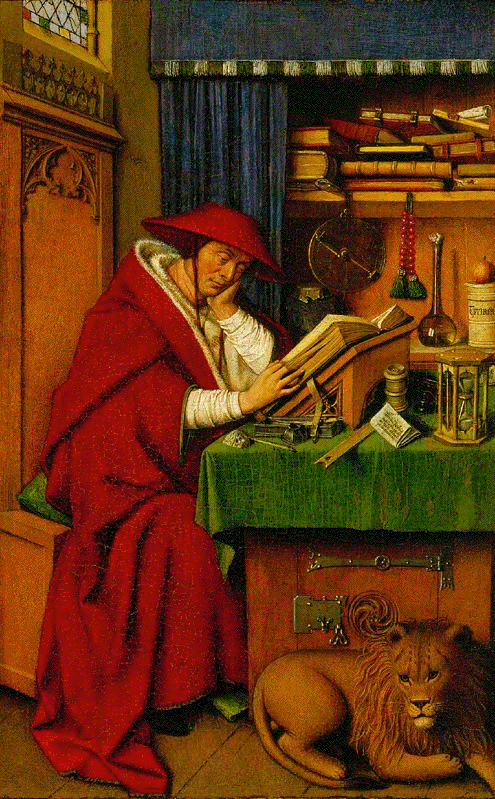
There are a lot of studioli in paintings of St. Jerome because he was a scholar and scholars need privacy to work. The studioli are small wooden studies, such as you can see here, a small room inside a room, or a panelled side of a room, with raised platforms to keep feet off the cold floor, nearly all with sliding piles of books, and hourglasses and pens and inkwells, more books on the floor, books toppling over in cabinets, reading stands, writing stands, astrolabes, green baize or Turkish carpets for table covers, high-backed seats to keep the draft off, prayer beads, vases, pots of flowers, a pear for snacking, scissors, glasses, notes on bulletin boards, cardinals' hats (because that is half of how you identify Jerome), clocks, birds and shells, antlers and squirrels; peacocks and quail--because scholars study nature.
The other half of how you identify Jerome is his lion--lions like kittens, lions like stuffed animals, sometimes Jerome looks like a lion, lions like old dogs, and in Durer's along with a dozing lion there is a sleeping dog, because wise men who are scholars have white dogs, in contrast to old wise women who are witches who have black cats. The best known of these white dogs is Carpaccio's Augustine, but that painting is about Jerome, too, because Augustine in his wonderful study--far grander than a studiolo--has abruptly had a vision of Jerome in death. Both of those last two wise men with white dogs are intended as portraits of Cardinal Bessarion and Bessarion is the explanation for the astrolabes that appear in Carpaccio's Augustine, and in occasional paintings of Jerome. The astronomer, Regiomontanus, made an astrolabe for Bessarion, and Bessarion, like Jerome, was a Cardinal. Most of these studiolo paintings bring you close in to the studiolo with Jerome, give you that wonderful enclosure, but the painting by Antonello da Messina showing an elevated studiolo in a setting something like a church, surrounds Jerome with privacy. In other paintings, the lion is sleeping, or guarding, or holding up his paw to have a thorn removed--at some point the story of Jerome got mixed up with the story of Androcles--and Bastiani and Carpaccio have great fun watching the lion scaring the monks.in the cloister. For Antonello, though, Jeroma has a cat among his flower pots, because scholars tend to work quietly and cats like not to be disturbed.

Far off to the right of Antonello's studiolo is the image you see above, an alert gracile lion pacing among the pillars of the cloister as if they were trees. Other studiolo lions might represent the taming of the bestial in man, the triumph of law over nature, the redemption of fallen nature, and so on and so forth, but not this lion. Antonello's lion is a metaphor for scholarship--for the deliberate and watchful stalking of information, for the pacing nature of thought, for the open spaces of the mind, for the easy interchange of views. And because it is Jerome: the lion suggests the possibility of the radical transformation of the culture from which the studiolo protects.

For much more, see the wonderful book by Eugene F. Rice, Jr., Saint Jerome in the Renaissance. and a modern architect's recreation.

31 August 2008

The Tenant from Naples

 In 1540, the Minio brothers--Alvise, Almoro, and Francesco-found themselves in severe financial trouble. After several years during which they were not paying their sister Lucrezia's dowry, an amount they had offered, plus not handing over the gold ducats left her in her mother's will, Lucrezia's husband, Leonardo Malipiero, brought suit on her behalf. He obtained a judgment against the brothers for more than 8,000 gold ducats. A considerable amount of Minio real estate was assessed and put up for sale at auction, including:
  • a farmhouse with a burnt roof and a field, beside a river
  • a vineyard and plowland near a church of S. Maria
  • a run-down house at S. Margherita
  • three 4-room workers' flats at S. Zane Bragola, valued at 240 ducats.
  • a palazzo at S. Zulian, valued at 1300 ducats.
  • the family palazzo on the campo at S. Moritzio, valued at 1100 ducats.
The auctions did not go well, and Leonardo was given the rents for the interim. The brothers rented a floor in the S. Moritzio palazzo for themselves. S. Zulian was rented to a Misser Zuam Thomaso from Naples for two years for 55 ducats a year. Zuam Thomaso got a very good deal as this was 25 ducats less than the 80-ducat rent of 3 years earlier. The lease specified--this is important--that the owners would supply beds, ironmongery, keys, and window glass. Zuam Thomaso left at the end of his lease in 1540, and the S. Zulian house was then rented to Ser Antonio Stampa, also from Naples. The rent was due every four months.

For that reason, it was four months before Leonardo noticed that there was no rent from S. Zulian . He sent his agent, Ser Baptista di Antonio, to inquire. Ser Baptista reported back on 8 July 1540 that Ser Antonio Stampa from Naples was missing. This is what was missing with him:

  • the door of the inner staircase with its ironmongery.
  • the glass from the veranda windows on the inner court
  • the glass from two windows beside the small door on the mezzanine
  • the firebox from the small room by the door on the mezzanine
  • a shelf and two glass windows from the kitchen
  • all the glass from the ground floor windows onto the courtyard.
  • the trundle bed from under the great bed in the upper chamber
  • all the bedding from the two upper chambers
  • the keys for the bedrooms and the storerooms
  • the keys for the back door, the mezzanine door, the office, and the great door.
Those of us who have had tenants will know how he felt.

Over the next few years, Almoro left Venice, Leonardo died, Lucrezia remarried, Francesco and Alvise died, Lucrezia died. In 1561, 31 years after the original judgment in the case, Alvise's son Oratio was still paying Lucrezia's second husband, Agustin Ferro, interest on the dowry.

25 August 2008

A Most Beautiful Red Parrot

In the summer of 1485, diplomat Giovanni Dario and the Ottoman court had to attend the hunting camp of the Sultan, Beyazid II. The weather was exceptionally hot, everyone had to live in tents, and cold water was unavailable. Dario was seventy-one and could not get neither doctor nor medicine for the pains in his chest. He wanted a taste of wine--impossible in Beyazid's ambit. He craved bed rest, but he was got out of bed to come observe the reception of the Egyptian ambassador. It took all day. The ambassador had brought gifts, a lot of gifts, for the Sultan, who remained invisible. The pashas invited Dario into the shade of their pavilion--they were sitting on carpets on the grass, and they had a stool brought so he would not have to lower his aching, weighty body to the ground. Then the procession of gifts began. 
The first was a great cat as large as a lion, with black spots: it had, he said, a terribilità. Then came six Arabian horses, the first with gilded saddle and trappings, and then three racing camels. "After this came the little presents," he wrote: three parrots in cages, four black eunuch boys, six swords, iron maces, battle axes, helmets, shields, saddles. Behind these came a procession of slaves, each one bearing two bolts of cloth--double weaves, scarlets, silks. All of these gifts were the preface to the Ambassador who advanced wearing green damask embroidered with gold and a cape of sable down to the ground. In July.
The ambassador was allowed fifteen minutes inside the imperial tent, then he was sent out to sit with the pashas and Dario. He directed that a large long scroll be cut open and read. As Dario said, "It was a very long reading." This was followed by a banquet of many dishes served on Chinese porcelain. He particularly liked a serving of vegetables with a lemon sauce. 
That was the first day. The second day Dario was got out of bed again, this time for the reception of the Indian ambassador. He too had brought gifts, the first of them in a chest, and when Dario arrived at the pavilion, the ambassador and the pashas were rummaging in the chest, pulling out handfuls of jewels and passing them around. Dario was handed a dagger in a gold sheath ornamented with twenty-two large rubies, more little rubies, turquoises, and topped with a large pearl. Then the ambassador was allowed his fifteen minutes in the imperial tent. Again there was a procession of gifts--the grounds were full of slaves waiting their turn to march past, it was still very hot, and Dario noted that of all the diplomatic corps present, he was the only one invited to sit in the shade.  
The pashas were making an inventory, and they reported 2600 bales of silk, eighty bales of scarlet cloth, more brocades, and then tray after tray laden with porcelain, followed by horse tails (these were Beyazid's symbol) cane lances, various Indian luxuries, and ending the procession, a single most beautiful red parrot.
 
This parrot, or one like it, came back to Venice with Dario. It appears in Venetian paintings of the period, as in the Carpaccio detail above. What also came back, or the idea of it, or a Venetian painter had seen one in the East, was the great cat with black spots, its terribilità no longer in evidence here in this painting by Mansueti set in a Venetian house decorated like Dario's--this painting of a lonely Turk and his cheetah that has no place to run.

20 August 2008

Kidnapping the Bride

In 1361, the most important woman in the Mediterranean was Fiorenza Sanudo--widow, mother to young Niccolò, heiress to the Duchy of the Archipelago, or the Cycladic islands. She was also heiress to two-thirds of the Greek island of Euboea. She is said to have been quite beautiful, but we have no evidence on that point. Given her qualifications as heiress, she could have looked like Grendel's mother and still be called beautiful.

She was interested in the young nobleman, Pietro Rechanelli, captain of Smyrna, a situation that sent the Venetian Signoria into paroxysms of anxiety: Pietro was Genoese, and islands in which Venice took a strong interest could not be allowed to come under Genoese influence. Although the islands were extremely picturesque and had abundant important antiquities above ground, they were also extremely poor and being Duchess of them was worth little more than the paper the title was written on, except that Venice needed access to these islands as safe harbours for ships trading in the Black Sea and down to Alexandria.

The Venetian Signoria wrote to Fiorenza and to both her parents expressing their distress at her careless association, and suggesting that there were a number of perfectly eligible young men in Venice. Her mother wrote back that they were shocked, shocked, that anyone could imagine Fiorenza would be allowed a marriage of which Venice did not approve.

Then another suitor appeared, the brother of the Archbishop of Patras, equally, if not more unsuitable, as he was a Florentine. More letters were written to Fiorenza who was now Duchess and possessor of two-thirds of Euboea in her own right. Contingents of guards were sent out to take over the main defenses on Euboea and in the Archipelago--a young woman grieving for her father could not be expected to be responsible for the defense of such important positions.

Various minor royalties in southern Italy expressed interest and concern. Letters were written in triplicate. The captain of the Venetian fleet was directed to keep all non-Venetian ships out of the Archipelago. The Duke of Crete was directed to kidnap Fiorenza, although that is not how the letter was phrased.

Many of the details of this story are missing, and we only have pieces of official correspondence surviving, but the Duke of Crete sent a ship that returned to Crete with Fiorenza. The Signoria talked to Niccolò "Spezzabanda" Sanudo, a minor condottiere and Fiorenza's first cousin whose father was the leading Venetian official on Euboea. They suggested he might want to visit Fiorenza on Crete. The Duke of Crete was directed to let the young people be alone together. You can see where this story is going.

They were married. The Pope was asked a year after the fact for a dispensation. While they were still on Crete, the Cretan population, provoked by administrative brutality, a lack of representation in goverment, extortionate taxes, and assorted insults, rose up and declared themselves an independent republic.
An embarassingly large number of Venetian colonists participated in the revolt. Niccolò in his role as "Spezzabanda" (this would means something like "Router of Bands" or "Disperser of Hosts") joined with Lucino dal Verme, a major condottiere from Verona who arrived with 1,000 cavalry, 11,000 infantry, twenty ships and eight galleys. After they scoured the island, uprooted fruit trees, sowed fields with salt, beheaded a number of rebels, and buried others alive, head-down, the condottieri declared victory for Venice.

Then Niccolò "Spezzabanda" apparently gave up war, took up trade in a minor way, and did whatever ruling was required in the Archipelago and Euboea on behalf of Fiorenza. She died in 1372. Her son, Niccolò, came of age that year and married another heiress, Petronilla Tocco. He was an erratic and violent ruler, and in 1383 was murdered while out hunting. No one in the hunting party saw who did it, but they all agreed it was strangers. One of the party, Francesco Crispi,declared himself Duke. Venice had never held the prejudice that criminal tendencies kept a man from having administrative competence, and let him have the Duchy, especially since that allowed them to absorb Euboea.

As this story ends, Maria, daughter of
Niccolò "Spezzabanda" and Fiorenza, was quite young but approaching marriageable age. The Signoria of Venice wrote to all those involved that she was not to be allowed to marry without their permission.

16 August 2008

Dear John

John VIII Palaiologos was a man in frequent crippling pain. He was an oldest son who constantly tried to do the right thing which was never adequate, and who lived a life of unremitting stress for which there were no solutions. His first two marriages were no marriages at all, and his third marriage ended by breaking his heart. He is about forty-six in the portrait to the left.

He was twenty-one at the first marriage in 1414 which was political--someone in his position would have expected nothing else--and the bride was a child, Anna of Russia. Constantinople sent a glorious vestment to the Metropolitan of Moscow with pearl portraits of the couple to celebrate the event. The marriage is not likely to have much affected his life. Anna lived in the women's apartments of the palace, and John served as regent while his father, Manuel, was out of the country. In 1416, when Manuel came home, John left for the Morea, and not until he arrived home in 1418 did he learn that Anna had died of the Eighth Death the previous August.

His second marriage was one of a.brace of marriages arranged on one side by the Pope, Martin V, as part of his project to unite the Eastern and Western churches, and on the other by Manuel II as part of his efforts to get military and financial aid for the battered empire. The brides arrived in November 1420 with large endowments Cleofe's story has already been told here. Sophia of Montferrat was quite young, already widowed, distantly related to the Palaiologues. She had blonde braids down to her feet, an ample bosom, a slender neck. They were married at Agia Sophia in January 1419, he was crowned co-emperor, she was crowned the next day, and he never spoke to her again. He couldn't bear her.

The accounts are most unclear about what was wrong. A writer who knew the family said that she was well-mannered, but that John disliked her, and then came to hate her because of his dislike--thie sequence is understandable. But his unkindness, taken together with the fact that his brother Theodoros was simultaneously hostile to the lovely bride chosen for him, suggests problems within the Palaiologos family left unaddressed by contemporary chroniclers and modern historians. It is perhaps not the place to comment that their father, Manuel II, had written a treatise against marriage (except for dynastic reasons) shortly after his own, late, marriage, and that he had kept the manuscript circulating in the palace all those years.

One writer says her face was distorted, and that she was tall. From that, a modern "historian" meanly pronounces Sophia "una gigantessa dalla faccia de gorgone," and claims that she was confined in the palace. Evidence suggests that neither statement was true. Constantinopolitan wits were saying it was a case of "Easter behind, Lent before."
My own thought is that however unfortunate her face, she was also larger than John who was, as the portrait above suggests, physically slight. He was very very conscious of appearances. A religious chronicler said:
This man was crowned with his wife whom they had brought for him with many riches. He accepted her but he did not love her at all. . . . The emperor was extremely addicted to pleasures of the flesh and, for this reason, he had no affection for her.
Another chronicle repeats this. They are monastic chronicles and can be expected to scowl, but they are nearly the only hints we get that John had any life at all that was not being fed into the maw of the state. A secular chronicle mentions one charming interlude, a possibly unwise interlude because a small military action was at stake, shortly before the Sophia marriage:

The Byzantine emperor was at Proikonēsos, at leisure with his lover who happened to be the daughter of a priest, and so he was not there when he was needed.

This is the only time during his father's lifetime that John is reported to have done something he enjoyed. One ventures to hope that this was not the only such interval. Sophia herself lived quietly in the palace with the household staff she had brought from home. John, out of obedience to his father, did not try to end the marriage. But the year after Manuel died, a year after John became emperor in his own right, some time in 1426, Sophia and a few Italian-speaking attendants went for a walk in a garden along the shore. A Genoese boat drew abreast, they boarded, the boat sailed. Somehow no one minded, and Sophia was returned to Montferrat where she lived out her small life in a convent until her death in 1434. It is said that only thing she took with her from Constantinople was the crown with which she had been crowned Empress of the Romans. But the Orthodox used crowns for weddings, and perhaps it was the crown of her marriage.

There was a third marriage for John the next year, his own decision, to the princess Maria of Trebizond. The young Bessarion, who was from Trebizond and related to her, and who appreciated womanly attractions, made the arrangements. If this painting above by Pisanello (who knew both Bessarion and John--and who might have seen a portrait of her), if this small and memorably lovely woman is actually intended to be Maria, we have a sense of the woman they might have seen. John apparently fell completely in love with her, and she with him. What fragmentary reports we have of their marriage shows her riding with him on hunts--wearing masses of rubies and other jewels, taking care of his guests, and sending letters to him when he was away.

While he was away having the worst experience of his life in Ferrara-Florence, trying to save the empire, when the picture above was painted, Maria and Zoe, wife of John's brother Demetrios, both contracted plague. Someone in the palace wrote to someone in Florence saying that the women were ill, but it was decided not to tell the brothers, because John would get upset and take to his bed and things would drag out even longer. Some of the delegation learned, as they were struggling to sail home against the winter storms, that Maria had died of the Tenth Death, on 17 December, but it was decided again to keep the information from John because he was a bad sailor at the best of times, and with this he would insist on going ashore indefinitely..

When the brothers arrived back in Constantinople on the first of February, they were met at the dock by a large and sober group from the palace led by their brother Constantine. Someone confided to Demetrios that Maria had died, but not to tell John. Someone else confided to John that Zoe had died, but not to tell Demetrios. The party walked in silence up to the palace, each brother stoically grieving for the other, to be met by their mother, Helena, who took them to her suite and told them that they were both widowers.

John buried Maria in the family church of the Pantokrator and collapsed into depression. When he himself died nine years later, the unforgiving Othodox clergy denied him funeral rites because of his support for Church Union, but his family buried him in Maria's grave.

12 August 2008

The Great Deaths


The First Death happened in 1347.
The Second Death in 1362.

The Third Death in 1373.
The Fourth Death in 1381. 
The Fifth Death in 1390.
The Sixth Death in 1396.
The Seventh Death in 1409.

The Eighth Death in 1417.
The Ninth Death in 1423 when the Albanians came to Tavia.
The Tenth Death in 1440.

So it is written in the fragmentary chronicles of the Morea, so fragmentary they rarely tell us anything but the year. The First broke out in September, the Fifth in April. The Seventh took 10,000 people in Constantinople in 1409 and was still requiring deaths in Nauplion at Christmas 1410.

In 1416 in Greece, they heard of plague around the Black Sea. If you lived in a port city, you simply waited for it to arrive. In 1417 it reached Constantinople and then the Morea in the summer and stayed for a year. It, or a new Death, broke out in Constantinople in 1419 and lasted into1421. The Ninth erupted in the Morea in 1422 or 1423 from an earthquake, lasting all through 1423. That particular year was remembered because the Turks broke down the wall at the Isthmus of Corinth in May, ravaged into the heart of the Morea and--the chronicles say--the Albanians came to Tavia. The Albanians, mostly recent immigrant herding clans who preferred war, were the only opposition to the Turks. Eight hundred Albanian heads were left at Tavia in June.


[Tavia is now Davia, but the eight hundred is its own kind of Great Death, a summer Turk-born contamination. Eight hundred were beheaded at Negroponte on 12 July 1471. Eight hundred were beheaded at Otranto on 14 August 1480. Eight hundred were beheaded at Modon on 9 August 1500. Eight hundred shows up in chronicles and eye-witness reports like a liturgical response.]

The Byzantine year began in September, so deaths reported in one year usually spill over into another year in our calculations. The chronicles stop numbering after the tenth episode of Death, but it is nearly always there in the records. The Venetian Senato warned the ship carrying Manuel II home from the West was warned not to stop there because of the plague that struck in the winter of 1401 and went into the spring. Negroponte had plague in the summer of 1426, Patras in 1430 when people were were weak from the famine of the previous year. A "terrible" plague hit Constantinople in 1435, and the beginnings of the Tenth took the wives of John VIII Palaiologos and his brother Demetrios. It came again in 1447 and1448, moving down to Negroponte where it devoured two-thirds of the city's population over two years, into the Morea, and then to Italy where it fed for four more years. Crete and the Morea were attacked in the summer of 1456 with plague that lasted into the next year. The 1460 plague in Negroponte moved on to Modon for 1461.

The Deaths mostly followed the shipping and trade routes, but Pius II's crusade against the infidels, brought plague from Ancona into the Morea in the summer of 1464. They were already dying on the ships, and ultimately three-fourths of Sigismondo Malatesta's army died, but enough survived to carry it from the west coast to Nauplion, and all across the south. It hung on for years, at least through 1468, supplemented by starvation because of the loss of so many farm workers, either because they had gone for soldiers, or had taken sick, or because those living around the cities disappeared into the mountains for fear of plague. When you count up the years of known plague in the Morea, they take in more than a third of the century.

The chronicles tell us that Moreote outbreak in 1423 was caused by an earthquake, and Halley's comet caused the plague of 1456. In fact, the etiology for 1423 may not be completely off: an earthquake could well dislodge rats and the burrowing rodents that carry the plague fleas, and they certainly associated rodents with plague. The ancients called Apollo "the far shooter," the bringer of plague, and also the mouse god, so possibly he was responsible for the comet, too.