06 February 2010

Roosters


Christopher Columbus has the distinction of being nearly the only famous person from the 15th-century Mediterranean not known to Cyriaco of Ancona. When Columbus was not pirating or otherwise engaged, he exported mastic  from Chios, and in his first letter to Queen Isabella, he presented the possibility of new sources of mastic as one reason to invest in his explorations.  One line of Columban theology claims that Columbus was a Greek from Chios but this is not relevant here.

Cyriaco also exported mastic. Mastic is (the word is from the same root as masticate) a gum produced by a small shrub, found mostly on Chios, a highly profitable trade in the pre-Colgate era for sale as a tooth cleaner and breath sweetner. In January 1446, Cyriaco rode out with friends in a mule train to see where mastic came from. "I finally saw drops of glittering mastic in large numbers rather nearby on every side among the tearful but joyous trucks and had the pleasure of gathering some in my hand . . .

"For I recalled that I had often seen numberous boxes filled with this highly esteemed gum being loaded on to the great ships in your broad and tranquil port of Chios and I knew that the world was being filled with the scent of this island's gift, this wholesome exhalation, since in the course of the years, through the agency of Genoese and foreign ships, these fragrances are carried, some through the Dardanelles and the Bosporus to Thrace and eastern Europe, others through the Black Sea and the Sea of Azov to the River Don, to comfort the Sarmatians, Scythians, and Hyrcanians beneath their cold sky; or elsewhere through Asia, to allure the Colchians, the Albanians, the Georgians, Cappadocians, and Cilicians, and thence the Persians, Parthians and Arabs and Bactrians and Medes and Babylonians, Others are carried over the immense Ionian and Libyan Seas to Egypt and Syria, thence to be transported to the Ethiopians, Garamantians, and Indians. And we know that others are brought via Illyria to Italy, while still others have been transported across the entire Mediterranean Sea, to Ocean and the western lands, to revivify Cadis, the Gauls, Germans, Spaniards, Britons, Irish and Scotch, and far-off Thule." 

This passage brings irresistibly to mind the letter to Henry Miller, in which Lawrence Durrell described George Katsimbalis at the locked gate of the Acropolis one midnight. He "sent out the most bloodcurdling clarion I have ever heard: Cock-a-doodle-doo . . .' and then, after a pause, 'lo from the distance, silvery-clear in the darkness, a cock drowsily answered -- and then another, then another." The night began to quiver with cockcrows.

In Mani at Cape Matapan, Patrick Leigh Fermor was told that they could sometimes hear cocks crowing from Cythera. "The distance between Cythera and Capate Matapan on the tattered map in my pocket, was somewhere between twenty and thirty miles. This enormously extended the possible ambit of George's initial cockcrow . . . the traffic could be reversed, and leap from the Mani (or better still, Cape Malea) to Cythera, from Cythera to Anticythera, and from Anticythera to the piratical peninsulas of western Crete; only to die out south of the great island in a last lonely crow on the islet of Gavdos, in the Libyan Sea. . . . But a timely west wind could carry it to the eastern capes of Crete, over the Cassos straits, through the islands of the Dodecanese, and thence to the Halicarnassus peninsula and the Taurus mountains. . . . The possibilities became suddenly tremendous and in our mind's ear the ghostly clarion travelled south-west into Egypt, south-east to the Persian Gulf; up the Nile, past the villages fo the stork-like Dinkas, through the great forests, from krall to krall of the Zulus, waking the drowsy Boers of the Transvaal and expiring from a chicken-run on Table Mountain over the Cape of Good Hope.

"North of Athens, all was plain sailing; it would be through the Iron Curtain, over the Great Balkan range and across the Danube within the hour, with nothing to hinder its spread across the Ukraine and Great Russia [[ the sudden hubbub in a hundred collective farms alerting the NKVD and causing a number of arrests on suspicion -- until it reached the reindeer-haunted forests of Lapland, and called across the ice toward Nova Zembla to languish among igloos . . . Thus, as the northern call fell silent among the tongue-tied penguins of the Arctic floes, the westward sweep, after startling the solitary Magyar herdsman with the untimely uproar and alarming the night-capped Normans with thoughts of theft, was culminating in ultimate unanswered challenges from John o'Groats and the Blasket Islands, Finisterre and Cape Trafalgar, and a regimental mascot in Gibraltar was already rousing the Berbers of Tangier . . ."

On New Year's Day of 1445, Cyriaco trumped the cock.  Despite the fact that the crew of his boat had celebrated long and deeply the night before, and were sprawled asleep on their benches, "long before the cock with his wakeful voice called for the warm day, I roused the captain and his crew by singing alleluia."


The mosaic is from Roman Tunisia.
The cockcrows are from Mani, by Patrick Leigh Fermor, pp, 123-124,
The mastic is from Cyriac of Ancona: The Later Travels by Edward Bodnar, pp. 213-215.

31 January 2010

Pure Pleasure


After two entries and images of fire damage, and two entries about outrage, and because the schedule has become snarled and I am unable to write a blog for this week, I am offering some pure pleasure -- two manuscript images I have recently come across. 

This first, of the Creation of Adam, is taken from the left margin of a page in the 1397 Kiev Psalter. [MMA catalog: Byzantium, Faith and Power, #161.]

Thanks to Konstantina Papakosma for the beehives, which come from an 11C manuscript (probably 1050-1075) in the Patriarchal Library of Jerusalem.

23 January 2010

The Greek Institute of Venice


The originals of these evocative watercolors by Marianna Gabriel hang in various rooms of the Greek Institute of Venice, the Istituto Ellinico di Studi Bizantini e Postbizantini di Venezia, and  they bring back memories.


21 January 2010

The Tree of Life


Recent News
On the night of January 5 and again on January 15, Etz Hayyim synagogue of Chania on Crete was firebombed.  The library of books and manuscripts dating back to the 17th century was destroyed.  The building itself dates from the 14th century. From May 1944 until 1999, the building stood in ruins, desecrated by the Germans and local residents, then Nikos Stavrolakis -- nearly the last Jew on Crete and founder of the wonderful Jewish Museum of Greece, led a group to bring back Etz Hayyim as a living building.

Etz Hayyim means Tree of Life and while it will no doubt flourish again, now there is grief and shock, and Stavrolakis has lost his personal books and papers.  Links about the fire are below, but this is about what happened to 98% of the Jews of Crete.

On 29 May 1944 the Jewish population of Crete -- essentially the Jews of Chania --were rounded up by the Wermacht.  These included Jews who had come to Chania from elsewhere. The Jews of Euboea had been collected in March, those on Corfu, Rhodes, and Kos were collected in June and July.   Archbishop Damaskinos of Athens went to magnificent lengths to protect Athenian Jews: no such claims can be made for any other Greek archbishop or, indeed, any other archbishop in Europe.

In Chania, the Germans allowed the neighbors and the homeless to  loot Jewish property: photographs of this were used to demonstrate "popular anti-Semitic agitation." The Matsas book (link below) has accounts from Jews who saw, as they were being led away, their neighbors carrying off their possessions.
After the war, Cretan Jews who had fought with the partisans were punished by the collaborationist government.  Samuel Dentis, age 18, was shot by a firing squad.  Iosif DeCastro and Salvator Minervos were sent to the prison island of Makronisos -- these names give the history of Crete in miniature. 

On June 10,  Chania's Jews, along with 48 Christians who had been caught in anti-German actions, and 112 Italian soldiers who would not fight for the Germans,  were loaded onto a cargo ship -- the Danai or the Danae or the Tanais, depending on your preferred form of transcription. En route to Piraeus where they were to be loaded onto trains, the ship was sunk.

It was originally thought that the ship was sunk by a German bomb on board, but is seems sure now that the ship was sunk by the British who were known to be sinking possible German shipping in the Mediterranean.
These are the missing Jews of Chania.


Ekathimerini commentary.
Samuel Gruber's Jewish Arts and Heritage blog is the source of the photograph here and gives more information on the fires.. 
U. S. State Department statement.  
If you did not read it already at the link above, read Archbishop Damaskinos' protest against the German treatment of the Jews and his response to the German threat of execution.


Nikos Stavrolakis, The Jews of Greece.
Michael Matsas, The Illusion of Safety.


16 January 2010

The Fire


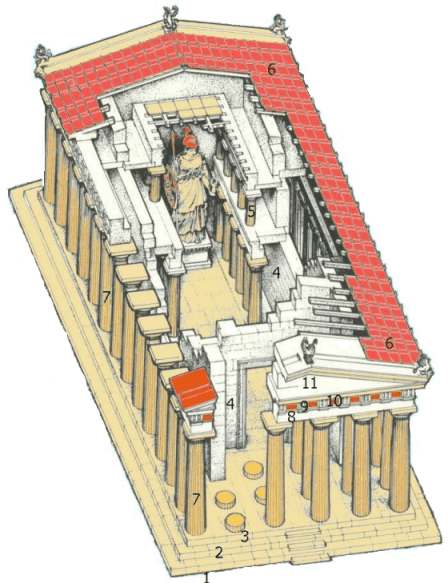
When I wrote the last entry, I had not yet seen Anthony Kaldellis' new book on the Parthenon.*    I was unable to borrow a copy locally, and it is expensive enough that we had to think a good while about buying our own.  But we did, and the book has now arrived.  It has a little more on the fire, much more on other topics, and some very interesting images.  Here you see Manolis Korres' drawing of what the Parthenon must have looked like after the catastrophe.  Korres leaves more standing than I would have thought one could hope for, but perhaps he is drawing on Evliya's description of two levels of fluted columns.

Some writers associate the fire with the Herulian assault in 267. Kaldellis finds evidence in Julian, and others, that it was not a ruin when he was studying in Athens in 355, and suggests it is more likely to have been caused by Alaric's Goths in 396.  I'm not sure why an invasion is necessary.  Pausanias reports a number of temples that burned because of carelessness with a lamp.  Perhaps the idea of external violence is more comforting than that of an internal accident.  More interesting is  Kaldellis' information that Korres found evidence that the columns were rebuilt and the statue of Athena restored.  Not the gold and ivory statue -- I learn that it had been dismantled and turned into cash long before -- but a replacement.  The cella was reroofed with clay tiles, but the space between the cella and the cage of columns was left open.
                
Then it was converted into a church, and we are hopelessly ignorant of the dating of fire and repair and conversion.  I was wrong when I thought that the Christians took over an empty hulk.  We do not know what the Christians converted.  There were a number of elements to this transformation, but I will leave them with Kaldellis, except for another image from Korres, this of the two stages of the transformation of the apse.

Anothere image in the book that particularly interests me is of the holy water font, or phiale, in the narthex.  Evliya mentioned it, commenting on how mighty must have been the men of old who drank from it.  This is pleasingly reminiscent of Nestor's cup, but Cyriaco who had seen this kind of thing in Italy did not find it impressive.  Here is a drawing of it by Xyngopoulos from a drawing by Pallas, which sounds rather as if we were talking about horse breeding.  Nerio Acciaiuoli had a stud farm which he left in his will for the support of this Church of the Virgin.  We do not know how that worked out.


* The Christian Parthenon: Classicism and Pilgrimage in Byzantine Athens byAnthony Kaldellis.

09 January 2010

Evliya Visits the Acropolis

George Wheler, 1676

In 1676 and earlier, when Evliya Celebi visited Athens, the minaret was not in the center, but more in the right front corner of the Parthenon: this will do as an impression of what Evliya saw in the extremely hot summer of 1668.

Athens was, you will be fascinated to learn, founded by Solomon. (Evliya is always interested in local history). He went up to the "walled city" which we know as the High City, commenting that its sides went down like the sides of the pits of hell.  Evliya saw the "Friday mosque," not the Parthenon: his descriptions give us the single best image we have of the Byzantine and medieval church of the Virgin.

Think of the Parthenon structurally as a box inside a cage of 46 columns, originally with a lid running from one side of the cage to the other. Remember the lid.  That is how Iktinos and Kallikrates built it.  When you come through the Propylea and head for the Parthenon, you are heading for the west end, which the ancients considered the back side.

The original entrance was around at the east end. Visitors approaching from the east went through a cluster of columns and a recessed door to enter the
cella with the great ivory and gold statue (We are, I think, the better off for not actually seeing Athena Parthenos). Here is an imperfect but adequate view of the interior construction. Behind the statue was a wall with an entrance to the treasury. Remember that wall.

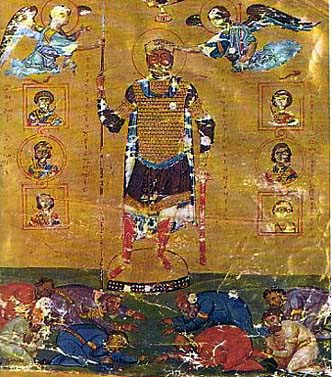
When it became a church -- probably in the 6th century -- an apse was constructed on the east end where the entrance was.  Evliya was informed that Plato used to hang a lamp in that dome with naphtha-soaked wicks that were lit in the morning through the heat of the sun on special stones.  Pilgrims reported an ever-burning lamp over the altar, and about 1020 Basil II had given a hanging lamp in the form of a golden dove.

A grand entrance was made in the west end, the treasury became the narthex, and the door between the treasury and the cella became the entrance to the church. Evliya described its finely carved cypress leaves "twenty yards high" which had once been gilded and still retained the insets that once held jewels. (In the late 14th century, Nerio Acciaiuoli needing cash had removed the silver covering Basil II had given for the doors, as well as the gold and jewels. He left money in his will for everything to be replaced but we do not know if it ever happened.) One of the ambones, pulpits, was constructed on six slender columnettes, which Evliya saw supporting a marble throne for Plato under its own dome.  When it was time for the cathedral to become a mosque, it served nicely as the mimbar.  Evliya much admired the colored marble of the furnishings, but essentially all that remains from the interior now is a few pieces like this -- a pretty carving from a world  very different from what had been 900 years before:


The ceiling Evliya saw was made of cypress, gilded and painted.  This was not the lid of marble coffers constructedby Iktinos and Kallikrates.  At some time in the unwritten history of Athens between about 250 and 550 -- Evliya said it was on the night of the birth of Mohammed * -- there was a catastrophic fire in the cella.  The gold and ivory Athena was consumed, and the marble lid came crashing down, bringing down most of the interior structure with the double levels of columns.  Essentially only the box was left.  Archaologist Manolis Korres has scraped off the calcined marble on what would have been the treasury wall behind the statue, and shown how frighteningly thin is the remaining supporting wall.  Athens is on an earthquake zone and it is remarkable that the wall did not collapse long ago, or come down in the incident of 1687.   The Christians took over a shell, not Pericles' Parthenon. Evliya knew of a second fire -- set by a mythical Egyptian sultan who looted the church of its treasures -- and said you could see "wounds" from that fire.  A second fire is quite possible.  [
Please read the subsequent entry for some corrections to this account of the fire.]

This mythical sultan is responsible for the disappearance of the jewels and treasures of the church to which Evliya keeps referring, though there were not many jewels and treasures remaining after the Franks of 1204 and the Catalans and the Acciaiuoli had made use of what Basil II had taken from his conquests in Bulgaria and given to Atheniotissa, the Virgin of Athens.

When Evliya saw the Parthenon, he saw a mosque with a minaret, surrounded by 46 columns, and for most of the way around, the space between the columns and the walls was open to the sky, not lidded over.
  He saw sculptured scenes on the metopes between the tops of the columns, and more scenes around the top of the cella. Our interpretations are dominated by archaeologists, but Evliya was under no such handicap.  The sculptures he saw contained fairies, angels, dragons, elephants, rhinoceri, giraffes, scorpions, crocodiles, thousands of mice, cats, ghouls, cherubs, and many many other kinds of creatures from this world and others in processions: one of the saved in Paradise, the other of those petrified in Hell.

Evliya says these sculptures are in the courtyard. In Evliya's experience of the classical Turkish mosque, the mosque is approached through a colonnaded courtyard, like the glorious Selimiye at Edirne.  The columns here, joined by lintels but almost completely separate from the interior structure ever since the fire and the collapse of the roof, allow him to interpret the Parthenon-mosque as a mosque
inside its courtyard.

He was fascinated with the holy water font in the narthex which he saw as a great goblet, large enough for a man to fit inside -- the men of old must have been mighty indeed to have been able to drink so much!  (Cyriaco had noticed the font, but little else.) He noticed that there had been a pipe organ over the door from the narthex into the church, but what fascinated him was a column supported by an arch. 

The mosque made use of the apse as a kibla, which he shows us covered with gold mosaics.  The arches and walls of the sanctuary were overlaid with multicolored mosaics which reminded him of the Dome of the Rock in Jerusalem. (Is there a reason there seem to be no good photographs of these mosaics on the internet?) I am imagining mosaics like these from Thessalonike.  

There was a gallery around the interior of the church, and the four columns closest to what would have been the altar were of porphyry.  So he said, Evliya always put the best possible interpretation on what he saw.  He counted 60 columns in all -- because of the gallery there would have been two levels -- all fluted and grooved. (An earlier Venetian visitor had said there were 80 -- this is the only known occasion on which Evliya produced a smaller number.) He doesn't mention the frescoes Basil gave, of which a few ghosts can still be seen, exposed to rain and Athens air for 450 years.

Evliya had seen the great mosques of Damascus and Edirne and Cairo and Jerusalem and Constantinople, but he said:

Presently there are well-constructed locations which have been disfigured by the wounds from the fire, but still, in the sphere of this ancient world, there is no such sparkling and luminous mosque since, no matter how often you enter it, on each subsequent entrance so many kinds of artful, individual and exemplary illustrations are evident and manifest. **


* You will recall that a fire the night of the birth of Alexander the Great brought down the great temple of Artemis of the Ephesians.
** Translation, Pierre MacKay. 

Notes:
  • Evliya's description of Athens and the Acropolis is to appear soon in a book of Evliya excerpts by Robert Dankoff.
  • An important new book is The Christian Parthenon: Classicism and Pilgrimage in Byzantine Athens byAnthony Kaldellis.   BMCR review. Bill Caraher's review. 
  • And thanks to  http://www.mlahanas.de/ for the Wheler image.

02 January 2010

Bessarion's Nazi


-->

-->I, Bessarion, while living, made this tomb for my body,
but my spirit will go to immortal God.

by Pierre A. MacKay, guest blogger and co-author on the Theodoros poems.

-->This is an account of two radically different personalities tied together over several centuries by a thread of scholarship. The earlier is the gracious and open-minded Cardinal Bessarion, whose sense of proportion and innate generosity, both material and emotional, makes him one of the most captivating humanists of the fifteenth century. The other was a small-minded, obsessive and, at best, mean-spirited scholar, Ludwig Mohler (18831943), who devoted much of his active life to studying the Cardinal.
The lifelong study of a sympathetic subject does not necessarily produce a sympathetic scholar. Mohler was not only one of the “Brown Priests” (Catholic priests who openly supported the Nazi party), he actually joined the party, one of a minority of even the brown priests. It appears that he did nothing worse than move into a Munich University position left vacant by the purge of its former occupant---he seems to have been an uninteresting Nazi and his party membership may have been largely opportune. It is still distasteful, and Bessarion himself would surely have found it distasteful.

At one point in an evaluation of the relations between the Greek and Roman churches, Mohler deplores the “outbreak of fanaticism (Fanatismus),” and one may wonder whether he felt any uneasiness about the Fanatismus of the party he belonged to.  It remains that he was explicitly a Nazi, and it must have been by his own choice.  Fifty of the hundred and thirty-eight known Brown Priests joined the Nazi party, nineteen of them on 1 May 1933, on the occasion of the first parade review for Adolf Hitler as Chancellor of Germany.  Mohler was one of those nineteen. 

Nonetheless, for the study of Bessarion, Mohler's work is the most thorough treatment we have, and the history of its thirty-year long composition is of interest, because he is subtle about some of his views in ways not always noticed by those who cite him, although they are essential for the interpretation of manuscripts which contain Bessarion's early writings.

Mohler went to Rome some time around 1910 to carry on research in the Vatican archives for a study of the revenues of Pope Clement VI 134252) and his successors. His work there, and in the libraries of Florence, Milan and Venice led to a broader interest the humanist world of the 14th and 15th centuries and eventually to a particular focus on Cardinal Bessarion, in whom he saw a distillation of all the best characteristics of humanists of the period. He did, eventually, finish the work on Clement VI in 1931, but his interest in Bessarion is seen in his 1920 doctoral thesis on Bessarion's early life and writings up through the council of Ferrara-Florence in 134748.

Bessarion remained the continuous undercurrent of Mohler's scholarlship, and he eventually published three volumes on aspects of the Cardinal's life. He announced a plan for these in 1923, but they were issued almost independently of one another in 1923, 1927 and 1942. By 1914, he was well started on the first part of the 1923 volume which he took it into the war with him—one assumes he served as a chaplain—and continued his philological research through the turmoil of 191920 in Munich with its quick succession of Communist and reactionary regimes.

--> -->
He managed to publish his doctoral thesis in 1920 and, in 1923, he saw the first, biographical, volume of his Bessarion studies through the press. Up to that year he still intended to publish the material that ultimately went into volume three as a second volume, a fact which complicates references to edited texts of Bessarion's letters in the footnotes to Volume One, because four years later he devoted the entire second volume to his edition of Bessarion in calumniatorem Platonis libri IV. (1927) .


Bessarion's treatise was occasioned by a comparison between Plato and Aristotle by Georgios Trapezuntios which strongly condemned Plato as a source of heresy, using arguments that distorted both philosophers by treating them as foreshadowers of Christian doctrines. Bessarion cited both Plato and Aristotle directly, discarding the Neo-Platonism of his teacher Gemistus, and cleverly dodging around those parts of Plato which were indeed incompatible with Christianity. 

Bessarion, “the most Greek of the Latins and the most Latin of the Greeks,” may have been the only person in either the Greek or Latin world who was familiar enough with the Platonic corpus to write such a treatise in his time. (It was surely this work, with its many long quotations from Plato, that helped to cure Bessarion of his youthful tendency to “a horribly over-ornamented style, (schrecklich verschnörkelten Sprache),” as Mohler describes it.) Scholars all across Europe recognized the value of Mohler's work and we learn, with some astonishment, that the director of the Marciana even permitted the principal manuscript of in calumniatorem Platonis to be borrowed for use in Münster.

Once the second volume was complete, there was a period of fourteen years when nothing more of the planned Bessarion corpus was published, although it quite obviously remained a significant part of Mohler's interests.

Mohler's third volume, Aus Bessarions Gelehrtenkreis. Abhandlungen, Reden, Briefe (1942) looks like a collection of much of the material Mohler had started on in 1914. The largest part of the book is given over to Bessarion but several contemporaries, Theodore of Gaza, Michael Apostolios, Andronikos Kallistos, Georgios Trapezuntios, Niccolò Perotti, and Niccolò Capranica, are also published here. 

One of the most interesting sub-collections in this volume is a collection of letters from a manuscript (Marciana, Cod. gr. 533) which contains a large part of Bessarion's youthful writingssome of them little more than school exercisesand others dating from his years spent at the court of Mistra, where he was a student of Gemistus Plethon and a friend of the Despot Theodore II and Kleopa. Despite their belonging to a genre that tends strongly to platitudinous ornament, these letters contain surprising indications of what the personal life of the court was like. They also contain three poems ascribed to Bessarion although they include phrases that could not possibly have been written by him. They are, in fact, the work of Theodore himself, as he makes very clear in one of them.


Bibliographical references to Mohler's Bessarion, expecially on the Web, can be quite confusing, so they are consolidated here.
The most accessible imprint is: Mohler, Ludwig. 1967. Kardinal Bessarion als Theologe, Humanist und Staatsmann. In 3 Volumes. Paderborn, Scientia Verlag Aalen Ferdinand Schöningh ( = Volumes XX, XXII, and XXIV of Quellen und Forschungen aus dem Gebiete der Geschichte). This printing is a photographic reproduction of three earlier printings:
Mohler. 1923. Vol. 1. Darstellung. Paderborn.
——. 1927. Vol 2. In calumniatorem Platonis libri iv. Paderborn.
——. 1942. Vol 3. Aus Bessarions Gelehrtenkreis. Abhandlungen, Reden, Briefe. Paderborn.

The photograph of Bessarion's epitaph comes with great appreciation from 
http://idlespeculations-terryprest.blogspot.com/2006/11/cardinal-bessarion.html


For portraits of Bessarion: http://nauplion.net/CP-BESSARION-portraits.html

31 December 2009

Pepper Silk Peacocks Bankrupt


"A lady whom Time hath surprised," said Sir Walter Raleigh of Queen Elizabeth.  I, too, have been surprised by time, and I have been surprised by time even more as a historian. I love this "Compact Object" by Natsayuki Nakanishi* from MoMA for offering Time as precious and confusing, an egg in the hand, a bomb, surprising, a beginning, a never-ending curve.

Since I began this blog on 22 July 2008, I have written 84 entries, close to 90,000 words, or a good-sized book, while working on two other books and two articles.  Ten months of that time was in Athens, financed by an NEH grant.  To all of you who pay US taxes, my deep gratitude.

The main work-in-process is The Knight and Death: Krokodeilos Kladas and the Fifteenth-Century Morea, an examination of the Morea's anarchic, desperate, and beautiful culture during the final disintegration of the Eastern Empire. I took the title from the great poem by Nikos Gatsos which I was translating the night before time surprised us with 9/11. I stood in the street in New York watching the pillars of fire and smoke, his lines running through my head: I who saw your descendants like birds split open  . . .the sky of my country.
Gatsos also gave me the lines that serve as epigraph here: . . . a little wine for remembrance . . . a little water for the dust, which is what I have been offering in these 84 entries.

The second book, which should come out in early spring, is a second collection with John Melville Jones of letters by Bartolomeo Minio, these from Crete in 1500-1502, as a companion to the volume we published of his letters from Nauplion between 1479 and 1483. This makes 150 letters from one man, an incomparable archive from a difficult world, and testimony to the pit-bull persistence of a good and cranky man.

The first article, "Golden Hammerings," with my partner Pierre A. MacKay, is a study of three poems, conventionally credited to Cardinal Bessarion, but which I have become convinced were written by Theodoros II Palaiologos of Mistra. I have given early summaries of two of them here in the past year. The second article is an expansion of the material provided by "The Anonymous Naupliote" as I discovered an exactly contemporary Venetian manuscript discussing the anarchic events at the same fair of Ag. Demetrios and the same corrupt Greek governor where Anonymous was surprised by time.

Much of the material in the blog has come from topics I have been chewing over for the Kladas book, and I can give footnotes to anyone who asks. Other material has come from thirty-two years of walking and cycling my beloved Nauplion and the surrounding area. This writing has been a discipline in deadlines, concision, evidence, and translation, as well as a vanity production and self-indulgence in the topics and images that please me.

Lately the blog has been averaging about 100+ viewers a day, not a large public, but there are millions of blogs out there, and quite a few are people who come back again and again, or who follow certain topics.  The number is inflated by the unfortunates who were googling for "second-hand hats" and found a fresco from Mistra, or "pictures of Toufa island"** and found a crown with feathers, or dianawright fabrics and found description of cloth in a fresco, or "music for pavane for a dead princess" and found several more from Mistra. The googler for "cape of dogs" found the entry 15 months after it was posted and seems to have been delighted.  Strangely, "thumb injuries" produced the description of an image of Athena "the size of a thumb," and "country house rent Lefkakia" must have bitterly dissapointed someone. My favorite of the search terms to bring in a viewer -- I have a widget on the site that gives me your IP address, your town, how long you spend reading, what search terms you use, the resolution of your browser, and various other bits of information -- is "pepper silk peacocks bankrupt." That, I think, pretty well sums it up.

The most downloaded images have been St. Jerome's lion, a laying-on of hands, the Euphronios crater, and one of my favorites, Carpaccio's parrot. Various pretty women have been quite popular: a possible Maria of Trebizond, a stand-in for Cleofe Malatesta, the girl with the pearl earring, and my mother. Surprisingly far down the list is my favorite, the most beautiful of antiquities, the gem of Athena Cyriaco held in the lamplight one night on a galley. 

I had hoped for more discussion, more questioning of my assertions, more information.  Pavlos has done that with his note for Nick the Greek with more on Greeks who sailed with big-name explorers, and the Singular Stratiote with material on stratioti from Zakynthos and much material on Columbus.  Otherwise, there have been only Bill Caraher confirmed the advance wall with a similar wall at Corinth; Stazybo Horn who identified my Meteora elephant; and Opoudjis who supplemented my discussion of "improvements." Readers have been kind with compliments but scholarship needs kind correction as well.


2010 is about to begin. The Venetians began their year on March 1, the Eastern Empire on September 1 because that was the first day of Creation, and the date from which the Romans counted their indictions. I work back and forth among these three systems and it keeps me keenly aware that there are alternative views of absolutely everything I have written and will write. Mary McCarthy wrote of Lillian Hellman: "Everything she wrote is a lie, including "and" and "the."
  Nevertheless, I love Hellman and find McCarthy unreadable.


What happens with the blog in the next months is uncertain.  I am anticipating my mother's funeral, my grandson's birth, two eye surgeries, a wedding.  Two conference papers  So it occurs to me that perhaps an occasional guest blogger might be of interest. Pavlos?  As Alexandra used to say, "Whobody?" If you have something within the tone or topics of this blog, write me at the e-mail address to the left of the title, and let's talk.

May 2010 be full of surprises.


* Googling will show that quite a few bloggers have found this image appealing.
** As best as I can make out, someone named Sofie Toufa has recorded on Island label.

27 December 2009

Martha


Martha, Ogbomosho Baptist Hospital, ca. 1950


My mother was set free today, at the age of ninety-two and a half, the last fourteen months completely bed-ridden, the last five years essentially blind. My brother and his wife kept her in their home, gave her exceptional, loving care.

These years of captivity were so wrong.  This was a woman delighted to be told she resembled a butterfly. Always moving. She loved dancing, though as a Baptist she couldn't. A petite Southern lady -- always a lady, and like the archetypal Southern lady, tough, unable to understand "you can't" -- who intended to become a professional organist, and who became instead a missionary doctor.  She thought, when she and my father arrived at the Ogbomosho Baptist Hospital in September 1946, that she was to take care of obstetrics and gynecology.  Those were the good days, when she had some preparation for what she encountered.

The picture above is of my mother in the women's ward of the hospital. For long periods of time she was the only doctor for a million square miles, and most days, even when she did surgery, she saw two hundred patients in clinic.  The first four years there was no electricity -- my father put that in, for the hospital and the mission station -- and night emergencies occurred in the presence of kerosene lamps, night surgery with the headlights from a car. Every single night she was wakened at least once by the distant knock of a bicycle pedal against the frame, the waver of a lantern, as a hospital messenger brought word of an emergency that couldn't wait till morning.

At every chance she got, she pushed oranges, fingernail brushes, beans. Nutrition, sanitation, and the difference between right and wrong. She taught piano lessons, Sunday School lessons, planted seed boxes and directed the gardener who raised most of our food.  She taught me from kindergarten into the middle of my second year of high school -- piano, blood typing, Latin.  In free time, she learned astronomy and read about mountain climbing.  She could name every peak when we flew over the Alps. She knew the name of every constellation and star we could see from our front porch in Ogbomosho, and when she explained the light-years she talked about the music she would hear up there in Heaven.

In the 40s and 50s, even missionaries could afford household help, so she taught someone to read and to cook. She taught herself to make bread on a wood stove so she could teach him. We had formal meals, cloth napkins, a steward in brass buttons.  The floors gleamed.  She loved color, flowers.  Our house was always prettier, more ordered than almost any other house we saw. 

For a woman who had given more than fifty years to healing, it was great injustice for her to be trapped by a deteriorating mind, blinded in one eye by a careless eye surgeon, unable to walk on legs that had cycled for 40 years, danced, run up and down stairs, taken brisk daily walks. A women who wept over the beauty of light barely able to distinguish between light and dark, though sometimes she could catch an intense red.  A woman disciplined about the emotions she showed, determined we would not learn fear, she was ravaged by sundowner syndrome.  An obstetrician, she nearly bled to death in childbirth because there was no obstetrician available when she gave birth in Nigeria to my brother. A surgeon, she underwent at least 7 major operations herself, and knew all about the pain, the submission, the fear.  

There is one last operation, today, when her brain is removed and sent in ice to a researcher who is studying brain changes in dementia.

We go to what we love. My mother dances today with the Lord of the Dance to the music of the spheres.  My mother is become light.  


19 December 2009

I, Joseph, was walking


And I, Joseph, was walking, and not walking, and I looked up
into the heavens and I saw the vault
of the heavens standing still,
and the birds of the heavens trembling,
and I looked down
on the earth and I saw a dish
lying on the ground and workmen reclining,

and their hands were in the dish,
and those raising their hands were not raising them,
and those who were bringing food to their mouths
were not eating,
but all of their faces were looking up,
and I saw sheep being driven and the sheep
standing still,
and the driver's hand raised up as if to strike them,
and I looked up
to the winter stream and saw the young goats
and their mouths were touching the water
and they drank not,
and everything was astonished.


᾿Ἐγὼ δὲ ᾿Ιωσὴφ περιεπάτουν καὶ οὐ περιεπάτουν καὶ ἀνέβλεψα
εἰς τὸν οὐρανὸν καὶ εἶδον τὸν πόλον τοῦ οὐρανοῦ ἑστῶτα καὶ τὰ πετεινὰ
τοῦ οὐρανοῦ τρὲμοντα καὶ ἐνέβλεψα ἐπὶ τὴν γῆν καὶ εἶδον σκάφην
κειμένην καὶ ἐργάτας ἀνακειμένους καὶ ἦσαν αἱ χεῖρες αὐτῶν ἐν τῆ
σκάφη καὶ οἱ αἴροντες οὐκ ἀνέφερον
καὶ οἱ προσφὲροντες εἰς τὸ στόμα οὐ προσὲφερον ἀλλὰ πἀντων αὐτῶν
ἦν τὰ πρόσωπα ἄνο βλέποντα καὶ εἶδον πρόβατα ἐλαυνόμενα καὶ τὰ
πρόβατα εἱστήκει ἐπῆρεν δὲ ὁ ποιμὴν τοῦ πατάξαι αὐτά καὶ ἡ
χεὶρ αὐτοῦ ἔστη ἄνω καὶ ἀνάβλεψα ἐπὶ τὸν χείμαρρον καὶ εἱδον ἐρίφους
καὶ τὰ στόματα αὐτῶν ἐπικείμενα τῶ ὕδατι καὶ μὴ πίνοντα
καὶ πάντα ὑπὸ ἔκπληξιν ὄντα.


Protevangelium Jacobi 18
Trans. DW